Evidences for evolution
NCERT Class 12 Biology Chapter 6 Section 6.3
Quick answer
Fossils, developmental patterns, homologous structures and molecular similarities provide evidence of common ancestry and change through time. Industrial melanism and resistance demonstrate selection acting on populations. NCERT calls evolution a stochastic process based on chance events and chance mutation; beyond NCERT, selection itself is not random.
With your textbook
NCERT Biology (Class 12), Chapter 6 “Evolution”, Section 6.3 “What are the Evidences for Evolution?”, pages 113–116.
Open the official NCERT chapter (PDF, 12.7 MB, ncert.nic.in) (opens in a new tab)
Checked against the 2026-27 reprint on .
What are the evidences for evolution?
Evidences for evolution
- Evidence that life forms have indeed evolved on earth has come from many quarters: fossils, embryology, comparative anatomy and morphology, biochemistry, artificial selection and natural selection observed in action (pages 113–116).
Homology indicates common ancestry.
NCERT Biology (Class 12), Section 6.3, page 114
In plain words: rocks preserve the remains of organisms that lived long ago and no longer exist; living organisms share body plans and molecules that point to shared ancestors; and we can watch populations change today, when the environment changes or when we apply pesticides and antibiotics.
Paleontological evidence: fossils
- NCERT: fossils are remains of hard parts of life-forms found in rocks (page 113). Beyond the NCERT text: imprints, tracks and, rarely, traces of skin, feathers or soft tissue also survive as fossils (Wikipedia, “Fossil”, facts in our words).
- Rocks form sediments, and a cross-section of the earth’s crust shows sediments laid one over another during the earth’s long history (page 113).
- Rock sediments of different ages contain fossils of different life forms, which probably died during the formation of that sediment. Some resemble modern organisms; others represent extinct organisms, such as dinosaurs (page 113; NCERT Figure 6.2, page 114, is a family tree of dinosaurs and their living modern-day counterparts, such as crocodiles and birds). Beyond the NCERT text: birds are themselves dinosaurs, so the extinct ones are the non-avian dinosaurs, and crocodilians are related reptiles that survived the same extinction (Wikipedia, “Dinosaur”, facts in our words).
- A study of fossils in different layers shows the geological period in which they existed: life forms varied over time, and certain life forms are restricted to certain geological time spans. New forms of life have arisen at different times. All this is paleontological evidence (page 113).
- NCERT asks how the ages of fossils are found and what principle lies behind radioactive dating (page 113). Beyond the NCERT Biology text: a radioactive isotope in a rock or fossil decays at a fixed rate, measured by its half-life (defined in NCERT Class 12 Physics, Chapter 13, page 319), so the amount left, compared with its decay product, gives the time since the rock formed (our reasoning). Beyond the NCERT text: the isotope has to suit the age; carbon-14, with a half-life of 5730 years, cannot date remains older than about 60 000 years (Wikipedia, “Radiometric dating”, facts in our words), so it is no use for dinosaur fossils, which are more than 66 million years old (Wikipedia, “Dinosaur”).
Embryological evidence and von Baer’s objection
- Ernst Haeckel proposed embryological support for evolution, based on features of the embryonic stage that are common to all vertebrates but absent in the adult. For example, the embryos of all vertebrates, including humans, develop a row of vestigial gill slits just behind the head; they are a functional organ only in fish (page 113). Beyond the NCERT text: these are the embryo’s pharyngeal arches, pouches and clefts; in fish the arches support the gills, while in humans they give rise to parts of the head and neck, such as the mandible and hyoid, not to gills (Wikipedia, “Pharyngeal arch”, facts in our words).
- Karl Ernst von Baer noted, on careful study, that embryos never pass through the adult stages of other animals, which goes against this proposal (page 113).
NCERT slip (page 113): NCERT spells the name “Heckel”; it is Ernst Haeckel, and NCERT’s “disapproved” means disproved. NCERT’s wording also implies that von Baer came after Haeckel; in fact von Baer’s view dates from the 1820s, before Haeckel’s version of the theory, which was later refuted in favour of von Baer’s ideas (Wikipedia, “Ernst Haeckel”, facts in our words). In an answer, write Haeckel, and name von Baer as the scientist whose observation goes against the idea, as NCERT does. Beyond the NCERT text: rejecting the claim that an embryo replays ancestral adult forms does not reject embryological evidence for common ancestry.
Homologous organs and divergent evolution
- Comparative anatomy and morphology show similarities and differences among organisms of today and those of the past; similarities can show whether common ancestors were shared (pages 113–114).
- The forelimbs of whales, bats, cheetahs and humans, all mammals, perform different functions but have a similar anatomical structure: humerus, radius, ulna, carpals, metacarpals and phalanges (page 114).
- In these animals the same structure developed along different directions due to adaptations to different needs: this is divergent evolution, and these structures are homologous. Homology indicates common ancestry. Other examples are vertebrate hearts and brains, and, in plants, the thorn of Bougainvillea and the tendril of Cucurbita (pages 114–115), both modifications of the shoot system (beyond the NCERT text; see stem tendrils and thorns in Class 11).
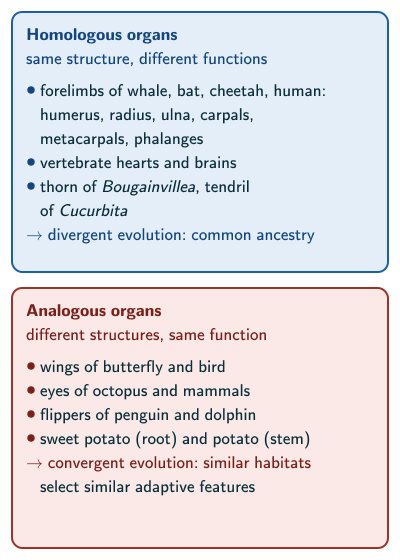
Beyond the NCERT text: what makes organs homologous is descent from a common ancestor, whatever their present functions (Wikipedia, “Homology (biology)”, facts in our words), so homologous organs may also keep similar functions. The diagram contrasts familiar textbook examples rather than giving an exhaustive definition.
Analogous organs and convergent evolution
- Analogy is the opposite situation. The wings of butterflies and of birds look alike and perform similar functions, but they are not anatomically similar structures (page 115).
- Analogous structures result from convergent evolution: different structures evolving for the same function and so coming to look similar. Other examples: the eye of the octopus and of mammals, the flippers of penguins and dolphins, and the sweet potato (a root modification) and the potato (a stem modification) (page 115). Beyond the NCERT text: penguin and dolphin flippers are analogous as separately evolved swimming organs, but their bones are homologous, since bird wings and mammal forelimbs all come from the same ancestral tetrapod limb (Wikipedia, “Homology (biology)”, facts in our words).
- A similar habitat has selected similar adaptive features in different groups of organisms, towards the same function (page 115).
Similarities in proteins and genes
Similarities in proteins and genes that perform a given function in diverse organisms give clues to common ancestry. These biochemical similarities point to the same shared ancestry as structural similarities do (page 115).
Artificial selection
Humans have bred selected plants and animals for agriculture, horticulture, sport or security, and have domesticated many wild animals and crops. Intensive breeding has created breeds that differ from other breeds (dogs, for example) but are still of the same group. If people could create new breeds within hundreds of years, could not nature have done the same over millions of years (page 115)?
Industrial melanism in moths
- In England, a collection of moths made in the 1850s, “before industrialisation set in” in NCERT’s words, had more white-winged moths on trees than dark-winged (melanised) ones. In a collection from the same area after industrialisation, in 1920, there were more dark-winged moths: the proportion was reversed (page 115).
- The explanation: predators spot a moth against a contrasting background. Industrial smoke and soot darkened the tree trunks, so white-winged moths were picked out by predators and dark-winged moths survived. Before industrialisation set in, a thick growth of almost white lichen covered the trees; against that background the white-winged moths survived and the dark moths were picked out by predators (page 116).
- Lichens can be used as industrial pollution indicators: they will not grow in areas that are polluted (page 116). Beyond the NCERT text: tolerance differs between species; with sulfur dioxide pollution the bushy and leaf-like kinds disappear first, while some crust-like kinds hang on in cities (Wikipedia, “Lichen”, facts in our words).
- Moths that could camouflage themselves survived. In rural areas, where industrialisation did not occur, the count of melanic moths was low. In a mixed population, those that can better adapt survive and increase in population size, and NCERT adds: “Remember that no variant is completely wiped out” (page 116). Beyond the NCERT text: that holds for the moth example, not as a general law; a variant can be lost through selection or drift.
NCERT slip (page 115): NCERT dates the 1850s collection “before industrialisation set in”, but the Industrial Revolution began in Britain around 1760 and had spread to continental Europe and the United States by about 1840 (Wikipedia, “Industrial Revolution”), and the dark form was already collected in industrial Manchester in 1848 and made up 98 per cent of the peppered moths recorded there by 1895 (Wikipedia, “Peppered moth evolution”, facts in our words). So the comparison is of earlier and later stages of industrial pollution. In an answer, give NCERT’s comparison (white-winged moths more common in the 1850s, dark-winged in 1920). Beyond the NCERT text: studies support bird predation as the main cause, and since about 1962 the dark form has become rarer again as the air over industrial cities has been cleaned up (same source).
Resistance to herbicides, pesticides and antibiotics
- Excess use of herbicides and pesticides has selected resistant varieties in a much shorter time; the same is true of microbes exposed to antibiotics, and of eukaryotic organisms or cells exposed to drugs. Resistant organisms appear in months or years, not centuries (page 116).
- These are examples of evolution by anthropogenic action. This also tells us that evolution is not a directed process in the sense of determinism: it is a stochastic process based on chance events in nature and chance mutation in the organisms (page 116). Beyond the NCERT text: mutation is not directed toward an organism’s needs and drift involves chance, but natural selection itself is not random, since the better fit leave more progeny (reasoned from NCERT page 113).
Solved examples
Example 1: Antibiotic resistance (NCERT Exercise 1)
Explain antibiotic resistance observed in bacteria in the light of Darwinian selection theory.
Answer: a bacterial population has built-in variation, and by chance mutation a few bacteria may resist an antibiotic. When the antibiotic is used, the sensitive bacteria die and the resistant ones survive and leave more progeny, so they are selected; within months or years the population is mostly resistant. This is natural selection, here driven by human action (NCERT pages 113 and 116). The antibiotic does not create resistance; it only selects resistant variants that had already arisen by chance (reasoned from NCERT pages 116 and 121: evolution is a stochastic process, based on chance mutation, and pre-existing advantageous mutations, when selected, give new phenotypes). Beyond the NCERT text: bacteria can also gain resistance genes from other bacteria by horizontal gene transfer (Wikipedia, “Antimicrobial resistance”, facts in our words).
Example 2: Homologous or analogous?
Classify each pair: (a) forelimbs of a bat and a whale; (b) wings of a butterfly and a bird; (c) thorn of Bougainvillea and tendril of Cucurbita; (d) sweet potato and potato.
Answer: (a) homologous: same bones, different functions; (b) analogous: different structures, same function; (c) homologous; (d) analogous: a root modification and a stem modification (NCERT pages 114–115).
Example 3: Why the moths changed
Why did dark-winged moths become commoner near English industrial towns after the 1850s, but not in rural areas?
Answer: industrial smoke and soot darkened the tree trunks, and lichens do not grow in polluted areas, so on dark bark the white-winged moths stood out and were eaten by predators, while dark moths were camouflaged and survived to breed. In rural areas the bark stayed light, white moths stayed hidden, and the melanic moths remained few (NCERT pages 115–116).
Common mistakes to avoid
Common mistake
Calling the wings of insects and birds homologous
They perform the same function but are not anatomically similar: they are analogous, the result of convergent evolution (NCERT page 115).
Common mistake
Saying the white moths disappeared completely
The proportion of white and dark moths was reversed, and no variant is completely wiped out (NCERT page 116). Beyond the NCERT text: the example shows changed frequencies; it does not make “no variant is completely wiped out” a general law of evolution.
Common mistake
Treating evolution as directed towards a goal
Evolution is not a directed process in the sense of determinism; it is a stochastic process based on chance events in nature and chance mutation in the organisms (NCERT page 116). Beyond the NCERT text: selection itself favours the heritable variants that leave more progeny in the current conditions (reasoned from NCERT page 113).
Quick revision summary
- Fossils in rock layers of different ages show that life forms varied over time and that new forms arose at different times (paleontological evidence, page 113); ages come from the order of the rock layers together with radioactive dating (reasoned from NCERT page 113, which asks how the ages of fossils are calculated; the dating principle, beyond the NCERT Biology text, is set out above).
- Embryology: Haeckel’s vestigial gill slits in vertebrate embryos (NCERT); against it, von Baer’s observation that embryos never pass through the adult stages of other animals. Beyond the NCERT text: the embryonic pharyngeal structures are not fish gills.
- Homologous organs (same structure, different functions; divergent evolution; common ancestry): mammal forelimbs, vertebrate hearts and brains, Bougainvillea thorn and Cucurbita tendril. Analogous organs (different structure, same function; convergent evolution): butterfly and bird wings, octopus and mammal eyes, penguin and dolphin flippers, sweet potato and potato.
- Similar proteins and genes point to common ancestry; artificial selection, industrial melanism (white moths in the 1850s, dark moths in 1920) and resistance to pesticides and antibiotics support evolution by natural selection, which NCERT calls a stochastic process based on chance events and chance mutation (page 116). Beyond the NCERT text: the selection step itself is not random; it acts on chance variation (our reading).
Formula sheet
- homologous: same structure, different function
- divergent evolution: common ancestry
- analogous: different structure, same function
- convergent evolution: similar habitat
- 1850s: more white moths; 1920: more dark moths
Questions students ask
Which moth shows industrial melanism in NCERT’s example?
Beyond the NCERT text, the moth of NCERT’s English example is the peppered moth, Biston betularia, whose colour is set by a single gene: one dominant allele, C, is enough to give the dark carbonaria form, while moths with two copies of the recessive allele, c, have the non-melanic typica form (Cook and others 2012, Biology Letters, CC BY). The same paper says melanism in this moth “led to the earliest measurements of natural selection on a Mendelian locus in the wild”. NCERT itself names no species and does not use the term industrial melanism (pages 115–116).
Is industrial melanism an example of directional selection?
Yes, by our reading industrial melanism fits what NCERT calls directional change, the kind of natural selection in which “more individuals acquire value other than the mean character value” (page 121): on soot-darkened bark the dark-winged moths, at one end of the colour range, survived predators better and increased (pages 115–116). Beyond the NCERT text, wing colour in this moth falls into a few distinct forms set by one gene (Cook and others 2012, CC BY), so, by our reading, the shift shows as a rising share of the dark form rather than as a bell-shaped curve sliding smoothly along a scale.
What is an example of molecular evidence for evolution?
An example of molecular evidence for evolution is the genetic code itself: NCERT Chapter 5 calls the code nearly universal, the same codons standing for the same amino acids from bacteria to humans (page 96). By our reading, one shared code in organisms as different as bacteria and humans is one of the biochemical similarities that NCERT’s Section 6.3 counts as evidence for evolution (page 115).
Are the wings of a bat and a bird homologous or analogous?
By our reasoning from NCERT’s definition of analogy (page 115), bat and bird wings are analogous as wings, built differently to fly; beyond the NCERT text, they are homologous as forelimbs (Wikipedia, “Homology (biology)”). A bird’s “forelimbs are modified into wings” (NCERT Class 11, page 49), and bats are among the mammals sharing one pattern of forelimb bones (page 114). Beyond the NCERT text, a bat’s wing is a thin skin membrane stretched between long finger bones (US National Park Service), and a 2023 study of bat wing development notes that bird wing membranes arose independently of the bat’s, so they are not homologous (Anthwal and others, BMC Biology, CC BY).
Practice questions
Try each question first, then open the answer to check your working.
-
Q1. Name the bones that the forelimbs of whales, bats, cheetahs and humans share.
Show answerHide answer
Humerus, radius, ulna, carpals, metacarpals and phalanges (NCERT page 114).
-
Q2. Why are lichens useful as indicators of industrial pollution?
Show answerHide answer
Lichens will not grow in areas that are polluted, so they can be used as industrial pollution indicators (NCERT page 116). Beyond the NCERT text: many lichens are sensitive to sulfur dioxide, and changes in which species grow can indicate air quality; tolerance varies.
-
Q3. Which earlier observation of von Baer contradicts Haeckel’s later recapitulation claim?
Show answerHide answer
That embryos never pass through the adult stages of other animals (NCERT page 113).