Radioactivity
NCERT Class 12 Physics Chapter 13 Section 13.6
Quick answer
Radioactivity is spontaneous nuclear decay; the daughter nucleus may remain radioactive. Alpha decay changes A → A − 4 and Z → Z − 2, beta-minus changes Z → Z + 1 at fixed A, beta-plus changes Z → Z − 1, and gamma decay changes neither A nor Z. For independent decay at a constant rate with no replenishment, N = N0/2n gives the expected parent population after n half-lives.
With your textbook
NCERT Physics Part II (Class 12), Chapter 13 “Nuclei”, Section 13.6 “Radioactivity”, page 314.
Open the official NCERT chapter (PDF, 1.8 MB, ncert.nic.in) (opens in a new tab)
Checked against the 2026-27 reprint on .
What is radioactivity?
Radioactivity
Radioactivity is the spontaneous decay of unstable nuclei, which give out alpha particles (helium nuclei), beta particles (electrons or positrons) or gamma rays (high-energy photons). A. H. Becquerel discovered it in 1896 while investigating uranium salts (NCERT page 314). In NCERT’s words:
Experiments performed subsequently showed that radioactivity was a nuclear phenomenon in which an unstable nucleus undergoes a decay.
NCERT Physics Part II (Class 12), Section 13.6, page 314
Radioactivity is a sign that a nucleus is unstable: stable nuclei need about as many neutrons as protons when light, rising to about 3 neutrons for 2 protons when heavy (NCERT Points to ponder 8, page 320).
In plain words: some nuclei are not put together in a lasting way. Sooner or later each one throws out a piece of itself or a burst of energy and lowers the total energy: the daughter may still be radioactive, so a decay chain can follow. Alpha or beta decay gives a different nuclide, while gamma decay leaves the same nuclide with less internal energy. Ordinary laboratory heating or pressure usually has negligible effect on nuclear decay rates; electron-capture and some highly ionised-atom decay rates can depend on the electron environment (beyond the NCERT text).
Becquerel’s discovery
- In 1896 A. H. Becquerel was studying the fluorescence and phosphorescence of compounds lit by visible light (NCERT page 314).
- NCERT page 314 describes blackening through opaque paper and silver in a simplified arrangement. In Becquerel’s own 1896 reports the photographic plate was wrapped in black paper and the uranium salt placed above it. Crucially, strong images also formed after the prepared apparatus had been kept in the dark: prior illumination was unnecessary (Becquerel, Comptes Rendus, 24 February and 2 March 1896; Nobel biography).
- Later experiments showed that this was a nuclear phenomenon: an unstable nucleus decays, giving radioactive decay (NCERT page 314).
- Most nuclides are unstable: NCERT estimates roughly 10% of the known isotopes of all elements are stable; this fraction changes as new nuclides are discovered. Most of the rest have been made artificially, by bombarding stable nuclei with alpha particles, protons, deuterons, neutrons and other particles, or identified in astronomical observations (NCERT Points to ponder 8, page 320). NCERT leaves out the unstable nuclides found in nature, such as the uranium-238 in Becquerel’s salt (Wikipedia, “Decay chain”).
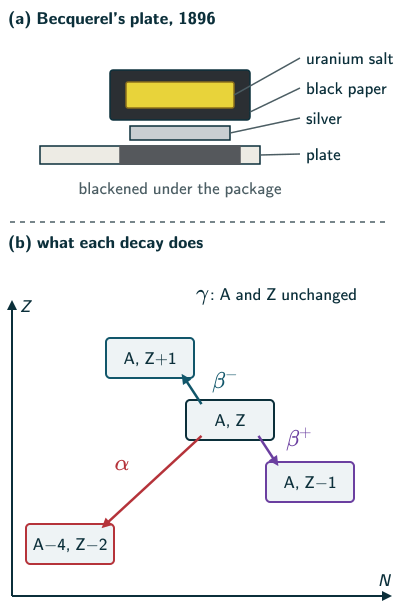
Alpha, beta and gamma decay
- Three familiar types of radioactive decay occur in nature (others include electron capture and spontaneous fission) (NCERT page 314):
- alpha decay, in which a helium nucleus, 42He, is emitted;
- beta decay, in which electrons, or positrons (particles with the mass of an electron but the opposite charge), are emitted;
- gamma decay, in which photons are emitted from nuclear transitions. Their energies are often keV or MeV, but “hundreds of keV or more” is not a lower bound.
- NCERT’s summary puts it briefly: alpha rays are helium nuclei, beta rays are electrons (NCERT Section 13.6 adds positrons), and gamma rays are electromagnetic radiation of wavelengths shorter than X-rays (NCERT Summary point 10, page 319). The two ranges in fact overlap; in nuclear spectroscopy a gamma ray is identified by a nuclear transition; annihilation photons are also conventionally called gamma rays (beyond the NCERT text).
- What happens to the nucleus (beyond the NCERT text; it follows from the conservation of charge and of the number of nucleons, NCERT Example 13.4, page 317):
- In alpha decay the nucleus loses 2 protons and 2 neutrons: A falls by 4 and Z by 2, giving a new element.
- In beta-minus decay a neutron in the nucleus turns into a proton, as a free neutron does (NCERT page 308); an electron and an antineutrino are emitted. A stays the same and Z rises by 1.
- In beta-plus decay a proton turns into a neutron, and a positron and a neutrino are emitted. A stays the same and Z falls by 1. This happens only inside a nucleus: a free proton, unlike a free neutron, is stable (NCERT page 308).
- In gamma decay a nucleus in an excited state drops to a lower energy state and gives out a photon. A and Z do not change.
- An electron and a positron are a particle–antiparticle pair: equal masses and opposite charges. When they meet they annihilate, giving gamma-ray photons (NCERT Points to ponder 7, page 320).
- Half-life and mean life. NCERT’s table of quantities (page 319) still defines the half-life, T1/2, the time for the expected number of undecayed parent nuclei to fall to half its initial value; the mean life, τ, the time by which their number has fallen to e−1 of its initial value; and the activity, R, measured in becquerel (Bq). These relations assume independent decays with a constant decay probability per unit time, no replenishment and a single parent population; individual decay times are random. The chapter no longer develops the law of radioactive decay. After each half-life half of the remaining nuclei are left, so after n half-lives a fraction 1/2n remains (beyond the NCERT text).
Nuclei left after n half-lives (beyond the NCERT text)
Solved examples
Example 1: An alpha decay
Uranium-238, 23892U, decays by emitting an alpha particle. What are the mass number and atomic number of the nucleus left behind?
Answer: A = 238 − 4 = 234 and Z = 92 − 2 = 90: the nucleus 23490Th, thorium (Wikipedia, “Decay chain”; the counting is beyond the NCERT text).
Example 2: A beta decay
Tritium, 31H, is beta-minus radioactive. What does it become?
Answer: A neutron turns into a proton: A stays 3 and Z rises to 2, giving 32He, helium-3, with an electron and an antineutrino emitted (Wikipedia, “Tritium”; the counting is beyond the NCERT text).
Example 3: Counting decays from uranium to lead
Uranium-238 (Z = 92) ends, after a chain of alpha and beta-minus decays, as lead-206 (Z = 82). How many of each decay are there?
Answer: Only alpha decay changes A: (238 − 206)/4 = 8 alpha decays, which would lower Z by 16, to 76. To reach 82, Z must rise by 6, so there are 6 beta-minus decays (beyond the NCERT text; the chain is the uranium series, Wikipedia, “Decay chain”).
Example 4: Half-lives
A sample holds 32 mg of a radioactive nuclide. How much is left after three half-lives?
Answer: It halves each time: 32 → 16 → 8 → 4 mg, that is 32/23 (beyond the NCERT text; half-life as defined in NCERT’s table, page 319).
Common mistakes to avoid
Common mistake
Thinking beta electrons come from the electron cloud
A beta-minus electron is made in the nucleus, when a neutron turns into a proton; the atom’s own electrons are not involved (reasoned from NCERT pages 308 and 314).
Common mistake
Thinking gamma decay changes the element
A gamma ray only carries away energy from an excited nucleus; A and Z, and so the element, stay the same (reasoned from NCERT page 314).
Common mistake
Calling an alpha particle a helium atom
It is a helium nucleus, two protons and two neutrons with charge +2e and no electrons (NCERT page 314).
Quick revision summary
- Becquerel discovered radioactivity in 1896: uranium salt emitted radiation that darkened an opaque-paper-covered photographic plate, even without prior illumination.
- Radioactivity is the decay of unstable nuclei; most known nuclides are unstable.
- Alpha decay emits a helium nucleus (A − 4, Z − 2); beta decay emits an electron (Z + 1) or a positron (Z − 1); gamma decay emits a high-energy photon (no change in A or Z).
- Half-life: the time for half the nuclei to decay; after n half-lives N = N0/2n.
Formula sheet
- α decay: A → A − 4, Z → Z − 2
- β decay: Z → Z + 1; β decay: Z → Z − 1
- N = N0/2n
Questions students ask
Who discovered radioactivity, Becquerel or Marie Curie?
Radioactivity was discovered by Henri Becquerel in 1896, when radiation from uranium salt blackened a photographic plate protected from visible light (NCERT page 314). Marie Curie gave the phenomenon its name, radioactivity, and with Pierre Curie discovered two new radioactive elements in 1898, polonium and radium; the Curies shared the 1903 Nobel Prize in Physics with Becquerel, and Marie Curie won a second Nobel Prize, in chemistry, in 1911 (beyond the NCERT text; NIST, “Marie Skłodowska-Curie: A Legacy of Innovation and Empowerment for Women in Science”). So Becquerel found the effect, and Marie Curie named it and found new elements that show it.
What is the difference between radioactivity and radiation?
Radioactivity is a property of unstable nuclei, their spontaneous decay, while radiation is energy that travels out from a source as particles or waves; the alpha, beta and gamma rays given out in radioactive decay are one kind of radiation (NCERT page 314; US CDC, Radiation Dictionary). Radiation is far wider: light, radio waves and microwaves are radiation too, and X-rays come from electrons, not nuclei (see the electromagnetic spectrum). An ordinary diagnostic X-ray tube emits X-rays while its electron beam is powered, but radioactive material keeps giving it out until its unstable nuclei have decayed (reasoned).
Which is the most penetrating of alpha, beta and gamma radiation, and what stops each?
For typical radioactive-source energies, alpha particles are least penetrating, beta particles intermediate, and gamma photons more penetrating, but range and shielding depend on energy and material. Paper stops typical alpha particles; plastic or thin metal can stop many beta particles. Dense shielding such as lead or concrete attenuates gamma radiation progressively, without a universal thickness that stops every photon (beyond the NCERT text; US EPA and US NRC, Radiation Basics). So alpha emitters are dangerous mainly when swallowed or breathed in. Becquerel’s rays passed through black paper and silver (NCERT page 314), so they were not alpha particles alone (reasoned).
What is the SI unit of radioactivity, and how is the becquerel related to the curie?
The SI unit of radioactivity, or activity, is the becquerel (Bq), the unit NCERT’s table of quantities gives for activity (page 319). One becquerel is one decay per second, and the older curie (Ci), based on the decay rate of 1 g of radium, is 3.7 × 10 decays per second, so 1 Ci = 3.7 × 10 Bq and a 1 μCi source has an activity of 37 000 Bq (beyond the NCERT text; US CDC, Radiation Dictionary). The gray and the sievert, often confused with them, measure radiation dose, not activity (same source).
How are half-life, decay constant and mean life related?
Half-life T1/2, decay constant λ and mean life τ are related by T1/2 = 0.693/λ = 0.693τ, since τ = 1/λ (beyond the 2026–27 NCERT physics text). Radioactive decay is first order (NCERT Class 12 Chemistry Part I, page 73), so its half-life is the first-order half-life 0.693/k (page 76) with λ for k, and the mean life is NCERT’s time for the nuclei to fall to e−1 of their number (Physics Part II, page 319); the mean life is also the expected lifetime of one nucleus in this exponential model. A nuclide with a half-life of 30 days has λ ≈ 0.0231 per day and a mean life of about 43.3 days.
Is radioactivity in the JEE Main and NEET syllabus?
Radioactivity is not in the JEE Main 2027 or the NEET (UG) 2026 syllabus: Unit 18, Atoms and Nuclei, of each names neither radioactivity nor alpha, beta and gamma decay nor half-life, and the CBSE Class XII Physics syllabus for 2026–27 does not name it either. It remains in NCERT Class 12 Physics Part II as Section 13.6 (page 314), which tells of Becquerel’s discovery and names the three types of decay but no longer teaches the law of radioactive decay. Half-life is still listed, but in chemistry: Unit 8, Chemical Kinetics, of both chemistry syllabuses lists zero and first-order reactions, “their characteristics and half-lives”.
Practice questions
Try each question first, then open the answer to check your working.
-
Q1. A nucleus with A = 210 and Z = 84 emits an alpha particle. Find A and Z of the new nucleus.
Show answerHide answer
A = 210 − 4 = 206 and Z = 84 − 2 = 82 (NCERT page 314; the counting is beyond the NCERT text).
-
Q2. How do A and Z change in beta-plus decay?
Show answerHide answer
A stays the same and Z falls by 1: a proton turns into a neutron, and a positron and a neutrino are emitted (beyond the NCERT text).
-
Q3. Which of the three radiations carries no electric charge?
Show answerHide answer
Gamma rays: they are photons, electromagnetic radiation (NCERT page 314).