Size of the nucleus
NCERT Class 12 Physics Chapter 13 Section 13.3
Quick answer
The approximate effective nuclear radius is R = R0 A1/3, R0 = 1.2 fm, where A counts nucleons and 1 fm = 10−15 m. In this spherical model, mass and volume both grow with A, giving ρ = 3m/(4π R03) ≈ 2.3 × 10¹⁷ kg m−3; real nuclei have diffuse surfaces and deviations from the simple law.
With your textbook
NCERT Physics Part II (Class 12), Chapter 13 “Nuclei”, Section 13.3 “Size of the Nucleus”, pages 309–310.
Open the official NCERT chapter (PDF, 1.8 MB, ncert.nic.in) (opens in a new tab)
Checked against the 2026-27 reprint on .
How big is a nucleus?
Size of the nucleus
A nucleus of mass number A is often approximated as a sphere with effective radius R = R0A1/3, with R0 = 1.2 fm, where 1 fm = 10−15 m (NCERT Eq. (13.5), page 309). Its volume is then proportional to A, so the model predicts nearly constant average nuclear density, about 2.3 × 10¹⁷ kg m−3. In NCERT’s words:
Different nuclei are like a drop of liquid of constant density.
NCERT Physics Part II (Class 12), Section 13.3, page 309
A nucleus is about 104 times smaller in radius than its atom, so its volume is about 10−12 of the atom’s; yet it holds more than 99.9% of the atom’s mass (NCERT page 306).
In plain words: if an atom were blown up to the size of a classroom, its nucleus would be about the size of a pinhead (NCERT page 306). Nuclei are packed like drops of the same liquid: put in more nucleons and the drop grows, but the average packing remains approximately the same. Light, deformed and halo nuclei need more detailed models; a real nucleus has a diffuse surface.
R = RA^(1/3)
- In the Geiger–Marsden experiment, alpha particles of 5.5 MeV got to within about 4.0 × 10⁻¹⁴ m of a gold nucleus, their distance of closest approach, while the Coulomb repulsion alone explained their scattering. So the gold nucleus must be smaller than 4.0 × 10⁻¹⁴ m (NCERT page 309).
- Alpha particles of higher energy get closer. At some point the short-range nuclear force starts to act and the scattering departs from Rutherford’s pure-Coulomb calculation; the onset constrains nuclear size after accounting for the projectile’s own size and the interaction model (NCERT page 309).
- Scattering of fast electrons has since measured the sizes of the nuclei of many elements accurately (NCERT page 309). The radii from electron scattering differ slightly from those from alpha scattering, because electrons sense the charge distribution of the nucleus while alpha particles sense the nuclear matter (NCERT Points to ponder 2, page 320).
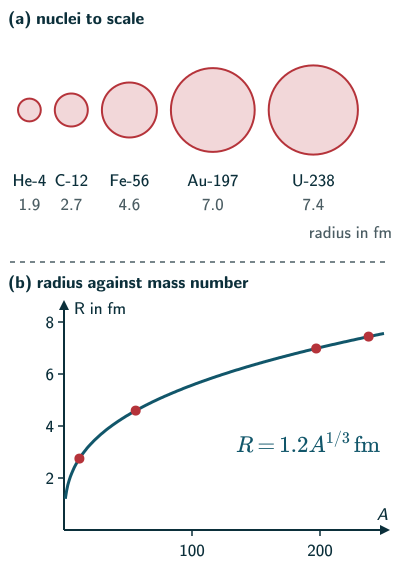
- An approximate effective sharp-sphere radius is (NCERT Eq. (13.5), page 309):
Nuclear radius (NCERT Eq. 13.5)
- So carbon-12 has R ≈ 2.7 fm, iron-56 about 4.6 fm, gold-197 about 7.0 fm and uranium-238 about 7.4 fm (computed). Because of the cube root, a nucleus with eight times the nucleons is only twice as wide.
- The volume, (4/3)πR3 = (4/3)πR03A, is proportional to A (NCERT page 309).
Electron scattering commonly reports a root-mean-square charge radius. For an ideal uniform sphere this is √(3/5)R, so it must not be confused directly with the sharp-sphere R in this formula (geometric extension).
Nuclear density
- Within the approximate mass ≈ A u and volume ∝ A model, average density does not depend on A (NCERT page 309; NCERT Exercise 13.10, page 322):
Nuclear density (reasoned from NCERT Eq. 13.5)
- Here m ≈ 1 u = 1.66 × 10⁻²⁷ kg is the mass per nucleon in a nucleus, which gives ρ ≈ 2.3 × 10¹⁷ kg m−3, as NCERT states (NCERT page 309; see Example 1).
- That is about 2 × 10¹⁴ times the density of water, 103 kg m−3. Ordinary matter is mostly empty space between nuclei (NCERT page 309).
- The density of an atom as a whole does not follow this rule: the approximate nuclear saturation-density rule does not describe the whole atom (NCERT Points to ponder 1, page 320).
- Matter in neutron stars has a density comparable to that of nuclei: this is a density analogy, not a literal giant nucleus. A neutron star is gravitationally bound and has a layered, neutron-rich composition (NCERT page 310).
Solved examples
Example 1: The density of an iron nucleus (NCERT Example 13.1)
The mass of an iron nucleus is 55.85 u and A = 56. Find the nuclear density.
Answer: Mass = 55.85 × 1.66 × 10−27 kg ≈ 9.27 × 10⁻²⁶ kg. Volume = (4/3)π(1.2 × 10−15)3 × 56 ≈ 4.05 × 10−43 m3. Density ≈ (9.27 × 10⁻²⁶)/
Note: 55.85 u is the average atomic mass of natural iron. NCERT’s own value for an iron-56 atom, 55.934939 u (NCERT Exercise 13.2, page 321), gives the same density to three figures.
Example 2: Gold and silver (NCERT Exercise 13.4)
Find roughly the ratio of the nuclear radii of gold-197 and silver-107.
Answer: R ∝ A1/3, so RAu/RAg = (197/107)1/3 ≈ 1.841/3 ≈ 1.23 (NCERT Exercise 13.4, page 321; answer on page 351).
Example 3: Density is approximately the same across many nuclei (NCERT Exercise 13.10)
Show from R = R0A1/3 that nuclear density is nearly independent of A.
Answer: The mass is about Am, where m is the mass of a nucleon. The volume is (4/3)πR3 = (4/3)πR03A. Their ratio, 3m/(4πR03), has no A in it. It is only “nearly” constant because R = R0A1/3 is itself an approximate fit, and a nucleus’s mass is not exactly A nucleon masses (NCERT Exercise 13.10, page 322).
Example 4: Nucleus against closest approach
How does the radius of a gold-197 nucleus compare with the 4.0 × 10⁻¹⁴ m that 5.5 MeV alpha particles reached?
Answer: R = 1.2 × 1971/3 fm ≈ 1.2 × 5.82 ≈ 7.0 fm = 7.0 × 10⁻¹⁵ m, about one-sixth of the distance of closest approach. Those alpha particles never touched the nucleus (NCERT Eq. (13.5) and page 309).
Common mistakes to avoid
Common mistake
Making the radius proportional to A
R grows as A1/3: doubling A makes R only about 1.26 times larger. It is the volume that is proportional to A (NCERT page 309).
Common mistake
Thinking heavier nuclei are denser
Volume grows in step with mass, so the density, about 2.3 × 10¹⁷ kg m−3, is approximately the same across many nuclei (NCERT page 309).
Common mistake
Forgetting the femtometre
R = 1.2 fm = 1.2 × 10 m; leaving out the 10 gives absurd densities (NCERT page 309).
Quick revision summary
The unit conversion is 1 fm = 10^−15 m.
- A nucleus is about 104 times smaller in radius than its atom but holds more than 99.9% of its mass.
- Scattering of alpha particles, and more accurately of fast electrons, gives the size of nuclei.
- R = R0A1/3 with R0 = 1.2 fm, so volume ∝ A.
- Nuclear density is approximately the same across many nuclei, about 2.3 × 10¹⁷ kg m−3, about 2 × 10¹⁴ times that of water.
Formula sheet
- R = R0 A1/3, R0 = 1.2 fm
- ρ = 3m/(4π R03) ≈ 2.3 × 10¹⁷ kg m−3
Questions students ask
Is there a derivation of the nuclear radius formula?
No, the nuclear radius formula R = R0A1/3 has no derivation in NCERT: it is an experimental law, the formula that the radii measured by scattering fast electrons from many elements are found to fit (NCERT page 309). It can be made plausible: if every nucleon takes up the same volume, the volume of a nucleus, (4/3)πR3, is proportional to A, so R ∝ A1/3, but the value of R0 comes only from measurement. The derivation NCERT asks for runs the other way, from the formula to a density that does not depend on A (NCERT Exercise 13.10, page 322).
What are R0 and A in the nuclear radius formula?
In the nuclear radius formula R = R0A1/3, A is the mass number, the number of protons plus neutrons in the nucleus, and R0 is a constant found by experiment, 1.2 fm or 1.2 × 10 m (NCERT Eq. (13.5), page 309). R0 fixes the volume each nucleon takes up, (4/3)πR03, about 7.2 fm, in this approximate model. It is not a fundamental constant like e or h: radii from electron scattering differ slightly from those from alpha-particle scattering (NCERT Points to ponder 2, page 320), so use the value a question gives, and 1.2 fm otherwise.
What is the unit of nuclear radius, and what is a fermi?
Nuclear radius is a length, so its SI unit is the metre, but nuclear sizes are given in femtometres: 1 fm = 10 m (NCERT page 309). The femtometre is also called the fermi, after the physicist Enrico Fermi, with the same symbol, fm; the historical name honours Enrico Fermi. On this scale nuclear radii are a few fermi: a nucleus with A = 125 has R = 1.2 × 1251/3 = 1.2 × 5 = 6.0 fm.
Why is nuclear density the same for all nuclei?
Nuclear density is nearly the same for all nuclei because nuclear matter tends toward a saturation density, like the molecules of a liquid: NCERT compares nuclei to drops of a liquid of constant density (page 309). The nuclear force between two nucleons is attractive beyond about 0.8 fm but strongly repulsive closer in (NCERT page 313), and its short range, together with quantum kinetic energy and the exclusion principle, helps limit compression: each new nucleon simply adds its own share of volume. Mass and volume therefore both grow in proportion to A, which is what R = R0A1/3 expresses (reasoned from NCERT pages 309 and 312–313).
Practice questions
Try each question first, then open the answer to check your working.
-
Q1. Find the radius of a carbon-12 nucleus.
Show answerHide answer
R = 1.2 × 121/3 fm ≈ 1.2 × 2.29 ≈ 2.7 fm (NCERT Eq. (13.5), page 309).
-
Q2. What is the ratio of the volumes of a gold-197 nucleus and a helium-4 nucleus?
Show answerHide answer
Volume ∝ A, so the ratio is 197/4 ≈ 49 (NCERT page 309).
-
Q3. For which mass number is the nuclear radius 3.6 fm?
Show answerHide answer
A1/3 = 3.6/1.2 = 3, so A = 27, as for aluminium-27 (NCERT Eq. (13.5), page 309).