Nuclear energy: fission and fusion
NCERT Class 12 Physics Chapter 13 Section 13.7
Quick answer
Nuclear reactions release energy when the total final rest mass is lower: Q = (minitial − mfinal) c2. Suitable heavy-nucleus fission and light-nucleus fusion channels are exothermic, but Q must be checked for the actual reaction. Fusion needs very high temperatures so that the nuclei can overcome the Coulomb barrier, though quantum tunnelling lets them fuse below the classical estimate.
With your textbook
NCERT Physics Part II (Class 12), Chapter 13 “Nuclei”, Section 13.7 “Nuclear Energy”, pages 314–318.
Open the official NCERT chapter (PDF, 1.8 MB, ncert.nic.in) (opens in a new tab)
Checked against the 2026-27 reprint on .
What is nuclear energy?
Nuclear energy
Nuclear energy is released when nuclei change into more tightly bound nuclei: when a heavy nucleus splits into two of intermediate mass (fission) or when light nuclei join into a heavier one (fusion). The energy per reaction is of the order of MeV, against a few eV for a chemical reaction (NCERT page 314). In NCERT’s words:
Thus for the same quantity of matter, nuclear sources produce a million times more energy than a chemical source.
NCERT Physics Part II (Class 12), Section 13.7, page 314
Fission of 1 kg of uranium gives about 1014 J, while burning 1 kg of coal gives about 107 J (NCERT page 314). NCERT’s two round figures give 107, ten times its “million”: both are only orders of magnitude.
In plain words: nucleons in middle-sized nuclei are held most tightly. A very heavy nucleus can split, or very light nuclei can join, so that the nucleons end up more tightly held; the difference comes out as energy, far more per unit fuel mass than ordinary chemical fuels for these reactions.
Energy from the binding energy curve
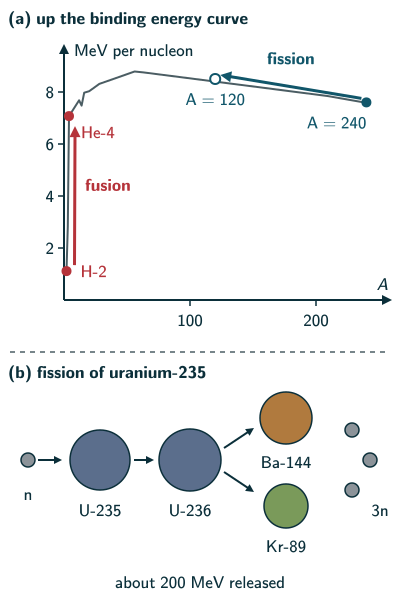
- The binding energy per nucleon is nearly constant, about 8.0 MeV, for 30 < A < 170, and less for lighter (A < 30) and heavier (A > 170) nuclei (NCERT page 314; NCERT Figure 13.1).
- The greater the binding energy, the less the total mass of the bound system. So if nuclei with less total binding energy turn into nuclei with more, energy is released: a heavy nucleus splitting into intermediate-mass fragments (fission), or light nuclei fusing into a heavier one (fusion) (NCERT page 314).
- The energy released in a nuclear process is its Q value, the final kinetic energy minus the initial kinetic energy; by the conservation of mass-energy it equals the loss of mass times c2 (NCERT Summary point 9, page 319). Strictly, energy carried off by gamma photons and neutrinos counts too, as in NCERT Eq. (13.15) (reasoned). A positive Q means energy is released (exothermic); a negative Q, that energy must be supplied (endothermic) (NCERT Exercises 13.5–13.6, page 321):
Q value (NCERT Summary point 9)
- Nuclear reactions are balanced not atom by atom, as chemical equations are, but in total charge and total number of nucleons, which NCERT Example 13.4 (page 317) calls ‘baryon number’. In fission, as in NCERT Eq. (13.10), the proton and neutron numbers are also each unchanged; whenever a positron or electron is made, as in NCERT Eq. 13.13(a), they are not. When proton and neutron counts are individually conserved, the free-nucleon rest masses cancel and Q is the gain in total binding energy. For weak processes that change protons into neutrons or vice versa, include the different nucleon and lepton rest masses explicitly (NCERT Example 13.4, pages 317–318).
- Chemical reactions convert mass and energy in the same way, through chemical binding energies, but their mass defects are almost a million times smaller, which is why the conversion goes unnoticed there (NCERT Example 13.4, page 318).
Fission
- In neutron-induced fission, a heavy nucleus absorbs a neutron and splits into two intermediate-mass fragments. For example (NCERT Eqs. (13.10)–(13.12), page 315):
- 1n + 235U → 236U → 144Ba + 89Kr + 3 1n;
- the same reaction can give 133Sb + 99Nb + 4 1n;
- or 140Xe + 94Sr + 2 1n.
- Fission can also occur spontaneously or be induced by other projectiles; neutron-induced uranium fission is the main example here.
- The fragments are radioactive and emit beta particles one after another until they reach stable end products (NCERT page 315).
- The energy released is of the order of 200 MeV per fission. Estimate: a nucleus with A = 240 has about 7.6 MeV per nucleon; two fragments of A = 120 have about 8.5 MeV per nucleon. The gain of about 0.9 MeV per nucleon over 240 nucleons is about 216 MeV (NCERT page 315).
- The energy first appears as the kinetic energy of the fragments and neutrons, and eventually it is transferred to the surrounding matter as heat (NCERT page 315). Nuclear reactors that produce electricity run on fission; the enormous energy of an atom bomb comes from uncontrolled fission (NCERT page 315).
- The fissions in NCERT Eqs. (13.10)–(13.12) free 3, 4 and 2 neutrons. These can split further uranium nuclei, a chain reaction: kept steady in a reactor, running away in a bomb (beyond the NCERT text).
Nuclear fusion – energy generation in stars
- When two light nuclei fuse into a larger, more tightly bound nucleus, energy is released. Examples (NCERT Eqs. 13.13(a)–(c), page 315):
- 1H + 1H → 2H + e+ + ν + 0.42 MeV: two protons give a deuteron and a positron;
- 2H + 2H → 3He + n + 3.27 MeV: two deuterons give the light isotope of helium;
- 2H + 2H → 3H + 1H + 4.03 MeV: two deuterons give a triton and a proton.
- The Coulomb barrier. For fusion, the two nuclei must come close enough for the short-range nuclear force to act, but both are positive and repel. They need enough kinetic energy to overcome the Coulomb barrier, whose height depends on their charges and radii: about 400 keV for two protons, and more for nuclei of higher charge (NCERT page 316). Beyond the NCERT text: quantum tunnelling lets protons through the barrier, so they fuse at temperatures below the classical estimate (Wikipedia, “Proton–proton chain”).
- Setting the average kinetic energy (3/2)kT equal to 400 keV gives T ~ 3 × 10⁹ K. When fusion is achieved by raising the temperature so that the particles have enough kinetic energy to overcome the Coulomb repulsion, it is called thermonuclear fusion (NCERT page 316). Strictly, the 3 × 10⁹ K is a classical estimate for particles of average energy, not the temperature fusion actually needs (reasoned; see tunnelling above).
- Thermonuclear fusion powers the stars. The sun’s interior is at about 1.5 × 10⁷ K, far below 3 × 10⁹ K, so fusion in the sun involves protons whose energies are much above the average energy (NCERT page 316). Even protons with ten times the average energy, which is about 2 keV at that temperature, are far below the 400 keV barrier (reasoned; see Q5). Beyond the NCERT text: in the 1920s the sun was thought too cool for its protons to overcome the Coulomb barrier; they fuse because quantum tunnelling lets them through it (Wikipedia, “Proton–proton chain”).
- The sun burns hydrogen into helium in the proton–proton cycle: (i) 1H + 1H → 2H + e+ + ν + 0.42 MeV; (ii) e+ + e− → γ + γ + 1.02 MeV; (iii) 2H + 1H → 3He + γ + 5.49 MeV; (iv) 3He + 3He → 4He + 1H + 1H + 12.86 MeV (NCERT Eq. (13.14), page 316).
- Reactions (i)–(iii) must happen twice for (iv) to occur once. The net effect is that four hydrogen atoms form one helium-4 atom and release 26.7 MeV in total, including energy carried away by two neutrinos (NCERT Eq. (13.15), page 316; see Example 5).
- As the hydrogen in the core gets depleted and becomes helium, the core starts to cool, the star begins to collapse under its own gravity, and that raises the core temperature. At about 108 K helium fuses into carbon, and so on to heavier elements, but elements more massive than those near the peak of the binding energy curve cannot be produced this way (NCERT page 316); in an exam, follow NCERT’s sequence. Strictly, the core does not cool first: with less pressure from hydrogen fusion to hold it up, it contracts until it is hot enough, around 108 K, for helium to fuse (Wikipedia, “Stellar evolution”). Beyond the NCERT text: the heavier elements are made by neutron capture instead (Wikipedia, “Nucleosynthesis”).
- The sun is about 5 × 10⁹ years old and has hydrogen for about another 5 billion years; then its core will contract and heat up while its outer envelope expands, turning it into a red giant (NCERT page 317).
Controlled thermonuclear fusion
- A fusion reactor aims to produce steady power by heating nuclear fuel to about 108 K (NCERT page 317).
- At such temperatures the fuel is a plasma, a mixture of positive ions and electrons. The challenge is to confine it, since no container can stand such a temperature (NCERT page 317).
- Several countries, including India, are developing techniques for this; if successful, fusion reactors will hopefully supply almost unlimited power (NCERT page 317).
- For fusion, the light nuclei must have sufficient initial energy to overcome the Coulomb potential barrier, which is why fusion requires very high temperatures (NCERT Points to ponder 5, page 320); give that reason in an exam. Beyond the NCERT text: tunnelling lets nuclei fuse below the classical estimate (Wikipedia, “Proton–proton chain”), but a high temperature is still needed to give enough fast collisions with a fair chance of tunnelling (reasoned).
Solved examples
Example 1: Two Q values (NCERT Exercise 13.5)
Find Q for (i) 1H + 3H → 2H + 2H and (ii) 12C + 12C → 20Ne + 4He, given the atomic masses 1.007825, 3.016049, 2.014102, 12.000000, 19.992439 and 4.002603 u.
Answer:
- (i) Δm = 1.007825 + 3.016049 − 2 × 2.014102 = −0.004330 u, so Q ≈ −4.03 MeV: endothermic.
- (ii) Δm = 24.000000 − 19.992439 − 4.002603 = 0.004958 u, so Q ≈ +4.62 MeV: exothermic.
Using atomic masses, the electrons balance on both sides (NCERT Exercise 13.5, page 321; answer on page 352).
Example 2: Can iron split in two? (NCERT Exercise 13.6)
Is the fission of 56Fe (55.93494 u) into two 28Al (27.98191 u each) energetically possible?
Answer: Two aluminium-28 atoms have a mass of 2 × 27.98191 = 55.96382 u, more than the iron. So Q = (55.93494 − 55.96382) × 931.5 MeV = −0.02888 × 931.5 ≈ −26.9 MeV. Q is negative, so the fission is not possible on its own: iron-56 sits near the peak of the binding energy curve (NCERT Exercise 13.6, page 321). NCERT’s answer on page 352 prints Q = 26.90 MeV without the minus sign; Q is negative.
Example 3: Energy in a kilogram of plutonium (NCERT Exercise 13.7)
239Pu releases on average 180 MeV per fission. How much energy is released if all the atoms in 1 kg of it undergo fission?
Answer: Number of atoms = (1000/239) × 6.023 × 1023 ≈ 2.52 × 1024. Energy ≈ 2.52 × 1024 × 180 ≈ 4.54 × 1026 MeV (NCERT Exercise 13.7, page 322; answer on page 352).
Example 4: The deuteron barrier (NCERT Exercise 13.9)
Two deuterons, taken as hard spheres of radius 2.0 fm, collide head on. Find the height of the Coulomb barrier.
Answer: When they just touch, their centres are 4.0 fm apart: U = ke2/r = 9 × 109 × (1.6 × 10−19)2/
Example 5: Energy of the proton–proton cycle
Add up the energy released in 2 × (i) + 2 × (ii) + 2 × (iii) + (iv) of the proton–proton cycle.
Answer: 2 × 0.42 + 2 × 1.02 + 2 × 5.49 + 12.86 = 0.84 + 2.04 + 10.98 + 12.86 ≈ 26.7 MeV (NCERT Eqs. (13.14)–(13.15), page 316).
Common mistakes to avoid
Common mistake
Thinking only one of fission and fusion can release energy
If nuclei with less total binding energy transform to nuclei with greater binding energy, there is a net energy release: this is what happens when a heavy nucleus splits into intermediate-mass fragments (fission) or when light nuclei fuse into a heavier nucleus (fusion) (NCERT page 314). Strictly, the curve shows the broad trend; the initial and final masses decide Q for each reaction, and not every such reaction is exothermic (reasoned).
Common mistake
Getting the sign of Q backwards
Q = (initial mass − final mass)c: positive when mass is lost and energy released (NCERT Summary point 9, page 319).
Common mistake
Thinking every proton in the sun has enough energy to fuse
The average proton energy at 1.5 × 10⁷ K, about 2 keV, is far below the 400 keV barrier: fusion in the sun involves protons whose energies are much above the average (NCERT page 316). Beyond the NCERT text: even they get through the barrier by quantum tunnelling (Wikipedia, “Proton–proton chain”).
Quick revision summary
- Fission of a heavy nucleus and fusion of light nuclei release energy because the products are more tightly bound; for any one reaction, check Q from the masses.
- Q = (minitial − mfinal)c2; Q > 0 means energy is released.
- Fission of uranium-235 releases of order 200 MeV; the illustrative A = 240 estimate gives 240 × 0.9 MeV ≈ 216 MeV.
- Fusion needs very high temperatures because the nuclei must overcome the Coulomb barrier, about 400 keV for two protons; beyond NCERT, quantum tunnelling lets them fuse below the classical estimate. Including positron annihilation, 4 protons + 2 electrons → helium-4 nucleus + 2 neutrinos releases about 26.7 MeV in total.
- Controlled fusion needs a plasma near 108 K confined without a material container.
Formula sheet
- Q = (minitial − mfinal) c2
- (3/2) k T ≈ K
- 4 H-1 atoms → He-4 atom + 2 neutrinos, releasing about 26.7 MeV
Questions students ask
What is the difference between nuclear fission and nuclear fusion?
Nuclear fission splits a heavy nucleus, such as uranium-235 struck by a neutron, into two intermediate-mass fragments, while nuclear fusion joins light nuclei, such as hydrogen’s, into a heavier one (NCERT pages 314–315). A fissile nucleus can be split by a neutron even at ordinary temperatures, releasing neutrons that may sustain a chain reaction (reasoned from NCERT Eqs. (13.10)–(13.12)), while thermonuclear fusion needs a very hot fuel (NCERT page 316). Fission fragments are radioactive (NCERT page 315), but the sun’s fusion ends in ordinary helium (page 316).
Which releases more energy, nuclear fission or nuclear fusion?
Nuclear fission releases more energy per reaction, but the fusion of hydrogen into helium releases more per kilogram of fuel: one fission of uranium-235 gives about 200 MeV (NCERT page 315), while the net conversion of four hydrogen atoms into helium-4, including positron annihilation, releases 26.7 MeV (NCERT page 316). Per nucleon taking part, that is about 200/236 ≈ 0.85 MeV for fission, a neutron plus 235 nucleons, against 26.7/4 ≈ 6.7 MeV for fusion, so a kilogram of hydrogen turned into helium gives nearly 8 times the energy of a kilogram of uranium-235 split (reasoned).
How much energy is released by the fission of 1 g of uranium-235?
The fission of all the nuclei in 1 g of uranium-235 releases about 8.2 × 10 J, taking about 200 MeV per fission (NCERT page 315). One gram holds 6.023 × 10/235 ≈ 2.56 × 10 nuclei, so the energy is 2.56 × 10 × 200 MeV ≈ 5.1 × 10 MeV, and with 1 MeV = 1.6 × 10 J (NCERT page 321) that is about 8.2 × 10 J, or 2.3 × 10 kWh (reasoned). At NCERT’s 10 J for burning 1 kg of coal (page 314), it would take about 8 tonnes of coal to give as much.
How is the chain reaction in a nuclear reactor controlled?
The chain reaction in a nuclear reactor is controlled by neutron-absorbing control rods, pushed into the core to slow it or pulled out to speed it up, so that on average exactly one neutron from each fission causes another; in most reactors a moderator also slows the fission neutrons so that they keep the chain going (beyond the NCERT text, whose page 315 says only that reactors run on fission; US Department of Energy, “Nuclear 101”; reasoned). A moderator is used in thermal reactors; fast reactors operate without one. Reactor designs use different combinations of absorbers and feedback to maintain the desired neutron balance (US Department of Energy, Nuclear 101).
Is nuclear fusion possible on Earth, and has it given more energy than it used?
Controlled fusion has been demonstrated experimentally, but target energy gain is different from net electricity supplied by a power plant: on 5 December 2022 the US National Ignition Facility got 3.15 MJ of fusion energy from a fuel capsule hit with 2.05 MJ of laser light, the first controlled fusion to give out more energy than the laser energy that drove it (beyond the NCERT text; US Department of Energy). LLNL’s 2025 experiment subsequently produced 8.6 MJ from 2.08 MJ delivered to the target, a target gain of about 4.13. Neither figure is a wall-plug electrical-energy gain: laser operation and the rest of the facility consume much more energy (US Department of Energy, 2026 fusion roadmap; reasoned). India is one of the seven members of ITER, the large tokamak being built in southern France (ITER Organization).
Are nuclear fission and fusion in the JEE Main and NEET syllabus?
Yes, nuclear fission and fusion are in both syllabuses: Unit 18, Atoms and Nuclei, of the JEE Main 2027 syllabus ends with “nuclear fission and fusion”, and Unit 18 of the NEET (UG) 2026 syllabus with “nuclear fission, and fusion”. The CBSE Class XII Physics syllabus for 2026–27 lists them too. In NCERT Class 12 Physics Part II they are Section 13.7 (pages 314–318), with Example 13.4 on how nuclear reactions balance and turn mass into energy, and Exercises 13.5–13.9 on Q values, the energy from fission and fusion and the Coulomb barrier.
Practice questions
Try each question first, then open the answer to check your working.
-
Q1. Check that 1n + 235U → 140Xe + 94Sr + 2 1n conserves nucleons and charge (Z: U 92, Xe 54, Sr 38).
Show answerHide answer
Nucleons: 1 + 235 = 236 and 140 + 94 + 2 = 236. Charge: 92 = 54 + 38 (NCERT Eq. (13.12), page 315).
-
Q2. At what temperature would the average kinetic energy (3/2)kT of the nuclei in a gas equal 100 keV?
Show answerHide answer
T = 2K/(3k) = 2 × 100 × 103 × 1.6 × 10−19/(3 × 1.381 × 10−23) ≈ 7.7 × 10⁸ K (reasoned as on NCERT page 316).
-
Q3. Why can fusion beyond the iron group not sustain a star’s energy output?
Show answerHide answer
NCERT: elements more massive than those near the peak of the binding energy curve cannot be produced by fusion (page 316); give that in an exam. Iron-group matter is near that peak, so building heavier nuclei by fusion releases no net energy (reasoned). Beyond the NCERT text: heavier elements are still made in stars, by the neutron-capture s-process and r-process (Wikipedia, “Nucleosynthesis”).