Mass-energy and nuclear binding energy
NCERT Class 12 Physics Chapter 13 Section 13.4
Quick answer
For a nucleus bound against breakup into free nucleons, the mass defect ΔM = Z mp + (A − Z) mn − M corresponds to binding energy Eb = ΔM c2. Average binding Eb/A is about 8 MeV for many medium-mass nuclei, with a maximum in the iron–nickel region; it describes tightness of binding but does not alone determine radioactive stability.
With your textbook
NCERT Physics Part II (Class 12), Chapter 13 “Nuclei”, Section 13.4 “Mass-Energy and Nuclear Binding Energy”, pages 310–313.
Open the official NCERT chapter (PDF, 1.8 MB, ncert.nic.in) (opens in a new tab)
Checked against the 2026-27 reprint on .
What is nuclear binding energy?
Nuclear binding energy
A nucleus bound against separation into its free nucleons has less rest mass than the protons and neutrons it is made of. The missing mass, the mass defect ΔM, corresponds by E = mc2 to the binding energy Eb = ΔMc2: the energy released when the nucleons come together, and the energy needed to pull the nucleus apart into separate nucleons (NCERT Eqs. (13.7)–(13.8), pages 311–312). In NCERT’s words:
Although we cannot tear apart a nucleus in this way, the nuclear binding energy is still a convenient measure of how well a nucleus is held together.
NCERT Physics Part II (Class 12), Section 13.4, page 312
The binding energy per nucleon, Ebn = Eb/A, is about 8 MeV for most nuclei and peaks near iron-56 (NCERT Eq. (13.9), page 312).
Conventions: masses refer to specified ground states and separated particles at rest. Hydrogen-1 has zero nuclear binding energy. Being bound against complete breakup does not imply stability against every possible decay, fission or particle-emission channel.
In plain words: when protons and neutrons snap together into a nucleus they give out energy, and the nucleus ends up lighter by exactly that energy divided by c2. To break the nucleus apart again you must pay that energy back. The more energy per nucleon it takes, the more tightly the nucleus is held.
Mass-energy
- E = mc here means rest energy; a moving particle’s total energy also includes kinetic energy. Einstein’s theory of special relativity treats mass as a form of energy; mass-energy can be converted into other forms, such as kinetic energy, and back (NCERT page 310):
Mass-energy equivalence (NCERT Eq. 13.6)
- Before this, mass and energy were thought to be conserved separately in a reaction. Now, NCERT says, we must speak of a unified law of conservation of mass and energy, and the most convincing evidence that it operates in nature comes from nuclear physics (NCERT page 310; NCERT Points to ponder 3, page 320). Strictly, total energy, rest energy included, and momentum are conserved in an isolated process, while the sum of the particles’ rest masses need not be (reasoned).
- One gram of matter is equivalent to 9 × 10¹³ J (NCERT Example 13.2, page 310; see Example 1).
- The energy equivalent of one atomic mass unit is 931.5 MeV, where 1 MeV is 106 electron volts, so masses are often given in MeV/c2 (NCERT Example 13.3, page 311):
Energy of one atomic mass unit (NCERT Example 13.3)
Nuclear binding energy
- An oxygen-16 nucleus has 8 protons and 8 neutrons, whose masses add to 8 × (1.00727 + 1.00866) u = 16.12744 u. The measured mass of the nucleus is only 15.99053 u: the atom’s 15.99493 u less 8 electrons of 0.00055 u (NCERT page 311).
- So the nucleus is lighter than its parts by 0.13691 u. Its energy is less than that of 8 separate protons and 8 separate neutrons, so to break it into them the difference, ΔMc2, must be supplied (NCERT page 311).
- When the same nucleons come together to form the nucleus, the energy Eb is released. It is the binding energy of the nucleus (NCERT pages 311–312):
Binding energy (NCERT Eq. 13.8)
Mass defect
- The mass defect is the difference between the mass of the separate nucleons and the mass M of the nucleus (NCERT Eq. (13.7), page 311):
Mass defect (NCERT Eq. 13.7)
- For oxygen-16, ΔM = 0.13691 u, so Eb = ΔMc2 ≈ 0.13691 × 931.5 MeV ≈ 127.5 MeV: the energy needed to separate oxygen-16 into its nucleons (NCERT Example 13.3, page 311; see Example 2).
- NCERT slip (page 311): Example 13.3 ends by calling this energy “127.5 MeV/c2”. That is the mass defect; the energy needed is 127.5 MeV.
- With atomic masses (reasoned): NCERT’s exercise data are atomic masses. Using the mass of a hydrogen atom, mH = 1.007825 u, in place of mp, the Z electron rest masses cancel; small differences in electronic binding energies are neglected at this precision, so with N = A − Z (NCERT page 321):
Mass defect from atomic masses (reasoned)
- Separation energy (reasoned): the energy needed to pull one neutron out of a nucleus of mass number A, using ground-state atomic masses M_A and M_{A−1} of isotopes with the same Z (neglecting the small change in electronic binding):
Neutron separation energy (reasoned)
Binding energy per nucleon and mass number
- A more useful measure of how tightly a nucleus is bound is the binding energy per nucleon, the average energy needed per nucleon to take the nucleus apart (NCERT Eq. (13.9), page 312):
Binding energy per nucleon (NCERT Eq. 13.9)
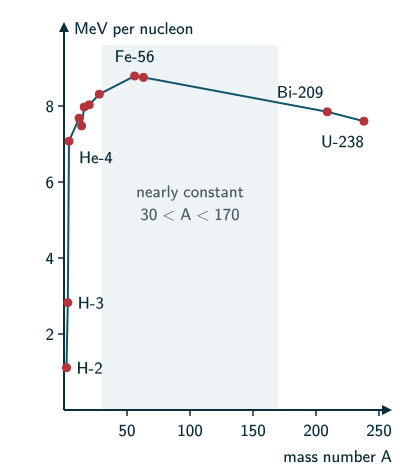
- NCERT Figure 13.1 plots Ebn against A (page 312):
- for nuclei of middle mass number, 30 < A < 170, Ebn is practically constant, about 8 MeV;
- it has a maximum of about 8.75 MeV near A = 56 and falls to 7.6 MeV for A = 238;
- it is lower for both light nuclei (A < 30) and heavy nuclei (A > 170).
- What this shows (NCERT pages 312–313):
- the nuclear force is attractive and strong enough to bind a few MeV per nucleon;
- the near-constancy comes from the short range of the nuclear force: a nucleon inside a large nucleus feels only the neighbours within that range, so adding more nucleons hardly changes its binding. This is the saturation property of the nuclear force;
- a nucleus with A = 240 is less tightly bound per nucleon than one with A = 120, so splitting it into two A = 120 nuclei releases energy (fission);
- two very light nuclei (A ≤ 10) joined into a heavier one are more tightly bound per nucleon, so joining them also releases energy (fusion), the energy source of the sun; strictly, this is a trend for light nuclei, not a rule for every pair or reaction channel (reasoned).
- Why it is lower at both ends (reasoned): in a light nucleus a large share of the nucleons sit at the surface with fewer neighbours. In a heavy nucleus every proton repels every other, so the Coulomb energy scales roughly as Z(Z − 1)/R while the nuclear attraction saturates; Ebn falls to 7.6 MeV for A = 238 (NCERT page 312).
- NCERT slip (page 312): in its argument for saturation, NCERT writes “Let the binding energy of the nucleus be pk” and three sentences later says the binding energy per nucleon is about pk. The sentence before makes it a nucleon’s binding energy, “proportional to p”, so read it as: the binding energy of each nucleon inside the nucleus is about pk; in an exam, give pk as the binding energy per nucleon. Strictly, this is a neighbour-counting argument for saturation, not an exact formula: pair energies need a factor of one half to avoid double counting, and nucleon kinetic energy also matters (reasoned).
- The curve is smooth overall but has peaks at nuclides like helium-4 and oxygen-16, evidence of a shell structure in nuclei like that of atoms (NCERT Points to ponder 6, page 320).
Solved examples
Example 1: The energy in one gram (NCERT Example 13.2)
Find the energy equivalent of 1 g of matter.
Answer: E = mc2 = 10−3 × (3 × 108)2 = 9 × 10¹³ J, an enormous amount (NCERT Example 13.2, page 310).
Example 2: 1 u in MeV, and oxygen-16 (NCERT Example 13.3)
Find the energy equivalent of 1 u in joules and in MeV, and express the mass defect of oxygen-16, 0.13691 u, in energy.
Answer: With 1 u = 1.660539 × 10⁻²⁷ kg (NCERT Eq. (13.1)), mc2 = 1.660539 × 10−27 × (2.9979 × 108)2 ≈ 1.4924 × 10⁻¹⁰ J. Dividing by 1.6022 × 10⁻¹⁹ J per eV gives about 9.315 × 10⁸ eV, so 1 u = 931.5 MeV/c2. For oxygen-16, 0.13691 × 931.5 ≈ 127.5 MeV is needed to separate it into its nucleons (NCERT Example 13.3, page 311).
Example 3: Nitrogen-14 (NCERT Exercise 13.1)
Find the binding energy of 147N, of atomic mass 14.00307 u, using mH = 1.007825 u and mn = 1.008665 u.
Answer: ΔM = 7 × 1.007825 + 7 × 1.008665 − 14.00307 = 0.11236 u, so Eb = 0.11236 × 931.5 ≈ 104.7 MeV, about 7.48 MeV per nucleon (NCERT Exercise 13.1, page 321; answer on page 351).
Example 4: Iron-56 and bismuth-209 (NCERT Exercise 13.2)
Find the binding energy per nucleon of 5626Fe (55.934939 u) and 20983Bi (208.980388 u).
Answer:
- Iron-56: ΔM = 26 × 1.007825 + 30 × 1.008665 − 55.934939 = 0.528461 u, so Eb ≈ 492.3 MeV and Ebn ≈ 8.79 MeV.
- Bismuth-209: ΔM = 83 × 1.007825 + 126 × 1.008665 − 208.980388 = 1.760877 u, so Eb ≈ 1640.3 MeV and Ebn ≈ 7.85 MeV.
Iron is the more tightly bound (NCERT Exercise 13.2, page 321). NCERT’s answer on page 351 gives 7.84 MeV for bismuth, which differs only in the last digit.
Common mistakes to avoid
Common mistake
Thinking a nucleus weighs more than its parts
Binding energy is released when the nucleus forms, so the nucleus is lighter than its separate nucleons by ΔM = Eb/c2 (NCERT page 311).
Common mistake
Comparing stability by total binding energy
Bismuth-209 has more total binding energy than iron-56, but less per nucleon (NCERT Exercise 13.2, page 321; see Example 4), and the binding energy per nucleon is the more useful measure of the binding between the constituents of the nucleus (NCERT page 312). Strictly, it measures average binding, not a complete prediction of radioactive stability (reasoned).
Common mistake
Mixing nuclear and atomic masses
Use mp with nuclear masses, or mH with atomic masses, so that the electron masses cancel (NCERT pages 311 and 321).
Quick revision summary
- Mass is a form of energy, E = mc; 1 u is equivalent to 931.5 MeV.
- A nucleus is lighter than its separate nucleons by the mass defect ΔM = Zmp + (A − Z)mn − M.
- Binding energy Eb = ΔMc2, the energy needed to split the nucleus into nucleons; for oxygen-16 it is 127.5 MeV.
- Binding energy per nucleon Ebn = Eb/A is about 8 MeV for 30 < A < 170, peaks near A = 56 and is lower for light and heavy nuclei.
- Its flatness shows the nuclear force is short-ranged (saturation); its shape explains energy from fission of heavy nuclei and fusion of light ones.
Formula sheet
- E = mc2
- 1 u = 931.5 MeV/c2
- ΔM = Z mp + (A − Z) mn − M
- Eb = ΔM c2
- ΔM = Z mH + N mn − Matom
- Sn = (MA−1 + mn − MA) c2
- Ebn = Eb/A
Questions students ask
Why is the binding energy per nucleon highest near iron?
The binding energy per nucleon is highest near iron because there the two effects that lower it at the ends of the curve, the large share of surface nucleons in light nuclei and the proton repulsion in heavy ones, add up to the least, so NCERT’s curve peaks at about 8.75 MeV near A = 56 (reasoned from NCERT pages 312–313). Strictly, nickel-62 is bound slightly more tightly, about 8.795 MeV per nucleon, 0.004 MeV more than iron-56, but iron-56 has the least mass per nucleon of all nuclides, as a larger share of its nucleons are protons, which are lighter than neutrons (beyond the NCERT text; NIST Atomic Weights and Isotopic Compositions).
Is nuclear binding energy positive or negative, and why is it zero for hydrogen-1?
For a many-nucleon nucleus bound against complete dissociation, nuclear binding energy is positive: it is the energy that must be supplied to pull a nucleus apart into free nucleons, Eb = ΔMc2, and the mass defect ΔM is positive because such a bound nucleus has less rest mass than its free nucleons (NCERT pages 311–312). Measured from the separated nucleons, the energy of the bound nucleus is −Eb, which is why some books draw the curve below the axis; that is a choice of sign, not different physics (reasoned). Ordinary hydrogen’s nucleus is a single proton, with nothing to bind, so its binding energy and its binding energy per nucleon are both zero; the deuteron, a proton and a neutron, is the simplest bound nucleus.
What is the difference between mass defect and binding energy, and what are their units?
Mass defect and binding energy describe the same thing as a mass and as an energy: the mass defect ΔM is the mass a nucleus lacks compared with its separate nucleons, in u or kg, while the binding energy Eb = ΔMc2 is the energy that mass corresponds to, in MeV or J (NCERT Eqs. (13.7)–(13.8), page 311). With 1 u = 931.5 MeV/c2 (NCERT Example 13.3, page 311), a mass defect of 0.2 u means a binding energy of 186.3 MeV. The binding energy per nucleon, Eb/A, is in MeV per nucleon, and 1 MeV = 1.6 × 10 J (NCERT page 321).
What is packing fraction, and how is it different from binding energy per nucleon?
Packing fraction is Francis Aston’s older measure of how far an atomic mass M differs from its mass number A, per nucleon: (M − A)/A, which he gave in parts per 10 000 on a scale with oxygen-16 = 16 (historical convention, beyond the NCERT text; Wikipedia, “Mass (mass spectrometry)”). Its M − A is not NCERT’s mass defect ΔM, which compares a nucleus with its free nucleons; on today’s carbon-12 scale, packing fraction is zero for carbon-12 and positive for hydrogen-1, which has no binding at all. It is most negative, about −0.0012, for iron-56, the nuclide with the least mass per nucleon (NIST atomic masses), and neither NCERT nor the JEE Main or NEET syllabus uses it.
Are mass defect and binding energy per nucleon in the JEE Main and NEET syllabus?
Yes, mass defect and binding energy per nucleon are in both syllabuses: Unit 18, Atoms and Nuclei, of the JEE Main 2027 syllabus lists “mass-energy relation, mass defect, binding energy per nucleon and its variation with mass number”, and Unit 18 of the NEET (UG) 2026 syllabus lists “Mass-energy relation, mass defect; binding energy per nucleon and its variation with mass number”. Both then go on to nuclear fission and fusion, whose energy the curve explains. The topic is NCERT Class 12 Physics Part II, Section 13.4 (pages 310–313), with Examples 13.2–13.3 and Exercises 13.1–13.3.
Practice questions
Try each question first, then open the answer to check your working.
-
Q1. Find the binding energy and binding energy per nucleon of helium-4, of atomic mass 4.002603 u.
Show answerHide answer
ΔM = 2 × 1.007825 + 2 × 1.008665 − 4.002603 = 0.030377 u, so Eb = 0.030377 × 931.5 ≈ 28.3 MeV and Ebn ≈ 7.07 MeV (data from NCERT page 321).
-
Q2. Which nucleus is more tightly bound per nucleon, iron-56 or uranium-238?
Show answerHide answer
Iron-56, at about 8.75 MeV per nucleon, against 7.6 MeV for uranium-238 (NCERT page 312).
-
Q3. What is the energy equivalent of the mass of an electron, 0.000548 u?
Show answerHide answer
0.000548 × 931.5 ≈ 0.510 MeV (data from NCERT page 321).