Nuclear force
NCERT Class 12 Physics Chapter 13 Section 13.5
Quick answer
The residual strong nuclear force binds nucleons and is short-ranged, becoming negligible beyond a few femtometres. In NCERT’s schematic potential, U(r) is least at r0 ≈ 0.8 fm and F = −dU/dr gives repulsion closer in and attraction farther out; real interactions also depend on spin and quantum channel, so charge independence compares corresponding states.
With your textbook
NCERT Physics Part II (Class 12), Chapter 13 “Nuclei”, Section 13.5 “Nuclear Force”, pages 313–314.
Open the official NCERT chapter (PDF, 1.8 MB, ncert.nic.in) (opens in a new tab)
Checked against the 2026-27 reprint on .
What is the nuclear force?
Nuclear force
The nuclear force is the strong attraction between nucleons that holds a nucleus together. The binding energy per nucleon, about 8 MeV, is far larger than the binding energies in atoms, and the protons in a nucleus repel each other; in NCERT’s words:
Therefore, to bind a nucleus together there must be a strong attractive force of a totally different kind.
NCERT Physics Part II (Class 12), Section 13.5, page 313
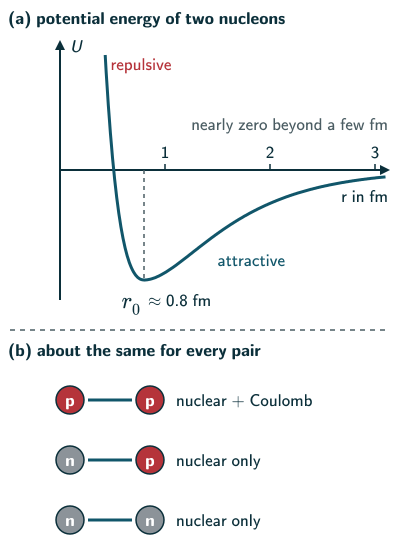
It is much stronger than the Coulomb force, acts only over a few femtometres, and is about the same between any two nucleons, whether protons or neutrons (NCERT pages 313–314).
Scope: the plotted potential is a rough, schematic plot, as NCERT calls it (page 313), not a universal force curve. Beyond the NCERT text: the nuclear force is the residual strong force between nucleons; the real interaction also depends on whether the nucleons’ spins are parallel or antiparallel, and “charge independent” means nearly the same force for neutrons and protons in corresponding spin states (Wikipedia, “Nuclear force”).
In plain words: inside a nucleus the protons push each other apart, yet the nucleus holds together. Something far stronger than electric repulsion must be gripping all the nucleons, but only when they almost touch; a few femtometres farther apart, its effect becomes very small.
Short range and charge independence
- The force that governs the atom’s electrons is the familiar Coulomb force. But the binding energy per nucleon, about 8 MeV, is much larger than the binding energy in atoms, so the force binding a nucleus must be of a totally different kind. It must overcome the repulsion between the protons and bind protons and neutrons into the tiny nuclear volume (NCERT page 313).
- Experiments from 1930 to 1950 showed these features (NCERT pages 313–314):
- (i) Strong. The nuclear force is much stronger than the Coulomb force between charges or the gravitational force between masses; it must dominate the Coulomb repulsion between the protons. Gravity is much weaker even than the Coulomb force.
- (ii) Short range. The force between two nucleons falls rapidly to zero once they are more than a few femtometres apart; strictly, to a negligible size (reasoned). So in a medium or large nucleus each nucleon feels only its near neighbours, the saturation of the force, which is why the binding energy per nucleon is nearly constant.
- (iii) Charge independent. The nuclear force between neutron and neutron, proton and neutron, and proton and proton is approximately the same: it does not depend on the electric charge. Beyond the NCERT text: the equality holds between nucleons in corresponding spin states, once electromagnetic effects are removed, so not every neutron–proton state has the same force as every proton–proton or neutron–neutron state (Wikipedia, “Nuclear force”).
- Unlike Coulomb’s law or Newton’s law of gravitation, the nuclear force has no simple mathematical form (NCERT page 314).
- Why heavy nuclei need extra neutrons. Stability needs a neutron-to-proton ratio of about 1 : 1 for light nuclei, rising to about 3 : 2 for heavy ones: more neutrons are needed to overcome the repulsion among the protons (NCERT Points to ponder 8, page 320). Neutrons add nuclear attraction without Coulomb repulsion (reasoned).
- How strong is the Coulomb repulsion it must beat? Two protons 1 fm apart have a Coulomb potential energy of about 1.44 MeV, a sizeable fraction of the 8 MeV binding per nucleon (reasoned; see Example 1).
Potential energy of a pair of nucleons
- NCERT Figure 13.2 is a rough plot of the potential energy of two nucleons against their separation r (NCERT page 313). In that schematic model the potential energy is least at a separation r0 of about 0.8 fm.
- In the schematic curve the force is attractive for separations larger than 0.8 fm and repulsive for separations less than 0.8 fm (NCERT page 313).
- Reading the curve (reasoned): the force is F = −dU/dr, minus the slope of the potential energy. Where U falls as r grows (r < r0) the force pushes the nucleons apart; where U rises as r grows (r > r0) it pulls them together; beyond a few fm the curve is nearly flat and the force is negligible.
- Together with saturation, short-range repulsion and quantum kinetic/exclusion effects prevent unlimited compression as a nucleus grows, so each takes up about the same volume. This fits nuclear density being independent of the size of the nucleus (reasoned; NCERT Points to ponder 1, page 320).
Solved examples
Example 1: Coulomb repulsion of two protons
Find the Coulomb potential energy of two protons 1.0 fm apart, in joules and in MeV.
Answer: U = ke2/r, with k = 1/(4πε0) = 9.0 × 10⁹ N m2 C−2 (NCERT page 321), so U = 9.0 × 109 × (1.6 × 10−19)2/
Example 2: Gravity against the Coulomb force
Compare the gravitational attraction and the Coulomb repulsion between two protons (m = 1.67 × 10⁻²⁷ kg, G = 6.67 × 10⁻¹¹ N m2 kg−2).
Answer: Both fall as 1/r2, so their ratio is the same at any distance. Gm2 = 6.67 × 10−11 × (1.67 × 10−27)2 ≈ 1.86 × 10−64 and ke2 = 9.0 × 109 × (1.6 × 10−19)2 ≈ 2.30 × 10⁻²⁸ (both in N m2), so Gm2/(ke2) ≈ 8 × 10−37. Gravity is hopelessly weak inside a nucleus (reasoned from NCERT page 313).
Example 3: Reading the potential energy curve
Using NCERT’s schematic central-potential curve, two nucleons are (a) 0.5 fm, (b) 1.5 fm, (c) 10 fm apart. Is the nuclear force between them repulsive, attractive or about zero?
Answer: (a) Closer than r0 ≈ 0.8 fm: repulsive. (b) Farther than r0 but within a few fm: attractive. (c) Far beyond a few fm: about zero (NCERT page 313).
Example 4: Why saturation keeps the binding energy per nucleon constant
Why does adding more nucleons to a large nucleus hardly change the binding energy per nucleon?
Answer: A nucleon feels only the neighbours within the short range of the nuclear force. Most nucleons in a large nucleus are inside it, already surrounded by as many neighbours as can reach them, so adding nucleons elsewhere does not change their binding (NCERT pages 312–313).
Common mistakes to avoid
Common mistake
Thinking the nuclear force acts only on protons
It acts between any two nucleons, and is about the same for neutron–neutron, neutron–proton and proton–proton pairs (NCERT page 314).
Common mistake
Thinking the nuclear force is always attractive
Closer than about 0.8 fm it is strongly repulsive; it is attractive only from about 0.8 fm out to a few femtometres (NCERT page 313).
Common mistake
Expecting an inverse-square law for the nuclear force
The nuclear force has no simple formula like Coulomb’s law; it falls to zero within a few femtometres (NCERT pages 313–314).
Quick revision summary
- A nucleus is held together by the nuclear force, far stronger than the Coulomb repulsion between its protons; gravity is weaker still.
- The nuclear force has a short range: it falls to zero beyond a few fm, which leads to saturation and a nearly constant binding energy per nucleon.
- It is charge independent: about the same for nn, np and pp pairs.
- The potential energy of two nucleons is least at r0 ≈ 0.8 fm; the force is repulsive closer in and attractive farther out.
- It has no simple mathematical form.
Formula sheet
- F = −dU/dr
- U(r) is least at r0 ≈ 0.8 fm
Questions students ask
What is the difference between the strong nuclear force and the weak nuclear force?
The fundamental strong interaction binds quarks into nucleons; its residual interaction binds nucleons into nuclei. The weak interaction enables processes such as a neutron changing into a proton in beta-minus decay, and is not what holds ordinary nuclei together. Gluons mediate the strong interaction; W and Z bosons mediate the weak interaction, whose characteristic range is much shorter than a femtometre. A fixed “100 times stronger” comparison is only a rough scale statement, not a universal ratio of forces (beyond the NCERT text; US Department of Energy, DOE Explains pages). In the sun the weak force turns a proton into a neutron in H + H → H + e + ν (reasoned from NCERT page 315).
Why is the nuclear force short range, and what particle carries it?
The longest-range part of the residual nuclear force is described by exchange of massive pions. A massive exchanged field gives an exponentially decaying Yukawa potential with characteristic length ħ/(mc), not a literal maximum travel distance for a real particle. With the charged-pion rest energy about 139.6 MeV, this scale is 197.3/139.6 ≈ 1.4 fm (Particle Data Group; NIST CODATA). Pion exchange is a useful long-range description; shorter-range and many-nucleon effects also matter. The underlying strong interaction acts between quarks through gluons (Jefferson Lab, Deuteron Form Factors; DOE, The Strong Force).
What is the difference between the nuclear force and binding energy?
The nuclear force is the strong, short-range force between nucleons, measured in newtons, while the binding energy is an energy, in MeV, the total that must be supplied to separate a nucleus into its free protons and neutrons (NCERT pages 311–313). They are related as a force and the energy needed to overcome it: the binding energy is what it takes to pull every nucleon free against the nuclear attraction, and it is made smaller by the Coulomb repulsion between the protons, which helps push them apart (reasoned). So the binding energy reflects the full nuclear energy, including interaction energies and nucleon kinetic energy; it is not simply the depth of a pair-potential well.
Is the nuclear force a central force, and does it depend on spin?
The nuclear force is not purely central: besides its central part, it has a non-central (tensor) part that depends on how the two nucleons’ spins point relative to the line joining them, so the deuteron is slightly elongated, as its electric quadrupole moment, found in 1939, shows (beyond the NCERT text; Kellogg, Rabi, Ramsey and Zacharias, Physical Review 55, 318). It is spin dependent: the deuteron is bound in the total-spin S = 1 (triplet) channel, whereas the neutron–proton spin-singlet channel has no bound state. “Parallel spins” is a simplified mnemonic for the triplet, not a statement that both measured spin projections must always be equal. The lowest pp and nn S-wave channels are spin singlets and have no bound pair (nuclear scattering and deuteron channel interpretation). Neither property is in NCERT’s Section 13.5.
Is the nuclear force in the JEE Main and NEET syllabus?
The nuclear force is not named in Unit 18, Atoms and Nuclei, of the JEE Main 2027 syllabus or of the NEET (UG) 2026 syllabus, whose nuclear topics run from “Composition and size of nucleus” to nuclear fission and fusion. It still matters for both: its short range keeps the binding energy per nucleon nearly constant (NCERT page 313), and both list “binding energy per nucleon and its variation with mass number”. The CBSE Class XII Physics syllabus for 2026–27 does list it, next to the composition and size of the nucleus, and it is Section 13.5 of NCERT Class 12 Physics Part II (pages 313–314).
Practice questions
Try each question first, then open the answer to check your working.
-
Q1. Why cannot gravity or the Coulomb force hold a nucleus together?
Show answerHide answer
Gravity is far too weak, and the Coulomb force between protons is repulsive; only the much stronger, attractive nuclear force can bind the nucleons (NCERT page 313).
-
Q2. Is the nuclear force between a neutron and a proton larger than that between two neutrons at the same separation?
Show answerHide answer
No: the nuclear force between neutron–neutron, proton–neutron and proton–proton pairs is approximately the same, and it does not depend on the electric charge (NCERT page 314); give that in an exam. For two protons the Coulomb repulsion comes on top (reasoned from NCERT page 313). Beyond the NCERT text: the equality holds between nucleons in corresponding spin states (Wikipedia, “Nuclear force”).
-
Q3. At what separation is the potential energy of two nucleons least, and what is the force there?
Show answerHide answer
At about 0.8 fm. There the slope of U is zero, so the nuclear force is zero: this is a stable minimum of the schematic classical pair potential, not a claim that quantum nucleons sit at fixed separation (NCERT page 313; reasoned from F = −dU/dr).