Atomic masses and composition of the nucleus
NCERT Class 12 Physics Chapter 13 Section 13.2
Quick answer
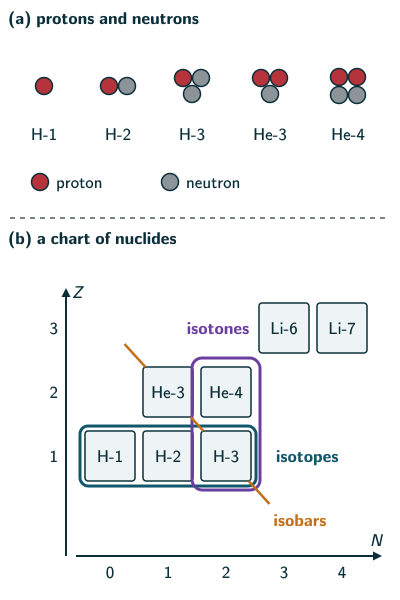
A nucleus contains Z protons and N neutrons, with mass number A = Z + N; hydrogen-1 has N = 0. Atomic electrons are not nuclear constituents, although their wavefunctions can overlap the nucleus; isotopes share Z, isobars share A with different Z, and isotones share N. The atomic mass unit is one twelfth of a free neutral ground-state carbon-12 atom’s mass, approximately 1.660539 × 10⁻²⁷ kg.
With your textbook
NCERT Physics Part II (Class 12), Chapter 13 “Nuclei”, Section 13.2 “Atomic Masses and Composition of Nucleus”, pages 306–309.
Open the official NCERT chapter (PDF, 1.8 MB, ncert.nic.in) (opens in a new tab)
Checked against the 2026-27 reprint on .
What is the nucleus made of?
Composition of the nucleus
An ordinary nucleus contains protons and usually neutrons, together called nucleons. The number of protons is the atomic number Z, the number of neutrons is the neutron number N, and the total number of nucleons is the mass number A = Z + N (NCERT Eqs. 13.4(a)–(c), page 308). A neutral atom has Z electrons in its surrounding electron cloud; the nucleus itself has charge +Ze. Electrons are not constituent nucleons, though atomic electron wavefunctions can overlap the nuclear volume. In NCERT’s words:
The number of protons in the nucleus of the atom is, therefore, exactly Z, the atomic number.
NCERT Physics Part II (Class 12), Section 13.2, page 308
A nuclide is written AZX, where X is the chemical symbol: the gold nucleus 19779Au has 197 nucleons, 79 protons and 118 neutrons (NCERT page 308).
In plain words: most nuclei are a tight bundle of two kinds of particles, positive protons and neutral neutrons, of almost the same mass. Hydrogen-1 is the simplest exception: its nucleus is one proton and has no neutron. The number of protons decides which element it is; the number of neutrons can vary a little, giving different versions of the same element.
Atomic mass unit
- The kilogram is far too large for atoms: a carbon-12 atom has a mass of 1.992647 × 10⁻²⁶ kg. So atomic masses are given in the atomic mass unit (u), defined as 1/12 of the mass of a free, neutral carbon-12 atom at rest in its ground state (NCERT Eq. (13.1), pages 306–307):
Atomic mass unit (NCERT Eq. 13.1)
-
That is, 1 u = 1.660539 × 10⁻²⁷ kg (NCERT Eq. (13.1), page 307).
-
NCERT slip (page 318): Summary point 2 gives 1 u = 1.660563 × 10⁻²⁷ kg. Eq. (13.1) gives 1.660539 × 10⁻²⁷ kg, and that is what the carbon-12 mass above gives: 1.992647 × 10⁻²⁶ kg/12 = 1.660539 × 10⁻²⁷ kg. Use the value of Eq. (13.1).
-
Atomic masses in u are close to whole multiples of the mass of a hydrogen atom, with striking exceptions such as chlorine, 35.46 u (NCERT page 307).
-
A mass spectrometer measures atomic masses accurately, and it shows that most elements are mixtures of isotopes: atoms of the same element with nearly the same electronic chemistry but different masses; isotope effects can change reaction rates and physical properties (NCERT page 307). NCERT uses chlorine isotope masses 34.98 u (75.4%) and 36.98 u (24.6%); their weighted average, 35.47 u, matches chlorine’s atomic mass (NCERT page 307; see Example 1).
-
Hydrogen has three familiar isotopes, of 1.0078 u, 2.0141 u and 3.0160 u. The nucleus of the lightest, about 99.99% of natural hydrogen (the abundance varies between samples), is the proton (NCERT page 307):
Mass of the proton (NCERT Eq. 13.2)
-
In kilograms, mp = 1.67262 × 10⁻²⁷ kg (NCERT Eq. (13.2), page 307).
-
This is the mass of the hydrogen atom, 1.00783 u, minus that of an electron, me = 0.00055 u, neglecting the tiny electronic binding-energy mass correction (NCERT page 307). The proton carries one unit of charge, +e, and is stable (NCERT page 307).
-
The heavier isotopes are deuterium and tritium. Tritium is unstable (NCERT page 307).
-
NCERT slip (page 307): NCERT says tritium nuclei “do not occur naturally”. Natural tritium is extremely rare, but the atmosphere has trace amounts, formed when cosmic rays strike its gases; tritium for use is made artificially, for example by irradiating lithium in a nuclear reactor (US EPA, Radionuclide Basics: Tritium).
-
The old proton–electron model treated electrons as permanently confined nuclear constituents. That model is ruled out; atomic electrons occupy orbitals whose probability density can extend into the nucleus (NCERT page 307).
Discovery of the neutron
- Deuterium and tritium are isotopes of hydrogen, so each nucleus has one proton. But the masses of the hydrogen, deuterium and tritium nuclei are in the ratio 1 : 2 : 3, so the heavier two must also hold neutral matter, about one and two proton masses of it (NCERT page 308).
- In 1932 James Chadwick confirmed this. Beryllium bombarded with alpha particles gave out a neutral radiation (NCERT page 308). Aimed at paraffin wax, which is rich in hydrogen, it knocked out fast protons, and it made the atoms of various gases recoil (James Chadwick, Nobel Lecture, 1935).
- NCERT slip (page 308): NCERT says the radiation knocked protons out of light nuclei “such as those of helium, carbon and nitrogen”. The protons came from the hydrogen in the paraffin wax; struck atoms of various gases simply recoiled (James Chadwick, Nobel Lecture, 1935).
- The only neutral radiation then known was the photon. But conservation of energy and momentum showed that photons would need far more energy than beryllium bombarded with alpha particles could supply (NCERT page 308).
- Chadwick solved the puzzle by taking the radiation to be a new neutral particle, the neutron. From conservation of energy and momentum he found its mass to be very nearly that of the proton (NCERT page 308). The reaction is 9Be + 4He → 12C + 1n (beyond the NCERT text). Chadwick received the 1935 Nobel Prize in Physics for the discovery (NCERT page 308).
Mass of the neutron (NCERT Eq. 13.3)
-
In kilograms, mn = 1.6749 × 10⁻²⁷ kg (NCERT Eq. (13.3), page 308).
-
A free neutron, unlike a free proton, is unstable: it decays into a proton, an electron and an antineutrino. NCERT says it is stable inside the nucleus (page 308), which is true in a stable nucleus. In a beta-radioactive nucleus such as tritium, a neutron does change into a proton (Particle Data Group, neutron listings; US EPA, Tritium).
-
NCERT gives the free neutron’s mean life as about 1000 s (page 308). Measurements give roughly 880 s, nearly 15 minutes; ultracold-neutron and beam measurements have a known disagreement (Particle Data Group, neutron mean-life listing).
Isotopes, isobars and isotones
- Isotopes have the same Z but different N. Deuterium, 21H, has one proton and one neutron; tritium, 31H, has one proton and two neutrons (NCERT page 309).
- Neutral isotopes have the same electron count and very similar electronic structure, so their chemistry is very similar, with measurable mass-dependent isotope effects and share one place in the periodic table, which is what isotope means in Greek (NCERT pages 307 and 309).
- NCERT says gold has 32 isotopes, from A = 173 to A = 204 (page 309). This historical count is not a fixed physical property; new radioactive isotopes continue to be identified. Gold-197 is the only stable naturally occurring gold isotope.
- Isobars have the same mass number A, for example 31H and 32He (NCERT page 309).
- Isotones have the same neutron number N but different Z, for example 19880Hg and 19779Au, which both have 118 neutrons (NCERT page 309).
Mass number (NCERT Eq. 13.4(c))
Solved examples
Example 1: The atomic mass of chlorine
Chlorine has isotopes of mass 34.98 u (abundance 75.4%) and 36.98 u (24.6%). Find the average mass of a chlorine atom.
Answer: 75.4 × 34.98 ≈ 2637.5 and 24.6 × 36.98 ≈ 909.7, so the weighted average is (2637.5 + 909.7)/100 ≈ 35.47 u, in agreement with the atomic mass of chlorine (NCERT page 307).
Example 2: Counting nucleons
How many protons, neutrons and nucleons are there in (a) 19779Au, (b) 168O, (c) 23592U?
Answer: Z protons, N = A − Z neutrons, A nucleons: (a) 79, 118, 197; (b) 8, 8, 16; (c) 92, 143, 235 (NCERT Eqs. 13.4(a)–(c), page 308).
Example 3: The proton from the hydrogen atom
The mass of a hydrogen atom is 1.00783 u and of an electron 0.00055 u. Find the mass of the proton in u and in kg.
Answer: mp = 1.00783 − 0.00055 = 1.00728 u, which NCERT gives as 1.00727 u; × 1.660539 × 10⁻²⁷ kg ≈ 1.6726 × 10⁻²⁷ kg (NCERT Eqs. (13.1)–(13.2), page 307; the last digit differs because the masses quoted are rounded).
Example 4: Sorting nuclides
Classify each pair as isotopes, isobars or isotones: (a) 126C and 146C; (b) 146C and 147N; (c) 136C and 147N.
Answer: (a) Same Z = 6: isotopes. (b) Same A = 14: isobars. (c) N = 13 − 6 = 7 and 14 − 7 = 7: isotones (NCERT page 309).
Common mistakes to avoid
Common mistake
Taking the mass number as the mass in u
The mass number A counts nucleons and is a whole number; the mass of a nuclide in u is close to A but not equal to it, for example 34.98 u for chlorine-35 or 15.99 u for oxygen-16 (NCERT pages 307 and 311). An element’s average atomic mass, such as chlorine’s 35.47 u, is not a mass number at all.
Common mistake
Mixing up isobars and isotones
Isobars share A (the top number); isotones share N = A − Z, which you must work out (NCERT page 309).
Common mistake
Thinking the neutron is stable on its own
A free neutron decays into a proton, an electron and an antineutrino; inside a stable nucleus it does not decay (NCERT page 308).
Quick revision summary
Hydrogen-1 has N = 0.
- 1 u is 1/12 of the mass of a carbon-12 atom, 1.660539 × 10⁻²⁷ kg.
- A nucleus has Z protons and N neutrons; its mass number is A = Z + N, and it is written AZX.
- mp = 1.00727 u and mn = 1.00866 u; the neutron was discovered by Chadwick in 1932.
- Isotopes share Z, isobars share A, isotones share N.
- A free neutron decays, with a mean life of about 15 minutes; inside a stable nucleus it does not.
Formula sheet
- 1 u = 1.660539 × 10⁻²⁷ kg
- A = Z + N
- mp = 1.00727 u
- mn = 1.00866 u
Questions students ask
Why was the discovery of the neutron important?
The discovery of the neutron in 1932 was important because it showed what every nucleus is made of, Z protons and A − Z neutrons, which accounted at once for the masses of nuclei and for isotopes (NCERT pages 308–309). It also gave physicists a new probe: having no charge, a neutron is not repelled by a nucleus, so it can enter even a heavy one, and neutrons fired at uranium led to the discovery of fission in 1938 (beyond the NCERT text; Chadwick’s nuclear-composition argument). Nuclear reactors run on this neutron-induced fission (NCERT page 315).
Why was paraffin wax used in Chadwick’s discovery of the neutron?
Paraffin wax was used because it is a hydrocarbon rich in hydrogen, a dense target of protons, and a proton has almost the same mass as a neutron (beyond the NCERT text). In a head-on elastic collision between equal masses the moving body stops and the struck one carries off all its kinetic energy, so the neutral radiation from beryllium knocked fast protons out of the wax, and fast protons are easy to detect because they ionise a gas. Comparing these recoils with those of other gas atoms, Chadwick found the new particle’s mass to be very nearly that of the proton (NCERT page 308; Wikipedia, “Discovery of the neutron”).
What are some examples of isotones, and how do you find them?
Isotones are nuclides with the same neutron number N = A − Z but different Z: sulphur-36, chlorine-37, argon-38, potassium-39 and calcium-40, for example, all have 20 neutrons (beyond the NCERT text; neutron counts computed from A − Z). To find isotones, subtract Z from A for each nuclide and look for equal results; along a set of isotones A and Z go up together, one for one. As a memory aid, isotopes share proton number and isotones share neutron number.
What are isodiaphers and isoelectronic species?
Isodiaphers are nuclides with the same neutron excess, N − Z: carbon-13, nitrogen-15 and oxygen-17 each have one neutron more than protons (beyond the NCERT text; direct counting of N − Z). A nucleus and the product of its alpha decay are always isodiaphers, since losing 2 protons and 2 neutrons leaves N − Z unchanged: thorium-232 (N − Z = 52) decays to radium-228, also 52 (nuclide counting in the natural thorium decay series). Isoelectronic species are atoms or ions with equal numbers of electrons, such as H, He and Li (2 each), a chemistry idea about electrons, not nuclei (ionic radius).
Are there electrons in the nucleus?
Electrons are not permanently bound constituents of an ordinary nucleus. Atomic electron wavefunctions can overlap the nuclear volume, enabling electron capture; a beta electron is created in the weak decay, not released from a store of pre-existing nuclear electrons (clarification of NCERT page 307). An electron confined in nitrogen-14, about 5.8 fm across by R = R0A1/3, would by the uncertainty principle need a momentum of at least about 9 × 10 kg m s, an energy of about pc = 17 MeV, while a uniformly charged nuclear sphere of that radius gives a central electrostatic binding scale of only about 5 MeV (an order-of-magnitude model estimate, not an exact quantum bound). Spin agrees: the old proton–electron model’s 14 protons and 7 electrons would give nitrogen-14 a half-integral spin, but it is 1 (beyond the NCERT text; Chadwick’s nuclear-composition argument).
Practice questions
Try each question first, then open the answer to check your working.
-
Q1. Using the mass of a carbon-12 atom, 1.992647 × 10⁻²⁶ kg, find 1 u in kilograms.
Show answerHide answer
1 u = 1.992647 × 10⁻²⁶/12 ≈ 1.660539 × 10⁻²⁷ kg (NCERT Eq. (13.1), page 307).
-
Q2. How many neutrons are there in 5626Fe?
Show answerHide answer
N = A − Z = 56 − 26 = 30 (NCERT Eq. 13.4(c), page 308).
-
Q3. Why do isotopes of an element have the same chemical properties?
Show answerHide answer
Neutral isotopes have the same proton and electron counts, giving very similar electronic chemistry; different nuclear masses can still produce isotope effects (NCERT page 309).