Hardy–Weinberg principle
NCERT Class 12 Biology Chapter 6 Section 6.7
Quick answer
Under the ideal Hardy–Weinberg model, allele frequencies remain constant and genotype frequencies at a two-allele autosomal locus are p, 2pq and q. NCERT names five factors that disturb this equilibrium: gene migration or gene flow, genetic drift, mutation, genetic recombination and natural selection (beyond NCERT, recombination mainly reshuffles combinations). When measured frequencies differ from expected values, NCERT says, the difference indicates the extent of evolutionary change (beyond NCERT, one sample’s genotype mismatch does not by itself prove change over time).
With your textbook
NCERT Biology (Class 12), Chapter 6 “Evolution”, Section 6.7 “Hardy-Weinberg Principle”, pages 120–121.
Open the official NCERT chapter (PDF, 12.7 MB, ncert.nic.in) (opens in a new tab)
Checked against the 2026-27 reprint on .
What is the Hardy–Weinberg principle?
Hardy–Weinberg principle
- In a given population one can find the frequency of the alleles of a gene or a locus. This frequency is supposed to remain fixed and even remain the same through generations, and the Hardy–Weinberg principle states it using algebraic equations (page 120). Beyond the NCERT text: this holds for an idealised population with no allele-changing forces (Wikipedia, “Hardy–Weinberg principle”, facts in our words).
This principle says that allele frequencies in a population are stable and is constant from generation to generation.
NCERT Biology (Class 12), Section 6.7, page 120
Beyond the NCERT text, the model’s assumptions: a very large, randomly mating population of diploid organisms that reproduce only sexually, in separate (non-overlapping) generations, with equal allele frequencies in males and females and no mutation, migration or selection (Wikipedia, “Hardy–Weinberg principle”, facts in our words). The equation describes genotype proportions under these assumptions; it is not a claim that every real population is unchanging.
In plain words: count every copy of every allele in a population. If nothing pushes on the population, the share of each allele stays the same, generation after generation. When the shares change, the population is evolving, so the principle gives a baseline against which evolution can be measured.
Gene pool and genetic equilibrium
- The gene pool is the total genes and their alleles in a population. Under the principle the gene pool remains constant: this is called genetic equilibrium (page 120).
- The sum total of all the allelic frequencies is 1. Individual frequencies are named p, q and so on; in a diploid, p and q are the frequencies of allele A and allele a (pages 120–121). With two alleles, p + q = 1.
- Beyond the NCERT text: the principle is named after the British mathematician G. H. Hardy, whose paper appeared in 1908, and the German physician Wilhelm Weinberg, who reached it independently the same year (Wikipedia, “Hardy–Weinberg principle”, facts in our words).
The Hardy–Weinberg equation
- The frequency of AA individuals is simply p: the probability that allele A, with a frequency p, appears on both chromosomes of a diploid individual is the product of the probabilities, p × p (page 121).
- Similarly, the frequency of aa is q and of Aa is 2pq (page 121). Aa gets the 2 because it can arise in two ways: A from one parent and a from the other, or the other way round (our reasoning; see the figure).
Hardy–Weinberg equation (NCERT page 121)
- NCERT notes that this is the binomial expansion of (p + q) (page 121). Since p + q = 1, its square is 1 too.
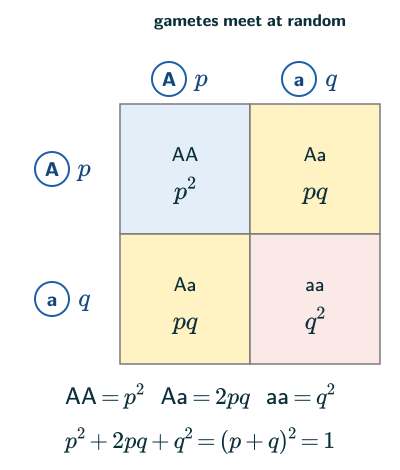
Two ways to use the equation (our reasoning from page 121):
- From genotype counts to allele frequencies: each AA individual carries two A alleles and each Aa individual one. In N individuals there are 2N alleles, so p = (2 × number of AA + number of Aa) ÷ 2N, and q = 1 − p.
- From a recessive trait to the carriers: if only aa individuals show a trait, the share showing it is q, so q = √(q), then p = 1 − q and the share of carriers is 2pq. This holds only for a population in equilibrium.
NCERT: when the measured frequency differs from the expected values, the difference (direction) indicates the extent of evolutionary change, and a disturbance in genetic equilibrium, a change of the frequency of alleles in a population, is interpreted as resulting in evolution (page 121). Give this in an NCERT-based answer.
Beyond the NCERT text, two tests to distinguish: a change in allele frequency across generations is population-genetic evolution. A departure of observed genotype proportions from p:2pq:q in one sample is not, by itself, proof of that change: nonrandom mating, mixed subpopulations, sampling or genotyping error can also cause a departure. Conversely, a snapshot matching Hardy–Weinberg proportions does not prove the absence of evolutionary forces (Wikipedia, “Hardy–Weinberg principle”, facts in our words).
Five factors that disturb the equilibrium
Five factors are known to affect Hardy-Weinberg equilibrium.
NCERT Biology (Class 12), Section 6.7, page 121
They are (page 121):
- gene migration or gene flow;
- genetic drift;
- mutation;
- genetic recombination;
- natural selection.
In an NCERT-based answer, give all five. Beyond the NCERT text, a mechanistic clarification: mutation, migration, drift and selection can change allele frequencies. Ordinary recombination reshuffles existing alleles and changes associations between loci; by itself it does not change a single locus’s allele frequency. Random mating is a sufficient condition for the familiar genotype proportions. Nonrandom mating can change genotype proportions without changing allele frequencies, and recombination need not stop for Hardy–Weinberg proportions to hold.
Gene flow, genetic drift and the founder effect
- When a section of a population migrates to another place and population, gene frequencies change in the original as well as in the new population: new genes/alleles are added to the new population and lost from the old one. NCERT: “There would be a gene flow if this gene migration, happens multiple times” (page 121). Give this definition in an NCERT-based answer.
- Beyond the NCERT text: population geneticists use gene flow for any movement of genes from one population into another (Wikipedia, “Gene flow”, facts in our words). The transfer happens only when migrants or their gametes contribute to the next generation, so a single successful event can count, while a visitor that leaves no descendants contributes no genes (reasoned from that definition). Migration need not remove an allele entirely from the source, or change both populations’ frequencies if their compositions are similar.
- If the same change occurs by chance, it is called genetic drift (page 121). Beyond the NCERT text: drift is change in allele frequencies through chance sampling, strongest in small populations, and it does not require migration.
- NCERT: sometimes the change in allele frequency in the new sample is so different that they become a different species; the original drifted population becomes the founders, and the effect is the founder effect (page 121). Beyond the NCERT text: a founder population starts from a small, unrepresentative sample of the source gene pool, which may reduce variation and alter allele frequencies (Wikipedia, “Founder effect”, facts in our words), but it does not by itself guarantee a new species.
Mutation, recombination and natural selection
- Microbial experiments show that pre-existing advantageous mutations, when selected, result in the observation of new phenotypes; over a few generations, NCERT says, this would result in speciation (page 121). Beyond the NCERT text: an adaptation does not by itself establish speciation, which needs evidence of independently evolving lineages. The kinds of mutation are in Chapter 4.
- Natural selection is a process in which heritable variations enabling better survival are enabled to reproduce and leave a greater number of progeny (page 121).
- Variation due to mutation, or to recombination during gametogenesis, or due to gene flow or genetic drift, results in changed frequency of genes and alleles in future generations; coupled to enhanced reproductive success, natural selection makes the population look like a different population (page 121). Beyond the NCERT text: the mechanisms differ: mutation supplies new alleles, recombination reshuffles them, migration transfers them and drift samples them by chance. Recombination, Morgan’s term for non-parental gene combinations, arises in meiosis from crossing over and independent assortment.
Stabilising, directional and disruptive selection
Natural selection can lead to (page 121):
- stabilisation, in which more individuals acquire the mean character value;
- directional change, in which more individuals acquire a value other than the mean character value;
- disruption, in which more individuals acquire peripheral character values at both ends of the distribution curve.
Beyond the NCERT text: individuals do not change their own character value; “acquire” describes the next generation’s distribution (our reading). In the usual modern terms, stabilising selection works against both tails of the distribution, directional selection against one tail, and disruptive selection against the middle (Wikipedia, “Natural selection”, facts in our words).
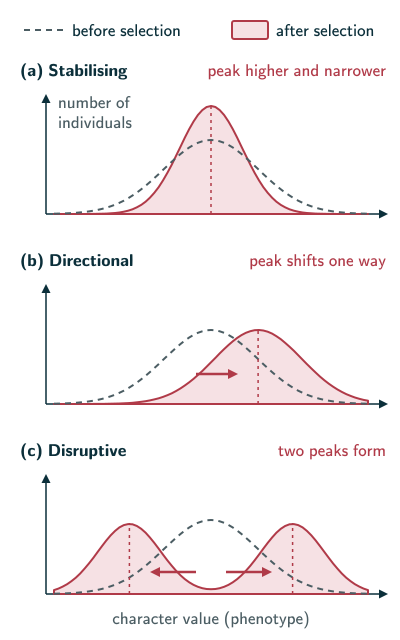
| Kind | Individuals favoured | Curve after selection (NCERT Figure 6.8) |
|---|---|---|
| Stabilising | those near the mean | peak higher and narrower |
| Directional | those on one side of the mean | peak shifts in one direction |
| Disruptive | those at both ends | two peaks form |
NCERT Figure 6.8 (page 120) labels its starting curve with medium-sized individuals favoured, which fits (a) stabilising only; in (b) one side of the mean is favoured and in (c) both ends, so name the kind from its result curve.
Solved examples
Example 1: Allele frequencies from genotype counts
A population of 600 plants has 384 AA, 192 Aa and 24 aa. Find p and q, and test whether the population is in Hardy–Weinberg equilibrium.
Answer: there are 2 × 600 = 1200 alleles. A alleles: 2 × 384 + 192 = 960, so p = 960 ÷ 1200 = 0.8 and q = 1 − 0.8 = 0.2. Expected: AA = p = 0.64, so 0.64 × 600 = 384; Aa = 2pq = 0.32, so 192; aa = q = 0.04, so 24. The observed counts equal the expected ones, so the population is in equilibrium: there is no difference from the expected values (reasoned from NCERT page 121). Beyond the NCERT text: one snapshot shows Hardy–Weinberg proportions at this locus; it does not by itself prove that the allele frequencies stay constant over generations (our reasoning).
Example 2: Carriers of a recessive trait
A recessive trait appears in 1 of every 2500 individuals of a population in equilibrium. What share of the population carries the allele without showing the trait?
Answer: q = 1 ÷ 2500 = 0.0004, so q = √0.0004 = 0.02 and p = 0.98. Carriers (Aa) = 2pq = 2 × 0.98 × 0.02 = 0.0392, about 3.9 per cent, or roughly 1 in 26: far more than the 1 in 2500 who show the trait.
Example 3: A population out of equilibrium
Of 1000 individuals, 450 are AA, 300 Aa and 250 aa. Is the population in equilibrium?
Answer: A alleles: 2 × 450 + 300 = 1200 of 2000, so p = 0.6 and q = 0.4. Expected: AA 0.36 × 1000 = 360, Aa 0.48 × 1000 = 480, aa 0.16 × 1000 = 160. The population has far fewer heterozygotes (300 against 480) and more homozygotes than expected, so it is not in equilibrium: some factor is acting. NCERT reads such a difference from the expected values as a measure of evolutionary change (page 121). Beyond the NCERT text: this calculation does not identify the factor; nonrandom mating such as inbreeding, for example, raises homozygosity and upsets the genotype proportions without by itself changing the allele frequencies (Wikipedia, “Hardy–Weinberg principle”, facts in our words).
Example 4: Naming the kind of selection
In a plant population, height varies around a mean. Name the kind of selection when (a) the tallest plants leave the most seeds, (b) medium plants leave the most, (c) both the shortest and the tallest leave more than the medium ones.
Answer: (a) directional: more individuals come to have a value other than the mean, and the peak shifts; (b) stabilising: more individuals acquire the mean value, and the peak gets higher and narrower; (c) disruptive: more individuals acquire values at both ends, and two peaks form (NCERT page 121, Figure 6.8).
Common mistakes to avoid
Common mistake
Taking q for q
Under Hardy–Weinberg assumptions, if 9 per cent of a population is aa, then q = 0.09 and q = 0.3, not 0.09. The allele frequency is the square root of the share of recessive homozygotes.
Common mistake
Dropping the 2 in 2pq
The heterozygote frequency is 2pq, not pq: Aa arises in two ways, so p + 2pq + q = 1 (NCERT page 121).
Common mistake
Mixing up gene flow and genetic drift
In NCERT, gene flow is gene migration that happens multiple times, while genetic drift is the same kind of change occurring by chance (NCERT page 121). Beyond the NCERT text: gene flow needs successful reproduction by the migrants, and drift is chance sampling.
Common mistake
Confusing disruptive with directional selection
Directional selection favours one side of the mean and shifts the single peak; disruptive selection favours both ends and gives two peaks (NCERT page 121, Figure 6.8).
Quick revision summary
- Hardy–Weinberg principle: allele frequencies in a population are stable from generation to generation; the gene pool stays constant: genetic equilibrium (NCERT page 120). Beyond the NCERT text, this is an ideal model (see the assumptions above), in which random mating gives predictable genotype proportions.
- With alleles A and a of frequencies p and q: p + q = 1 and p + 2pq + q = 1, the binomial expansion of (p + q). AA = p, Aa = 2pq, aa = q.
- NCERT: when measured frequencies differ from the expected values, the difference indicates the extent of evolutionary change (beyond NCERT, one sample’s genotype-proportion deviation alone does not prove change over time). NCERT’s five factors: gene migration or gene flow, genetic drift, mutation, genetic recombination and natural selection; beyond NCERT, recombination alone reshuffles alleles without changing single-locus frequencies.
- Gene flow (NCERT): gene migration happening multiple times; beyond NCERT, one event with successful reproduction can count. Drift: the same change by chance. Founder effect: the drifted population becomes founders (NCERT); beyond NCERT, not automatic speciation.
- Natural selection: stabilising (mean favoured), directional (one side favoured), disruptive (both ends favoured, two peaks).
Formula sheet
- p + q = 1
- p + 2pq + q = 1
- AA = p; Aa = 2pq; aa = q
- five factors (NCERT): gene flow, drift, mutation, recombination, selection
- recombination: reshuffles allele combinations (beyond NCERT)
- stabilising: mean; directional: one side; disruptive: both ends
Questions students ask
What is the Hardy–Weinberg equation for three alleles?
The Hardy–Weinberg equation for three alleles, beyond the NCERT text and by our own extension of NCERT’s binomial expansion (page 121), is p + q + r + 2pq + 2pr + 2qr = 1, the square of (p + q + r), where the allele frequencies p, q and r add up to 1. NCERT’s three-allele gene is I of the ABO blood groups, with IA, IB and i (Chapter 4, page 61). Writing p, q and r for these, by our reasoning the share of blood group O is r and of group AB 2pq, so if a quarter of a population in equilibrium is group O, r = 0.5.
What is the difference between genetic drift and natural selection?
Genetic drift changes allele frequencies by chance, while natural selection changes them because some heritable variations help their carriers survive and breed: NCERT calls a change that “occurs by chance” genetic drift, and says that in natural selection variations enabling better survival leave a “greater number of progeny” (page 121). Beyond the NCERT text, drift can carry an allele to a very high frequency or remove it altogether (NHGRI glossary, public domain). So, by our reading, drift acts whether or not an allele helps survival: selection fits a population to its surroundings, while drift can spread a harmful allele or lose a useful one.
What is the bottleneck effect, and how is it different from the founder effect?
Beyond the NCERT text, the bottleneck effect is genetic drift after a sudden crash in a population’s numbers, so later generations descend from a few survivors carrying only part of the old gene pool (Hoffman and colleagues 2024, CC BY). By our reading, it differs from NCERT’s founder effect (page 121) in how it starts: a bottleneck shrinks the whole population in place, while founders leave a population that can itself stay large. Beyond the NCERT text, hunting cut the northern elephant seal to about 20 animals in 1892; it now numbers over 220 000, yet its genetic diversity remains far lower than before the crash (Hoelzel and colleagues 2024, CC BY; both in Nature Ecology & Evolution).
Why is genetic drift stronger in small populations?
Beyond the NCERT text, genetic drift is stronger in small populations, as the NHGRI glossary (public domain) notes, because each generation inherits a chance sample of its parents’ alleles, and a small sample strays further from the parents’ frequencies than a large one (our reasoning). By our arithmetic, 10 tosses of a fair coin give 7 or more heads about one time in six, but 1000 tosses give 700 or more heads with a chance below one in 10. In the same way, a population of five diploid individuals carries only 10 copies of a gene and one of 500 carries 1000, so an allele’s share can swing widely between generations in the first but hardly moves in the second.
Practice questions
Try each question first, then open the answer to check your working.
-
Q1. The frequency of allele A in a population in equilibrium is 0.9. Find q and the expected frequency of heterozygotes.
Show answerHide answer
q = 1 − 0.9 = 0.1; Aa = 2pq = 2 × 0.9 × 0.1 = 0.18 (NCERT page 121).
-
Q2. What is the founder effect?
Show answerHide answer
A small group that founds a new population carries a chance sample of the parent population’s alleles, so its allele frequencies can differ markedly; NCERT adds that the drifted sample sometimes becomes a different species, the original drifted population being the founders (NCERT page 121).
-
Q3. In which kind of natural selection do two peaks form?
Show answerHide answer
Disruptive selection, in which more individuals acquire peripheral character values at both ends of the distribution curve (NCERT page 121, Figure 6.8).