Diazonium salts in the synthesis of aromatic compounds
NCERT Class 12 Chemistry Chapter 9 Section 9.10
Quick answer
Arenediazonium salts enable replacement of a chosen amino group by F, Cl, Br, I, CN, OH or other groups under suitable conditions. They can improve positional selectivity compared with simple direct substitution. Diazotisation followed by reduction also removes an amino group, as used in NCERT’s 4-nitrotoluene-to-2-bromobenzoic-acid route.
With your textbook
NCERT Chemistry Part II (Class 12), Chapter 9 “Amines”, Section 9.10 “Importance of Diazonium Salts in Synthesis of Aromatic Compounds”, pages 276–277.
Open the official NCERT chapter (PDF, 2.9 MB, ncert.nic.in) (opens in a new tab)
Checked against the 2026-27 reprint on .
Why are diazonium salts important in synthesis?
Diazonium salts in the synthesis of aromatic compounds
Arenediazonium salts are very good intermediates for putting –F, –Cl, –Br, –I, –CN, –OH and –NO2 groups on an aromatic ring, so they are used to make substituted aromatic compounds that are difficult to obtain selectively by the simple direct-substitution routes taught here (NCERT Section 9.10, pages 276–277). NCERT gives two examples:
Aryl fluorides and iodides cannot be prepared by direct halogenation. The cyano group cannot be introduced by nucleophilic substitution of chlorine in chlorobenzene but cyanobenzene can be easily obtained from diazonium salt.
NCERT Chemistry Part II (Class 12), Section 9.10, page 276
In plain words: an –NH2 group is easy to put on a ring (nitrate, then reduce), and once it is turned into –N2+ it can be replaced by several useful groups, or simply removed. That gives two kinds of help: groups that will not go on directly, and positions that the groups already on the ring would not direct to.
Groups that cannot be introduced by direct substitution
- Fluorine: fluoroarenes are not made by direct halogenation, because fluorine is too reactive (NCERT Unit 6, page 166). From the diazonium salt: HBF4, then heat the fluoroborate, ArN2+BF4− → ArF + BF3 + N2 (NCERT page 275).
- Iodine: iodination of a ring is reversible and needs an oxidising agent such as HNO3 or HIO4 to remove the HI formed (NCERT Unit 6, page 166); see halogenation of arenes. From the diazonium salt: treat it with KI (NCERT page 275).
- Note on NCERT’s wording (pages 275–276): Section 9.10 says aryl iodides “cannot be prepared by direct halogenation”, but page 275 says only that iodine “is not easily introduced into the benzene ring directly”, and NCERT Unit 6 (page 166) iodinates arenes when an oxidising agent removes the HI. What fails is iodine alone, because the reaction is reversible; with KI, the diazonium salt gives the iodide easily. In an exam, give that reason, and say that direct iodination needs an oxidising agent (reasoned).
- Cyano: “The cyano group cannot be introduced by nucleophilic substitution of chlorine in chlorobenzene” (NCERT page 276), because aryl halides are very unreactive towards nucleophiles (NCERT Unit 6, page 181; see why haloarenes resist substitution). Strictly, this means simple cyanide under ordinary conditions (reasoned). From the diazonium salt: CuCN/KCN, the Sandmeyer reaction (NCERT page 275).
| Group | Direct route | From ArN2+ |
|---|---|---|
| –F | too reactive | HBF4, heat |
| –I | reversible | KI |
| –CN | ordinary ArCl resists simple cyanide substitution | CuCN/KCN |
Steering a group to the right position
- Groups already on a ring decide where the next one goes: –CH3 and –NH2 send it ortho and para, –NO2 and –COOH send it meta (NCERT Class 11 Chemistry, Unit 9, pages 324–325; Class 12 Unit 8, page 254); see directive influence.
- An –NH2 group (or a –NO2 group reduced to one) can be used to place other groups, and then removed: diazotise, then reduce with H3PO2 or ethanol, which puts H in its place (NCERT page 275). The route can favour a positional isomer that direct substitution of the simpler arene does not give selectively (reasoned from NCERT page 277).
Removing an amino group
ArNH2 + NaNO2 + 2HCl → ArN2+Cl− + NaCl + 2H2O (273–278 K)
ArN2+Cl− + H3PO2 + H2O → ArH + N2 + H3PO3 + HCl
ArN2+Cl− + C2H5OH → ArH + CH3CHO + N2 + HCl
The first is NCERT’s diazotisation of aniline (page 274) written for any primary aromatic amine ArNH2; the other two are NCERT’s reductions with hypophosphorous acid and with ethanol (page 276), each replacing –N2+ by H.
NCERT Example 9.5: 4-nitrotoluene to 2-bromobenzoic acid
NCERT works one such route in full (Example 9.5, page 277):
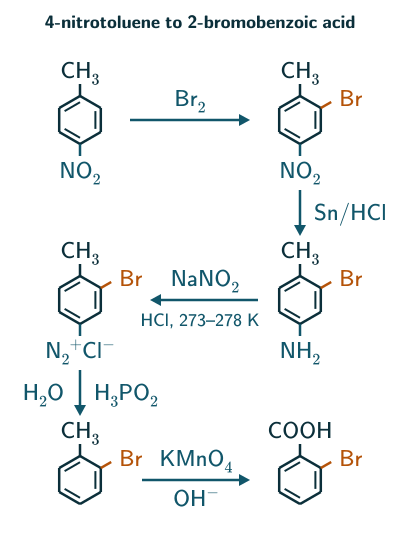
- Bromination (Br2): 4-nitrotoluene gives 2-bromo-4-nitrotoluene. Both groups send bromine to the same carbon: it is ortho to –CH3 (the para position is taken) and meta to –NO2 (reasoned). NCERT writes only Br2 over the arrow; ring bromination needs a Lewis acid catalyst such as iron (NCERT Unit 6, page 166), so write Br2/Fe in an exam.
- Reduction (Sn/HCl): –NO2 becomes –NH2, giving 3-bromo-4-methylaniline; nitro compounds are reduced by metals in acid (NCERT page 262).
- Diazotisation (NaNO2/HCl, 273–278 K): the amine becomes 3-bromo-4-methylbenzenediazonium chloride.
- Removal (H3PO2, water): H replaces –N2+, giving 2-bromotoluene.
- Oxidation (KMnO4, OH−): the whole side chain becomes –COOH (NCERT Unit 8, page 246), giving 2-bromobenzoic acid; the free acid is obtained when the alkaline mixture is acidified (reasoned).
Why this order? Bromine goes on first, while –CH3 and –NO2 both send it to C-2. Oxidised first, the ring would carry –COOH and –NO2, two meta-directing groups that point to different carbons (–COOH to C-3, –NO2 to C-2) and both deactivate the ring (NCERT Unit 8, page 254; NCERT Class 11 Chemistry, Unit 9, page 325). Reduced first, the ring would carry –NH2, a powerful activating group (NCERT page 272) that would send bromine next to itself, meta to –CH3. Direct bromination of toluene would not give the same selectivity: toluene is brominated ortho and para, and benzoic acid meta, to 3-bromobenzoic acid. Holding the para position with –NO2, then removing it, favours the desired ortho product in the designed route; directing effects predict major products, not absolute exclusion of every side product (reasoned).
Solved examples
Example 1: 3-Methylaniline into 3-nitrotoluene
How would you convert 3-methylaniline into 3-nitrotoluene? (NCERT Intext Question 9.9 (i), page 277.)
Answer: Diazotise with NaNO2 and HCl at 273–278 K, precipitate the fluoroborate with HBF4, then heat it with aqueous NaNO2 in the presence of copper: –NO2 replaces –N2+ (NCERT pages 274–276). Nitrating toluene does not selectively give the target: –CH3 favours ortho and para, although minor meta product can form (reasoned).
Example 2: Mass of product from NCERT Example 9.5’s route
At most, what mass of 2-bromobenzoic acid can 13.7 g of 4-nitrotoluene give by NCERT’s route? (C = 12, H = 1, N = 14, O = 16, Br = 80.)
Answer: Each step turns one mole into one mole. M(CH3C6H4NO2) = 84 + 7 + 14 + 32 = 137 g mol−1, so 13.7/137 = 0.100 mol. M(BrC6H4COOH) = 84 + 5 + 80 + 32 = 201 g mol−1: 0.100 × 201 = 20.1 g (reasoned; real yields are lower at every step).
Common mistakes to avoid
Common mistake
Oxidising the side chain too early
–COOH is meta directing, so brominating benzoic acid gives 3-bromobenzoic acid, not the 2-bromo acid of NCERT Example 9.5. Oxidise last.
Common mistake
Expecting KCN to turn chlorobenzene into benzonitrile
Aryl halides resist nucleophilic substitution; benzonitrile is made from the diazonium salt with CuCN/KCN.
Quick revision summary
- Through the diazonium salt: –F (HBF4, heat), –I (KI) and –CN (CuCN/KCN), which simple direct routes do not introduce readily or selectively; also –Cl, –Br, –OH and –NO2.
- An –NH2 group can steer substitution and then be removed (diazotise, then H3PO2).
- NCERT Example 9.5: Br2, Sn/HCl, NaNO2/HCl, H3PO2, KMnO4/OH−; 4-nitrotoluene to 2-bromobenzoic acid.
Formula sheet
- ArNH + NaNO + 2HCl → ArNCl + NaCl + 2HO (273–278 K)
- ArNCl + CHOH → ArH + CHCHO + N + HCl
- ArNBF (heat) → ArF + BF + N
Questions students ask
What are diazonium salts used for?
They are intermediates in azo-dye synthesis and in transformations to aryl halides, nitriles, phenols and arenes (NCERT pages 275–278). The useful idea is positional control: convert a suitably placed primary amino group into a diazonium group, then replace it with the target group or remove it as H.
Are diazonium salts used to make medicines?
Diazonium chemistry can help prepare aromatic building blocks used in medicinal chemistry. A synthetic intermediate is not itself a medicine: the educational point is how diazotisation enables replacement at a chosen ring carbon. Which route is used for a particular drug requires evidence for that specific manufacturing process.
Why must an amino group be diazotised before it can be replaced?
An amino group must be diazotised before it can be replaced because –NH2 would have to leave as the amide ion, NH2−, a very strong base and so a very poor leaving group, while the diazonium group is a very good leaving group that departs as nitrogen gas (NCERT page 275; reasoned). Diazotisation at 273–278 K (NCERT page 274) thus turns the –NH2, easily put on a ring by nitration and reduction (NCERT Class 11 Chemistry, Unit 9, page 322; NCERT page 262), into a group that can be replaced by –F, –Cl, –Br, –I, –CN, –OH, –NO2 or –H (NCERT pages 275–276).
Practice questions
Try each question first, then open the answer to check your working.
-
Q1. How would you convert aniline into 1,3,5-tribromobenzene? (NCERT Intext Question 9.9 (ii), page 277.)
Show answerHide answer
Bromine water at room temperature gives 2,4,6-tribromoaniline (NCERT page 272). Diazotise it with NaNO2 and HCl at 273–278 K, then reduce with H3PO2: H replaces –N2+, leaving 1,3,5-tribromobenzene. Repeated direct bromination is not a selective route to this substitution pattern, since bromine favours ortho and para substitution (reasoned).
-
Q2. How would you convert benzene into m-bromophenol? (NCERT Exercise 9.8 (ii), page 279.)
Show answerHide answer
Nitrate benzene to nitrobenzene, then brominate it with Br2 and iron: –NO2 sends bromine meta, giving 1-bromo-3-nitrobenzene (NCERT Class 11 Chemistry, Unit 9, page 325). Reduce it with Sn/HCl to 3-bromoaniline (NCERT page 262), diazotise at 273–278 K, and let the solution warm to 283 K: the salt is hydrolysed, giving m-bromophenol, 3-bromophenol (NCERT page 276). Direct bromination of phenol favours ortho and para products rather than selectively giving the meta target (NCERT Class 11 Chemistry, Unit 9, page 324; reasoned).