Physical properties of amines
NCERT Class 12 Chemistry Chapter 9 Section 9.5
Quick answer
Small amines can hydrogen bond with water, while increasing hydrocarbon chain length generally lowers the free base’s water solubility. Primary and secondary amines can also donate N–H hydrogen bonds to one another; simple tertiary amines cannot. NCERT gives the boiling-point order of isomeric amines as primary > secondary > tertiary; branching and molecular shape make it a trend rather than a universal rule.
With your textbook
NCERT Chemistry Part II (Class 12), Chapter 9 “Amines”, Section 9.5 “Physical Properties”, pages 265–266.
Open the official NCERT chapter (PDF, 2.9 MB, ncert.nic.in) (opens in a new tab)
Checked against the 2026-27 reprint on .
What are the physical properties of amines?
Physical properties of amines
The lower aliphatic amines are gases with a fishy odour; amines hydrogen bond with water, so the lower ones dissolve, and primary and secondary amines hydrogen bond with one another, so NCERT orders the boiling points of isomeric amines primary > secondary > tertiary (NCERT Section 9.5, pages 265–266). Branching can upset that order for particular isomers (see below). NCERT explains the tertiary amines:
Tertiary amines do not have intermolecular association due to the absence of hydrogen atom available for hydrogen bond formation.
NCERT Chemistry Part II (Class 12), Section 9.5, page 265
In plain words: an N–H group can give a hydrogen bond to the nitrogen of a neighbouring molecule. A primary amine has two N–H, a secondary amine one and a tertiary amine none, which influences boiling points alongside molecular size, shape, dipole interactions and dispersion. The quoted lack of tertiary-amine “association” refers to N–H hydrogen bonding, not to all intermolecular forces. Because nitrogen is less electronegative than oxygen, these hydrogen bonds are weaker than those in alcohols.
Physical state, colour and odour
- The lower aliphatic amines are gases with a fishy odour; primary amines with three or more carbon atoms are liquids, and still higher ones are solids (NCERT page 265). Strictly, the state depends on temperature and pressure, and the carbon-count rule is approximate: methylamine is a gas at room conditions, many intermediate members are liquids and higher straight-chain members may be solids (reasoned).
- Aniline and other arylamines are usually colourless, but they become coloured on storage because of atmospheric oxidation (NCERT page 265).
Solubility in water
- Lower aliphatic amines dissolve in water because they form hydrogen bonds with water molecules (NCERT page 265).
- Solubility decreases as the molar mass grows, because the hydrophobic alkyl part gets bigger; higher amines are essentially insoluble in water (NCERT page 265).
- Taking the electronegativity of nitrogen as 3.0 and of oxygen as 3.5, alcohols are more polar than amines and form stronger intermolecular hydrogen bonds (NCERT page 265). From this NCERT asks which of butan-1-ol and butan-1-amine is more soluble in water (page 265). It prints no answer, but its hint points to butan-1-ol (reasoned from NCERT page 265).
- Note on NCERT’s question (page 265): measured solubility runs the other way. Beyond the NCERT text: NIOSH lists butan-1-amine as miscible with water, while only about 68 g of butan-1-ol dissolves per litre of water at 25 °C (both via PubChem, US National Library of Medicine). O–H hydrogen bonding is stronger than N–H hydrogen bonding, but that alone does not decide water solubility: solute–water interactions, the solute’s own association, protonation and temperature all count (reasoned). In an exam that asks NCERT’s question, give the answer NCERT’s reasoning leads to, butan-1-ol, with its reason; where a question gives solubility data, go by the data. Distinguish the free amine from its protonated salt.
- Amines dissolve in organic solvents such as alcohol, ether and benzene (NCERT page 265).
Boiling points and hydrogen bonding
- Primary and secondary amines associate through hydrogen bonds between the nitrogen of one molecule and a hydrogen of another. The association is greater in primary amines, which have two hydrogens on nitrogen; tertiary amines have none (NCERT pages 265–266).
- So for isomeric amines NCERT gives the order of boiling points primary > secondary > tertiary (NCERT page 266, with its Table 9.2); give that order in an exam. Beyond the NCERT text, it is a trend, not a rule for every isomer: the primary amine 2-methylpropan-2-amine boils near 318 K (NIST), below diethylamine at 329.3 K in NCERT’s table, because branching and molecular shape matter too.
NCERT Table 9.2 (page 266), compounds of almost the same molar mass, rearranged here in order of boiling point:
| Compound | M | b.p./K |
|---|---|---|
| C2H5CH(CH3)2 | 72 | 300.8 |
| C2H5N(CH3)2 | 73 | 310.5 |
| (C2H5)2NH | 73 | 329.3 |
| n-C4H9NH2 | 73 | 350.8 |
| n-C4H9OH | 74 | 390.3 |
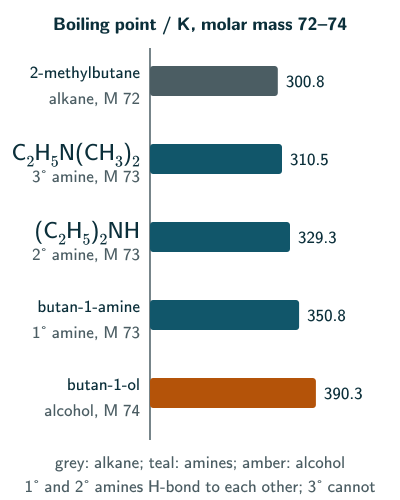
All three amines boil above the alkane of similar mass and below the alcohol, whose O–H groups hydrogen bond more strongly than N–H groups; the alcohols page shows alcohols boiling above alkanes in the same way (reasoned from NCERT pages 265–266).
Solved examples
Example 1: Ranking NCERT’s five compounds
Rank C2H5CH(CH3)2, C2H5N(CH3)2, (C2H5)2NH, n-C4H9NH2 and n-C4H9OH by boiling point, and check that their molar masses are close. (C = 12, H = 1, N = 14, O = 16.)
Answer: C5H12 = 60 + 12 = 72; the three amines, C4H11N = 48 + 11 + 14 = 73; C4H10O = 48 + 10 + 16 = 74. Order: alkane (300.8 K) < tertiary amine (310.5 K) < secondary amine (329.3 K) < primary amine (350.8 K) < alcohol (390.3 K). The alkane has no hydrogen bonds; among the amines, more N–H means more association; the alcohol’s O–H bonds are stronger still (NCERT pages 265–266).
Example 2: How big are the steps?
From NCERT’s data, by how much does butan-1-amine boil above its tertiary isomer, and butan-1-ol above butan-1-amine?
Answer: 350.8 − 310.5 = 40.3 K; 390.3 − 350.8 = 39.5 K. Hydrogen bonding helps explain the order, but these differences cannot be assigned quantitatively to hydrogen bonding alone (reasoned from NCERT Table 9.2, page 266).
Common mistakes to avoid
Common mistake
Expecting the tertiary amine to boil highest
A simple tertiary alkylamine lacks N–H and cannot donate N–H hydrogen bonds. That explains NCERT’s order for isomeric amines (page 266); class alone does not establish a universal boiling-point ranking, and other donor groups, if present, also matter (reasoned).
Common mistake
Expecting amines to boil higher than alcohols
Nitrogen (3.0) is less electronegative than oxygen (3.5), so amine molecules hydrogen bond to one another more weakly than alcohol molecules do: butan-1-amine boils at 350.8 K, butan-1-ol at 390.3 K (NCERT Table 9.2, page 266).
Quick revision summary
- The lower aliphatic amines are gases with a fishy odour; primary amines with three or more carbons are liquids, higher ones solids (NCERT; strictly, state depends on temperature). Arylamines colour on storage (air oxidation).
- Lower amines dissolve in water (hydrogen bonds); solubility falls as molar mass grows; soluble in alcohol, ether, benzene.
- Isomeric amines: b.p. primary > secondary > tertiary (NCERT page 266); branching can upset it for particular isomers, such as 2-methylpropan-2-amine (318 K, NIST).
Formula sheet
- Isomeric amines (NCERT): b.p. 1° > 2° > 3°; a trend
- NCERT Table 9.2: alkane 300.8 K < 3° 310.5 K < 2° 329.3 K < 1° 350.8 K < alcohol 390.3 K
- Electronegativity: N 3.0, O 3.5
Questions students ask
Are tertiary amines soluble in water if they cannot form hydrogen bonds with one another?
Yes. A simple tertiary amine lacks an N–H donor, but its nitrogen lone pair can accept a hydrogen bond from water. Small tertiary amines can therefore dissolve well. Solubility depends on the nonpolar groups, temperature and pH: protonation forms an ammonium ion and can strongly increase aqueous solubility. Absence of N–H self-hydrogen bonding does not mean absence of solute–water hydrogen bonding.
Do amines boil higher than aldehydes and ketones of similar molar mass?
There is no universal order between these classes. An amine may have N–H hydrogen bonding, while a carbonyl compound has strong dipole interactions; dispersion and shape contribute in both. Compare measured boiling points at the same pressure rather than ranking all amines above all aldehydes or ketones from one type of interaction.
Why do amines smell fishy?
Volatile lower amines commonly have a fishy odour; trimethylamine is a familiar example. Volatility lets molecules enter the gas phase and reach odour receptors. Odour is not an identification or handling method: do not deliberately inhale laboratory amines (NCERT page 265; NIOSH chemical guidance).
Practice questions
Try each question first, then open the answer to check your working.
-
Q1. Why does butan-1-amine boil higher than diethylamine in NCERT’s table?
Show answerHide answer
Primary amines have two hydrogen atoms on nitrogen available for hydrogen bonding, secondary amines only one, so primary amines are more associated (NCERT page 265). For other pairs of isomers, branching can matter as well (reasoned).
-
Q2. Why does aniline turn coloured when kept for some time?
Show answerHide answer
Arylamines such as aniline are usually colourless, but they are oxidised by the air on storage, which colours them (NCERT page 265).