Structure of amines
NCERT Class 12 Chemistry Chapter 9 Section 9.1
Quick answer
Amines are ammonia derivatives with one, two or three H atoms replaced by alkyl or aryl groups. Simple alkylamines have pyramidal nitrogen, described by three bonds and a lone pair in an sp model; conjugation can flatten nitrogen in arylamines. NCERT labels trimethylamine’s angle 108°, while NIST’s experimental value is 110.9°.
With your textbook
NCERT Chemistry Part II (Class 12), Chapter 9 “Amines”, Section 9.1 “Structure of Amines”, pages 259–260.
Open the official NCERT chapter (PDF, 2.9 MB, ncert.nic.in) (opens in a new tab)
Checked against the 2026-27 reprint on .
What is the structure of amines?
Structure of amines
Amines are derivatives of ammonia in which one, two or all three hydrogen atoms are replaced by alkyl or aryl groups. Their nitrogen keeps an unshared pair of electrons, and NCERT describes the shape that follows:
Like ammonia, nitrogen atom of amines is trivalent and carries an unshared pair of electrons. Nitrogen orbitals in amines are therefore, sp hybridised and the geometry of amines is pyramidal.
NCERT Chemistry Part II (Class 12), Section 9.1, page 259
In plain words: the nitrogen of a simple alkylamine is modelled with four sp3 orbitals pointing to the corners of a tetrahedron. Three hold its bonds to hydrogen or carbon, and the fourth holds the lone pair, so the atoms themselves form a low pyramid with nitrogen at the top, just as in ammonia.
Where amines are found
- In nature, amines occur among proteins, vitamins, alkaloids and hormones; synthetic examples include polymers, dyestuffs and drugs (NCERT Unit 9, Introduction, page 259).
- Adrenaline and ephedrine, both containing a secondary amino group, are used to increase blood pressure; Novocain, a synthetic amino compound, is used as an anaesthetic in dentistry; and Benadryl, a well-known antihistamine, contains a tertiary amino group (NCERT Unit 9, Introduction, page 259); give these uses in an exam. Beyond the NCERT text: Novocain is a brand of procaine hydrochloride, and its current US label says these solutions are not intended for dental use (DailyMed, US National Library of Medicine), so read NCERT’s dentistry use as the textbook’s example (reasoned). Benadryl is a brand of diphenhydramine (MedlinePlus). These examples teach functional groups, not medical advice.
- Quaternary ammonium salts are used as surfactants; diazonium salts are intermediates in aromatic synthesis, including azo dyes (NCERT page 259).
- Examples of amines are methylamine, aniline, dimethylamine and trimethylamine (NCERT page 259).
The sp hybridised nitrogen atom
- Like ammonia’s, the nitrogen atom of a simple alkylamine is trivalent and carries an unshared pair of electrons, so its orbitals are sp3 hybridised (NCERT page 259).
- Each of three sp3 orbitals overlaps with an orbital of hydrogen or carbon, depending on the amine; the fourth sp3 orbital in this localised model holds the unshared pair (NCERT page 259).
- So an amine nitrogen has three σ bonds and one lone pair: four electron pairs in all, as in NH3 (reasoned).
Pyramidal shape of amines
- With three bonds and one lone pair on the tetrahedral set of orbitals, the geometry at nitrogen in simple alkylamines is pyramidal (NCERT page 259).
- NCERT explains that the unshared pair makes the C–N–E angle (E is C or H) less than the tetrahedral 109.5°, and gives 108° for trimethylamine (NCERT pages 259–260 and Figure 9.1). The same lone pair–bond pair repulsion reduces the angle in ammonia from 109.5° to 107° (NCERT Class 11 Chemistry, Unit 4, page 122).
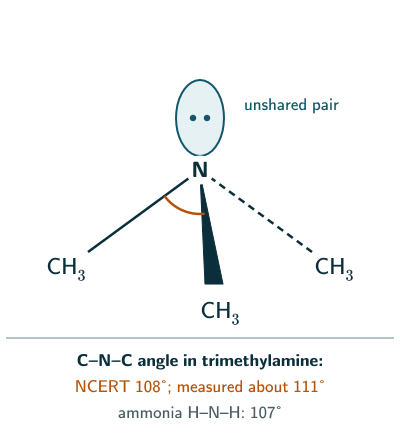
- NCERT slip (page 260): NCERT Figure 9.1 labels trimethylamine’s C–N–C angle 108°, below 109.5°. NIST’s experimental geometry instead gives 110.9°, slightly greater than the ideal tetrahedral angle. Bond angles reflect the whole molecule, including substituents and electronic structure; a lone-pair repulsion rule alone is insufficient (reasoned). In an NCERT-based exam, give 108° and the lone-pair reason, as NCERT does; for the measured angle use 110.9°.
Solved examples
Example 1: Counting electron pairs on nitrogen
How many σ bonds and lone pairs does the nitrogen of CH3NH2 have, and what is its hybridisation?
Answer: Nitrogen forms three σ bonds, one to carbon and two to hydrogen, and keeps one unshared pair: four electron pairs, so it is sp3 hybridised and the arrangement of the atoms around it is pyramidal (reasoned from NCERT page 259).
Example 2: How far from tetrahedral?
By how many degrees does each angle differ from 109.5°: ammonia’s H–N–H (NCERT, 107°), trimethylamine’s C–N–C as NCERT gives it (108°), and as measured (110.9°)?
Answer: 109.5 − 107 = 2.5° smaller; 109.5 − 108 = 1.5° smaller; 110.9 − 109.5 = 1.4° larger (reasoned from NCERT page 260, NCERT Class 11 Chemistry, Unit 4, page 122, and the NIST data).
Common mistakes to avoid
Common mistake
Drawing amines flat
Simple alkylamines have pyramidal nitrogen. Conjugation, as in aniline, can flatten the nitrogen; the localised sp description is a model, not a universal geometry rule.
Common mistake
Forgetting the fourth orbital
The fourth sp3 orbital of nitrogen holds the unshared pair in the localised alkylamine model, whether primary, secondary or tertiary.
Quick revision summary
- Amines: ammonia with one, two or three H replaced by alkyl or aryl groups.
- In simple alkylamines, nitrogen is trivalent and sp3 hybridised; three orbitals form bonds, the fourth holds the unshared pair.
- Shape: pyramidal; NCERT gives C–N–C 108° for trimethylamine (measured about 111°); ammonia H–N–H 107°.
Formula sheet
- Simple alkylamine N: sp model, 3 σ bonds + 1 lone pair, pyramidal
- NH: H–N–H about 107°
- (CH)N: C–N–C 108° in NCERT; measured 110.9°
Questions students ask
Is the nitrogen in aniline sp2 or sp3 hybridised?
Aniline’s nitrogen lone pair is conjugated with the benzene ring (NCERT page 269), so a localised tetrahedral sp picture is incomplete. Conjugation favours a flatter arrangement and p-orbital overlap. Hybridisation labels are approximate descriptions of bonding: use the pyramidal alkylamine model for simple alkylamines and explain lone-pair delocalisation when discussing aniline.
Are amines with three different groups on nitrogen optically active?
A pyramidal nitrogen bearing three different groups can be stereogenic, but ordinary flexible amines usually invert rapidly, interconverting the nitrogen configurations. They therefore cannot normally be resolved solely on that nitrogen centre. Restricted inversion, as in rigid bridged amines, can allow configurational stability. An amine can also be optically active because of a stable chiral carbon: rapid nitrogen inversion does not remove that carbon’s chirality.
What is the difference between an amine and an amide?
An amine nitrogen is bonded to alkyl or aryl groups and possibly hydrogen; in an amide it is directly bonded to a carbonyl carbon. Amide resonance delocalises the nitrogen lone pair into the carbonyl system, makes the C–N bond partly double and usually favours a planar arrangement. Consequently the amide nitrogen is much less basic than an alkylamine nitrogen. In strong acid, ordinary amides protonate preferentially at oxygen; a single protonated-amide pKa is not a universal nitrogen-basicity value.
Where does this lesson fit in the amines chapter?
Amines is Unit 9 of NCERT Class 12 Chemistry Part II, with structure in Section 9.1. Study classification, naming, basicity, preparation, reactions and identification alongside this lesson. Use the official syllabus for the examination year you are taking to confirm the assessed scope; NCERT coverage alone does not guarantee a particular examination question.
Practice questions
Try each question first, then open the answer to check your working.
-
Q1. Why is the nitrogen of a simple alkylamine pyramidal?
Show answerHide answer
The nitrogen is sp3 hybridised: three of its four sp3 orbitals form bonds and the fourth holds the unshared pair, so the three bonded atoms sit at three corners of a tetrahedron around nitrogen (NCERT page 259).
-
Q2. Which amine contains a tertiary amino group, according to NCERT’s examples of useful amines: adrenaline, ephedrine or Benadryl?
Show answerHide answer
Benadryl, the antihistamine, contains a tertiary amino group; adrenaline and ephedrine contain secondary amino groups (NCERT page 259). Beyond the NCERT text, Benadryl’s drug is diphenhydramine (MedlinePlus).