Chemical reactions of diazonium salts
NCERT Class 12 Chemistry Chapter 9 Section 9.9
Quick answer
In most reactions of diazonium salts nitrogen leaves as a gas and is replaced: Cu(I) salts give aryl chlorides, bromides and cyanides (Sandmeyer reaction), copper powder with the halogen acid gives chlorides and bromides (Gattermann reaction), KI gives iodides, HBF and heat give fluorides, HPO or ethanol gives the arene, warm water gives phenol, and the fluoroborate with NaNO and Cu gives nitro compounds. In coupling reactions the –N=N– group is kept: with phenol and aniline the salt gives orange and yellow azo dyes.
With your textbook
NCERT Chemistry Part II (Class 12), Chapter 9 “Amines”, Section 9.9 “Chemical Reactions”, pages 275–276.
Open the official NCERT chapter (PDF, 2.9 MB, ncert.nic.in) (opens in a new tab)
Checked against the 2026-27 reprint on .
What reactions do diazonium salts undergo?
Reactions of diazonium salts
Diazonium salts react in two ways: the –N2+ group is replaced by –Cl, –Br, –CN, –I, –F, –H, –OH or –NO2 while nitrogen gas escapes, or it is kept, as when the salt couples with phenol or aniline to give coloured azo compounds (NCERT Section 9.9, pages 275–276). Of the second kind NCERT says:
The azo products obtained have an extended conjugate system having both the aromatic rings joined through the –N=N– bond. These compounds are often coloured and are used as dyes.
NCERT Chemistry Part II (Class 12), Section 9.9, page 276
In plain words: N2 is one of the best leaving groups there is, because it leaves as a stable gas. Suitable reagent systems can therefore replace it with several useful groups on the ring. Alternatively, the diazonium ion can act as an electrophile and attach itself, nitrogen and all, to an activated ring.
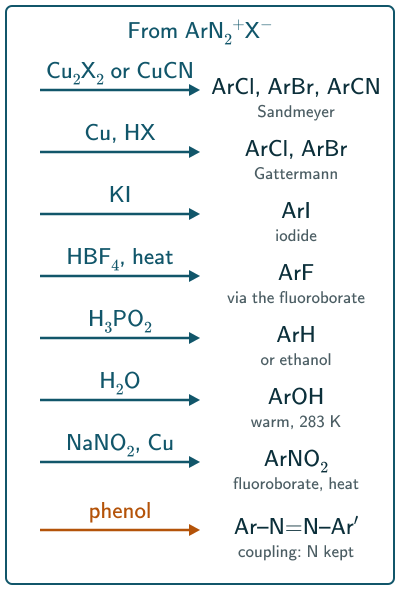
Displacement of nitrogen
- The diazonium group, “being a very good leaving group”, is substituted by Cl−, Br−, I−, CN− and OH−, each with its own reagent system, and the nitrogen escapes as a gas (NCERT page 275).
- Iodide: iodine is not easily put on a benzene ring directly, but the diazonium salt with potassium iodide gives iodobenzene: ArN2+Cl− + KI → ArI + KCl + N2 (NCERT page 275).
- Fluoride: fluoroboric acid precipitates the arenediazonium fluoroborate, which on heating gives the aryl fluoride: ArN2+Cl− + HBF4 → ArN2+BF4− + HCl, then ArN2+BF4− → Ar–F + BF3 + N2 (NCERT page 275). NCERT’s schemes leave the HCl out of the first step, here and in the nitro scheme on page 276; put it in when a balanced equation is asked for (reasoned).
- Hydrogen: mild reducing agents, hypophosphorous acid (phosphinic acid) or ethanol, reduce the salt to the arene and are themselves oxidised to phosphorous acid and ethanal (NCERT page 275).
- Hydroxyl: if the temperature of the solution is allowed to rise to 283 K, the salt is hydrolysed to phenol (NCERT page 276); 283 K is not a sharp threshold (reasoned).
- Nitro: the diazonium fluoroborate heated with aqueous sodium nitrite in the presence of copper gives the nitro compound: ArN2+BF4− + NaNO2 → ArNO2 + N2 + NaBF4 (NCERT page 276).
Replacement by H and by OH
ArN2+Cl− + H3PO2 + H2O → ArH + N2 + H3PO3 + HCl
ArN2+Cl− + CH3CH2OH → ArH + N2 + CH3CHO + HCl
ArN2+Cl− + H2O → ArOH + N2 + HCl
Sandmeyer and Gattermann reactions
- Sandmeyer reaction: Cl−, Br− and CN− are introduced easily in the presence of copper(I): with Cu2Cl2/HCl, Cu2Br2/HBr or CuCN/KCN the salt gives ArCl, ArBr or ArCN, with N2 (NCERT page 275), the same reaction as in the preparation of haloarenes.
- Gattermann reaction: chlorine or bromine can also be introduced with the corresponding halogen acid and copper powder (NCERT page 275).
- “The yield in Sandmeyer reaction is found to be better than Gattermann reaction” (NCERT page 275); actual yields depend on the substrate and conditions (reasoned).
- Spelling note: NCERT prints both “Gatterman reaction” and “Gattermann reaction” on page 275; it is the same reaction, and either spelling may appear in a question.
Coupling reactions
- In coupling reactions the diazo group is retained: the products have both aromatic rings joined through –N=N–, an extended conjugated system, so they are often coloured and are used as dyes (NCERT page 276).
- Benzenediazonium chloride couples with phenol at phenol’s para position to give p-hydroxyazobenzene, an orange dye (in alkali), and with aniline in weakly acidic conditions to give p-aminoazobenzene, a yellow dye (in acid). Coupling is an electrophilic substitution (NCERT page 276), the diazonium ion attacking the ring activated by –OH or –NH2 (reasoned; see directive influence).
Coupling with phenol and with aniline
C6H5N2+Cl− + C6H5OH + OH− → C6H5N=NC6H4OH + Cl− + H2O
C6H5N2+Cl− + C6H5NH2 → C6H5N=NC6H4NH2 + HCl
- NCERT draws both on page 276, with OH− over the phenol arrow and H+ over the aniline arrow; written as above, each balances. Leaving out the Cl−, which takes no part, the first is ArN2+ + C6H5OH + OH− → ArN=NC6H4OH + H2O for any arenediazonium ion (reasoned).
- NCERT slip (page 276): NCERT’s scheme for coupling with aniline, with H+ over the arrow, shows Cl− and H2O as the other products. No oxygen enters this reaction, so no water can form: the products are p-aminoazobenzene and HCl, as in the second equation above. Water is right only in NCERT’s phenol scheme just above it, where OH− is a reactant. In an exam, write HCl (reasoned).
Solved examples
Example 1: Four products from one salt
What does benzenediazonium chloride give with (i) CuCN/KCN, (ii) KI, (iii) H3PO2, (iv) water at 283 K?
Answer: (i) Benzonitrile, C6H5CN (Sandmeyer). (ii) Iodobenzene, C6H5I. (iii) Benzene, C6H6. (iv) Phenol, C6H5OH. Each time nitrogen gas escapes (NCERT pages 275–276).
Example 2: Mass of an azo dye
At most, what mass of p-hydroxyazobenzene can 0.020 mol of benzenediazonium chloride give with excess phenol in alkali? (C = 12, H = 1, N = 14, O = 16.)
Answer: By the first coupling equation, one mole of salt gives one mole of C6H5N=NC6H4OH, C12H10N2O. M = 144 + 10 + 28 + 16 = 198 g mol−1: 0.020 × 198 = 3.96 g (reasoned from NCERT page 276).
Common mistakes to avoid
Common mistake
Thinking nitrogen always leaves
In coupling reactions the –N=N– unit stays, joining two rings; the extended conjugated system often absorbs visible light, giving colour.
Common mistake
Expecting H<sub>3</sub>PO<sub>2</sub> to give back the amine
Hypophosphorous acid and ethanol replace –N2+ by H, so benzenediazonium chloride gives benzene, not aniline, and the nitrogen leaves as N2 (NCERT pages 275–276). This is how an amino group is removed from a ring (reasoned).
Quick revision summary
- Displacement of N2: Cu(I) salts give ArCl, ArBr, ArCN (Sandmeyer); Cu and HX give ArCl, ArBr (Gattermann; lower yield); KI gives ArI; HBF4, then heat, ArF; H3PO2 or ethanol ArH; water at 283 K ArOH; NaNO2 and Cu, from the fluoroborate, ArNO2.
- Retention: in coupling the –N=N– group is kept; phenol gives p-hydroxyazobenzene (orange), aniline p-aminoazobenzene (yellow); electrophilic substitution.
Formula sheet
- ArN + I → ArI + N (with KI)
- ArNBF (heat) → ArF + BF + N
- ArNCl + CHOH → ArH + CHCHO + N + HCl
- ArNCl + HO (warm) → ArOH + N + HCl
- ArN + CHOH + OH → ArN=NCHOH + HO
Questions students ask
What is the Balz–Schiemann reaction, and is it in NCERT?
The Balz–Schiemann reaction converts an arenediazonium tetrafluoroborate into an aryl fluoride with loss of N and BF. NCERT gives this transformation without the name (page 275). Isolated diazonium salts can decompose violently; descriptions of heating are reaction schemes, not instructions for an unassessed laboratory operation.
Why does benzenediazonium chloride couple with phenol but not with benzene?
Benzenediazonium chloride couples only with strongly activated rings because the diazonium ion is a weak electrophile, its charge spread by resonance (reasoned from NCERT page 274): the –OH of phenol and the –NH2 of aniline make the ortho and para carbons electron rich (NCERT Unit 7, page 211, and Unit 9, page 272), and benzene has no such group. Beyond the NCERT text, the usual coupling partners are phenols, naphthols and aromatic amines (Wikipedia, “Azo coupling” and “Diazonium compound”). With benzene and sodium hydroxide, a different reaction, the Gomberg–Bachmann reaction, joins the two rings directly as N2 is lost, giving biphenyl (Wikipedia).
Why is coupling with phenol carried out in alkaline solution?
Coupling with phenol is carried out in alkaline solution because alkali turns phenol into the phenoxide ion, which NCERT calls even more reactive than phenol towards electrophilic aromatic substitution (Unit 7, page 212); beyond the NCERT text, phenol couples with benzenediazonium chloride faster in alkali (Wikipedia, “Azo coupling”). NCERT’s p-hydroxyazobenzene shows the usual site, the para carbon (page 276); a phenol whose para carbon is already substituted couples beside the –OH, more slowly (Wikipedia). Excessively strong alkali can divert diazonium species into other forms, so pH is controlled. Aromatic amines, by contrast, are coupled in weakly acidic solution, as for aniline yellow.
Why does potassium iodide replace the diazonium group without a copper catalyst?
Potassium iodide needs no copper catalyst because the iodide ion can itself give an electron to the diazonium ion, the job copper(I) does for Cl−, Br− and CN− in the Sandmeyer reaction (the copper’s role); beyond the NCERT text, this electron transfer gives an aryl radical and an iodine atom (Wikipedia, “Diazonium compound”), which combine (reasoned). Iodide is by far the easiest halide ion to oxidise: in NCERT Table 2.1 (Unit 2, page 37), E⊖ is 0.54 V for I2/I−, 1.09 V for Br2/Br− and 1.36 V for Cl2/Cl−.
How does coupling connect theory and practical chemistry?
NCERT Section 9.9 covers azo coupling, and the laboratory manual applies it to aromatic primary-amine identification and azo-dye preparation. Learn the coupling partners, pH conditions and retained –N=N– group. Confirm examination coverage from the official syllabus for the year concerned rather than inferring a guaranteed question from this lesson.
Practice questions
Try each question first, then open the answer to check your working.
-
Q1. Why are azo compounds coloured?
Show answerHide answer
Both aromatic rings are joined through the –N=N– bond, which gives an extended conjugated system; such compounds are often coloured and are used as dyes (NCERT page 276).
-
Q2. How do the Sandmeyer and Gattermann reactions differ?
Show answerHide answer
The Sandmeyer reaction uses copper(I) salts (Cu2Cl2/HCl, Cu2Br2/HBr, CuCN/KCN); the Gattermann reaction uses copper powder with the halogen acid. NCERT finds the yield in the Sandmeyer reaction better than in the Gattermann reaction (NCERT page 275).