Chemical reactions of amines
NCERT Class 12 Chemistry Chapter 9 Section 9.6
Quick answer
Amines act as bases and nucleophiles; aqueous basicity depends on substituent effects and solvation. Primary and secondary amines form amides on acylation, while carbylamine, nitrous-acid and Hinsberg reactions help distinguish the classes. Aniline activates its ring towards electrophilic substitution, and acetyl protection helps control that reactivity.
With your textbook
NCERT Chemistry Part II (Class 12), Chapter 9 “Amines”, Section 9.6 “Chemical Reactions”, pages 266–274.
Open the official NCERT chapter (PDF, 2.9 MB, ncert.nic.in) (opens in a new tab)
Checked against the 2026-27 reprint on .
What reactions do amines undergo?
Reactions of amines
The unshared electron pair on nitrogen makes amines bases and nucleophiles, and the number of hydrogens on nitrogen decides how each class reacts: amines form salts with acids and are alkylated; primary and secondary amines form amides on acylation, and react with chloroform (carbylamine test), nitrous acid and benzenesulphonyl chloride (Hinsberg’s test) in ways that tell primary, secondary and tertiary amines apart; aniline’s ring is strongly activated towards electrophilic substitution (NCERT Section 9.6, pages 266–273). On basic strength NCERT says:
Aliphatic amines are stronger bases than ammonia due to +I effect of alkyl groups leading to high electron density on the nitrogen atom.
NCERT Chemistry Part II (Class 12), Section 9.6, page 267
In plain words: everything starts with nitrogen’s lone pair. It takes a proton (basicity), attacks carbon (alkylation, acylation) and pushes electrons into an attached benzene ring (activation). How many hydrogens the nitrogen still carries decides which further reactions are possible.
Basic character of amines
- Amines are basic: with acids they form salts, and a base such as NaOH sets the amine free again. Amine salts dissolve in water but not in organic solvents such as ether; this difference is the basis for separating amines from non-basic organic compounds that are insoluble in water (NCERT pages 266–267). Strictly, salt solubility depends on the cation, anion and conditions (reasoned).
- The unshared pair on nitrogen makes amines Lewis bases (NCERT page 267).
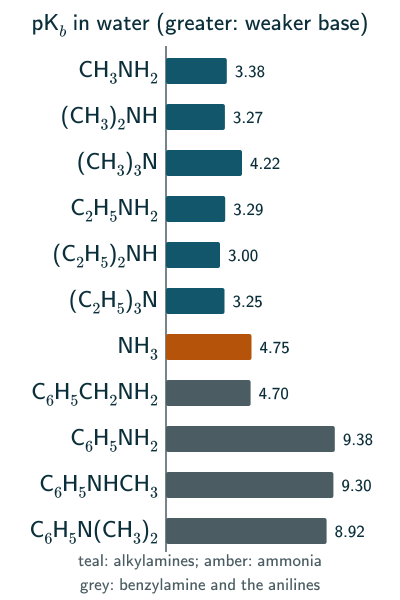
- Basic strength is measured by Kb or pKb = −log Kb: the larger Kb, or the smaller pKb, the stronger the base. Compare values in the same solvent and at the same temperature. The concentration form below approximates the activity-based equilibrium constant in dilute solution. Ammonia’s pKb is 4.75 (NCERT page 267).
Amines as bases
RNH2 + H2O ⇌ RNH3+ + OH−, Kb = [RNH3+][OH−]/[RNH2]
RNH2 + HCl → RNH3+Cl−
Basic strength of alkanamines and arylamines
- Aliphatic amines are stronger bases than ammonia, as NCERT puts it, and the simple methyl- and ethylamines compared here show it: alkyl groups push electrons towards nitrogen by the +I effect, making the lone pair more available and spreading the positive charge of the cation. Their pKb values lie between 3 and 4.22 (NCERT pages 267–268).
- Note on NCERT’s range (page 267): 3 to 4.22 covers the six alkanamines of Table 9.3. Phenylmethanamine (benzylamine), C6H5CH2NH2, is aliphatic too, because its –NH2 is on a CH2 group, not on the ring, but NCERT lists it at 4.70. Its lone pair is not in conjugation with the ring, so it is a far stronger base than aniline (9.38) and slightly stronger than ammonia (4.75) (reasoned from NCERT page 269). NCERT’s answers to Intext Question 9.4 place it above NH3 and below (CH3)3N (page 280); do the same in an exam.
- NCERT’s two books differ on triethylamine: Table 9.3 gives N,N-diethylethanamine, (C2H5)3N, a pKb of 3.25 (Kb = 5.6 × 10⁻⁴), but NCERT Class 11 Chemistry, Unit 6, Table 6.7 (page 197) gives its Kb as 6.45 × 10⁻⁵, a pKb of 4.19. That value would make triethylamine a weaker base than ethanamine (pKb 3.29), against NCERT’s order in water below, so rank amines with Table 9.3 (reasoned). In a problem, use the value the question gives.
- For the corresponding methyl or ethyl series in the gas phase, basicity follows the order, tertiary > secondary > primary > NH3 (NCERT page 268).
- In water, the cations are also stabilised by hydrogen bonding with water: the more N–H the cation has, the better it is solvated, which by itself would give primary > secondary > tertiary. Larger alkyl groups also hinder this hydrogen bonding. The interplay of the inductive effect, solvation and steric hindrance gives (NCERT pages 268–269):
- (C2H5)2NH > (C2H5)3N > C2H5NH2 > NH3
- (CH3)2NH > CH3NH2 > (CH3)3N > NH3
- Arylamines are weaker bases than ammonia: in aniline the lone pair is in conjugation with the ring, so it is less available for protonation, and aniline has five resonance structures against two for the anilinium ion, so aniline is stabilised more than its cation (NCERT page 269). Electron-releasing groups such as –OCH3 and –CH3 on the ring increase basic strength; –NO2, –SO3H, –COOH and –X decrease it (NCERT page 269). Give both of NCERT’s reasons in an exam. Strictly, counting resonance drawings does not measure energies: the point is that protonation removes the lone pair from conjugation, so the free base loses that stabilisation; and substituent effects also depend on position and conditions (reasoned).
Alkylation, acylation and benzoylation
- Alkylation: amines react with alkyl halides by nucleophilic substitution, the reaction that also prepares amines by ammonolysis (NCERT page 270, referring to Unit 6).
- Acylation: primary and secondary amines, aliphatic and aromatic, react with acid chlorides, anhydrides and esters by nucleophilic substitution: the acyl group replaces a hydrogen of –NH2 or >N–H, giving an amide. NCERT carries out the reaction “in the presence of a base stronger than the amine, like pyridine, which removes HCl so formed and shifts the equilibrium to the right hand side” (NCERT page 270); give that reason in an exam. Anhydrides instead release a carboxylic acid (reasoned). Examples: ethanamine with ethanoyl chloride gives N-ethylethanamide; aniline with ethanoic anhydride gives acetanilide (NCERT page 270).
- NCERT slip (page 270): pyridine is a stronger base than aniline but not than the alkylamines. Beyond the NCERT text, the pKa of pyridine’s cation is 5.23 (HSDB via PubChem), so its pKb is about 8.8, against aniline’s 9.38 (NCERT Table 9.3) and the alkylamines’ 3 to 4.22 (NCERT page 267). Its job is to take up the HCl from an acid chloride and limit protonation of the reacting amine (reasoned). In an exam, give NCERT’s reason.
- Benzoylation is acylation with benzoyl chloride: CH3NH2 + C6H5COCl → CH3NHCOC6H5 + HCl, N-methylbenzamide (NCERT page 270).
- With carboxylic acids, amines form salts at room temperature (NCERT page 270).
Carbylamine reaction
The product is hazardous; this identification reaction is studied or demonstrated under an approved fume-hood procedure, never by deliberately smelling the vapour.
- Primary amines, aliphatic and aromatic, heated with chloroform and ethanolic KOH form foul-smelling isocyanides (carbylamines); secondary and tertiary amines do not, so this isocyanide test is a test for primary amines (NCERT page 271).
Carbylamine reaction
R–NH2 + CHCl3 + 3KOH → R–NC + 3KCl + 3H2O (heat)
Reaction with nitrous acid
- Nitrous acid is made in the mixture from a mineral acid and sodium nitrite (NCERT page 271).
- Primary aliphatic amines form unstable aliphatic diazonium salts, which “liberate nitrogen gas quantitatively and alcohols”; the quantitative evolution of nitrogen is used in the estimation of amino acids and proteins (NCERT page 271). Strictly, rearranged alcohols and alkenes may also form, so this is not a clean alcohol preparation, and the nitrogen measures reactive amino nitrogen, not every nitrogen atom in a protein (reasoned).
- Aromatic primary amines react at 273–278 K to give diazonium salts: C6H5NH2 + NaNO2 + 2HCl → C6H5N2+Cl− + NaCl + 2H2O, benzenediazonium chloride (NCERT page 271).
- Secondary and tertiary amines react with nitrous acid in a different manner (NCERT page 271).
Hinsberg’s reagent: benzenesulphonyl chloride
- Benzenesulphonyl chloride, C6H5SO2Cl, Hinsberg’s reagent, forms sulphonamides with primary and secondary amines (NCERT page 271).
- Primary amine: ethanamine gives N-ethylbenzenesulphonamide. Its N–H hydrogen is strongly acidic because of the electron-withdrawing sulphonyl group, so it dissolves in alkali (NCERT page 271).
- Secondary amine: N-ethylethanamine gives N,N-diethylbenzenesulphonamide, which has no N–H, so it is not acidic and is insoluble in alkali (NCERT pages 271–272).
- Tertiary amines do not react. The different behaviour is used to tell primary, secondary and tertiary amines apart and to separate mixtures; these days benzenesulphonyl chloride is replaced by p-toluenesulphonyl chloride (NCERT page 272).
- A naming note (page 271): NCERT’s text calls the primary amine’s product “N-ethylbenzenesulphonyl amide”, while the structure below it is labelled N-ethylbenzenesulphonamide, the usual name; use the second.
| Amine | With C6H5SO2Cl | Product in alkali |
|---|---|---|
| primary | sulphonamide with N–H | dissolves |
| secondary | sulphonamide without N–H | does not dissolve |
| tertiary | no reaction | no product |
Bromination, nitration and sulphonation of aniline
- In aniline’s resonance structures the ortho and para positions carry high electron density, so –NH2 is an ortho, para directing and powerful activating group (NCERT page 272; see directive influence).
- Bromination: with bromine water at room temperature aniline gives a white precipitate of 2,4,6-tribromoaniline (NCERT page 272).
- Controlling the reactivity: to get one substituent, protect –NH2 by acetylation with acetic anhydride, substitute, then hydrolyse the amide. In acetanilide the nitrogen’s lone pair also interacts with the C=O oxygen by resonance, so –NHCOCH3 activates less than –NH2: acetanilide with Br2 in CH3COOH gives mainly the para product, and hydrolysis gives 4-bromoaniline (NCERT pages 272–273).
- Nitration: direct nitration gives tarry oxidation products, and in strong acid aniline becomes the anilinium ion, which is meta directing: NCERT’s illustrated figures at 288 K are 51% para, 47% meta and 2% ortho; the ratio is condition-specific. Protecting –NH2 by acetylation makes p-nitroacetanilide the major product, and hydrolysis gives p-nitroaniline (NCERT page 273).
- Sulphonation: aniline and concentrated H2SO4 give anilinium hydrogensulphate, which heated at 453–473 K gives p-aminobenzenesulphonic acid, sulphanilic acid, mainly; NCERT draws it in equilibrium with its zwitter ion, H3N+–C6H4–SO3− (NCERT page 273).
Bromination of aniline
C6H5NH2 + 3Br2 → C6H2Br3NH2 + 3HBr (bromine water, room temperature)
Why aniline does not undergo Friedel–Crafts reactions
- Aniline does not undergo Friedel–Crafts alkylation or acylation: it forms a salt with aluminium chloride, the Lewis acid catalyst, so its nitrogen carries a positive charge and acts as a strong deactivating group (NCERT page 273, which writes “alkylation and acetylation”). The complex also ties up the catalyst (reasoned).
Solved examples
Example 1: Ranking by pKb
Arrange C2H5NH2, (C2H5)2NH, (C2H5)3N and C6H5NH2 in increasing order of basic strength. (NCERT Intext Question 9.4 (ii), page 274.)
Answer: From NCERT Table 9.3, pKb: C6H5NH2 9.38, C2H5NH2 3.29, (C2H5)3N 3.25, (C2H5)2NH 3.00. The smaller the pKb, the stronger the base, so C6H5NH2 < C2H5NH2 < (C2H5)3N < (C2H5)2NH (NCERT pages 267–269).
Example 2: How much weaker is aniline?
Using NCERT’s pKb values, find Kb for methanamine (3.38) and aniline (9.38), and compare them.
Answer: Kb is 10 raised to the power −pKb: methanamine 10−3.38 = 4.2 × 10⁻⁴; aniline 10−9.38 = 4.2 × 10⁻¹⁰. The pKb values differ by 6, so methanamine is 106, a million, times stronger as a base (reasoned from NCERT Table 9.3, page 267).
Example 3: Telling the three classes apart
How would Hinsberg’s reagent and nitrous acid distinguish propan-1-amine, N-methylethanamine and N,N-dimethylmethanamine?
Answer: With C6H5SO2Cl, propan-1-amine (1°) gives a sulphonamide that dissolves in alkali, N-methylethanamine (2°) one that does not, and N,N-dimethylmethanamine (3°) does not react. With nitrous acid only the primary aliphatic amine gives off nitrogen gas, forming an alcohol as NCERT writes it (pages 271–272); rearrangement and elimination products can also form (reasoned).
Example 4: Mass of tribromoaniline
What mass of 2,4,6-tribromoaniline can 0.93 g of aniline give with excess bromine water, and how much bromine reacts? (C = 12, H = 1, N = 14, Br = 80.)
Answer: M(C6H7N) = 72 + 7 + 14 = 93 g mol−1, so 0.93 g is 0.010 mol. M(C6H4Br3N) = 72 + 4 + 240 + 14 = 330 g mol−1, so the product is 0.010 × 330 = 3.3 g. Bromine used: 3 × 0.010 = 0.030 mol, 0.030 × 160 = 4.8 g (reasoned from NCERT page 272).
Common mistakes to avoid
Common mistake
Expecting tertiary amines to be the strongest bases in water
The gas-phase order 3° > 2° > 1° describes the corresponding simple methyl or ethyl series, not every possible amine. In water solvation and steric hindrance change it: (C2H5)2NH > (C2H5)3N > C2H5NH2, and (CH3)2NH > CH3NH2 > (CH3)3N.
Common mistake
Expecting nitration of aniline to give only *ortho* and *para* products
In the strongly acidic mixture much of the aniline is protonated to the meta-directing anilinium ion, so NCERT reports 47% meta product. Protect –NH2 by acetylation first.
Common mistake
Expecting bromine water to give one bromoaniline
–NH2 activates the ring so strongly that bromine water at room temperature substitutes both ortho positions and the para position, giving 2,4,6-tribromoaniline. For 4-bromoaniline, acetylate first, brominate in CH3COOH, then hydrolyse (NCERT pages 272–273).
Quick revision summary
- Amines are bases (lone pair on N): salts with acids; pKb = −log Kb, smaller pKb stronger base; ammonia 4.75.
- Aliphatic amines are stronger bases than NH3 (+I); in water (C2H5)2NH > (C2H5)3N > C2H5NH2 > NH3; aniline is weaker than NH3 (lone pair in conjugation; five resonance structures against two).
- Primary/secondary amine acylation gives amides, in the presence of a base stronger than the amine, like pyridine, which removes the HCl (NCERT; strictly, pyridine outranks only the arylamines); benzoylation with C6H5COCl.
- Carbylamine test: 1° amines only, foul-smelling isocyanide. Nitrous acid: 1° aliphatic gives N2 quantitatively and alcohols (NCERT; used to estimate amino acids; rearranged products possible); 1° aromatic gives diazonium salt at 273–278 K.
- Hinsberg: 1° sulphonamide dissolves in alkali, 2° does not, 3° no reaction.
- Aniline: o,p directing and activating; bromine water gives 2,4,6-tribromoaniline; protect by acetylation for monosubstitution and para-nitration; sulphanilic acid at 453–473 K; no Friedel–Crafts.
Formula sheet
- pKb = −log Kb
- CHNH + CHCl + 3KOH → CHNC + 3KCl + 3HO (heat)
- ArNH + NaNO + 2HCl → ArNCl + NaCl + 2HO (273–278 K)
- CHNH + 3Br → 3HBr + CHBrNH (2,4,6-tribromoaniline)
- Ethylamines in water: 2° > 3° > 1° > NH
Questions students ask
What is the mechanism of the carbylamine reaction, and why do only primary amines give it?
In the carbylamine reaction, beyond the NCERT text, the base first removes HCl from chloroform to give dichlorocarbene, :CCl2, a short-lived intermediate whose carbon is attacked by the amine’s lone pair, and two further losses of HCl, each driven by the base, then give the isocyanide, R–NC (Wikipedia, “Carbylamine reaction”). Along the way the nitrogen gives up both of its hydrogens, so only a primary amine, R–NH2, can end up as an isocyanide; a secondary amine has only one N–H and a tertiary amine none (reasoned). That is why NCERT uses the reaction as a test for primary amines, aliphatic and aromatic alike (page 271).
How does Hinsberg’s reagent separate a mixture of primary, secondary and tertiary amines?
Under the standard test conditions, a primary amine gives an N–H sulphonamide that dissolves in alkali as its anion; acidification can precipitate the neutral sulphonamide. A secondary amine gives a sulphonamide without N–H that does not acquire this alkali solubility. A tertiary amine remains unconverted and can form an acid-soluble ammonium salt. These are chemical distinctions; actual visible layers or precipitates depend on solubility and concentration, so use controls and do not classify from appearance alone.
What is the pKa of an amine, and how is it related to its pKb?
The pKa quoted for an amine is that of its conjugate acid, the substituted ammonium ion, and in water at 298 K pKa + pKb = 14, since Ka × Kb = Kw = 10 for a conjugate pair. From NCERT’s Table 9.3 (page 267), the cation of N,N-diethylethanamine has pKa 14 − 3.25 = 10.75 and the anilinium ion 14 − 9.38 = 4.62 (reasoned); beyond the NCERT text, PubChem gives 10.78 at 25 °C for triethylamine (Hazardous Substances Data Bank). The higher the pKa of its cation, the stronger the amine as a base.
How is the basicity of amines in the gas phase measured?
Two related thermodynamic quantities must be distinguished. Proton affinity is the negative enthalpy change for B + H → BH; gas-phase basicity is the negative Gibbs energy change for that reaction at a specified temperature (NIST Chemistry WebBook). The methylamine series follows the familiar increasing gas-phase trend as methyl groups are added. These solvent-free comparisons do not predict the aqueous order by themselves, because hydration of both the base and its conjugate acid also matters.
Practice questions
Try each question first, then open the answer to check your working.
-
Q1. Aniline’s pKb is 9.38 and ammonia’s 4.75. Give NCERT’s two reasons why aniline is the weaker base.
Show answerHide answer
In aniline the nitrogen’s lone pair is in conjugation with the benzene ring, so it is less available for a proton; aniline also has five resonance structures and the anilinium ion only two, so protonation costs stabilisation (NCERT page 269). Strictly, the count of drawings is not a measure of energy: protonation removes the lone pair from ring conjugation, so the free base loses that stabilisation (reasoned).
-
Q2. Write the reaction of aniline with benzoyl chloride and name the product. (NCERT Intext Question 9.7, page 274.)
Show answerHide answer
C6H5NH2 + C6H5COCl → C6H5NHCOC6H5 + HCl. The product is N-phenylbenzamide (benzanilide): benzoylation replaces one hydrogen of –NH2 by the benzoyl group, and a base such as pyridine removes the HCl (reasoned from NCERT page 270).