Preparation of amines
NCERT Class 12 Chemistry Chapter 9 Section 9.4
Quick answer
Amines can be prepared by reduction of nitro compounds, nitriles or amides, and by ammonolysis or Gabriel synthesis with suitable halides. Excess ammonia favours the primary amine but does not guarantee a pure product. Nitrile formation from an alkyl halide adds one carbon, whereas Hofmann degradation of a primary amide removes its carbonyl carbon.
With your textbook
NCERT Chemistry Part II (Class 12), Chapter 9 “Amines”, Section 9.4 “Preparation of Amines”, pages 262–265.
Open the official NCERT chapter (PDF, 2.9 MB, ncert.nic.in) (opens in a new tab)
Checked against the 2026-27 reprint on .
How are amines prepared?
Preparing amines
Amines are made by reducing nitro compounds, nitriles or amides, by ammonolysis of alkyl halides, by Gabriel phthalimide synthesis (primary amines only) and by Hofmann bromamide degradation of primary amides (NCERT Section 9.4, pages 262–264). Of the last, NCERT says:
In this degradation reaction, migration of an alkyl or aryl group takes place from carbonyl carbon of the amide to the nitrogen atom. The amine so formed contains one carbon less than that present in the amide.
NCERT Chemistry Part II (Class 12), Section 9.4, page 264
In plain words: there are three kinds of route. Reductions turn –NO2, –C≡N or –CONH2 into an amine and keep every carbon; substitutions put nitrogen where a halogen was; Hofmann degradation cuts out the carbonyl carbon. So the carbon count changes in only two cases: Hofmann degradation removes one carbon, and the nitrile route adds one when it starts from an alkyl halide, because cyanide brings that carbon in (NCERT Example 9.2, page 264).
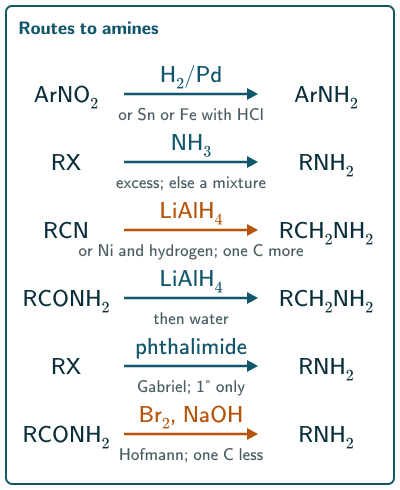
Reduction of nitro compounds
- Nitro compounds are reduced to amines by hydrogen gas over finely divided nickel, palladium or platinum, or by metals in acid; nitroalkanes are reduced in the same way to alkanamines (NCERT page 262).
- Nitrobenzene gives aniline with H2/Pd in ethanol, or with Sn + HCl or Fe + HCl (NCERT page 262); in strongly acidic solution the product is an anilinium salt, and base work-up releases free aniline.
- Iron scrap and hydrochloric acid is preferred, because the FeCl2 formed is hydrolysed and releases hydrochloric acid during the reaction, so only a little acid is needed to start it (NCERT page 262).
Nitrobenzene to aniline
C6H5NO2 + 3H2 → C6H5NH2 + 2H2O (Pd, ethanol)
Ammonolysis of alkyl halides
The heated sealed-tube description is a theoretical reaction condition. Practical work requires approved pressure-rated apparatus and supervision; an ordinary closed test tube is not suitable.
- An alkyl or benzyl halide heated with ethanolic ammonia under NCERT’s sealed-tube conditions at 373 K undergoes nucleophilic substitution: –NH2 replaces the halogen. This cleavage of the C–X bond by ammonia is ammonolysis (NCERT page 262).
- The primary amine is itself a nucleophile, so it reacts further with the alkyl halide: RNH2 → R2NH → R3N → R4N+X−, the quaternary ammonium salt (NCERT pages 262–263).
- The amine is set free from its ammonium salt by a strong base: R–NH3+X− + NaOH → R–NH2 + H2O + NaX (NCERT page 263).
- The disadvantage is a mixture of primary, secondary and tertiary amines and the quaternary salt; a large excess of ammonia makes the primary amine the major product. The reactivity of halides with amines is RI > RBr > RCl (NCERT page 263).
- NCERT slip (page 263): in Example 9.1 (i), the last step adds C2H5Cl to N,N-diethylethanamine, (C2H5)3N, yet the quaternary salt is printed as (C2H5)3N+Cl−. The product carries four ethyl groups: (C2H5)4N+Cl−, tetraethylammonium chloride (reasoned from NCERT’s own scheme, R3N → R4N+X−, page 263). In an exam, write (C2H5)4N+Cl−.
Reduction of nitriles and amides
- Nitriles are reduced to primary amines by lithium aluminium hydride or by catalytic hydrogenation: R–C≡N → R–CH2–NH2 (H2/Ni, or Na(Hg)/C2H5OH, in NCERT’s scheme) (NCERT page 263).
- This is used for the ascent of the amine series, making an amine with one carbon atom more than the alkyl halide used to make the nitrile (NCERT Example 9.2). The reduction itself keeps every carbon: the extra one is the nitrile carbon, brought in when cyanide replaces a halogen (NCERT Example 9.2, page 264), and it becomes the new CH2 (reasoned).
- Primary amides RCONH are reduced by LiAlH4, then water, to amines with the same number of carbons: R–CONH2 → R–CH2–NH2 (NCERT page 263).
Gabriel phthalimide synthesis
- Phthalimide with ethanolic KOH gives the potassium salt of phthalimide; heating this with an alkyl halide gives an N-alkylphthalimide, whose alkaline hydrolysis (aqueous NaOH) gives the primary amine and sodium phthalate (NCERT page 264).
- Aromatic primary amines cannot be prepared by Gabriel synthesis, because aryl halides do not undergo nucleophilic substitution with the phthalimide anion (NCERT page 264); so chlorobenzene does not give aniline this way. Strictly, this holds for ordinary, unactivated aryl halides (reasoned).
Hofmann bromamide degradation
- Treating a primary amide RCONH (R alkyl or aryl) with bromine in aqueous or ethanolic NaOH gives a primary amine with one carbon less: the alkyl or aryl group migrates from the carbonyl carbon to the nitrogen (NCERT page 264).
Hofmann bromamide degradation
RCONH2 + Br2 + 4NaOH → RNH2 + Na2CO3 + 2NaBr + 2H2O
- NCERT’s Example 9.3 (page 265): butanamide, CH3CH2CH2CONH2, gives the three-carbon amine, and benzamide gives aniline.
- NCERT slip (pages 264–265), and a naming note: NCERT writes “Hoffmann” on pages 264–265 but “Hofmann’s bromamide reaction” in its exercises (page 279); beyond the NCERT text, the reaction is named after its discoverer, August Wilhelm von Hofmann, with one f (Wikipedia, “Hofmann rearrangement”). Expect either spelling. In Example 9.3, NCERT calls the product “propanamine”; its own rules give propan-1-amine, since propan-2-amine also exists (NCERT Table 9.1, page 261), so write the locant in an exam.
Solved examples
Example 1: Same amide, two reagents
Butanamide, CH3CH2CH2CONH2, is treated (a) with LiAlH4 and then water, (b) with Br2 and NaOH. Name the amine formed each time.
Answer: (a) Butan-1-amine, CH3CH2CH2CH2NH2: reduction keeps all four carbons. (b) Propan-1-amine, CH3CH2CH2NH2: Hofmann degradation removes the carbonyl carbon, as in NCERT Example 9.3 (i), page 265 (reasoned from NCERT pages 263–264).
Example 2: Three conversions
How would you convert (i) benzene into aniline, (ii) benzene into N,N-dimethylaniline, (iii) Cl–(CH2)4–Cl into hexane-1,6-diamine? (NCERT Intext Question 9.3, page 265.)
Answer: (i) Nitrate benzene with concentrated HNO3 and H2SO4 (electrophilic substitution), then reduce the nitrobenzene with Sn or Fe and HCl and use base work-up to release aniline. (ii) Two formal N-methylation steps take aniline to N,N-dimethylaniline. However, simply supplying two equivalents of CH3Cl does not ensure a pure tertiary amine: successive alkylation gives mixtures and can continue to the quaternary salt. Treat this as a conversion scheme, not a selective preparative recipe. (iii) Heat with ethanolic NaCN to get NC–(CH2)4–CN, then reduce both nitrile groups with LiAlH4 or H2/Ni: H2N–(CH2)6–NH2. Each cyanide adds one carbon, so four become six (reasoned from NCERT pages 262–264; the ethanolic NaCN step is NCERT Example 9.2’s).
NCERT slip (page 265): NCERT prints the target in (iii) as “hexan-1,6-diamine”, dropping the “e” that its own rule (page 260) and Table 9.1 (“Hexane-1,6-diamine”, page 261) keep. Write hexane-1,6-diamine.
Example 3: Mass from a Hofmann degradation
At most, what mass of ethanamine can 7.3 g of propanamide, CH3CH2CONH2, give by Hofmann degradation, and what mass of bromine does it use? (C = 12, H = 1, N = 14, O = 16, Br = 80.)
Answer: M(C3H7NO) = 36 + 7 + 14 + 16 = 73 g mol−1, so 7.3 g is 0.10 mol, giving 0.10 mol of C2H5NH2, M = 24 + 7 + 14 = 45 g mol−1: 0.10 × 45 = 4.5 g. It uses 0.10 mol of Br2: 0.10 × 160 = 16 g (reasoned from NCERT’s equation, page 264).
Common mistakes to avoid
Common mistake
Using Gabriel synthesis for aniline
The standard Gabriel SN2 method works with suitable alkyl or benzyl halides, not unactivated aryl halides such as chlorobenzene. Secondary halides react poorly and tertiary ones favour elimination (reasoned from NCERT Unit 6, pages 175 and 180).
Common mistake
Losing track of the carbon count
LiAlH4 reduction of an amide keeps every carbon; Hofmann degradation removes one; a nitrile made from an alkyl halide adds one.
Quick revision summary
- Nitro compounds: H2 with Ni, Pd or Pt, or Sn/Fe and HCl (Fe and HCl preferred).
- Ammonolysis: RX + ethanolic NH3, pressure-rated apparatus, 373 K (textbook conditions); gives a mixture up to R4N+X−; excess NH3 favours RNH2; RI > RBr > RCl.
- Nitriles (LiAlH4 or H2/Ni): one carbon more than the alkyl halide that gave the nitrile; amides (LiAlH4): same carbons.
- Gabriel (potassium phthalimide, RX, then NaOH): primary aliphatic amines only.
- Hofmann (primary amide, Br2, NaOH): one carbon less; formamide is the special case giving ammonia.
Formula sheet
- CHNO → CHNH (H and Pd, in ethanol)
- RNH + OH → RNH + HO (with NaOH)
- R–C≡N → R–CH–NH (LiAlH, or H/Ni)
- RCONH → RCHNH (LiAlH, then HO)
- RCONH → RNH (Br + 4NaOH; one carbon less)
Questions students ask
What is the mechanism of the Hofmann bromamide reaction, and why does it need a primary amide?
In the Hofmann bromamide reaction, beyond the NCERT text, bromine and NaOH form hypobromite, which turns the amide, RCONH2, into an N-bromoamide; the base takes the second N–H proton, and R shifts from carbon to nitrogen as Br− departs, forming an isocyanate, R–N=C=O (Wikipedia, “Hofmann rearrangement”). Water then converts the isocyanate into a carbamic acid, which falls apart into CO2 (Na2CO3 in NCERT’s equation, page 264) and the amine with one carbon less (Wikipedia). The nitrogen loses both its hydrogens on the way to the isocyanate, so only a primary amide reacts; an N-substituted amide such as acetanilide cannot (reasoned).
Is the Gabriel phthalimide synthesis SN1 or SN2, and which alkyl halides does it suit?
The Gabriel phthalimide synthesis rests on an SN2 step, a point beyond the NCERT text: the phthalimide anion, formed when ethanolic KOH takes the N–H proton of phthalimide (NCERT page 264), attacks the alkyl halide’s carbon and displaces the halide ion in one step (SN2; Wikipedia, “Gabriel synthesis”). So it suits primary alkyl halides but seldom secondary ones, unless unusually reactive (Wikipedia), since the bulky anion reaches a crowded carbon only with difficulty (reasoned). The amine can also be freed with hydrazine instead of NCERT’s alkaline hydrolysis, the Ing–Manske procedure (Wikipedia).
What is the difference between the Hofmann bromamide reaction and the Hofmann elimination?
The Hofmann bromamide reaction turns a primary amide into a primary amine with one carbon less, using bromine and NaOH (NCERT page 264), while the Hofmann elimination, beyond the NCERT text, makes an alkene from an amine: the amine is turned into a quaternary ammonium hydroxide, which on heating gives the alkene, a tertiary amine and water (Wikipedia, “Hofmann elimination”; reasoned). The first keeps nitrogen in the product; the second strips it from the carbon chain, giving mainly the least substituted alkene, the Hofmann product behind Hofmann’s rule (Wikipedia). Both honour August Wilhelm von Hofmann (Wikipedia).
How is aniline made on an industrial scale?
Catalytic hydrogenation of nitrobenzene is an industrial route to aniline, applying the same reduction principle as NCERT’s first preparation method. Catalyst, temperature and pressure depend on the process; a single temperature range or annual production total should not be treated as a universal chemical fact.
Practice questions
Try each question first, then open the answer to check your working.
-
Q1. Why is reduction with iron scrap and hydrochloric acid preferred for nitro compounds?
Show answerHide answer
The FeCl2 formed is hydrolysed and releases hydrochloric acid during the reaction, so only a small amount of acid is needed to start it (NCERT page 262).
-
Q2. How can ammonolysis be made to give mainly the primary amine?
Show answerHide answer
By using a large excess of ammonia; otherwise the primary amine reacts further with the alkyl halide and a mixture of amines and the quaternary salt results (NCERT page 263).