Reactions of aldehydes and ketones
NCERT Class 12 Chemistry Chapter 8 Section 8.4
Quick answer
Aldehydes and ketones undergo nucleophilic addition, reduction and reactions involving α-hydrogens; comparable aldehydes usually add nucleophiles more readily than ketones. Mild oxidation tests help distinguish ordinary aldehydes from simple ketones, with exceptions for other reducing compounds. Aldol addition needs an α-hydrogen, Cannizzaro involves aldehydes without one, and methyl ketones or ethanal give the haloform reaction.
With your textbook
NCERT Chemistry Part II (Class 12), Chapter 8 “Aldehydes, Ketones and Carboxylic Acids”, Section 8.4 “Chemical Reactions”, pages 236–243.
Open the official NCERT chapter (PDF, 4.4 MB, ncert.nic.in) (opens in a new tab)
Checked against the 2026-27 reprint on .
What reactions do aldehydes and ketones undergo?
Reactions of aldehydes and ketones
Both contain the polar carbonyl group, so they react in similar ways: nucleophilic addition, reduction, oxidation, reactions of the α-hydrogens, and a few others (NCERT Section 8.4, pages 236–243). The key contrast with alkenes, in NCERT’s words:
Contrary to electrophilic addition reactions observed in alkenes, the aldehydes and ketones undergo nucleophilic addition reactions.
NCERT Chemistry Part II (Class 12), Section 8.4, page 236
In plain words: the slightly positive carbonyl carbon invites nucleophiles to add; aldehydes, which carry a hydrogen on that carbon, are also easy to oxidise, which underlies the silver mirror and Fehling’s tests, subject to their selectivity limits; and a hydrogen on the carbon next to C=O is acidic enough to start the aldol reaction.
Nucleophilic addition to the carbonyl group
- A nucleophile attacks the electrophilic carbonyl carbon from a direction roughly perpendicular to the plane of its sp2 orbitals (NCERT page 236).
- In the anionic-nucleophile pathway, the carbon changes from sp2 to sp3, giving a tetrahedral alkoxide intermediate, which takes a proton from the medium. The net result is addition of Nu− and H+ across the C=O bond (NCERT page 236 and NCERT Figure 8.2), unlike the electrophilic additions of alkenes.
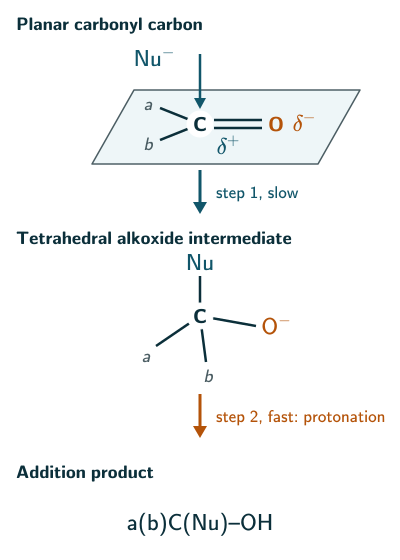
Relative reactivity of aldehydes and ketones
For comparable substituents, aldehydes are generally more reactive than ketones in nucleophilic addition, for two reasons (NCERT page 236):
- Steric. A ketone’s two relatively large groups hinder the approach of the nucleophile more than an aldehyde’s one.
- Electronic. Two alkyl groups reduce the electrophilicity of the carbonyl carbon more than one does.
Benzaldehyde is less reactive than propanal: resonance with the ring reduces the polarity of its carbonyl group, making the carbon less electrophilic (NCERT Example 8.3, page 236).
Addition of HCN, sodium hydrogensulphite, Grignard reagents and alcohols
- HCN → cyanohydrins. The reaction is very slow with pure HCN, so a base is added: it generates CN−, a stronger nucleophile, which adds readily. Cyanohydrins are useful synthetic intermediates (NCERT page 237).
- Sodium hydrogensulphite → bisulphite addition compounds. The equilibrium lies largely to the right for most aldehydes and to the left for most ketones, for steric reasons. The crystalline addition compound is water soluble and gives back the carbonyl compound with dilute mineral acid or alkali, so it is used to separate and purify aldehydes (NCERT page 237).
- NCERT slip (page 237): the scheme joins the carbon to an oxygen of the sulphur group, drawing the intermediate as >C(ONa)–OSO2H and the addition compound as >C(OH)–OSO2Na. Beyond the NCERT text: in the real compound the sulphur atom is bonded to the carbon, so it is a hydroxy sulphonate, >C(OH)SO3−Na+; PubChem lists the methanal adduct as sodium hydroxymethanesulfonate and the propanone adduct as sodium 2-hydroxypropane-2-sulfonate, both with a C–S bond. In an exam, write the addition compound as >C(OH)SO3Na.
- Grignard reagents add to the carbonyl group, and hydrolysis of the adduct gives an alcohol: NCERT page 237 refers to Unit 7, which makes alcohols from Grignard reagents this way (NCERT Unit 7, page 201).
- Alcohols. In acid-catalysed addition of an alcohol, a hemiacetal is an intermediate; further reaction gives a gem-dialkoxy compound, an acetal. These are equilibria: one equivalent does not guarantee an isolable hemiacetal, and excess alcohol or removal of water favours acetal formation: RCHO + 2R′OH → RCH(OR′)2 + H2O. Ketones with ethylene glycol give cyclic ethylene glycol ketals. Dry HCl protonates the carbonyl oxygen, making the carbon more electrophilic; aqueous mineral acid hydrolyses acetals and ketals back to the carbonyl compound (NCERT pages 237–238).
Addition of ammonia and its derivatives
Ammonia and its derivatives, H2N–Z, add to the carbonyl group; the reaction is reversible and acid-catalysed, and loss of water from the intermediate gives >C=N–Z (NCERT page 238): >C=O + H2N–Z → >C=N–Z + H2O.
NCERT Table 8.2 (page 238), reagent → product:
- ammonia (Z = H) → imine in the simplified scheme; unsubstituted imines can be unstable and undergo further reactions
- primary amine (Z = R) → substituted imine (Schiff’s base)
- hydroxylamine (Z = OH) → oxime
- hydrazine (Z = NH2) → hydrazone
- phenylhydrazine (Z = NHC6H5) → phenylhydrazone
- 2,4-dinitrophenylhydrazine → 2,4-dinitrophenylhydrazone
- semicarbazide (Z = NHCONH2) → semicarbazone
Moderate acid catalysis helps addition and dehydration; excessive acidity protonates the nitrogen nucleophile and reduces its reactivity. Use the reagent’s specified conditions, not a rule that more acid is always faster.
The 2,4-DNP derivatives are yellow, orange or red solids, useful for characterising aldehydes and ketones (NCERT page 238).
Clemmensen and Wolff–Kishner reductions
- To alcohols. NaBH4, LiAlH4 or catalytic hydrogenation reduce aldehydes to primary and ketones to secondary alcohols (NCERT page 238).
- To hydrocarbons, >C=O → >CH2:
- Clemmensen reduction: zinc amalgam and concentrated HCl (NCERT page 238).
- Wolff–Kishner reduction: hydrazine, then heating with NaOH or KOH in a high-boiling solvent such as ethylene glycol; the hydrazone loses N2 (NCERT page 239).
Tollens’ and Fehling’s tests
Aldehydes are easily oxidised to carboxylic acids, even by mild oxidising agents; ketones need strong oxidising agents and high temperatures, which break C–C bonds and give a mixture of acids with fewer carbons (NCERT page 239). Two mild reagents help distinguish ordinary aldehydes from simple ketones (NCERT page 239):
- Tollens’ test. Warming an aldehyde with freshly prepared ammoniacal silver nitrate gives metallic silver as a silver mirror or a dark precipitate; the aldehyde becomes the carboxylate ion, in alkaline medium:
Tollens’ test
RCHO + 2[Ag(NH3)2]+ + 3OH− → RCOO− + 2Ag + 2H2O + 4NH3
- Fehling’s test. Fehling solution A (aqueous copper sulphate) and B (alkaline sodium potassium tartrate, Rochelle salt) are mixed in equal amounts; heating with an aldehyde gives a red-brown precipitate of Cu2O. Aromatic aldehydes do not respond to this test:
Fehling’s test
RCHO + 2Cu2+ + 5OH− → RCOO− + Cu2O + 3H2O
- NCERT slip (page 239): NCERT prints “tartarate”. The salt of tartaric acid is a tartrate, as in sodium potassium tartrate (Rochelle salt), so write “tartrate” in an exam.
These are reducing-group tests, not unique proofs of –CHO: reducing sugars, some α-hydroxy ketones and formic acid can also respond. Aromatic aldehydes normally fail Fehling’s test. Use a combination of tests and the molecular formula.
Haloform reaction
- Methyl ketones, RCOCH3, and ethanal, CH3CHO are oxidised by sodium hypohalite to the sodium salt of an acid with one carbon fewer; the methyl group becomes haloform, CHX3. NCERT says: “This oxidation does not affect a carbon-carbon double bond, if present in the molecule” (page 240), as its example shows; give that in an exam. Strictly, it is a rule for this reaction, not a claim that every alkene is inert under every hypohalite condition (reasoned).
- The iodoform reaction, with sodium hypoiodite, detects methyl ketones and ethanal, and also ethanol or secondary alcohols CH3CH(OH)R that are first oxidised to a suitable carbonyl compound (NCERT page 240).
- NCERT Example 8.4 (page 240) puts the tests together: C8H8O that gives a 2,4-DNP derivative and iodoform but reduces neither Tollens’ nor Fehling’s reagent, and does not decolourise bromine water, is acetophenone; chromic acid oxidises it to benzoic acid, C7H6O2.
Acidity of α-hydrogens
The α-hydrogens of aldehydes and ketones are acidic because of the strong electron-withdrawing effect of the carbonyl group and the resonance stabilisation of the conjugate base (NCERT page 241).
Aldol and cross aldol condensation
- Aldol reaction. With dilute alkali, aldehydes and ketones with at least one α-hydrogen give β-hydroxy aldehydes (aldols) or β-hydroxy ketones (ketols); the name comes from aldehyde + alcohol. The aldol and ketol “readily lose water to give α,β-unsaturated carbonyl compounds”, on heating in NCERT’s schemes: this is aldol condensation (NCERT page 241). The water lost takes an α-hydrogen from the addition product, so one initial α-hydrogen is enough for addition but not necessarily for dehydration (reasoned).
- 2CH3CHO (dil. NaOH) → CH3CH(OH)CH2CHO, 3-hydroxybutanal → CH3CH=CHCHO, but-2-enal
- 2CH3COCH3 (Ba(OH)2) → 4-hydroxy-4-methylpentan-2-one → 4-methylpent-3-en-2-one
- Cross aldol condensation, between two different aldehydes and/or ketones: ethanal and propanal each have one enolisable α-carbon, giving four first-stage constitutional condensation products (ignoring E/Z isomers and further reaction). Other pairs can give different counts because of multiple enolate sites, symmetry or controlled conditions. Ethanal and propanal give but-2-enal and 2-methylpent-2-enal (self aldol) and 2-methylbut-2-enal and pent-2-enal (cross aldol) (NCERT page 242).
- Ketones can be one partner: benzaldehyde and acetophenone with OH− at 293 K give mainly 1,3-diphenylprop-2-en-1-one (benzalacetophenone) (NCERT page 242).
- NCERT slip (Summary, page 255): the chapter summary calls the products of aldol condensation α-hydroxyaldehydes (aldol) and α-hydroxyketones (ketol). Page 241 itself, with its products 3-hydroxybutanal and 4-hydroxy-4-methylpentan-2-one, puts the OH group on the β-carbon, the second carbon from the carbonyl carbon: aldols are β-hydroxy aldehydes and ketols β-hydroxy ketones. Write β-hydroxy in an exam.
Cannizzaro reaction
Aldehydes with no α-hydrogen, heated with concentrated alkali, undergo self oxidation and reduction (disproportionation): one molecule becomes the alcohol and another the salt of the carboxylic acid (NCERT page 242).
Cannizzaro reaction
2HCHO + KOH → CH3OH + HCOOK
2C6H5CHO + NaOH → C6H5CH2OH + C6H5COONa
Electrophilic substitution in aromatic aldehydes and ketones
A –CHO or –COR group directly bonded through its carbonyl carbon to the aromatic ring deactivates that ring and is meta-directing (see directive influence): benzaldehyde with HNO3/H2SO4 at 273–283 K gives m-nitrobenzaldehyde (NCERT page 243).
Solved examples
Example 1: Identify the compound
A compound C4H8O gives an orange 2,4-DNP derivative and a yellow precipitate with iodine and NaOH, but does not reduce Tollens’ reagent. Identify it.
Answer: The 2,4-DNP derivative shows a carbonyl group; no silver mirror rules out the aldehydes (butanal and 2-methylpropanal), so it is a ketone; the iodoform test confirms a CH3CO group. The only four-carbon ketone is butanone, CH3COCH2CH3 (reasoned from NCERT pages 238–240).
Example 2: Silver from Tollens’ reagent
What mass of silver can 0.44 g of ethanal deposit with excess Tollens’ reagent? (C = 12, H = 1, O = 16, Ag = 107.9.)
Answer: 0.44/44 = 0.010 mol of CH3CHO. By the equation, 1 mol of aldehyde gives 2 mol of Ag: 0.020 × 107.9 = 2.16 g (reasoned from NCERT page 239).
Example 3: Cannizzaro yields
21.2 g of benzaldehyde is heated with excess concentrated NaOH. What masses of benzyl alcohol and sodium benzoate can form at most? (C = 12, H = 1, O = 16, Na = 23.)
Answer: M(C6H5CHO) = 106, so 0.20 mol, giving 0.10 mol of each product. Benzyl alcohol, C7H8O, M = 108: 10.8 g; sodium benzoate, C7H5O2Na, M = 144: 14.4 g (reasoned from NCERT page 242).
Common mistakes to avoid
Common mistake
Expecting NaBH<sub>4</sub> to remove the oxygen
NaBH4 and LiAlH4 reduce >C=O only as far as the alcohol, >CH–OH. To turn >C=O into >CH2, use the Clemmensen (Zn-Hg, concentrated HCl) or Wolff–Kishner (hydrazine, then KOH in ethylene glycol) reduction.
Common mistake
Mixing up aldol and Cannizzaro conditions
Aldol needs an α-hydrogen and dilute alkali; Cannizzaro is for aldehydes with no α-hydrogen, with concentrated alkali.
Common mistake
Using the iodoform test only for methyl ketones
Ethanal and alcohols with a CH3CH(OH) group, such as ethanol, also give iodoform.
Quick revision summary
- Nucleophilic addition: Nu− to the carbonyl carbon (sp2 → sp3), then H+; comparable aldehydes generally react faster than ketones (steric and electronic reasons).
- Additions: HCN (base-catalysed) → cyanohydrin; NaHSO3 (purifying aldehydes); Grignard → alcohols; alcohols → hemiacetal, acetal; ethylene glycol → ketal; H2N–Z → >C=N–Z (oxime, hydrazone, 2,4-DNP derivative, semicarbazone).
- Reduction: NaBH4/LiAlH4 → alcohols; Clemmensen (Zn-Hg, HCl) and Wolff–Kishner (NH2NH2, then KOH in ethylene glycol) → >CH2.
- Oxidation tests: ordinary aldehydes reduce Tollens’ reagent; aliphatic aldehydes usually reduce Fehling’s reagent. Reducing sugars and some α-hydroxy ketones are exceptions to an aldehyde-only rule. Methyl ketones and ethanal give haloform.
- α-Hydrogens are acidic: aldol and cross aldol condensation; no α-hydrogen: Cannizzaro.
- –CHO and –COR directly attached to an aromatic ring are deactivating and meta-directing.
Formula sheet
- RCHO + 2[Ag(NH)] + 3OH → RCOO + 2Ag + 2HO + 4NH
- RCHO + 2Cu + 5OH → RCOO + CuO + 3HO
-
C=O + HN–Z → >C=N–Z + HO
- 2CHCHO (dil. NaOH) → CHCH(OH)CHCHO (heat) → CHCH=CHCHO + HO
- 2HCHO + KOH → CHOH + HCOOK (Cannizzaro)
Questions students ask
Why do aldehydes and ketones undergo nucleophilic addition while alkenes undergo electrophilic addition?
Aldehydes and ketones undergo nucleophilic addition because their C=O bond is polar: oxygen draws the π electrons to itself, leaving the carbonyl carbon electron-poor, a target for nucleophiles (NCERT pages 231 and 236). An alkene’s C=C has no such polarity, and its loosely held π electrons attract electrophiles instead (NCERT Class 11 Chemistry, Unit 9, page 310). Addition to C=O also leaves the negative charge on the electronegative oxygen, as the alkoxide intermediate (reasoned from NCERT page 236), and because the carbonyl oxygen is basic, dry HCl can protonate it first, making the carbon still more electrophilic, which is how alcohols add (NCERT page 237).
What is the difference between aldol condensation and the Cannizzaro reaction?
Aldol condensation builds a new C–C bond between two carbonyl molecules, while the Cannizzaro reaction is a redox reaction that builds none: one aldehyde molecule is reduced to the alcohol and another oxidised to the acid’s salt (NCERT pages 241–242). In aldol condensation the base acts only as a catalyst, removing an α-hydrogen to start the reaction, while in the Cannizzaro reaction it adds to a carbonyl carbon and ends up in the salt, so the alkali is used up (reasoned from NCERT pages 241–242). Beyond the NCERT text, the Cannizzaro step that does the work is direct transfer of a hydride equivalent from that adduct to a second aldehyde molecule, without a free H− ion in water (Wikipedia, “Cannizzaro reaction”).
What is the crossed Cannizzaro reaction?
The crossed Cannizzaro reaction, beyond the NCERT text, pairs formaldehyde with another aldehyde that has no α-hydrogen: the formaldehyde is oxidised to formate and the other aldehyde reduced to its alcohol, so more of it becomes alcohol than the half its own Cannizzaro reaction gives (Wikipedia, “Cannizzaro reaction”). With benzaldehyde, C6H5CHO + HCHO + NaOH → C6H5CH2OH + HCOONa (reasoned). Formaldehyde takes the hydroxide because, with only hydrogens on its carbonyl carbon, it is the less hindered and more electrophilic aldehyde (reasoned from NCERT page 236).
What is the difference between aldol condensation and Claisen condensation?
Aldol condensation joins two aldehydes or ketones, while in the Claisen condensation, beyond the NCERT text, the enolate attacks an ester, and a typical ester self-condensation gives a β-keto ester, while acylation of a suitable ketone enolate gives a β-diketone (Wikipedia, “Claisen condensation”). The ester’s alkoxy group then leaves, so the tetrahedral addition intermediate collapses to an acyl-substitution product rather than an isolated aldol, and the alkoxide base is used up in pulling a proton from the product, so a full equivalent is needed (Wikipedia). The Claisen–Schmidt condensation, despite its name, is a cross aldol in which the aromatic partner has no α-hydrogen of its own (Wikipedia, “Claisen–Schmidt condensation”), as with NCERT’s benzaldehyde and acetophenone (page 242).
What is the difference between the Clemmensen and Wolff–Kishner reductions?
The Clemmensen and Wolff–Kishner reductions both turn >C=O into >CH2, the Clemmensen in strong acid, zinc amalgam and concentrated HCl, and the Wolff–Kishner in strong base, hydrazine and then NaOH or KOH in hot ethylene glycol (NCERT pages 238–239). So the choice depends on what else the molecule carries, a point beyond the NCERT text: Wolff–Kishner suits acid-sensitive compounds and Clemmensen those that strong base attacks (Wikipedia, “Clemmensen reduction” and “Wolff–Kishner reduction”). Hot alkali would hydrolyse an ester group (NCERT page 247), for example, and concentrated HCl can turn an alcohol into an alkyl chloride (NCERT Unit 7, page 208; reasoned).
Why does the haloform reaction replace all three hydrogens of the methyl group?
The haloform reaction replaces all three hydrogens of the CH3 next to C=O because each halogen that goes in adds its electron pull to the carbonyl group’s, making the hydrogens left more acidic, so each substitution is faster than the last (reasoned from NCERT page 241 and the inductive effect). Beyond the NCERT text, hydroxide then adds to the carbonyl carbon and the CX3− ion, stabilised by its three halogens, breaks away and takes a proton, giving CHX3 (Wikipedia, “Haloform reaction”). So the CH3 must sit on the carbonyl carbon (NCERT page 240).
Where are the aldol, Cannizzaro and haloform reactions taught?
They appear in NCERT Class 12 Chemistry Part II, Unit 8, Section 8.4: haloform and iodoform on page 240, aldol and Cannizzaro on pages 241–242. The Laboratory Manual also uses the iodoform test for alcohol identification. Check your examination year’s official syllabus for the required theory and practical coverage.
Practice questions
Try each question first, then open the answer to check your working.
-
Q1. Why does HCN add to carbonyl compounds faster when a little base is present?
Show answerHide answer
The base generates the cyanide ion, CN−, a much stronger nucleophile than HCN, which adds readily to the carbonyl carbon (NCERT page 237).
-
Q2. Which of these undergo the Cannizzaro reaction: methanal, ethanal, benzaldehyde, propanal?
Show answerHide answer
Methanal and benzaldehyde, which have no α-hydrogen; ethanal and propanal have α-hydrogens and undergo aldol condensation instead (NCERT pages 241–242).