Preparation of carboxylic acids
NCERT Class 12 Chemistry Chapter 8 Section 8.7
Quick answer
Carboxylic acids can be prepared by oxidation of primary alcohols, aldehydes and suitable alkylbenzenes, or by hydrolysis of acid derivatives. Benzylic oxidation needs a benzylic hydrogen: that carbon becomes –COOH while further side-chain carbons are cleaved away. Nitrile and Grignard–CO routes add one carbon; alkaline hydrolysis gives a carboxylate that must be acidified to isolate the acid.
With your textbook
NCERT Chemistry Part II (Class 12), Chapter 8 “Aldehydes, Ketones and Carboxylic Acids”, Section 8.7 “Methods of Preparation of Carboxylic Acids”, pages 245–248.
Open the official NCERT chapter (PDF, 4.4 MB, ncert.nic.in) (opens in a new tab)
Checked against the 2026-27 reprint on .
How are carboxylic acids prepared?
Preparing carboxylic acids
Carboxylic acids are made by oxidising primary alcohols, aldehydes or alkylbenzenes; by hydrolysing nitriles, amides, acyl chlorides, anhydrides and esters; and from Grignard reagents and carbon dioxide (NCERT Section 8.7, pages 245–247). One rule is easy to miss; NCERT says of alkylbenzenes:
The entire side chain is oxidised to the carboxyl group irrespective of length of the side chain.
NCERT Chemistry Part II (Class 12), Section 8.7, page 246
In plain words: oxidising a primary alcohol through an aldehyde often gives –COOH while retaining the carbon skeleton; further oxidation or cleavage is possible in some cases, notably formic acid to CO2. It is also what is left when the other carboxylic acid derivatives are split by water. And when a nitrile or a Grignard reagent is made from an alkyl halide, the new carbon becomes the –COOH carbon.
From primary alcohols and aldehydes
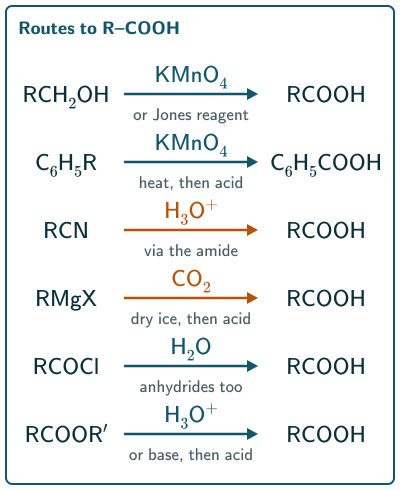
- Primary alcohols are readily oxidised to carboxylic acids by KMnO4 in neutral, acidic or alkaline media, or by acidified K2Cr2O7. Jones reagent specifically uses CrO3 in aqueous H2SO4, commonly with acetone solvent: RCH2OH with alkaline KMnO4, then H3O+, gives RCOOH; CH3(CH2)8CH2OH, 1-decanol, with CrO3–H2SO4 gives decanoic acid (NCERT page 245).
- Aldehydes are oxidised to acids even by mild oxidising agents (NCERT page 246, referring to Section 8.4).
From alkylbenzenes
- Vigorous oxidation with chromic acid or acidic or alkaline KMnO4 turns a side chain with at least one benzylic hydrogen into –COOH at its attachment to the ring: the benzylic carbon is retained and other side-chain carbons are cleaved away, not packed into one carbon. Thus toluene and propylbenzene both give benzoic acid (KMnO4–KOH, heat, then H3O+) (NCERT page 246).
- Primary and secondary alkyl groups are oxidised this way; a tert-alkyl substituent with no benzylic hydrogen does not undergo the usual side-chain oxidation under these conditions. Suitably substituted alkenes are also oxidised to acids by these reagents (NCERT page 246), as in the oxidation of alkenes.
From nitriles and amides
- Nitriles hydrolyse through amides. Acidic conditions give the acid and ammonium ion; alkaline conditions give carboxylate and ammonia, followed by acidification to isolate the acid. Controlled partial hydrolysis can stop at the amide (NCERT page 246): R–CN → R–CONH2 → RCOOH.
- NCERT slip (page 246): NCERT calls the H+ or OH− a catalyst and draws RCOOH as the product either way; its amide equations likewise show NH3 in acid. That fits the first step, nitrile to amide, but over the whole hydrolysis one H+ or OH− is used up for each nitrile: in acid the ammonia leaves as NH4+, and in alkali the product is the carboxylate ion, which gives RCOOH only on acidification, as NCERT shows for esters on page 247. Beyond the NCERT text: CH3CN + 2H2O + H+ → CH3COOH + NH4+ and CH3CN + H2O + OH− → CH3COO− + NH3; the H+ or OH− ends up in the ammonium ion or the carboxylate ion and is not given back, so it is a reactant here, not a catalyst (Wikipedia, “Nitrile”). In an exam, write H3O+, heat over the arrow, or OH−, heat, then H3O+.
- In acid, amide hydrolysis gives the acid and ammonium: CH3CONH2 + H2O + H+ → CH3COOH + NH4+ (heat); benzamide gives benzoic acid the same way (NCERT page 246).
- Nitriles come from alkyl halides with cyanide, by nucleophilic substitution (NCERT page 246, referring to Unit 6).
From Grignard reagents
- Grignard reagents react with carbon dioxide (dry ice) to give salts of carboxylic acids, which mineral acid turns into the acids: RMgX + CO2 → RCOO−MgX+ (dry ether), then H3O+ → RCOOH (NCERT page 246).
- Grignard reagents, like nitriles, are made from alkyl halides, so both routes give an acid with one carbon more than the alkyl halide (NCERT pages 246–247).
From acyl halides, anhydrides and esters
- Acid chlorides are hydrolysed by water to the acid, or more readily by aqueous base to the carboxylate ion, which acid turns into the acid: RCOCl + H2O → RCOOH + HCl (NCERT page 247).
- NCERT slip (page 247): for water, NCERT’s scheme prints RCOOH + Cl− as the products, leaving out an H+, so neither the hydrogen atoms nor the charges balance. The second product is hydrochloric acid, as in the equation above (reasoned: count the atoms and charges). In an exam, write HCl, or H+ + Cl−.
- Anhydrides are hydrolysed by water to the acid or acids: (C6H5CO)2O + H2O → 2C6H5COOH; the mixed benzoic ethanoic anhydride gives benzoic acid and ethanoic acid (NCERT page 247).
- Esters: acidic hydrolysis gives the acid directly; basic hydrolysis gives the carboxylate, which acid then converts: ethyl benzoate gives benzoic acid and ethanol; ethyl butanoate with NaOH gives sodium butanoate and ethanol, then butanoic acid (NCERT page 247).
- NCERT slip (page 247): NCERT draws the hydrolysis of ethyl butanoate by NaOH with the equilibrium sign ⇌, the same sign it uses for acid hydrolysis. Beyond the NCERT text: base hydrolysis (saponification) is not an equilibrium process in practice, and a full equivalent of base is used up (Wikipedia, “Ester”), because the acid formed is deprotonated to carboxylate (reasoned). Strictly, every step has a reverse reaction, but the overall position lies far to the products, so a single arrow is the right summary (reasoned). In an exam, use ⇌ for acid hydrolysis and a single arrow, →, for hydrolysis by NaOH.
Solved examples
Example 1: Two ways to add a carbon
Show two ways of making propanoic acid from bromoethane.
Answer: (i) CH3CH2Br + KCN → CH3CH2CN + KBr, then H3O+, heat → CH3CH2COOH. (ii) CH3CH2Br + Mg (dry ether) → CH3CH2MgBr; + CO2, then H3O+ → CH3CH2COOH. Both add the carbon that becomes –COOH (reasoned from NCERT pages 246–247).
Example 2: Mass from a Grignard route
What mass of propanoic acid can 10.9 g of bromoethane give at most by the Grignard route? (C = 12, H = 1, O = 16, Br = 79.9.)
Answer: M(C2H5Br) = 24 + 5 + 79.9 = 108.9 g mol−1, so 10.9 g is 0.100 mol, giving 0.100 mol of CH3CH2COOH, M = 36 + 6 + 32 = 74 g mol−1: 0.100 × 74 = 7.4 g (reasoned from NCERT page 246).
Example 3: Which side chains survive?
What do ethylbenzene, isopropylbenzene and tert-butylbenzene give on vigorous oxidation with KMnO4?
Answer: Ethylbenzene (a primary alkyl group) and isopropylbenzene (a secondary one) both give benzoic acid, because their benzylic carbon has a hydrogen and becomes the –COOH carbon; the other side-chain carbons are removed by oxidative cleavage. tert-Butylbenzene is not affected, because its benzylic carbon has no hydrogen (reasoned from NCERT page 246; NCERT Intext Question 8.7 (i), page 248, asks for ethylbenzene).
Common mistakes to avoid
Common mistake
Expecting a longer side chain to give a longer acid
With a benzylic hydrogen present, KMnO4 leaves one side-chain carbon as –COOH and cleaves the remaining carbons: propylbenzene gives benzoic acid, not 3-phenylpropanoic acid.
Common mistake
Forgetting the carbon the nitrile or CO adds
From an alkyl halide, the cyanide and Grignard routes give an acid with one carbon more: bromoethane gives propanoic acid, not ethanoic acid.
Quick revision summary
- Oxidation: RCH2OH or RCHO → RCOOH (KMnO4; K2Cr2O7; CrO3–H2SO4, Jones reagent).
- Alkylbenzenes → benzoic acid (KMnO4, heat): the benzylic carbon is retained as –COOH; a benzylic H is needed for the usual reaction.
- Nitriles → amides → acids in acid; alkali gives carboxylate, then acidification gives the acid; Grignard reagent + CO2, then acid: both one carbon more than the alkyl halide.
- Hydrolysis of acyl chlorides, anhydrides and esters gives the acids.
Formula sheet
- RCHOH → RCOOH (KMnO, or CrO–HSO)
- CHR → CHCOOH (KMnO–KOH, heat; then HO)
- R–CN → R–CONH → RCOOH (acidic hydrolysis, or alkali followed by acidification)
- RMgX + CO → RCOOMgX → RCOOH (HO)
- RCOCl + HO → RCOOH + HCl
Questions students ask
What happens when a Grignard reagent reacts with a carboxylic acid?
A Grignard reagent and a carboxylic acid react as base and acid: the acid’s O–H proton turns R′MgX into the hydrocarbon R′H, leaving the salt RCOOMgX, because Grignard reagents react with sufficiently acidic proton donors, including water, alcohols and carboxylic acids (NCERT Unit 6, page 181). Methylmagnesium bromide and ethanoic acid, for example, give methane and CH3COOMgBr (reasoned). Beyond the NCERT text, the proton is taken long before any addition to the C=O could happen, so the reagent is used up without adding to the acid (Wikipedia, “Grignard reagent”). So the Grignard route to acids needs dry conditions and a halide with no –COOH or –OH group (reasoned from NCERT Unit 6, page 181).
How does side-chain oxidation work, and why is a tertiary alkyl group not oxidised?
The useful school-level criterion is a hydrogen on the benzylic carbon, directly attached to the ring. NCERT says primary and secondary alkyl groups are oxidised while a tertiary group is not affected (page 246); only the tertiary group has no benzylic hydrogen (reasoned). Under the usual vigorous permanganate conditions the benzylic carbon becomes the carboxyl carbon, while any remaining side-chain carbons are oxidatively cleaved. This accounts for NCERT’s products without suggesting that several carbon atoms turn into one.
When is the nitrile route used instead of the Grignard route to make a carboxylic acid?
Both routes add one carbon, but substrate compatibility decides which is useful. Cyanide substitution is favourable for many primary halides; tertiary halides resist SN2 and may eliminate. Grignard formation and carbonation require dry conditions and compatible functional groups, and can also suffer side reactions. An –OH, –NH2 or –COOH group does not automatically make cyanide the correct alternative: competing reactions or protection may be needed, and acid would protonate cyanide to hazardous HCN. Assess the complete substrate and approved reaction conditions.
Practice questions
Try each question first, then open the answer to check your working.
-
Q1. Why does NCERT call the nitrile and Grignard routes “ascending the series”?
Show answerHide answer
Each route adds one carbon, which becomes the –COOH carbon: the carbon of the cyanide ion in the nitrile route and the carbon of CO2 in the Grignard route. Both reagents are made from an alkyl halide, so the acid has one carbon more than the alkyl halide (NCERT pages 246–247).
-
Q2. How can the hydrolysis of a nitrile be stopped at the amide?
Show answerHide answer
By using mild conditions; under stronger conditions the amide is hydrolysed on to the acid (NCERT page 246).