Physical properties of carboxylic acids
NCERT Class 12 Chemistry Chapter 8 Section 8.8
Quick answer
Simple carboxylic acids generally have high boiling points because of intermolecular hydrogen bonding; monomers and dimers coexist in the vapour and in nonpolar solvents. In NCERT’s data ethanoic acid boils at 391.1 K, above propan-1-ol at 370 K. Lower simple aliphatic acids mix readily with water, while water solubility generally decreases as the hydrocarbon chain grows.
With your textbook
NCERT Chemistry Part II (Class 12), Chapter 8 “Aldehydes, Ketones and Carboxylic Acids”, Section 8.8 “Physical Properties”, page 249.
Open the official NCERT chapter (PDF, 4.4 MB, ncert.nic.in) (opens in a new tab)
Checked against the 2026-27 reprint on .
What are the physical properties of carboxylic acids?
Physical properties of carboxylic acids
Comparable simple carboxylic acids generally boil higher than aldehydes, ketones and alcohols of similar molar mass, most of them exist as hydrogen-bonded dimers in the vapour and in aprotic solvents, and those with up to four carbon atoms mix with water (NCERT page 249). NCERT gives the reason for the boiling points:
Carboxylic acids are higher boiling liquids than aldehydes, ketones and even alcohols of comparable molecular masses. This is due to more extensive association of carboxylic acid molecules through intermolecular hydrogen bonding.
NCERT Chemistry Part II (Class 12), Section 8.8, page 249
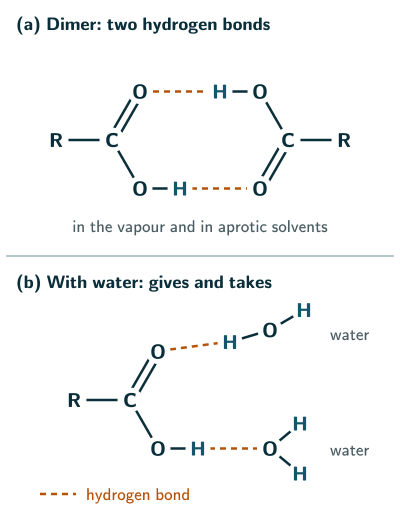
In plain words: a –COOH group has both an O–H that can give a hydrogen bond and a C=O oxygen that can take one. So two acid molecules can hold each other by two hydrogen bonds at once, and these pairs are hard to pull apart.
Physical state and odour
- The simple straight-chain saturated monocarboxylic acids with up to nine carbon atoms are colourless liquids at room temperature with unpleasant odours (NCERT page 249).
- The higher acids are wax-like solids and practically odourless, because they are not very volatile (NCERT page 249).
Hydrogen-bonded dimers
- Carboxylic acid molecules associate through intermolecular hydrogen bonds, more extensively than alcohol molecules do (NCERT page 249).
- These hydrogen bonds are not broken completely even in the vapour: NCERT says most carboxylic acids “exist as dimer in the vapour phase or in the aprotic solvents” (page 249). Give that statement in an exam. Strictly, monomers and dimers coexist, the dimer fraction depends on temperature, pressure or concentration and solvent, and pairing is favoured in nonpolar solvents such as benzene; a solvent that itself accepts hydrogen bonds strongly competes with acid–acid pairing, as water does in NCERT’s drawing (reasoned from NCERT page 249).
- In the dimer, the O–H of each molecule bonds to the C=O oxygen of the other, so two hydrogen bonds close a ring of eight atoms (reasoned from NCERT’s drawing, page 249).
- The same pairing happens in benzene: ethanoic acid dimerises there, so, if dimerisation is nearly complete, colligative measurements give a molar mass near twice the true value and a van ’t Hoff factor near 0.5 (NCERT Class 12 Unit 1, page 24).
Boiling points
NCERT’s data for compounds of molar mass 58–60, in increasing order of boiling point:
| Compound | M | b.p./K |
|---|---|---|
| methoxyethane | 60 | 281 |
| propanal | 58 | 322 |
| propan-1-ol | 60 | 370 |
| ethanoic acid | 60 | 391.1 |
The first three values are from NCERT Section 8.3 (page 235); ethanoic acid’s is from NCERT Class 12 Unit 1, Table 1.3 (page 19), where it is listed as a solvent. The acid boils 21.1 K above propan-1-ol of the same molar mass, although alcohol molecules are hydrogen bonded too: this is NCERT’s “more extensive association” at work.
Solubility in water
- Simple aliphatic carboxylic acids with up to four carbon atoms are miscible with water, because they form hydrogen bonds with it (NCERT page 249).
- Solubility decreases as the number of carbon atoms grows; the higher acids are practically insoluble, because of the larger hydrophobic hydrocarbon part (NCERT page 249).
- Benzoic acid, the simplest aromatic carboxylic acid, is nearly insoluble in cold water (NCERT page 249).
- Carboxylic acids also dissolve in less polar organic solvents such as benzene, ether, alcohol and chloroform (NCERT page 249).
Compare the aldehydes and ketones: NCERT gives methanal, ethanal and propanone, with at most three carbon atoms, as examples of lower members that mix with water in all proportions (NCERT page 235), while for the acids it sets a limit of four carbon atoms, so butanoic acid still mixes. The acid both gives and takes hydrogen bonds with water (reasoned).
Solved examples
Example 1: Four compounds of nearly equal mass
Arrange ethanoic acid, propan-1-ol, propanal and methoxyethane in order of increasing boiling point, and check that their molar masses are comparable. (C = 12, H = 1, O = 16.)
Answer: CH3COOH, C2H4O2 = 24 + 4 + 32 = 60; propan-1-ol and methoxyethane, C3H8O = 36 + 8 + 16 = 60; propanal, C3H6O = 58. Order: methoxyethane (281 K) < propanal (322 K) < propan-1-ol (370 K) < ethanoic acid (391.1 K). The ether is only weakly polar, propanal has dipole–dipole attraction, the alcohol is hydrogen bonded, and the acid is hydrogen bonded more extensively (NCERT pages 235 and 249; ethanoic acid’s value from NCERT Unit 1, page 19).
Example 2: Molar mass of the dimer
If propanoic acid vapour were made entirely of dimers, what molar mass would a measurement on the vapour suggest? (C = 12, H = 1, O = 16.)
Answer: CH3CH2COOH, C3H6O2 = 36 + 6 + 32 = 74. Each dimer is two molecules, (CH3CH2COOH)2, so the apparent molar mass is 2 × 74 = 148 g mol−1, twice the true value, as NCERT describes for ethanoic acid in benzene (reasoned from NCERT page 249 and Unit 1, page 24). For an ideal-gas mixture of monomers and dimers only, partial association gives an apparent molar mass between 74 and 148. Non-ideality, other aggregates or decomposition would require a different model.
Common mistakes to avoid
Common mistake
Saying the acid boils higher only because it is heavier
At the same molar mass, 60, ethanoic acid boils 21.1 K above propan-1-ol and 110.1 K above methoxyethane. The difference reflects intermolecular interactions and structure, including hydrogen bonding; equal molar mass alone does not fix a boiling point.
Common mistake
Thinking the dimers break up on boiling
NCERT says the hydrogen bonds “are not broken completely even in the vapour phase” (page 249): many molecules stay paired as dimers, in equilibrium with monomers. Heating does not remove every hydrogen bond, but neither is complete dimerisation guaranteed (reasoned).
Common mistake
Expecting benzoic acid to dissolve like ethanoic acid
Only the simple aliphatic acids with up to four carbon atoms are miscible with water. Benzoic acid is nearly insoluble in cold water.
Quick revision summary
- Simple straight-chain saturated monoacids up to nine carbon atoms near ordinary room temperature: colourless liquids with unpleasant odours; higher acids: wax-like, practically odourless solids.
- Generally higher b.p. than aldehydes, ketones and even alcohols of comparable mass: more extensive intermolecular hydrogen bonding.
- Most carboxylic acids exist as hydrogen-bonded dimers in the vapour and in aprotic solvents (NCERT), in a monomer–dimer equilibrium that solvent, temperature and concentration control; nonpolar benzene favours pairing.
- Up to four carbon atoms: miscible with water; solubility falls as the chain grows; benzoic acid is nearly insoluble in cold water; soluble in benzene, ether, alcohol and chloroform.
Formula sheet
- General b.p. trend at similar mass: ether < aldehyde < alcohol < carboxylic acid
- methoxyethane 281 K, propanal 322 K, propan-1-ol 370 K, ethanoic acid 391.1 K
- 2RCOOH ⇌ (RCOOH), in the vapour and in nonpolar solvents
Questions students ask
Why do aldehydes and ketones boil lower than carboxylic acids of similar molar mass?
Aldehydes and ketones boil lower than carboxylic acids of similar molar mass because they have no O–H group: simple molecules without additional O–H or N–H groups have dipole–dipole and dispersion forces between C=O groups (NCERT page 235), while acid molecules hydrogen bond to one another, with dimers that can survive in equilibrium with monomers even in the vapour (NCERT page 249). Beyond the NCERT text, propanoic acid boils at 414 K, but butanal and butanone, with slightly lighter molecules, at only 348 K and 353 K (PubChem). The C=O oxygen of an aldehyde or ketone can accept a hydrogen bond from water (NCERT page 235), but with no O–H the molecule cannot give one to a neighbour (reasoned).
Do carboxylic acids boil higher than esters and amides?
Comparable simple carboxylic acids generally boil higher than esters because acids can both donate and accept hydrogen bonds; an ester without another O–H or N–H group cannot donate one. Primary amides often form extensive hydrogen-bond networks and can have high boiling points or decompose before boiling. These are trends, not a universal order: substituents, molar mass, pressure and decomposition must be considered.
What are the melting points of carboxylic acids?
Melting points depend on crystal packing as well as hydrogen bonding, so they do not increase smoothly with carbon count. NCERT’s “up to nine carbons are liquids” trend concerns simple straight-chain saturated monoacids near ordinary room temperature, not every branched acid or diacid. Its own ethanoic acid datum, 290 K, shows why temperature matters: compare the stated temperature with it before calling the pure acid a liquid. Use a measured melting range for the specific compound.
Why does benzoic acid dissolve in sodium hydroxide solution though not in cold water?
Benzoic acid dissolves in sodium hydroxide solution because it reacts to give sodium benzoate, a salt (NCERT page 249), and water surrounds the benzoate and sodium ions far better than the neutral acid with its large hydrophobic benzene ring (reasoned from NCERT page 249). Beyond the NCERT text, only about 3.4 g of benzoic acid dissolves in a litre of water at 25 °C, while 1 g of sodium benzoate dissolves in less than 2 mL of water (PubChem). Adding a mineral acid such as HCl turns the benzoate back into benzoic acid, which precipitates if its solubility limit is exceeded (reasoned from NCERT page 247). Hot water also dissolves benzoic acid much better than cold water does (PubChem).
Practice questions
Try each question first, then open the answer to check your working.
-
Q1. Why does ethanoic acid boil higher than propan-1-ol, although both have a molar mass of 60?
Show answerHide answer
Ethanoic acid molecules associate more extensively through intermolecular hydrogen bonds, so more energy is needed to separate them; the hydrogen bonds are not broken completely even in the vapour, and most carboxylic acids, ethanoic acid among them, exist there as dimers (NCERT page 249), in equilibrium with monomers (reasoned). By NCERT’s data the acid boils at 391.1 K and the alcohol at 370 K (pages 19 and 235).
-
Q2. Butanoic acid mixes with water, but decanoic acid is practically insoluble. Why?
Show answerHide answer
Both form hydrogen bonds with water through the –COOH group, but solubility decreases as the number of carbon atoms grows: decanoic acid’s long hydrocarbon part is hydrophobic. Only acids with up to four carbon atoms are miscible (NCERT page 249).