Chemical reactions of carboxylic acids
NCERT Class 12 Chemistry Chapter 8 Section 8.9
Quick answer
Carboxylic acids form salts, esters, acyl chlorides, amides and anhydrides under appropriate conditions, and can be reduced to primary alcohols. Their acidity depends on substituents and stabilisation of the carboxylate ion; a smaller pK means a stronger acid under comparable conditions. Soda-lime decarboxylation removes the carboxyl carbon into carbonate, while Kolbe electrolysis releases CO; acids with an α-hydrogen can undergo HVZ halogenation.
With your textbook
NCERT Chemistry Part II (Class 12), Chapter 8 “Aldehydes, Ketones and Carboxylic Acids”, Section 8.9 “Chemical Reactions”, pages 249–254.
Open the official NCERT chapter (PDF, 4.4 MB, ncert.nic.in) (opens in a new tab)
Checked against the 2026-27 reprint on .
What reactions do carboxylic acids undergo?
Reactions of carboxylic acids
NCERT sorts the reactions of carboxylic acids by what breaks: the O–H bond (acidity, with metals, alkalies and carbonates), the C–OH bond (anhydrides, esters, acyl chlorides and amides), the –COOH group as a whole (reduction and decarboxylation), and C–H bonds in the hydrocarbon part (the Hell–Volhard–Zelinsky reaction and ring substitution) (NCERT Section 8.9, pages 249–254). On their acidity NCERT says:
Electron withdrawing groups increase the acidity of carboxylic acids by stabilising the conjugate base through delocalisation of the negative charge by inductive and/or resonance effects.
NCERT Chemistry Part II (Class 12), Section 8.9.1, page 250
In plain words: a carboxylic acid gives up its proton easily because the carboxylate ion left behind spreads its negative charge over two oxygen atoms. For otherwise comparable molecules, electron withdrawal generally favours acidity and electron donation opposes it. Compare the acid and conjugate base in the same solvent; position, solvation and steric effects can modify the trend.
Reactions with metals and alkalies
- Like alcohols, carboxylic acids give hydrogen with electropositive metals; like phenols, they form salts with alkalies (NCERT page 249).
- Unlike ordinary phenol in the hydrogencarbonate test, carboxylic acids give carbon dioxide with NaHCO3. Sufficient acid also gives CO2 from carbonate; carbonate itself can partly deprotonate phenol without that effervescence. Strongly electron-withdrawing substituents make some phenols exceptions. This reaction is used to detect a carboxyl group in an organic compound (NCERT page 249).
Metals and bases
2RCOOH + 2Na → 2RCOO−Na+ + H2
RCOOH + NaOH → RCOO−Na+ + H2O
RCOOH + NaHCO3 → RCOO−Na+ + H2O + CO2
- In water, carboxylic acids dissociate into resonance-stabilised carboxylate ions and hydronium ions, RCOOH + H2O ⇌ H3O+ + RCOO−. In a dilute solution the concentration approximation to the acid dissociation constant is Ka = [H3O+][RCOO−]/[RCOOH], and strength is usually given as pKa = −log Ka (NCERT pages 249–250).
Acidity and the effect of substituents
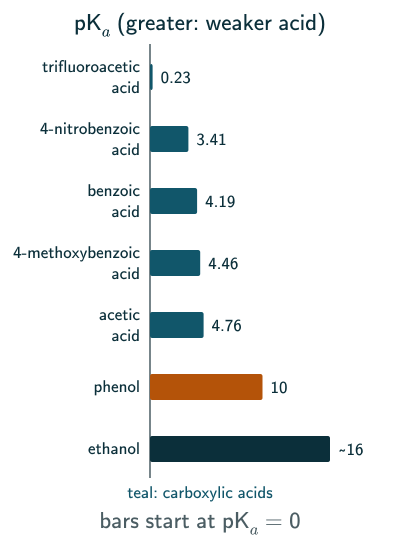
At the same temperature and in the same solvent, the smaller the pKa, the stronger the acid. Thermodynamic constants use activities; concentration expressions are dilute-solution approximations. NCERT’s values and its bands (page 250): strong acids have pKa below 1, moderately strong acids 1 to 5, weak acids 5 to 15, and extremely weak acids above 15.
| Acid | pKa | Band |
|---|---|---|
| hydrochloric acid | −7.0 | strong |
| trifluoroacetic acid | 0.23 | strong |
| benzoic acid | 4.19 | moderately strong |
| acetic acid | 4.76 | moderately strong |
| phenol | 10 | weak |
| ethanol | about 16 | extremely weak |
Typical simple carboxylic acids are weaker than strong mineral acids such as HCl and HNO3 but stronger than alcohols and many simple phenols; NCERT calls them among the most acidic organic compounds met so far (page 250).
-
‘Moderately strong’ here, ‘weak’ in equilibrium. The four bands are NCERT’s for this section. In ionic equilibrium, an acid that ionises only partly in water is a weak acid, and acetic and benzoic acids are in NCERT Class 11’s table of weak acids (Unit 6, page 195). So in an equilibrium question call acetic acid a weak acid, and use the bands above only when a question asks for NCERT’s pKa classes (reasoned).
-
Why stronger than phenols. The carboxylate ion has two equivalent resonance structures, with the negative charge on the more electronegative oxygen atoms; the phenoxide ion has non-equivalent structures that put the charge on less electronegative carbon atoms. So the charge is spread over two oxygen atoms in carboxylate but less effectively over one oxygen and some carbon atoms in phenoxide, and the carboxylate ion is the more stable (NCERT page 250).
Effect of substituents
- Electron-withdrawing groups (EWG) stabilise the carboxylate ion by the inductive effect and/or resonance, and so strengthen the acid; electron-donating groups (EDG) destabilise it and weaken the acid (NCERT page 250).
- NCERT’s order of groups by the acidity they give (page 251): Ph < I < Br < Cl < F < CN < NO2 < CF3.
- Note on NCERT’s order (page 251): the order puts CF3 above CN and NO2, but CF3 appears in NCERT’s acid list only as CF3COOH, where its three fluorine atoms sit on the carbon next to –COOH; the list never compares it with CN or NO2 at the same position. Beyond the NCERT text: compared on a benzene ring, CF3 is the weakest of the three. Hammett’s substituent constant for a group in the 4-position is the drop it causes in the pKa of benzoic acid in water: 0.54 for CF3, 0.66 for CN and 0.78 for NO2 (Hansch, Leo and Taft, Chemical Reviews, 1991, substituent-constant compilation). So 4-(trifluoromethyl)benzoic acid has pKa about 4.19 − 0.54 = 3.65, while 4.19 − 0.78 = 3.41, NCERT’s own figure for 4-nitrobenzoic acid (reasoned). Do not treat the printed group sequence as a universal order. When two real acids are compared, such as 4-nitrobenzoic and 4-(trifluoromethyl)benzoic acid, the nitro acid is the stronger.
- NCERT’s list of acids (page 251), strongest first:
CF3COOH > CCl3COOH > CHCl2COOH > NO2CH2COOH > NC–CH2COOH > FCH2COOH > ClCH2COOH > BrCH2COOH > HCOOH > ClCH2CH2COOH > C6H5COOH > C6H5CH2COOH > CH3COOH > CH3CH2COOH
- Reading NCERT’s list. NCERT introduces it as “in order of increasing acidity” but writes it with > signs, strongest first, and draws arrows pointing to the left: acidity increases from right to left. Read each > as “is a stronger acid than”.
- Patterns in the list (reasoned): more halogen atoms, stronger acid (CCl3COOH > CHCl2COOH > ClCH2COOH); with the same number of halogen atoms, F > Cl > Br, the order of electronegativity (CF3COOH > CCl3COOH, and FCH2COOH > ClCH2COOH > BrCH2COOH); and the nearer the group, the bigger its effect. ClCH2CH2COOH, with chlorine one carbon further away, comes far below ClCH2COOH, because the inductive effect “decreases rapidly as the number of intervening bonds increases and becomes vanishingly small after three bonds” (NCERT Class 11, Section 8.7.5, page 274). Three bonds is a rule of thumb, not an exact physical cutoff (reasoned).
- Phenyl or vinyl attached directly to –COOH increases the acidity, contrary to the decrease the resonance effect would suggest, because the carboxyl carbon is then bonded to a more electronegative sp2 carbon (NCERT page 251): C6H5COOH > CH3COOH.
- Substituted benzoic acids. An EWG on the ring increases the acidity and an EDG decreases it: 4-nitrobenzoic acid (pKa 3.41) > benzoic acid (4.19) > 4-methoxybenzoic acid (4.46) (NCERT page 251).
Reactions breaking the C–OH bond
- Anhydrides. Suitable dehydrating conditions, such as heating with P2O5, can join two acid molecules with loss of water. Heating any acid with any mineral acid is not a general guarantee of anhydride formation; water removal and the substrate matter: 2CH3COOH → (CH3CO)2O + H2O (H+, heat, or P2O5, heat), giving ethanoic anhydride (NCERT page 251; NCERT’s scheme leaves out the water).
- Esterification. Alcohols give esters in the presence of a mineral acid catalyst such as concentrated H2SO4 or HCl gas: RCOOH + R′OH ⇌ RCOOR′ + H2O (H+) (NCERT page 251). Phenols are weaker nucleophiles and are not generally esterified efficiently by this ordinary Fischer procedure; acyl chlorides or anhydrides are usual alternatives. Special catalysed methods are a separate case.
- Mechanism of esterification (nucleophilic acyl substitution, NCERT page 252): (i) protonation of the carbonyl oxygen activates the C=O group; (ii) the alcohol adds as a nucleophile, giving a tetrahedral intermediate; (iii) a proton transfer turns an –OH into –OH2+, a better leaving group; (iv) it leaves as a neutral water molecule; (v) the protonated ester loses a proton to give the ester.
- Acyl chlorides. The –OH is replaced by chlorine with PCl5, PCl3 or SOCl2. Thionyl chloride is preferred, because the other two products are gases that escape, which makes the product easier to purify (NCERT page 252).
Acyl chlorides
RCOOH + PCl5 → RCOCl + POCl3 + HCl
3RCOOH + PCl3 → 3RCOCl + H3PO3
RCOOH + SOCl2 → RCOCl + SO2 + HCl
- Amides. With ammonia the acid first gives an ammonium salt, which on further heating at high temperature loses water to give the amide: CH3COOH + NH3 ⇌ CH3COO−NH4+ → CH3CONH2 + H2O (heat); benzoic acid gives benzamide the same way. Phthalic acid gives ammonium phthalate, then phthalamide (losing 2H2O), and on strong heating phthalimide (losing NH3) (NCERT pages 252–253).
- NCERT slip (page 253): NCERT’s scheme shows phthalic acid + NH3 ⇌ ammonium phthalate, but ammonium phthalate has two NH4+ ions, one for each –COO− group, so two molecules of ammonia are needed: C6H4(COOH)2 + 2NH3 ⇌ C6H4(COO−NH4+)2 (reasoned: count the nitrogen atoms). In an exam, write 2NH3.
Reactions of the –COOH group
- Reduction. Lithium aluminium hydride or diborane reduces carboxylic acids to primary alcohols: RCOOH → RCH2OH ((i) LiAlH4/ether or B2H6, (ii) H3O+). NCERT prefers diborane (“or better with diborane”), which “does not easily reduce functional groups such as ester, nitro, halo, etc.”, and states: “Sodium borohydride does not reduce the carboxyl group” (NCERT page 253).
- Decarboxylation. Sodium salts of carboxylic acids heated with soda lime (NaOH and CaO in the ratio 3 : 1) give hydrocarbons with one fewer carbon; the carboxyl carbon ends up in carbonate, not free CO2 gas in this overall equation: RCOONa + NaOH → RH + Na2CO3 (CaO, heat) (NCERT page 253).
- Kolbe electrolysis. Alkali-metal salts of carboxylic acids decarboxylate on electrolysis of their aqueous solutions, giving a hydrocarbon with twice the number of carbon atoms in the alkyl group (NCERT page 253). CO2 is released at the anode; side reactions and yields depend on the substrate and conditions (reasoned): 2CH3COONa + 2H2O → CH3–CH3 + 2CO2 + H2 + 2NaOH, as in the preparation of alkanes (NCERT Class 11, Unit 9, page 301).
Substitution in the hydrocarbon part
Hell–Volhard–Zelinsky reaction
- Carboxylic acids with an α-hydrogen are halogenated at the α-position by chlorine or bromine with a small amount of red phosphorus, giving α-halocarboxylic acids (NCERT page 253):
Hell–Volhard–Zelinsky reaction
RCH2COOH → RCH(X)COOH ((i) X2/red phosphorus, (ii) H2O; X = Cl, Br)
Ring substitution in aromatic acids
- When –COOH is directly bonded to an aromatic ring, it is deactivating and meta-directing in electrophilic substitution (NCERT page 254; see directive influence): benzoic acid with concentrated HNO3 and concentrated H2SO4 gives m-nitrobenzoic acid, and with Br2/FeBr3 m-bromobenzoic acid.
- No Friedel–Crafts reaction: the carboxyl group deactivates the ring, and the catalyst, aluminium chloride (a Lewis acid), gets bonded to the carboxyl group (NCERT page 254).
Solved examples
Example 1: Which acid is stronger?
Which acid of each pair is stronger: (i) CH3CO2H or CH2FCO2H; (ii) CH2FCO2H or CH2ClCO2H; (iii) CH2FCH2CH2CO2H or CH3CHFCH2CO2H; (iv) 4-CF3C6H4COOH or 4-CH3C6H4COOH? (NCERT Intext Question 8.8, page 254.)
Answer: (i) CH2FCO2H: fluorine withdraws electrons and stabilises the carboxylate ion. (ii) CH2FCO2H: fluorine is more electronegative than chlorine (NCERT’s order Cl < F, page 251). (iii) CH3CHFCH2CO2H: its fluorine is one carbon nearer the –COOH group, and the inductive effect fades with distance. (iv) The CF3 acid: CF3 withdraws electrons, while CH3 donates them (reasoned from NCERT pages 250–251).
Example 2: How many times stronger?
Using NCERT’s pKa values, by what factor is benzoic acid stronger than acetic acid, and 4-nitrobenzoic acid stronger than benzoic acid?
Answer: The ratio of the Ka values is 10 raised to the difference in pKa. Benzoic against acetic: 4.76 − 4.19 = 0.57, and 100.57 = 3.7. 4-Nitrobenzoic against benzoic: 4.19 − 3.41 = 0.78, and 100.78 = 6.0. As a check, Ka = 10−4.76 = 1.74 × 10⁻⁵ for acetic acid and 10−4.19 = 6.5 × 10⁻⁵ for benzoic acid, the values in NCERT Class 11’s table of weak acids (Unit 6, page 195) (reasoned).
Example 3: From an acid to an amide
What does propanoic acid give with ammonia, and what does that product give on strong heating?
Answer: First the ammonium salt, ammonium propanoate: CH3CH2COOH + NH3 ⇌ CH3CH2COO−NH4+. Heated at a high temperature, the salt loses water and gives the amide, propanamide: CH3CH2COO−NH4+ → CH3CH2CONH2 + H2O (reasoned from NCERT page 252).
Example 4: Mass of an acyl chloride
What mass of acetyl chloride can 6.0 g of acetic acid give with excess SOCl2? (C = 12, H = 1, O = 16, Cl = 35.5.)
Answer: M(CH3COOH) = 24 + 4 + 32 = 60 g mol−1, so 6.0 g is 0.10 mol. CH3COOH + SOCl2 → CH3COCl + SO2 + HCl, so 0.10 mol of CH3COCl forms, M = 24 + 3 + 16 + 35.5 = 78.5 g mol−1: 0.10 × 78.5 = 7.85 g, about 7.9 g. The SO2 and HCl escape as gases (reasoned from NCERT page 252).
Common mistakes to avoid
Common mistake
Reducing –COOH with sodium borohydride
Ordinary NaBH4 conditions do not reduce the carboxyl group. Standard choices are LiAlH4 or a suitable borane reagent, followed by H3O+.
Common mistake
Counting the carbons of the acid in Kolbe electrolysis
The product has twice the carbons of the alkyl group, because the –COO carbon leaves as CO2: sodium butanoate gives hexane (C6), not octane.
Common mistake
Trying a Friedel–Crafts reaction on benzoic acid
The carboxyl group deactivates the ring and ties up the AlCl3 catalyst, so aromatic acids do not undergo Friedel–Crafts reactions.
Common mistake
Reading NCERT’s acid list the wrong way round
The list on page 251 is written strongest first, with > signs, although the sentence that introduces it says “increasing acidity”. CF3COOH is the strongest and CH3CH2COOH the weakest.
Quick revision summary
- O–H cleavage: H2 with Na; salts with NaOH; CO2 with NaHCO3 (supports an acidic group; ordinary phenol is negative, with exceptions for strongly acidic phenols).
- Acidity: pKa = −log Ka, smaller pKa stronger; CF3COOH 0.23, benzoic 4.19, acetic 4.76, phenol 10, ethanol about 16. EWG raise acidity, EDG lower it; the effect falls off with distance.
- C–OH cleavage: anhydrides (H2SO4 or P2O5, heat); esters (alcohol, H+; nucleophilic acyl substitution); acyl chlorides (PCl5, PCl3, SOCl2, SOCl2 preferred); amides (heating ammonium salts).
- –COOH group: reduced to –CH2OH by LiAlH4 or B2H6 (not NaBH4); removed into carbonate with soda lime; released as CO2 during Kolbe electrolysis.
- Hydrocarbon part: Cl2 or Br2 with red phosphorus gives α-halo acids (HVZ); –COOH is meta-directing and deactivating; no Friedel–Crafts.
Formula sheet
- pKa = −log Ka
- RCOOH + NaHCO → RCOONa + HO + CO
- RCOOH + R′OH ⇌ RCOOR′ + HO (H)
- RCOOH + SOCl → RCOCl + SO + HCl
- RCOOH → RCHOH (LiAlH or BH, then HO)
- RCOONa + NaOH → RH + NaCO (CaO, heat)
- RCHCOOH → RCH(X)COOH (X/red P, then HO)
Questions students ask
Why are carboxylic acids stronger acids than alcohols?
Carboxylic acids are far stronger acids than alcohols because the carboxylate ion spreads its negative charge over two oxygen atoms through two equivalent resonance structures (NCERT page 250), while an alkoxide ion such as ethoxide has no resonance and keeps the charge on one oxygen (reasoned). The gap is large: pKa about 16 for ethanol against 4.76 for acetic acid (NCERT page 250), so acetic acid’s Ka is roughly 1011 times greater (reasoned). So carboxylic acids react with alkalies and even hydrogencarbonates, while alcohols are much weaker acids and can react with active metals such as sodium or sufficiently strong bases such as NaH (NCERT pages 205 and 249).
Is formic acid a stronger acid than acetic acid?
Formic acid, HCOOH, is about ten times as strong an acid as acetic acid, CH3COOH: NCERT Class 11 gives Ka = 1.8 × 10⁻⁴ and 1.74 × 10⁻⁵ (Unit 6, Table 6.6, page 195), a ratio of 10.3, or pKa 3.74 against 4.76 (reasoned). The difference is the methyl group: it donates electrons by its inductive effect and so destabilises the acetate ion, while formate has only a hydrogen on its carboxyl carbon (reasoned from NCERT page 250). NCERT’s acid list ranks HCOOH above CH3COOH, with CH3CH2COOH weakest (page 251).
What is the order of reactivity of carboxylic acid derivatives?
Carboxylic acid derivatives react with nucleophiles in the order acyl chloride > anhydride > ester > amide, a point beyond the NCERT text (Wikipedia, “Acyl group”) that fits NCERT’s conditions: water alone hydrolyses acyl chlorides and anhydrides, esters are hydrolysed with acid or base (page 247), and amides with H3O+ and heat (page 246). Two effects set the order (Wikipedia): Cl−, the conjugate base of the strong acid HCl, leaves far more easily than RCOO−, RO− or NH2−, and the more the atom next to C=O shares its lone pair, as an amide’s nitrogen does most, the less electrophilic the carbon.
Why does sodium borohydride not reduce carboxylic acids when LiAlH4 does?
Under ordinary conditions NaBH4 reduces aldehydes and ketones but is not an effective reagent for converting –COOH to –CH2OH. An acid can consume hydride by proton transfer, generating H2 and carboxylate, and reduction also depends on electrophilicity and coordination. LiAlH4 or suitable borane reagents can complete the reduction after appropriate work-up. The difference is not explained by bond strengths alone, and modified NaBH4 systems should not be confused with the standard textbook reagent.
What does HVZ stand for, and what does the red phosphorus do in the HVZ reaction?
HVZ stands for Hell–Volhard–Zelinsky, the three chemists the reaction is named after, Carl Magnus von Hell and Jacob Volhard, both German, and Nikolay Zelinsky, a Russian, a point beyond the NCERT text (Wikipedia, “Hell–Volhard–Zelinsky halogenation”). The red phosphorus and bromine make PBr3 in the flask, as NCERT describes for making haloalkanes (Unit 6, page 164); PBr3 replaces the acid’s –OH by Br, the acyl bromide formed changes into its enol, bromine attacks the enol at its α-carbon, and water finally turns the –COBr group back into –COOH (Wikipedia). This route through the enol is why only acids with an α-hydrogen react (NCERT page 253; reasoned).
Where is the HVZ reaction taught, and how should I check examination coverage?
The Hell–Volhard–Zelinsky reaction is taught in NCERT Class 12 Chemistry Part II, Unit 8, Section 8.9.4, page 253, under substitution in the hydrocarbon part of carboxylic acids. It is useful for connecting an α-hydrogen to α-halogenation. For examination scope, consult the official syllabus for your year; a broad heading about general reactions does not guarantee inclusion of every named reaction.
Practice questions
Try each question first, then open the answer to check your working.
-
Q1. Why are carboxylic acids stronger acids than phenols?
Show answerHide answer
The carboxylate ion is stabilised by two equivalent resonance structures with the negative charge on the electronegative oxygen atoms; the phenoxide ion’s structures put the charge partly on carbon atoms, so it is less stable. The more stable the conjugate base, the stronger the acid (NCERT page 250).
-
Q2. Why is thionyl chloride preferred to PCl5 for making acyl chlorides?
Show answerHide answer
With SOCl2 the other two products, SO2 and HCl, are gases that escape from the reaction mixture, so the acyl chloride is easier to purify (NCERT page 252).