Preparation of aldehydes and ketones
NCERT Class 12 Chemistry Chapter 8 Section 8.2
Quick answer
Aldehydes and ketones can be made from alcohols, alkenes and alkynes; under HSO/HgSO hydration conditions only ethyne gives an aldehyde. Aldehyde routes include Rosenmund, Stephen, controlled DIBAL-H reduction, Etard and Gattermann–Koch; the usual Gattermann–Koch catalyst combines AlCl with CuCl. Ketones can also be made from acyl chlorides with dialkylcadmium, from nitriles with Grignard reagents, and by Friedel–Crafts acylation.
With your textbook
NCERT Chemistry Part II (Class 12), Chapter 8 “Aldehydes, Ketones and Carboxylic Acids”, Section 8.2 “Preparation of Aldehydes and Ketones”, pages 231–234.
Open the official NCERT chapter (PDF, 4.4 MB, ncert.nic.in) (opens in a new tab)
Checked against the 2026-27 reprint on .
How are aldehydes and ketones prepared?
Preparing aldehydes and ketones
Both are made by oxidising or dehydrogenating alcohols, by ozonolysis of alkenes and by hydration of alkynes. Aldehydes also come from acyl chlorides, nitriles, esters and aromatic hydrocarbons by reactions that stop at the aldehyde, and ketones from acyl chlorides, nitriles and Friedel–Crafts acylation (NCERT pages 231–234). The first named reaction:
Acyl chloride (acid chloride) is hydrogenated over catalyst, palladium on barium sulphate. This reaction is called Rosenmund reduction.
NCERT Chemistry Part II (Class 12), Section 8.2.2, page 232
In plain words: an aldehyde sits halfway between an alcohol and an acid, so the trick in most aldehyde routes is to stop at the right point, with a mild reducing agent coming down from an acid derivative or a controlled oxidant going up from a hydrocarbon. Ketones do not oxidise easily, so they are simpler to stop at.
Methods for both
- Oxidation of alcohols. Controlled oxidation of primary alcohols gives aldehydes (for example, with PCC, or by removing the aldehyde as it forms); stronger aqueous oxidation can continue to the acid. Secondary alcohols give ketones (NCERT page 231, referring to Unit 7).
- Dehydrogenation of alcohols. Alcohol vapours passed over heavy metal catalysts (Ag or Cu) give aldehydes from primary and ketones from secondary alcohols; the method suits volatile alcohols and is used in industry (NCERT page 231).
- Ozonolysis of alkenes. Ozonolysis followed by zinc dust and water gives aldehydes, ketones or both, depending on the alkene’s substitution (NCERT pages 231–232).
- Hydration of alkynes. Water adds to ethyne in the presence of H2SO4 and HgSO4 to give acetaldehyde; under these acid/mercury(II) conditions, other alkynes give ketones (NCERT page 232).
Preparation of aldehydes
Rosenmund reduction and Stephen reaction
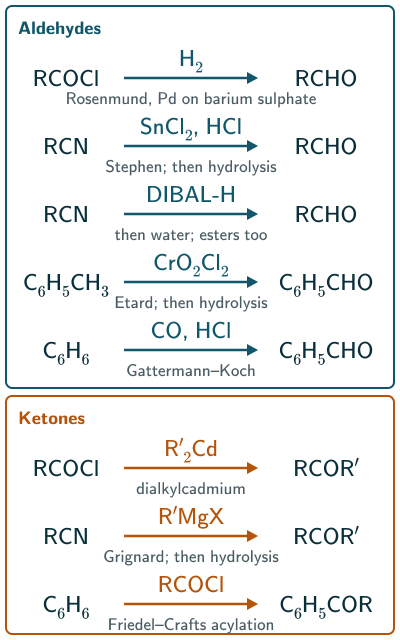
- Rosenmund reduction. An acyl chloride is hydrogenated over palladium on barium sulphate: C6H5COCl + H2 → C6H5CHO + HCl (Pd–BaSO4), benzoyl chloride to benzaldehyde (NCERT page 232).
- Stephen reaction. Nitriles “are reduced to corresponding imine with stannous chloride in the presence of hydrochloric acid”, which hydrolysis turns into the aldehyde (NCERT page 232). The reaction sequence is RCN → RCH=NH → RCHO, with SnCl2/HCl for reduction and water for hydrolysis. In the acid the imine is present protonated, as an iminium salt, so the middle formula is a shorthand, not a balanced reagent equation (reasoned); name it the imine, as NCERT does, in an exam.
- DIBAL-H. Diisobutylaluminium hydride, AlH(i-Bu)2, selectively reduces nitriles to imines, which water hydrolyses to aldehydes; the isolated C=C bond is retained in the NCERT example, CH3CH=CHCH2CH2CN → CH3CH=CHCH2CH2CHO. Esters can also give aldehydes with a controlled amount of DIBAL-H at low temperature (commonly about −78 °C), under dry conditions, followed by aqueous work-up. Excess reagent or warmer conditions can give further reduction to alcohols. NCERT illustrates: CH3(CH2)9COOC2H5 → CH3(CH2)9CHO (NCERT page 232).
Etard and Gattermann–Koch reactions
Strong oxidising agents take toluene all the way to benzoic acid. The first three methods below modify its methyl group; Gattermann–Koch instead introduces a new formyl carbon into an aromatic ring (NCERT page 232):
- Etard reaction. Chromyl chloride, CrO2Cl2, in CS2 converts the methyl group of toluene into a chromium complex, C6H5CH(OCrOHCl2)2, which H3O+ hydrolyses to benzaldehyde (NCERT pages 232–233).
- Chromic oxide. CrO3 in acetic anhydride at 273–283 K gives benzylidene diacetate, C6H5CH(OCOCH3)2, which aqueous acid hydrolyses to benzaldehyde (NCERT page 233).
- Side-chain chlorination, then hydrolysis. Cl2 in light turns toluene into benzal chloride, C6H5CHCl2, which water at 373 K hydrolyses to benzaldehyde; this is a commercial method (NCERT page 233). Light initiates radical side-chain chlorination; the extent of chlorination must be controlled to favour CHCl2 over CH2Cl or CCl3. The absence of iron alone does not specify the reaction conditions. Compare the chlorination of toluene (reasoned).
- Gattermann–Koch reaction. Benzene or a derivative with carbon monoxide and hydrogen chloride, in the presence of anhydrous AlCl3 with CuCl, gives benzaldehyde or a substituted benzaldehyde (NCERT page 233, whose catalyst wording is the slip below).
- NCERT slip (page 233): the text says “anhydrous aluminium chloride or cuprous chloride”, as if either would do, while its scheme labels the arrow “Anhyd. AlCl3/CuCl”. Beyond the NCERT text: AlCl3 is the Lewis acid, and when CO is not used at high pressure, traces of a copper(I) chloride co-catalyst are often necessary, so the usual system combines the two chlorides; the method does not apply to phenols and phenol ethers (Wikipedia, “Gattermann reaction”). In an exam, write CO and HCl with anhydrous AlCl3/CuCl, as NCERT’s scheme does.
- Spelling note: NCERT writes “Gatterman-Koch” here (page 233), and on page 275 (Unit 9, Amines) it prints both “Gatterman reaction” and “Gattermann reaction”, for a different reaction that carries the same name. This page uses Gattermann, the spelling NCERT also prints. Expect either spelling in a question.
Preparation of ketones
- From acyl chlorides. A dialkylcadmium, made from cadmium chloride and a Grignard reagent, converts an acyl chloride into a ketone (NCERT page 233): 2RMgX + CdCl2 → R2Cd + 2Mg(X)Cl, then 2R′COCl + R2Cd → 2R′COR + CdCl2.
- From nitriles. A Grignard reagent adds to the nitrile, and hydrolysis of the product gives a ketone: CH3CH2CN + C6H5MgBr, in dry ether, then a separate H3O+ work-up, gives C2H5COC6H5, propiophenone (NCERT page 234).
- Friedel–Crafts acylation. Benzene or a substituted benzene with an acid chloride and anhydrous AlCl3 gives the ketone, C6H5COR or C6H5COAr (NCERT page 234), the acylation of suitable aromatic hydrocarbons.
Friedel–Crafts acylation is unsuitable for strongly deactivated rings; amino groups can bind AlCl3 and prevent the usual reaction. Grignard steps require dry apparatus and no unprotected acidic O–H or N–H groups.
- NCERT slip (page 234): NCERT labels propiophenone “1-Phenylpropanone”, without the locant of the carbonyl group. The name is ambiguous: 1-phenylpropan-2-one, C6H5CH2COCH3, is a different ketone. NCERT itself writes 1-phenylpropan-1-one on page 229; use that name in an exam. NCERT uses the same name again in Exercise 8.7 (vi) (page 256); either reading is a ketone with α-hydrogens, so the expected answer there, aldol condensation, is the same (reasoned).
Solved examples
Example 1: Choosing the reagent
Name a reagent for each change: (i) propanoyl chloride to propanal; (ii) benzonitrile to benzaldehyde; (iii) 4-methoxytoluene to 4-methoxybenzaldehyde; (iv) ethyl hexanoate to hexanal.
Answer: (i) H2 over Pd–BaSO4 (Rosenmund). (ii) SnCl2 and HCl, then H3O+ (Stephen), or DIBAL-H then water. (iii) CrO2Cl2 in CS2, then H3O+ (Etard), or CrO3 in acetic anhydride, then aqueous acid. (iv) DIBAL-H, then water (reasoned from NCERT pages 232–233).
Example 2: Benzaldehyde from toluene
What mass of benzaldehyde can 13.8 g of toluene give, at most, by side-chain chlorination and hydrolysis? (C = 12, H = 1, O = 16.)
Answer: M(C7H8) = 84 + 8 = 92 g mol−1, so 13.8 g is 0.150 mol. One mole of toluene gives one mole of benzaldehyde, C7H6O, M = 84 + 6 + 16 = 106 g mol−1: 0.150 × 106 = 15.9 g (reasoned from NCERT page 233).
Example 3: A ketone from a nitrile
Which nitrile and Grignard reagent give butan-2-one, CH3COCH2CH3?
Answer: Either CH3CN with CH3CH2MgBr, or CH3CH2CN with CH3MgBr, each followed by hydrolysis: the Grignard group and the nitrile’s group end up on the two sides of the C=O (reasoned from NCERT page 234).
Common mistakes to avoid
Common mistake
Using acidified permanganate to make benzaldehyde from toluene
Strong oxidising agents go on to benzoic acid. To stop at the aldehyde, use chromyl chloride (Etard) or CrO3 in acetic anhydride.
Common mistake
Forgetting the hydration conditions
With dilute H2SO4/HgSO4, ethyne gives ethanal and other ordinary alkynes give ketones. Hydroboration followed by oxidation, which NCERT applies to alkenes (Unit 7, page 200), is a different route: on a terminal alkyne it puts the OH on the end carbon, and the enol formed changes to an aldehyde (reasoned from NCERT Unit 7, page 200, and the enol step in alkyne hydration).
Common mistake
Mixing up the Stephen and Rosenmund starting materials
Stephen starts from a nitrile (SnCl2, HCl); Rosenmund starts from an acyl chloride (H2, Pd–BaSO4).
Quick revision summary
- Both: oxidation or dehydrogenation (Ag or Cu) of 1° and 2° alcohols; ozonolysis of alkenes; H2SO4/HgSO4 hydration of alkynes (only ethyne gives an aldehyde under these conditions).
- Aldehydes: Rosenmund (RCOCl, H2, Pd–BaSO4); Stephen (RCN, SnCl2/HCl, then H3O+); DIBAL-H for nitriles and esters; Etard (CrO2Cl2); CrO3 in acetic anhydride; benzal chloride hydrolysis; Gattermann–Koch (CO, HCl, AlCl3 with CuCl).
- Ketones: R2Cd with acyl chlorides; Grignard reagents with nitriles, then hydrolysis; Friedel–Crafts acylation.
Formula sheet
- RCOCl + H → RCHO + HCl (Pd–BaSO, Rosenmund)
- RCN → RCH=NH → RCHO (SnCl and HCl, then HO; Stephen)
- CHCH → CHCHO (CrOCl in CS, then HO; Etard)
- CH + CO → CHCHO (HCl, anhydrous AlCl with CuCl; Gattermann–Koch)
- 2R′COCl + RCd → 2R′COR + CdCl
Questions students ask
What is the role of barium sulphate in the Rosenmund reduction?
BaSO4 supports the palladium catalyst: NCERT’s Rosenmund reduction uses palladium on barium sulphate (page 232). Catalyst activity and reaction conditions are chosen to favour the aldehyde over further hydrogenation; additional deactivating agents can be used, but are not universal. Do not confuse this with Lindlar’s catalyst, “palladised charcoal partially deactivated with poisons like sulphur compounds or quinoline”, used to stop alkyne hydrogenation at a cis alkene (NCERT Class 11 Chemistry Part II, page 309); beyond the NCERT text, the conventional Lindlar catalyst is Pd on CaCO3, modified with lead compounds and commonly quinoline (Wikipedia, “Lindlar catalyst”).
Why can formaldehyde not be prepared by the Rosenmund reduction?
The required starting material would be formyl chloride, HCOCl, which is unstable under ordinary preparation and storage conditions. Rosenmund reduction is therefore not a standard route to formaldehyde. Gattermann–Koch introduces –CHO onto an aromatic ring and makes aromatic aldehydes; it does not make formaldehyde. Methanol oxidation or dehydrogenation provides the familiar route to formaldehyde.
Why does the Stephen reaction give an aldehyde and not an amine?
The Stephen reaction gives an aldehyde because SnCl2 and HCl reduce the nitrile only as far as the imine, RCH=NH, which water then hydrolyses to RCHO (NCERT page 232). Beyond the NCERT text, the imine is held as its salt, [RCH=NH2]+Cl−, which separates as a tin chloride compound, and its hydrolysis also gives ammonium chloride (Wikipedia, “Stephen aldehyde synthesis”). Stronger reducing agents carry a nitrile past the imine to a primary amine (reduction of nitriles), so the reducing agent decides the product; DIBAL-H also stops at the imine (NCERT page 232).
Why is carbon disulphide used in the Etard reaction?
CS2 is the solvent in NCERT’s Etard scheme; it is not the oxidising reagent. CrO2Cl2 converts the benzylic methyl group into a chromium-containing intermediate, and hydrolytic work-up releases benzaldehyde (NCERT pages 232–233). The key distinction from strong aqueous oxidation is this controlled intermediate and work-up. This reaction scheme is for understanding the conversion; solvent and chromium handling require an approved laboratory procedure.
Where are these named reactions taught, and how should I use them for exam preparation?
These reactions appear in NCERT Class 12 Chemistry Part II, Unit 8, Section 8.2, pages 231–234. They are useful preparation methods to study alongside the unit’s general organic chemistry. A syllabus heading about general methods of preparation does not establish that every named method will be tested; check the official syllabus for your examination year instead of treating this page as a guarantee of question coverage.
Practice questions
Try each question first, then open the answer to check your working.
-
Q1. Why can toluene not be turned into benzaldehyde with acidified KMnO4, and what is used instead?
Show answerHide answer
Strong oxidising agents oxidise the methyl group right through to –COOH, giving benzoic acid. Chromyl chloride (Etard) or CrO3 in acetic anhydride converts it to an intermediate that resists further oxidation and is hydrolysed to benzaldehyde (NCERT pages 232–233).
-
Q2. What does but-2-yne, CH3C≡CCH3, give on hydration with dilute H2SO4 and HgSO4?
Show answerHide answer
Butan-2-one, CH3COCH2CH3: under these conditions only ethyne gives an aldehyde; other ordinary alkynes give ketones (NCERT page 232). This symmetrical alkyne can give only one ketone, the same one that Example 3 makes from a nitrile (reasoned).