Physical properties of aldehydes and ketones
NCERT Class 12 Chemistry Chapter 8 Section 8.3
Quick answer
Simple aldehydes and ketones generally boil above hydrocarbons and ethers but below alcohols of comparable mass; this trend has exceptions. Their carbonyl oxygen accepts hydrogen bonds from water, so small members dissolve readily, while water solubility generally falls as the hydrocarbon chain grows. Ethanal, which NCERT calls a volatile liquid, boils near 20–21 °C at 1 atm, so it is a gas at 25 °C.
With your textbook
NCERT Chemistry Part II (Class 12), Chapter 8 “Aldehydes, Ketones and Carboxylic Acids”, Section 8.3 “Physical Properties”, pages 235–236.
Open the official NCERT chapter (PDF, 4.4 MB, ncert.nic.in) (opens in a new tab)
Checked against the 2026-27 reprint on .
What are the physical properties of aldehydes and ketones?
Physical properties of aldehydes and ketones
Simple aldehydes and ketones generally boil higher than hydrocarbons and ethers of similar molar mass but lower than alcohols; the small ones mix with water in all proportions, and solubility falls as the carbon chain grows (NCERT page 235). NCERT explains the boiling points:
The boiling points of aldehydes and ketones are higher than hydrocarbons and ethers of comparable molecular masses. It is due to weak molecular association in aldehydes and ketones arising out of the dipole-dipole interactions.
NCERT Chemistry Part II (Class 12), Section 8.3, page 235
In plain words: the polar C=O groups of neighbouring molecules attract each other, which raises the boiling point above that of an alkane. A simple aldehyde or ketone with no additional O–H or N–H group has no conventional hydrogen-bond donor, so its molecules cannot hydrogen bond to each other as alcohol molecules do. Its oxygen can still accept a hydrogen bond from water, which is why the small ones dissolve.
Physical state and odour
- Methanal is a gas at room temperature, ethanal is “a volatile liquid”, and the other aldehydes and ketones are liquids or solids (NCERT page 235). Beyond the NCERT text: ethanal boils at about 20–21 °C at 1 atm (NIST), so it is a liquid only below that and a gas at 25 °C and 1 atm. In an exam that follows NCERT’s wording, give methanal as the gas at room temperature and ethanal as a volatile liquid.
- The lower aldehydes have sharp, pungent odours; as the molecules get larger the odour becomes less pungent and more fragrant, and many natural aldehydes and ketones are used in perfumes and flavourings (NCERT page 235).
Boiling points
- Higher than hydrocarbons and ethers of comparable molar mass, because of the weak association of the polar C=O dipoles (dipole–dipole attraction) (NCERT page 235).
- Lower than alcohols of similar molar mass, because simple aldehydes and ketones without an additional hydrogen-bond donor have no conventional intermolecular hydrogen bonding (NCERT page 235).
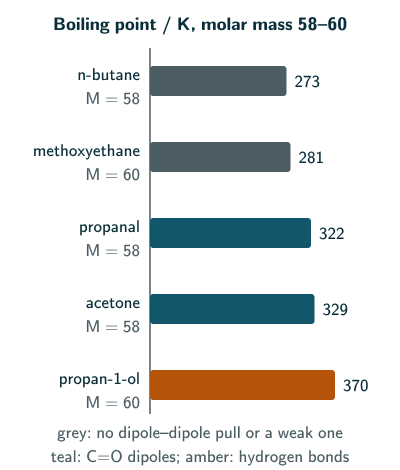
NCERT’s compounds of molar mass 58 and 60, in increasing order of boiling point (page 235):
| Compound | M | b.p./K |
|---|---|---|
| n-butane | 58 | 273 |
| methoxyethane | 60 | 281 |
| propanal | 58 | 322 |
| acetone | 58 | 329 |
| propan-1-ol | 60 | 370 |
The same pattern holds for the haloalkanes, whose polar C–X bonds help raise their boiling points considerably above those of hydrocarbons of comparable molecular mass (NCERT Unit 6, page 168).
- NCERT slip (page 235): Example 8.2 prints CH3CH2CH2CH3, which is butane (M = 58), in its question and again in its answer, but its solution says the masses are “in the range of 72 to 74” and calls the compound n-pentane, CH3CH2CH2CH2CH3 (M = 72). The two readings do not give the same order. Butane (273 K) boils far below ethoxyethane, so NCERT’s printed order is right for butane. n-Pentane does not boil lowest: NCERT’s own data for ethers put n-pentane at 309.1 K and ethoxyethane at 307.6 K (NCERT Unit 7, page 217). Answer for the formula actually given. For n-pentane and ethoxyethane, the measured order is ethoxyethane < n-pentane; the generic functional-group trend does not override these data. If a question gives n-pentane and its answer key follows NCERT’s functional-group order, n-pentane < ethoxyethane < butanal < butan-1-ol, choose that order, and in a written answer add that by NCERT’s own data (Unit 7, page 217) ethoxyethane in fact boils 1.5 K lower.
Solubility
- NCERT gives the lower members, methanal, ethanal and propanone, as “miscible with water in all proportions, because they form hydrogen bond with water” (page 235); give that in an exam. Beyond the NCERT text: ethanal and propanone are truly miscible, but methanal is a gas whose saturated solution holds about 37% by mass, and it reacts with water, mainly to the hydrate CH2(OH)2, with oligomers, so its dissolution is not simple physical mixing (Wikipedia, “Formaldehyde”).
- Solubility decreases rapidly as the alkyl chain gets longer (NCERT page 235): the growing hydrocarbon part cannot hydrogen bond (reasoned).
- NCERT says all aldehydes and ketones are fairly soluble in organic solvents such as benzene, ether, methanol and chloroform (page 235).
Solved examples
Example 1: Ranking NCERT’s four compounds
Arrange CH3CH2CH2CHO, CH3CH2CH2CH2OH, H5C2–O–C2H5 and CH3CH2CH2CH3 in order of increasing boiling point, and give their molar masses. (C = 12, H = 1, O = 16.)
Answer: Butane, C4H10 = 48 + 10 = 58; butanal, C4H8O = 48 + 8 + 16 = 72; ethoxyethane and butan-1-ol, C4H10O = 48 + 10 + 16 = 74. Order: butane < ethoxyethane < butanal < butan-1-ol. Butane has only weak van der Waals forces; butanal is more polar than ethoxyethane, so its dipole–dipole attraction is stronger; butan-1-ol molecules are hydrogen bonded (NCERT Example 8.2, page 235, with the formula it prints). Put n-pentane in place of butane and the first two places reverse: ethoxyethane 307.6 K < n-pentane 309.1 K (NCERT Unit 7, page 217).
Example 2: How big are the gaps?
Using NCERT’s data, by how many kelvin does propanal boil above n-butane, and propan-1-ol above acetone?
Answer: Propanal − n-butane = 322 − 273 = 49 K. Propan-1-ol − acetone = 370 − 329 = 41 K. These differences illustrate the trend, but cannot isolate the numerical contribution of one intermolecular force: molecular structure and all interactions change together (reasoned from NCERT page 235).
Common mistakes to avoid
Common mistake
Saying aldehyde molecules hydrogen bond to each other
Simple aldehydes and ketones without an additional O–H or N–H group cannot donate conventional hydrogen bonds. A hydroxyaldehyde, for example, can hydrogen bond through its –OH group. Their oxygen accepts hydrogen bonds from water, which explains their solubility, not their boiling points.
Common mistake
Expecting all aldehydes and ketones to dissolve in water
Only the small ones mix in all proportions; solubility falls rapidly as the alkyl chain grows.
Quick revision summary
- Methanal is a gas at room temperature and ethanal a volatile liquid (NCERT); ethanal boils near 20–21 °C at 1 atm, so it is gaseous at 25 °C (NIST). Other members are liquids or solids.
- General b.p. trend for comparable simple compounds: hydrocarbons and ethers < aldehydes and ketones (dipole–dipole attraction between C=O groups) < alcohols (hydrogen bonding), at similar molar mass.
- NCERT data (M 58–60): n-butane 273 K < methoxyethane 281 K < propanal 322 K < acetone 329 K < propan-1-ol 370 K.
- Ethanal and propanone are miscible with water; NCERT includes methanal too, which in fact is very soluble (saturated near 37% by mass) and hydrates. Water solubility falls as the chain grows; all are fairly soluble in organic solvents (NCERT).
Formula sheet
- General b.p. trend at similar mass: alkanes and ethers < aldehydes and ketones < alcohols
- n-butane 273 K, methoxyethane 281 K, propanal 322 K, acetone 329 K, propan-1-ol 370 K
Questions students ask
Which has the higher boiling point, an aldehyde or a ketone?
Neither class always boils higher. In NCERT’s data, the isomers propanal and acetone have the same molar mass, yet they boil at different temperatures (NCERT page 235). Their molecular geometry, dipole moments and dispersion interactions differ. Use measured values for a close comparison; the broad alcohol/carbonyl/hydrocarbon trend is not a complete ordering rule.
How soluble in water are aldehydes and ketones with four or five carbon atoms?
They generally have finite, lower water solubility than the smallest members. The carbonyl oxygen still accepts hydrogen bonds, but the growing hydrocarbon portion makes mixing less favourable. Isomerism and temperature also matter, so carbon count alone does not provide a numerical solubility. Always specify temperature and units when using measured solubility data; do not confuse a saturated solution with miscibility in every proportion.
What are the melting points of aldehydes and ketones?
There is no single melting-point rule for the functional group. Melting depends on crystal packing as well as intermolecular forces, so isomers can differ substantially and need not follow their boiling-point order. NCERT Section 8.3 supplies boiling-point examples rather than a melting-point table. For a state-of-matter question, compare the stated temperature with both the melting and boiling points at the stated pressure.
Practice questions
Try each question first, then open the answer to check your working.
-
Q1. Why is propanone miscible with water in all proportions while hexan-2-one is much less soluble?
Show answerHide answer
Both can accept hydrogen bonds from water at the C=O oxygen, but hexan-2-one’s longer hydrocarbon chain cannot, and solubility falls rapidly as the chain grows (NCERT page 235; reasoned).
-
Q2. Why does propanal boil lower than propan-1-ol although their molar masses are close?
Show answerHide answer
Propan-1-ol molecules are held together by intermolecular hydrogen bonds; propanal has no O–H group, so its molecules have dipole–dipole and dispersion attractions without the alcohol’s hydrogen-bond network (NCERT page 235).