Forms of the equation of a line
NCERT Class 11 Mathematics Chapter 9 Section 9.3
Quick answer
A line through (x, y) with slope m is y − y = m(x − x), and through two points with x ≠ x it is y − y = ((y − y)/(x − x))(x − x). With slope m and y-intercept c it is y = mx + c, and with non-zero intercepts a and b on the axes it is x/a + y/b = 1. Every line can be written as Ax + By + C = 0, with A and B not both zero; if B ≠ 0 its slope is −A/B, and horizontal and vertical lines are y = a and x = b.
With your textbook
NCERT Mathematics (Class 11), Chapter 9 “Straight Lines”, Section 9.3 “Various Forms of the Equation of a Line”, pages 159–164.
Open the official NCERT chapter (PDF, 2.5 MB, ncert.nic.in) (opens in a new tab)
Checked against the 2026-27 reprint on .
What is the equation of a line?
We know that every line in a plane contains infinitely many points on it.
NCERT Mathematics (Class 11), Section 9.3, page 159
Equation of a line
- An equation of a line L is an equation in x and y that is true for the coordinates of every point of L and false for every other point.
- The forms below all describe straight lines; they differ in which facts about the line they start from.
To decide whether a point lies on a line, we need a test that the point passes exactly when it is on the line. NCERT Section 9.3 (page 159) says that this test is just an equation:
Of course the statement is merely an algebraic equation involving the variables x and y.
NCERT Mathematics (Class 11), Section 9.3, page 159
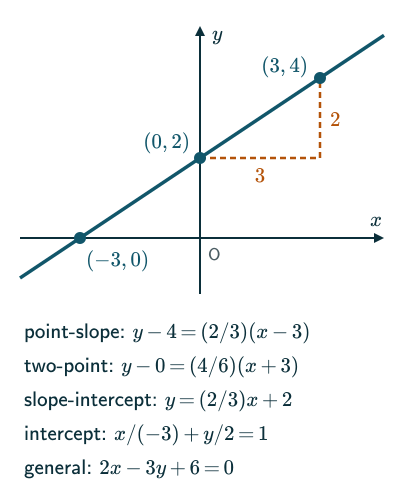
In plain words: once you have the equation, a point is on the line exactly when its coordinates make the equation true. For example, (3, 4) is on 2x − 3y + 6 = 0 because 6 − 12 + 6 = 0, and (1, 1) is not, because 2 − 3 + 6 = 5.
Horizontal and vertical lines
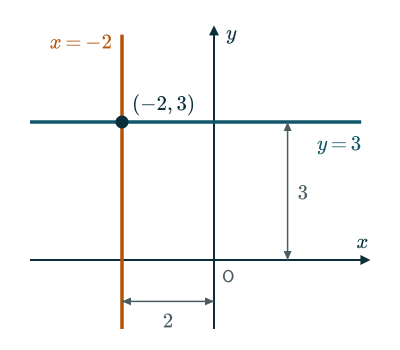
Every point of a horizontal line at distance a from the x-axis has y-coordinate a (above the x-axis) or −a (below it). So its equation is y = a or y = −a. In the same way, a vertical line at distance b from the y-axis is x = b (to the right) or x = −b (to the left) (NCERT Section 9.3.1, pages 159–160, Fig 9.8).
NCERT says the sign for the horizontal line depends on whether the line is “above or below the y-axis”. It means the x-axis, because a horizontal line is above or below the x-axis.
NCERT Example 4 (page 160): the lines through (−2, 3) parallel to the axes are y = 3, since every point of the horizontal line has y-coordinate 3, and x = −2.
Point-slope form
Let P0(x0, y0) be a fixed point on a non-vertical line L with slope m, and P(x, y) any other point of L (NCERT Section 9.3.2, page 160). By the slope formula for two points, m = (y − y0)/(x − x0). Multiplying by x − x0:
Point-slope form
y − y = m(x − x)
P0 itself also satisfies this equation, and no point off L does, so it is the equation of L.
NCERT Example 5 (page 161): the line through (−2, 3) with slope −4 is y − 3 = −4(x + 2), that is 4x + y + 5 = 0. NCERT introduces this working with “By slope-intercept form formula (1) above”, but formula (1) is the point-slope form, which is what the example uses.
Two-point form
Let L pass through P1(x1, y1) and P2(x2, y2), with x1 ≠ x2, and let P(x, y) be any point of L (NCERT Section 9.3.3, page 161). P1, P2 and P are collinear, so slope of P1P = slope of P1P2:
Two-point form
y − y = ((y − y)/(x − x))(x − x)
This is the point-slope form with the slope worked out from the two points. The two given points must be distinct. If x1 = x2, the line is vertical: x = x1.
NCERT Example 6 (page 161): through (1, −1) and (3, 5), the slope is (5 + 1)/(3 − 1) = 3. So y + 1 = 3(x − 1), that is −3x + y + 4 = 0.
Slope-intercept form
If L has slope m and meets the y-axis at (0, c), the point-slope form gives y − c = m(x − 0) (NCERT Section 9.3.4, page 162). The number c is the y-intercept.
Note that the value of c will be positive or negative according as the intercept is made on the positive or negative side of the y-axis, respectively.
NCERT Mathematics (Class 11), Section 9.3.4, page 162
If instead L meets the x-axis at (d, 0), the x-intercept is d, and the point-slope form gives y = m(x − d).
Slope-intercept forms
y = mx + c
y = m(x − d)
NCERT Example 7 (page 162): tan θ = 1/2. (i) With y-intercept −3/2: y = x/2 − 3/2, that is 2y − x + 3 = 0. (ii) With x-intercept 4: y = (x − 4)/2, that is 2y − x + 4 = 0.
Intercept form
If L meets the x-axis at (a, 0) and the y-axis at (0, b), with a, b ≠ 0, the two-point form gives (NCERT Section 9.3.5, page 163):
y − 0 = ((b − 0)/(0 − a))(x − a)
ay = −bx + ab
bx + ay = ab
Dividing by ab:
Intercept form
x/a + y/b = 1
NCERT Example 8 (page 163): intercepts −3 and 2 give x/(−3) + y/2 = 1. Multiplying by −6 gives 2x − 3y = −6, that is 2x − 3y + 6 = 0. A line through the origin has both intercepts 0, so it has no intercept form; it is y = mx or x = 0.
The general equation Ax + By + C = 0
Any equation of the form Ax + By + C = 0, where A and B are not zero simultaneously is called general linear equation or general equation of a line.
NCERT Mathematics (Class 11), Section 9.3, page 163
Every form above can be rearranged to this one, and every such equation is a straight line. Reading its features:
- If B ≠ 0: y = −(A/B)x − C/B, so the slope is −A/B and the y-intercept is −C/B. This is the graph of the linear function f(x) = mx + c with m = −A/B and c = −C/B.
- If A ≠ 0: the x-intercept is −C/A.
- If B = 0, the line is vertical, x = −C/A. If A = 0, it is horizontal, y = −C/B. If C = 0, it passes through the origin.
Reading Ax + By + C = 0
slope = −A/B, B ≠ 0
x-intercept = −C/A, A ≠ 0
y-intercept = −C/B, B ≠ 0
Parallel and perpendicular lines through a point. A line parallel to Ax + By + C = 0 has the same normal direction (A, B), and the same slope −A/B when B ≠ 0. So the one through (x1, y1) is A(x − x1) + B(y − y1) = 0 (NCERT Exercise 9.3, Q10). The perpendicular one swaps A and B and changes one sign: B(x − x1) − A(y − y1) = 0.
Parallel line through (x, y)
A(x − x) + B(y − y) = 0
Perpendicular line through (x, y)
B(x − x) − A(y − y) = 0
NCERT Exercise 9.3, Q1 and Q2 (page 167): 6x + 3y − 5 = 0 becomes y = −2x + 5/3, with slope −2 and y-intercept 5/3. 3x + 2y − 12 = 0 becomes x/4 + y/6 = 1, with intercepts 4 and 6.
Solved examples
Example 1: A median (NCERT Exercise 9.2, Q8, page 164)
The vertices of triangle PQR are P(2, 1), Q(−2, 3) and R(4, 5). Find the equation of the median through R.
The median joins R to the mid-point of PQ, which is ((2 − 2)/2, (1 + 3)/2) = (0, 2). The slope from (0, 2) to (4, 5) is 3/4, and the y-intercept is 2:
y = (3/4)x + 2
Answer: 3x − 4y + 8 = 0.
Example 2: Intercepts with a given sum (NCERT Exercise 9.2, Q12, page 164)
Find the equation of the line through (2, 2) whose intercepts on the axes add up to 9.
Take intercepts a and 9 − a: x/a + y/(9 − a) = 1. Putting in (2, 2):
2(9 − a) + 2a = a(9 − a)
a2 − 9a + 18 = 0, a quadratic equation with roots a = 3 and a = 6.
Answer: x/3 + y/6 = 1, that is 2x + y − 6 = 0, or x/6 + y/3 = 1, that is x + 2y − 6 = 0.
Example 3: The foot of the perpendicular from the origin (NCERT Exercise 9.2, Q14, page 164)
The perpendicular from the origin to a line meets it at (−2, 9). Find the equation of the line.
The perpendicular OP has slope 9/(−2) = −9/2, so the line has slope 2/9 and passes through (−2, 9):
y − 9 = (2/9)(x + 2)
9y − 81 = 2x + 4
Answer: 2x − 9y + 85 = 0.
Example 4: Reading the general equation (NCERT Miscellaneous Exercise, Q1, page 172)
Find the values of k for which the line (k − 3)x − (4 − k2)y + k2 − 7k + 6 = 0 is (a) parallel to the x-axis, (b) parallel to the y-axis, (c) passing through the origin.
(a) Parallel to the x-axis means the coefficient of x is 0 (and that of y is not): k = 3. Then the y-coefficient is −(4 − 9) = 5 ≠ 0.
(b) Parallel to the y-axis means the coefficient of y is 0: 4 − k2 = 0, k = ±2. Then the x-coefficient is −1 or −5, not 0.
(c) Through the origin means the constant is 0: k2 − 7k + 6 = (k − 1)(k − 6) = 0.
Answer: (a) k = 3; (b) k = 2 or −2; (c) k = 1 or 6.
Example 5: A linear model (NCERT Exercise 9.2, Q16, page 164)
A milk store sells 980 litres a week at ₹14 a litre and 1220 litres a week at ₹16 a litre. Assuming a linear relationship between price and demand, how much could it sell at ₹17 a litre?
Plot litres q vertically against price p horizontally. The line through (14, 980) and (16, 1220) has slope 240/2 = 120 litres per rupee:
q − 1220 = 120(p − 16)
At p = 17, q = 1220 + 120 = 1340.
Answer: 1340 litres a week.
Example 6: A point dividing a segment between the axes (NCERT Exercise 9.2, Q18, page 164)
R(h, k), with h, k ≠ 0, divides a line segment between the axes internally in the ratio 1 : 2. Find the equation of the line.
Let the segment run from A(p, 0) on the x-axis to B(0, q) on the y-axis, with AR : RB = 1 : 2. By the section formula, R = (2p/3, q/3), so p = 3h/2 and q = 3k. The intercept form gives
x/(3h/2) + y/(3k) = 1.
Answer: 2kx + hy = 3hk. If the ratio is measured from the y-axis end instead, the same steps give kx + 2hy = 3hk.
Common mistakes to avoid
Common mistake
Misreading the slope −A/B
The slope is −A/B, not A/B or −B/A. For 2x − 3y + 6 = 0 it is −2/(−3) = 2/3.
Common mistake
Using the intercept form for a line through the origin
x/a + y/b = 1 needs a, b ≠ 0. In “equal intercepts through (2, 3)” (NCERT Exercise 9.2, Q11), x + y = 5 is the line NCERT wants. But y = 3x/2 also passes through (2, 3), and its intercepts are both 0, so they are equal too. Unless the question says the intercepts are non-zero, give both lines. If it says “equal in magnitude”, b = −a also counts: x − y = a, which through (2, 3) is x − y + 1 = 0.
Common mistake
Dropping the sign of an intercept
Intercepts are coordinates, so they can be negative. Intercepts −3 and 2 give x/(−3) + y/2 = 1, not x/3 + y/2 = 1.
Common mistake
Using the point-slope form for a vertical line
A vertical line has no slope. The line through (3, −2) and (3, 4) is x = 3; y − y0 = m(x − x0) cannot describe it.
Quick revision summary
- Horizontal lines are y = a, vertical lines are x = b.
- Point-slope: y − y0 = m(x − x0). Two-point: the same with m = (y2 − y1)/(x2 − x1).
- Slope-intercept: y = mx + c, or y = m(x − d) with x-intercept d. Intercept form: x/a + y/b = 1, for a, b ≠ 0.
- General form Ax + By + C = 0 (A, B not both 0): slope −A/B (B ≠ 0), intercepts −C/A (A ≠ 0) and −C/B (B ≠ 0). The parallel line through (x1, y1) is A(x − x1) + B(y − y1) = 0.
Formula sheet
- horizontal: y = a; vertical: x = b
- y − y = m(x − x)
- y − y = ((y − y)/(x − x))(x − x), x ≠ x
- y = mx + c; y = m(x − d)
- x/a + y/b = 1 (a, b ≠ 0)
- Ax + By + C = 0: slope −A/B (B ≠ 0); intercepts −C/A (A ≠ 0), −C/B (B ≠ 0)
- parallel through (x, y): A(x − x) + B(y − y) = 0
- perpendicular through (x, y): B(x − x) − A(y − y) = 0
Questions students ask
What is the difference between point-slope form and slope-intercept form?
Point-slope form and slope-intercept form describe the same line from different starting facts: y − y0 = m(x − x0) uses the slope and any known point, while y = mx + c uses the slope and the point (0, c) where the line crosses the y-axis. So slope-intercept form is point-slope form with the known point on the y-axis, and expanding a point-slope equation and solving for y converts one into the other. For example, the line through (2, 7) with slope 3 is y − 7 = 3(x − 2) in point-slope form and y = 3x + 1 in slope-intercept form.
Which form of the equation of a line should you use?
The form of the equation of a line to use depends on what the question gives: a point and the slope call for point-slope form, two points for two-point form, the slope and the y-intercept for y = mx + c, and two non-zero intercepts for x/a + y/b = 1. A line parallel to an axis is simply x = b or y = a, and a line parallel or perpendicular to a given line Ax + By + C = 0 comes quickest from the general form. Whichever form you start from, the answer is usually written in the general form, which every line has.
Is the general form of a line the same as the standard form?
The general form and the standard form of a line are the same equation written in two ways. NCERT calls Ax + By + C = 0, with A and B not both zero, the general equation of a line, while many other books, especially American ones, call Ax + By = C the standard form (the name is not used the same way everywhere). Moving the constant across changes its sign, so 5x − 2y + 7 = 0 in general form is 5x − 2y = −7 in standard form: the same line, with the same slope 5/2.
What is the slope-intercept form of a vertical line?
A vertical line has no slope-intercept form: its equation is x = b, it has no slope, and it does not cross the y-axis at a single point, so it cannot be written as y = mx + c. In the general form Ax + By + C = 0 the vertical lines are exactly those with B = 0, which is why reading the slope as −A/B needs B ≠ 0. A horizontal line does have one: y = 5, for example, is y = 0·x + 5, with slope 0 and y-intercept 5, while x = −4 has none.
Is the normal form of a line in the Class 11 syllabus?
The normal form of a line, x cos ω + y sin ω = p, is not in the 2026–27 NCERT Class 11 book, whose Section 9.3 covers lines parallel to the axes, the point-slope, two-point, slope-intercept and intercept forms and the general equation; NCERT dropped the normal form in its 2022 rationalisation. The JEE Main syllabus (Unit 10) says only “various forms of equations of a line”, without naming them. Here p is the length of the perpendicular from the origin and ω the angle it makes with the positive x-axis: dividing 5x + 12y = 26 by √(52 + 122) = 13 gives (5/13)x + (12/13)y = 2, so p = 2.
Practice questions
Try each question first, then open the answer to check your working.
-
Q1. Find the equation of the line through (−4, 3) with slope 1/2 (NCERT Exercise 9.2, Q2).
Show answerHide answer
y − 3 = (1/2)(x + 4), so 2y − 6 = x + 4, that is x − 2y + 10 = 0.
-
Q2. Find the equation of the line through (2, 2√3) inclined to the x-axis at 75° (NCERT Exercise 9.2, Q4).
Show answerHide answer
m = tan 75° = 2 + √3. Then
y − 2√3 = (2 + √3)(x − 2)
y = (2 + √3)x − 4,
that is (2 + √3)x − y − 4 = 0.
-
Q3. Find the equation of the line that meets the x-axis 3 units to the left of the origin, with slope −2 (NCERT Exercise 9.2, Q5).
Show answerHide answer
The x-intercept is −3, so y = −2(x + 3), that is 2x + y + 6 = 0.
-
Q4. Find the equation of the line that meets the y-axis 2 units above the origin and makes 30° with the positive x-axis (NCERT Exercise 9.2, Q6).
Show answerHide answer
m = tan 30° = 1/√3 and c = 2, so y = x/√3 + 2, that is x − √3y + 2√3 = 0.