Coordinate geometry basics
NCERT Class 11 Mathematics Chapter 9 Section 9.1
Quick answer
The distance PQ between P(x, y) and Q(x, y) is given by PQ = (x − x) + (y − y), from Pythagoras’ theorem; PQ is its square root. The point dividing PQ internally in the ratio m : n is ((mx + nx)/(m + n), (my + ny)/(m + n)), and m = n gives the mid-point ((x + x)/2, (y + y)/2). A triangle with these vertices and (x, y) has area ½|x(y − y) + x(y − y) + x(y − y)|, and three points are collinear exactly when this area is zero.
With your textbook
NCERT Mathematics (Class 11), Chapter 9 “Straight Lines”, Section 9.1 “Introduction”, pages 151–152.
Open the official NCERT chapter (PDF, 2.5 MB, ncert.nic.in) (opens in a new tab)
Checked against the 2026-27 reprint on .
Points in the coordinate plane
Coordinate geometry studies figures with algebra. A point of the plane is named by an ordered pair (x, y), an element of R × R: x is its signed distance from the y-axis and y its signed distance from the x-axis. NCERT Section 9.1 (page 151) recalls that René Descartes was the first to study geometry systematically with algebra, in his book La Géométrie of 1637 (NCERT spells the title “La Géométry”).
We may note that the point (6, – 4) is at 6 units distance from the y-axis measured along the positive x-axis and at 4 units distance from the x-axis measured along the negative y-axis.
NCERT Mathematics (Class 11), Section 9.1, page 151
In plain words: the sign of each coordinate says which side of the axis the point is on, and its size says how far away it is. The point (3, 0) is on the x-axis, 3 units to the right of the origin. Chapter 9 starts by recalling four formulas from earlier classes: the distance, section, mid-point and area formulas (page 152). The rest of the chapter, from the slope to the distance of a point from a line, uses them throughout. JEE Main 2027 lists the distance and section formulas at the start of Unit 10, Co-ordinate Geometry.
Distance formula
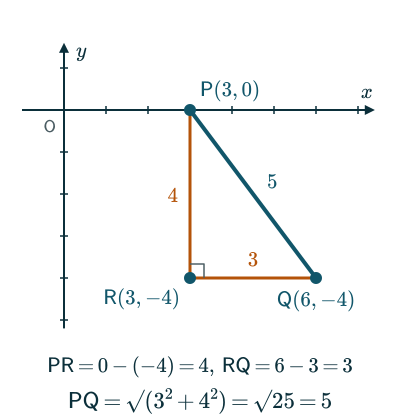
Take P(x1, y1) and Q(x2, y2). The vertical line through P and the horizontal line through Q meet at R(x1, y2), and the angle at R is a right angle. The legs are PR = |y2 − y1| and RQ = |x2 − x1|. By Pythagoras’ theorem, PQ2 = (x2 − x1)2 + (y2 − y1)2. Squaring removes the need for the modulus signs.
Distance formula
PQ = √((x − x) + (y − y))
OP = √(x + y), O the origin
NCERT’s example (page 152): the distance between (6, −4) and (3, 0) is √((3 − 6)2 + (0 + 4)2) = √(9 + 16) = 5 units. The order of the two points does not matter, because (x1 − x2)2 = (x2 − x1)2. If the two points have the same x-coordinate, the formula gives |y2 − y1|; if they have the same y-coordinate, it gives |x2 − x1|. In the Argand plane, the same formula gives the modulus |z1 − z2| as the distance between two complex numbers. In space, the third coordinate adds a third square: see the distance formula in three dimensions.
Section formula
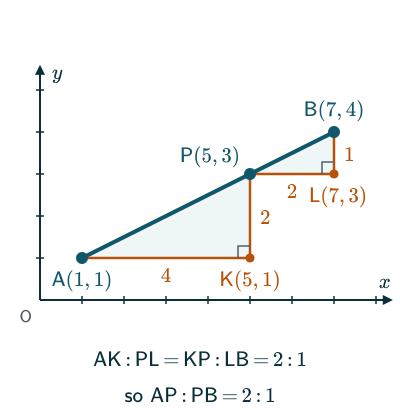
For distinct A and B and positive m, n, a point P on the segment AB divides AB internally in the ratio m : n if AP : PB = m : n. Let A(x1, y1), B(x2, y2) and P(x, y). Draw the horizontal line through A and the vertical line through P to meet at K(x, y1). Then draw the horizontal line through P and the vertical line through B to meet at L(x2, y). The right triangles AKP and PLB have equal angles at A and P, because AK and PL are parallel. So they are similar, and their sides are in the ratio AP : PB = m : n:
AK/PL = (x − x1)/(x2 − x) = m/n,
so n(x − x1) = m(x2 − x) and (m + n)x = mx2 + nx1. The vertical sides KP and LB give y in the same way. This triangle argument uses non-zero horizontal and vertical gaps; on a horizontal or vertical segment, the fixed coordinate stays unchanged and the other coordinate divides in the same ratio.
Section formula (internal division, m : n)
x = (mx + nx)/(m + n)
y = (my + ny)/(m + n)
Each end point is multiplied by the part of the ratio next to the other end: m, the part next to A, multiplies B’s coordinates. In the figure, m : n = 2 : 1, A(1, 1) and B(7, 4) give x = (2 × 7 + 1 × 1)/3 = 5 and y = (2 × 4 + 1 × 1)/3 = 3. Used for all three coordinates, the same rule gives the section formula in space.
NCERT’s example (page 152): the point dividing A(1, −3) and B(−3, 9) internally in the ratio 1 : 3 has x = (1 × (−3) + 3 × 1)/(1 + 3) = 0 and y = (1 × 9 + 3 × (−3))/(1 + 3) = 0. It is the origin.
External division (JEE). If P lies on the line AB but outside the segment, with AP : PB = m : n and m ≠ n, P divides AB externally. Its coordinates are ((mx2 − nx1)/(m − n), (my2 − ny1)/(m − n)), the internal formula with n replaced by −n. P lies beyond B when m > n and beyond A when m < n.
Finding the ratio. When the dividing point is unknown, take the ratio as k : 1. Then a single condition, such as “P lies on the x-axis”, gives k. Here k is a signed ratio used in the internal-form expression: positive k means internal division; negative k means external, with ordinary length ratio |k| : 1. The value k = −1 gives no finite dividing point.
Mid-point formula
The mid-point divides the segment in the ratio 1 : 1. Putting m = n in the section formula gives:
Mid-point formula
M = ((x + x)/2, (y + y)/2)
The mid-point of (6, −4) and (3, 0) is (9/2, −2). A quadrilateral is a parallelogram exactly when its diagonals bisect each other, that is, when the two diagonals have the same mid-point. This is the quickest test with coordinates.
Take the vertices in order: the diagonals of ABCD are AC and BD. So if A(x1, y1), B(x2, y2) and C(x3, y3) are three vertices of a parallelogram ABCD, the fourth is D(x1 + x3 − x2, y1 + y3 − y2). If three vertices are given without their order, the fourth has three possible positions: for (1, 2), (4, 3) and (6, 6) they are (3, 5), (−1, −1) and (9, 7).
Area of a triangle
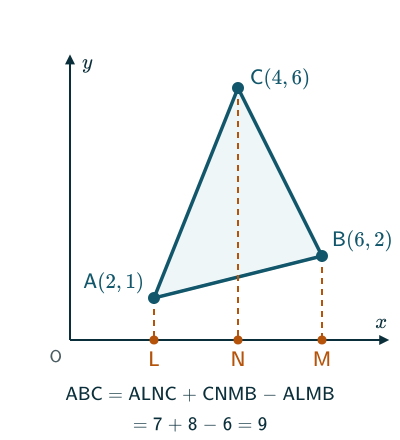
Let A(x1, y1), B(x2, y2) and C(x3, y3) lie above the x-axis with x1 < x3 < x2 and C above AB, as in the figure. Drop perpendiculars AL, CN and BM to the x-axis. The triangle is the two trapeziums ALNC and CNMB with ALMB taken away. A trapezium’s area is half the sum of its parallel sides times the distance between them, so
2 × area ABC = (y1 + y3)(x3 − x1)
+ (y3 + y2)(x2 − x3)
− (y1 + y2)(x2 − x1).
Multiplying out, the terms x1y1, x2y2 and x3y3 cancel, and the six terms left regroup as x1(y2 − y3) + x2(y3 − y1) + x3(y1 − y2). For other positions of the vertices the same expression comes out, possibly with a minus sign: it is negative when A, B, C are taken clockwise. So the area is half its absolute value.
Area of a triangle
Area = ½|x(y − y) + x(y − y)
+ x(y − y)|
For the triangle in the figure, ½|2(2 − 6) + 6(6 − 1) + 4(1 − 2)| = ½|−8 + 30 − 4| = 9. NCERT’s example (page 152): for (4, 4), (3, −2) and (−3, 16), the expression is 4(−2 − 16) + 3(16 − 4) + (−3)(4 + 2) = −72 + 36 − 18 = −54, and the area is |−54|/2 = 27. The minus sign only shows that these vertices run clockwise.
For a simple polygon (whose sides do not cross), take the vertices (x1, y1), …, (xn, yn) in order round the figure:
Area of a polygon (vertices in order)
Area = ½|(xy − xy)
+ (xy − xy) + …
+ (xy − xy)|
For a triangle this is the formula above. For a convex polygon you can also add the triangles cut off by the diagonals from one vertex, as in Example 1 below.
Collinear points
Three points are collinear if they lie on one line. Then the “triangle” they make is flat and has no area.
If the area of the triangle ABC is zero, then three points A, B and C lie on a line, i.e., they are collinear.
NCERT Mathematics (Class 11), Section 9.1, page 152
Collinearity condition
x(y − y) + x(y − y)
+ x(y − y) = 0
For example, A(1, 5), B(2, 3) and C(−2, 11) give 1(3 − 11) + 2(11 − 5) + (−2)(5 − 3) = −8 + 12 − 4 = 0, so they are collinear. Distances confirm it: AB = √5, AC = √45 = 3√5 and BC = √80 = 4√5. Since AB + AC = BC, A lies between B and C. NCERT’s chapter summary (page 174) gives a third test: A, B and C are collinear exactly when the slope of AB equals the slope of BC (if AB is vertical, BC must be vertical too).
Solved examples
Example 1: Area of a quadrilateral (NCERT Exercise 9.1, Q1, page 158)
Draw the quadrilateral with vertices (−4, 5), (0, 7), (5, −5) and (−4, −2), and find its area.
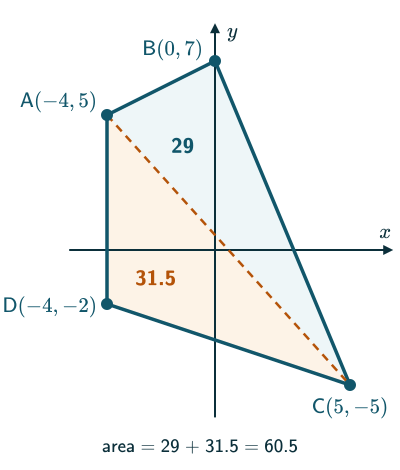
Name the vertices A(−4, 5), B(0, 7), C(5, −5), D(−4, −2) in order round the figure, and cut along the diagonal AC.
Triangle ABC:
½|−4(7 + 5) + 0(−5 − 5)
+ 5(5 − 7)|
= ½|−48 + 0 − 10| = 29.
Triangle ACD:
½|−4(−5 + 2) + 5(−2 − 5)
+ (−4)(5 + 5)|
= ½|12 − 35 − 40| = 31.5.
Answer: 29 + 31.5 = 60.5 = 121/2 square units.
Example 2: An equilateral triangle on the y-axis (NCERT Exercise 9.1, Q2, page 158)
The base of an equilateral triangle with side 2a lies along the y-axis, and the mid-point of the base is at the origin. Find its vertices.
The base has length 2a and mid-point O, so its ends are (0, a) and (0, −a), taking a > 0. The third vertex is equally far from both ends, so it lies on the perpendicular bisector of the base, which is the x-axis: call it (h, 0). Its distance from (0, a) is 2a, so h2 + a2 = 4a2 and h = ±a√3.
Answer: (0, a), (0, −a) and (a√3, 0), or (0, a), (0, −a) and (−a√3, 0).
Example 3: Equidistant point on the x-axis (NCERT Exercise 9.1, Q4, page 159)
Find a point on the x-axis which is equidistant from (7, 6) and (3, 4).
A point on the x-axis is (x, 0). Equal distances means equal squared distances: (x − 7)2 + 36 = (x − 3)2 + 16. Expanding, x2 − 14x + 85 = x2 − 6x + 25, so 8x = 60 and x = 15/2.
Answer: (15/2, 0). Check: the squared distances are 1/4 + 36 and 81/4 + 16, both equal to 145/4.
Example 4: The ratio in which an axis cuts a segment
In what ratio does the x-axis divide the segment joining (2, −3) and (5, 6)? Find the point of division.
Take the ratio as k : 1. The point is ((5k + 2)/(k + 1), (6k − 3)/(k + 1)). It is on the x-axis, so 6k − 3 = 0 and k = 1/2.
Answer: the ratio is 1 : 2 (internal, since k > 0), and the point is ((5/2 + 2)/(3/2), 0) = (3, 0).
Example 5: Points of trisection
Find the points that divide the segment joining A(2, −2) and B(−7, 4) into three equal parts.
The point nearer A divides AB in the ratio 1 : 2: ((1 × (−7) + 2 × 2)/3, (1 × 4 + 2 × (−2))/3) = (−1, 0). The point nearer B divides it in the ratio 2 : 1: ((2 × (−7) + 1 × 2)/3, (2 × 4 + 1 × (−2))/3) = (−4, 2).
Answer: (−1, 0) and (−4, 2).
Example 6: External division (JEE)
Find the point P that divides the segment joining A(−1, 2) and B(3, 4) externally in the ratio 3 : 1.
x = (3 × 3 − 1 × (−1))/(3 − 1) = 10/2 = 5 and y = (3 × 4 − 1 × 2)/(3 − 1) = 10/2 = 5.
Answer: P(5, 5). Check: AP = √(36 + 9) = 3√5 and BP = √(4 + 1) = √5, so AP : BP = 3 : 1, with P beyond B.
Common mistakes to avoid
Common mistake
Attaching m to the wrong end
In the section formula, m (the part next to A) multiplies B’s coordinates. Dividing the segment from (1, −3) to (−3, 9) in the ratio 1 : 3 gives (0, 0). Swapping the weights gives ((3 × (−3) + 1 × 1)/4, (3 × 9 + 1 × (−3))/4) = (−2, 6), which is the point dividing it in the ratio 3 : 1.
Common mistake
Dropping the modulus in the area formula
The bracket can be negative: for (4, 4), (3, −2), (−3, 16) it is −54. An area is never negative, so the answer is 27, not −27.
Common mistake
Adding the square roots
√(9 + 16) = √25 = 5, not √9 + √16 = 7. Add the squares first, then take one square root.
Common mistake
Splitting a quadrilateral the wrong way
Name the vertices in order round the figure and cut along a diagonal, joining opposite corners. In Example 1, triangles ABC and ABD share the side AB, not a diagonal: they overlap, miss part of the figure, and their areas 29 and 14 add up to 43, not 60.5. If the quadrilateral has a reflex angle, only the diagonal inside it works: for A(0, 0), B(4, 0), C(1, 1), D(0, 4), of area 4, the diagonal AC gives 2 + 2 = 4, but BD, which lies outside, gives 8 + 4 = 12.
Quick revision summary
- A point (x, y) is x units from the y-axis and y units from the x-axis, each with its sign.
- Distance: PQ2 = (x2 − x1)2 + (y2 − y1)2, from Pythagoras’ theorem, and PQ is its square root.
- Section formula: the point dividing the segment internally in the ratio m : n is ((mx2 + nx1)/(m + n), (my2 + ny1)/(m + n)); m = n gives the mid-point, and −n in place of n gives external division.
- Area of a triangle: ½|x1(y2 − y3) + x2(y3 − y1) + x3(y1 − y2)|; three points are collinear exactly when it is zero.
Formula sheet
- PQ = (x − x) + (y − y)
- internal m : n: ((mx + nx)/(m + n), (my + ny)/(m + n))
- external m : n: ((mx − nx)/(m − n), (my − ny)/(m − n)), m, n > 0, m ≠ n
- mid-point: ((x + x)/2, (y + y)/2)
- area = ½|x(y − y) + x(y − y) + x(y − y)|
- collinear ⇔ x(y − y) + x(y − y) + x(y − y) = 0
- polygon: ½|(xy − xy) + … + (xy − xy)|
Questions students ask
What is the difference between the distance formula and Pythagoras’ theorem?
The distance formula is Pythagoras’ theorem written in coordinates: the theorem relates the three sides of a right triangle, and the distance formula applies it to the right triangle whose legs are the horizontal and vertical gaps |x2 − x1| and |y2 − y1| between two points. So it needs no drawn triangle, only the coordinates, and it works for any two points, even two on one horizontal or vertical line, where there is no triangle at all. For (2, 1) and (7, 13), the gaps are 5 and 12, and the distance is √(25 + 144) = √169 = 13.
What is the difference between the distance formula and the section formula?
The distance formula gives a number, the length of the segment joining two points, while the section formula gives a point, the one that divides that segment in a given ratio m : n. Both start from the coordinates of the two end points: the distance formula squares and adds their differences under a square root, and the section formula takes a weighted average of them. For A(1, 2) and B(10, 14), AB = √(81 + 144) = √225 = 15, and the point dividing AB internally in the ratio 2 : 1 is ((2 × 10 + 1 × 1)/3, (2 × 14 + 1 × 2)/3) = (7, 10).
What is the difference between internal and external division in the section formula?
In internal division the dividing point P lies on the segment AB, between A and B, while in external division it lies on the line AB outside the segment; in both cases AP : PB = m : n. The formulas differ only in signs: internal division uses (mx2 + nx1)/(m + n), external division uses (mx2 − nx1)/(m − n) with m ≠ n, and y follows the same pattern. For A(0, 0), B(6, 3) and the ratio 2 : 1, internal division gives (4, 2) and external division gives (12, 6), beyond B. No point divides a segment externally in the ratio 1 : 1, since a point outside the segment is always nearer one end.
What is the difference between collinear and non-collinear points?
Collinear points lie on one straight line, while non-collinear points do not, so three non-collinear points are always the vertices of a triangle of non-zero area. Any two points are collinear, so the question only arises for three or more. With coordinates, three points are collinear exactly when the area formula gives zero, or, if AB is not vertical, when the slopes of AB and BC are equal. For example, (1, 1), (3, 5) and (4, 7) are collinear, since 1(5 − 7) + 3(7 − 1) + 4(1 − 5) = 0, but for (1, 1), (3, 5) and (4, 6) the same expression is −2, so they form a triangle of area 1.
Does the distance formula work in three dimensions?
The distance formula works in three dimensions with a third square: for points P and Q in space, PQ2 = (x2 − x1)2 + (y2 − y1)2 + (z2 − z1)2, found by using Pythagoras’ theorem twice. NCERT Section 11.4, Distance between Two Points (pages 211–213), derives it and works examples; for instance, (1, 2, 3) and (3, 5, 9) give PQ2 = 4 + 9 + 36 = 49, so PQ = 7.
Practice questions
Try each question first, then open the answer to check your working.
-
Q1. Find the distance between P(x1, y1) and Q(x2, y2) when (i) PQ is parallel to the y-axis, (ii) PQ is parallel to the x-axis (NCERT Exercise 9.1, Q3).
Show answerHide answer
(i) Then x1 = x2, so PQ = √((y2 − y1)2) = |y2 − y1|. (ii) Then y1 = y2, so PQ = |x2 − x1|.
-
Q2. Find the distance between (−1, 2) and (5, −6).
Show answerHide answer
√((5 + 1)2 + (−6 − 2)2) = √(36 + 64) = √100 = 10.
-
Q3. Find the point that divides the segment joining (−2, 3) and (8, −2) internally in the ratio 3 : 2.
Show answerHide answer
x = (3 × 8 + 2 × (−2))/5 = 20/5 = 4 and y = (3 × (−2) + 2 × 3)/5 = 0. The point is (4, 0).
-
Q4. Find the area of the triangle with vertices (1, 1), (4, 5) and (−2, 3).
Show answerHide answer
½|1(5 − 3) + 4(3 − 1) + (−2)(1 − 5)| = ½|2 + 8 + 8| = 9 square units.