Relationship between A.M. and G.M.
NCERT Class 11 Mathematics Chapter 8 Section 8.5
Quick answer
The relationship between the arithmetic mean and geometric mean of two positive numbers a and b is A ≥ G: the A.M., A = (a + b)/2, is never less than the G.M., G = √(ab), and A = G only when a = b. The reason is that A − G = (√a − √b) / 2, and a square is never negative. If A and G are known, the numbers are the roots of x − 2Ax + G = 0, that is A ± √(A − G).
With your textbook
NCERT Mathematics (Class 11), Chapter 8 “Sequences and Series”, Section 8.5 “Relationship Between A.M. and G.M.”, pages 144–147.
Open the official NCERT chapter (PDF, 1.7 MB, ncert.nic.in) (opens in a new tab)
Checked against the 2026-27 reprint on .
What are the A.M. and the G.M.?
Arithmetic mean and geometric mean
- The arithmetic mean (A.M.) of two numbers a and b is A = (a + b)/2. It is the number that makes a, A, b an arithmetic progression: A − a = b − A.
- The geometric mean (G.M.) of two positive numbers a and b is G = √(ab). It is the positive number that makes a, G, b a geometric progression: G/a = b/G.
In plain words: the A.M. is the ordinary average, halfway between a and b on the number line; the G.M. is the “multiplicative middle”, the same number of times bigger than a as b is bigger than it. For 2 and 8, the G.M. is √16 = 4 (NCERT Section 8.4.3, page 143) and the A.M. is (2 + 8)/2 = 5: 2, 4, 8 go up in equal ratios of 2, and 2, 5, 8 go up in equal steps of 3.
Let A and G be A.M. and G.M. of two given positive real numbers a and b, respectively.
NCERT Mathematics (Class 11), Section 8.5, page 144
NCERT Section 8.5 opens with this sentence and writes A = (a + b)/2 and G = √(ab), but the 2026–27 chapter has no section that defines the arithmetic mean: the G.M. is defined in Section 8.4.3, while the A.M. is only listed in the introduction (Section 8.1, page 135) among the topics the chapter will study. The definition above fills that gap.
A.M. ≥ G.M.
For any two positive numbers the A.M. is at least the G.M. (NCERT Section 8.5, page 144). Subtract and write the result as a square:
A − G as a square
A − G = (a + b)/2 − √(ab)
= (a + b − 2√(ab))/2
= (√a − √b) / 2 ≥ 0
For positive a and b, a = (√a)2, b = (√b)2 and √(ab) = √a √b, so the top is (√a − √b)2; a square is never negative.
From (1), we obtain the relationship A ≥ G.
NCERT Mathematics (Class 11), Section 8.5, page 144
The square is 0 only when √a = √b, so A = G exactly when a = b, and A > G whenever a ≠ b. A ≥ G is a slack inequality: the equals case is allowed and happens only for equal numbers.
A.M. and G.M.
A = (a + b)/2, G = √(ab)
A − G = (√a − √b) / 2 ≥ 0
A ≥ G; A = G only when a = b
Using A and G
Finding the numbers from A and G. If A and G are known, then a + b = 2A and ab = G2, so a and b are the roots of the quadratic equation x2 − 2Ax + G2 = 0:
Numbers from their means
x − 2Ax + G = 0
a, b = A ± √(A − G)
For valid means of positive numbers, A ≥ G > 0, so these roots are real and positive. Conversely, proposed values must satisfy A ≥ G > 0; for example A = 3, G = 4 cannot be means of two positive real numbers.
Least sum, greatest product. If the product ab is fixed, G is fixed and the sum a + b = 2A is least when A = G, that is, when a = b. For example, for x > 0, x and 1/x have product 1, so x + 1/x ≥ 2, with equality only at x = 1. In the same way, if the sum is fixed, the product is greatest when the two numbers are equal.
Solved examples
Example 1: Numbers from their means (NCERT Example 13, pages 144–145)
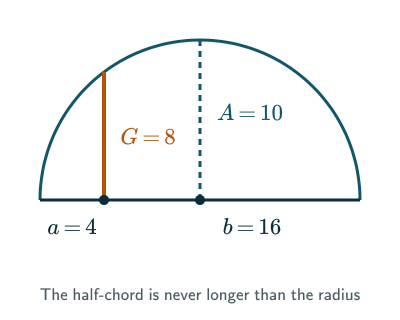
The A.M. and G.M. of two positive numbers a and b are 10 and 8. Find the numbers.
a + b = 20 and ab = 64. Then (a − b)2 = (a + b)2 − 4ab = 400 − 256 = 144, so a − b = ±12. Solving with a + b = 20 gives a = 16, b = 4 or a = 4, b = 16.
Answer: the numbers are 4 and 16.
Example 2: A ratio from the means (NCERT Exercise 8.2, Q28)
The sum of two positive numbers is 6 times their geometric mean. Show that the larger to the smaller is in the ratio (3 + 2√2) : (3 − 2√2).
a + b = 6√(ab), so 2A = 6G and A = 3G. The numbers are A ± √(A2 − G2) = 3G ± √(9G2 − G2) = 3G ± √(8G2) = (3 ± 2√2)G.
Answer: larger : smaller = (3 + 2√2) : (3 − 2√2). Without specifying which of a, b is larger, a : b can also be the reciprocal ratio.
Example 3: A quadratic from the means (NCERT Exercise 8.2, Q32)
The A.M. and G.M. of the roots of a quadratic equation are 8 and 5. Find the equation.
Sum of the roots = 2 × 8 = 16 and product = 52 = 25. The roots are 8 ± √39, both positive, as a G.M. needs (and 8 ≥ 5, so they are real).
Answer: x2 − 16x + 25 = 0.
Example 4: A least value
Find the least value of x + 9/x for x > 0.
The two terms are positive with product x × 9/x = 9, so their A.M. is at least √9 = 3: x + 9/x ≥ 2 × 3 = 6. Equality needs x = 9/x, that is x = 3.
Answer: 6, at x = 3.
Common mistakes to avoid
Common mistake
Using A ≥ G with a negative number
A ≥ G is for positive numbers. For −4 and −9 the “G.M.” √36 = 6 is larger than the A.M. −6.5. In Example 4 the result holds only because x > 0.
Common mistake
Forgetting when equality holds
A = G only when a = b. A least value found from A ≥ G is reached only if the two terms can be made equal; check that such an x exists.
Common mistake
Forgetting that the equal case may be out of reach
For 0 < t ≤ 1, t + 4/t ≥ 2√4 = 4 would need t = 2, which is not allowed. On 0 < t ≤ 1 the expression only falls as t grows, so its least value is 1 + 4 = 5, at t = 1.
Common mistake
Mixing up the two means
The A.M. of 4 and 16 is 10, the G.M. is √64 = 8. The G.M. is not (ab)/2 and not √(a + b).
Quick revision summary
- The A.M. of a and b is A = (a + b)/2; the G.M. of positive a and b is G = √(ab).
- A − G = (√a − √b)2/2 ≥ 0, so A ≥ G, with A = G only when a = b.
- Two numbers with means A and G are the roots of x2 − 2Ax + G2 = 0, that is A ± √(A2 − G2).
Formula sheet
- A = (a + b)/2, G = √(ab)
- A − G = (√a − √b) / 2 ≥ 0
- A ≥ G; A = G only when a = b
- x − 2Ax + G = 0
- a, b = A ± √(A − G)
Questions students ask
Does A.M. ≥ G.M. hold for three or more numbers?
Yes, the A.M.–G.M. inequality holds for any number of positive numbers: for three, (a + b + c)/3 ≥ ∛(abc), and for n numbers the A.M. is at least the nth root of their product, with equality only when all the numbers are equal. NCERT Class 11 proves only the two-number case; the general one, beyond NCERT, works well after splitting a term into equal parts. For x > 0, write x2 + 2/x = x2 + 1/x + 1/x: the three parts have product 1, so the sum is at least 3 × ∛1 = 3, reached when x2 = 1/x, that is at x = 1.
What is the relation between A.M., G.M. and H.M.?
For two positive numbers a and b, the arithmetic, geometric and harmonic means satisfy A ≥ G ≥ H, where the harmonic mean is H = 2ab/(a + b), and all three are equal only when a = b. They are also linked by G2 = AH, because (a + b)/2 × 2ab/(a + b) = ab, and G ≥ H then follows from A ≥ G. For 3 and 12, A = 7.5, G = 6 and H = 4.8, and 7.5 × 4.8 = 36 = 62. The harmonic mean, the reciprocal of the A.M. of 1/a and 1/b, is beyond the NCERT Class 11 book and is not named in JEE Main Unit 6, so treat it as extra reading.
Which chapter is A.M. ≥ G.M. in, and is it in the JEE Main syllabus?
The relation A.M. ≥ G.M. is in Chapter 8, Sequences and Series, of the NCERT Class 11 Mathematics book, as Section 8.5 of the 2026–27 reprint, and it is in the JEE Main syllabus, whose Unit 6 (Sequence and Series) ends with “Relation between A.M and G.M.” after arithmetic and geometric progressions and the insertion of means. NCERT proves it for two positive numbers and, in Example 13, finds two numbers from their A.M. and G.M.
When should you use the geometric mean instead of the arithmetic mean?
Use the geometric mean when quantities multiply rather than add, as growth factors, ratios and compound rates do, and the arithmetic mean when they add, as marks or lengths do. If a price rises 25% one year and 80% the next, it is multiplied by 1.25 × 1.8 = 2.25, and the steady yearly factor with the same effect is the G.M. √2.25 = 1.5, a rise of 50% each year. The A.M. of the two rises, 52.5%, overstates it, as A ≥ G predicts: two rises of 52.5% would multiply the price by 1.5252 ≈ 2.33, not 2.25.
How is A.M. ≥ G.M. used to find the least value of a trigonometric expression?
A.M. ≥ G.M. gives the least value of a sum of two positive trigonometric terms whose product is a constant, as long as the two terms can be made equal. Wherever tan x and cot x are defined, 9 tan2 x and 4 cot2 x are positive with product 36, so 9 tan2 x + 4 cot2 x ≥ 2√36 = 12, with equality when 9 tan2 x = 4 cot2 x, that is tan2 x = 2/3. In the same way, sin2 x + cosec2 x ≥ 2 wherever sin x ≠ 0, with equality when sin2 x = 1.
Practice questions
Try each question first, then open the answer to check your working.
-
Q1. Find the A.M. and G.M. of 4 and 9, and check that A ≥ G.
Show answerHide answer
A = 13/2 = 6.5 and G = √36 = 6, so A > G (the numbers are different).
-
Q2. If A and G are the A.M. and G.M. of two positive numbers, prove that the numbers are A ± √((A + G)(A − G)) (NCERT Exercise 8.2, Q29).
Show answerHide answer
The numbers are the roots of x2 − 2Ax + G2 = 0, so they are A ± √(A2 − G2) = A ± √((A + G)(A − G)).
-
Q3. Two positive numbers have A.M. 25 and G.M. 7. Find them.
Show answerHide answer
25 ± √(625 − 49) = 25 ± 24: the numbers are 49 and 1.
-
Q4. The ratio of the A.M. and G.M. of two positive numbers a ≥ b is m : n, where m ≥ n > 0. Show that a : b = (m + √(m2 − n2)) : (m − √(m2 − n2)) (NCERT Miscellaneous Exercise, Q10).
Show answerHide answer
Take A = mk and G = nk with k > 0. Then a, b = A ± √(A2 − G2) = k(m ± √(m2 − n2)), and the k cancels in the ratio.