Sequences
NCERT Class 11 Mathematics Chapter 8 Section 8.2
Quick answer
A sequence is a list of numbers in a definite order, with a first term a, a second term a, and so on; the nth term a is also called the general term. A sequence is a function whose domain is the natural numbers or a set {1, 2, …, k}, and it is finite if it has a fixed number of terms and infinite otherwise. Its terms may come from a formula such as a = 2n − 1, from a recurrence such as Fibonacci’s, or only from a description in words.
With your textbook
NCERT Mathematics (Class 11), Chapter 8 “Sequences and Series”, Section 8.2 “Sequences”, pages 135–137.
Open the official NCERT chapter (PDF, 1.7 MB, ncert.nic.in) (opens in a new tab)
Checked against the 2026-27 reprint on .
What is a sequence?
Sequence
a sequence can be regarded as a function whose domain is the set of natural numbers or some subset of it.
NCERT Mathematics (Class 11), Section 8.2, page 137
- A sequence is a list of numbers in a definite order, with a first term a1, a second term a2, a third term a3, and so on.
- The number in the nth place is the nth term, an. It is also called the general term.
In plain words: a sequence is numbers in order, each with a position. NCERT opens Section 8.2 with two illustrations. The first (pages 135–136) counts a person’s ancestors over 300 years with a generation gap of 30 years, so 300/30 = 10 generations. In this idealized model no ancestor occupies more than one position in the family tree. The numbers of ancestors in the first, second, third, …, tenth generations are 2, 4, 8, 16, 32, …, 1024: a1 = 2, a2 = 4, a3 = 8, …, a10 = 1024. Each term is twice the one before, which makes this a geometric progression.
The second divides 10 by 3 one step at a time. The quotients 3, 3.3, 3.33, 3.333, … form a sequence with a1 = 3, a2 = 3.3, …, a6 = 3.33333 (NCERT page 136).
Because each position n = 1, 2, 3, … gets exactly one value an, a sequence is a function with domain the natural numbers or a set {1, 2, …, k}. NCERT sometimes writes a(n) for an (page 137). Writing the terms with plus signs between them gives the series associated with the sequence.
Finite and infinite sequences
A sequence containing finite number of terms is called a finite sequence.
NCERT Mathematics (Class 11), Section 8.2, page 136
A sequence is called infinite, if it is not a finite sequence.
NCERT Mathematics (Class 11), Section 8.2, page 136
The ancestors over ten generations form a finite sequence: it has exactly 10 terms. The quotients 3, 3.3, 3.33, … form an infinite sequence, because the division never ends and there is always a next term (NCERT page 136).
The general term
The nth term is also called the general term of the sequence.
NCERT Mathematics (Class 11), Section 8.2, page 136
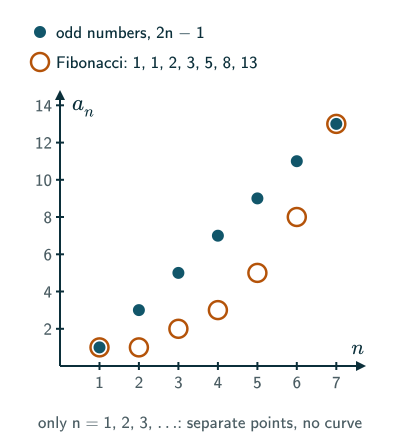
Often a formula gives an directly from n (NCERT page 136). For the even natural numbers 2, 4, 6, …, a1 = 2 × 1, a2 = 2 × 2, …, a24 = 2 × 24 = 48, so an = 2n. For the odd natural numbers 1, 3, 5, …, an = 2n − 1. To find any term, put its position in place of n. Both sequences go up in equal steps of 2, so they are arithmetic progressions.
Some sequences are given instead by a recurrence relation, a rule that builds each term from earlier ones. The Fibonacci sequence 1, 1, 2, 3, 5, 8, … starts with a1 = a2 = 1, and every later term is the sum of the two before it (NCERT page 136):
General term and recurrence
even numbers: a = 2n
odd numbers: a = 2n − 1
Fibonacci: a = a = 1
a = a + a, n > 2
NCERT gives Fibonacci’s dates as 1175–1250 beside the chapter opening (page 135) and as 1170–1250 in the Historical Note (page 150), so the book disagrees with itself about the year of his birth.
A sequence need not be presented by a formula. NCERT describes the primes 2, 3, 5, 7, … by their defining property, rather than an arithmetic or geometric progression rule (page 137).
In every sequence, we should not expect that its terms will necessarily be given by a specific formula.
NCERT Mathematics (Class 11), Section 8.2, page 137
Solved examples
Example 1: First terms from a formula (NCERT Example 1, pages 137–138)
Write the first three terms of the sequences (i) an = 2n + 5; (ii) an = (n − 3)/4.
(i) a1 = 2(1) + 5 = 7, a2 = 9, a3 = 11. (ii) a1 = (1 − 3)/4 = −1/2, a2 = −1/4, a3 = 0.
Answer: (i) 7, 9, 11; (ii) −1/2, −1/4, 0.
Example 2: A far-off term (NCERT Example 2, page 138)
What is the 20th term of the sequence an = (n − 1)(2 − n)(3 + n)?
Put n = 20: a20 = (20 − 1)(2 − 20)(3 + 20) = 19 × (−18) × 23.
Answer: a20 = −7866.
Example 3: Terms from a recurrence (NCERT Exercise 8.1, Q12, first part)
Write the first five terms of the sequence a1 = −1, an = an−1/n for n ≥ 2.
a2 = −1/2, a3 = (−1/2)/3 = −1/6, a4 = (−1/6)/4 = −1/24, a5 = (−1/24)/5 = −1/120.
Answer: −1, −1/2, −1/6, −1/24, −1/120. NCERT also asks for the corresponding series; that part is on the Series page.
Common mistakes to avoid
Common mistake
Mixing up the position and the term
In an = 4n − 3, a10 means “put n = 10”, which gives 37. Here 10 is the position and 37 is the term.
Common mistake
Joining the points with a curve
A sequence has terms only at n = 1, 2, 3, …. There is no 2.5th term of (n − 3)/4, so its graph is separate points, not a line.
Common mistake
Guessing the general term from a few terms
A few terms never fix the rule. 1, 2, 4 fits both an = 2n−1 and an = (n2 − n + 2)/2, whose 4th terms are 8 and 7. A sequence is fixed only by its rule.
Common mistake
Getting the sign of (−1) wrong
(−1)n−1 is +1 when n is odd and −1 when n is even. So an = (−1)n−1n2 gives a5 = +25, not −25, and a4 = −16.
Quick revision summary
- A sequence is numbers in a definite order; an, the nth term, is also called the general term. A sequence is a function on the natural numbers or on {1, 2, …, k}.
- A finite sequence has a fixed number of terms; an infinite sequence never ends.
- A sequence may be given by a formula for an, by a recurrence such as Fibonacci’s, or only in words, as for the primes.
Formula sheet
- a = nth term (general term), n = 1, 2, 3, …
- even numbers: a = 2n; odd numbers: a = 2n − 1
- Fibonacci: a = a = 1, a = a + a for n > 2
Questions students ask
What is the difference between a sequence and a progression?
A progression is a sequence whose terms follow a specific pattern, so every progression is a sequence but not every sequence is a progression: NCERT says “Sequences, following specific patterns are called progressions” (Section 8.1, page 135). The arithmetic progression 4, 9, 14, 19, … adds 5 at each step, and the geometric progression 3, 6, 12, 24, … doubles at each step. The primes 2, 3, 5, 7, 11, … also form a sequence, but no rule of that kind produces them, so they are not called a progression.
What is the difference between a sequence and a set?
A sequence keeps its terms in order and may repeat them, while a set has no order and no repeated elements: {1, 2, 3} and {3, 2, 1} are the same set, but 1, 2, 3 and 3, 2, 1 are different sequences, and the sequence 2, 2, 5 has three terms while the set of its values is {2, 5}. The reason is that a sequence is a function on the positions 1, 2, 3, …, so each term is tied to its place, whereas a set records only which objects belong (see roster form). The set of values of a sequence is its range: 1, −1, 1, −1, … has the range {−1, 1}.
What is the difference between an explicit formula and a recursive formula for a sequence?
An explicit formula gives the nth term straight from n, while a recursive formula (a recurrence relation) builds each term from earlier ones, starting from given first terms. The sequence 5, 8, 11, 14, … has the explicit formula an = 3n + 2 and the recursive formula a1 = 5, an = an−1 + 3 for n ≥ 2. The explicit form reaches a far-off term at once, a40 = 3 × 40 + 2 = 122, while direct iteration of this recursive rule computes the earlier terms first.
Is there a formula for the nth term of the Fibonacci sequence?
Yes, the nth term of the Fibonacci sequence 1, 1, 2, 3, 5, 8, … is given by Binet’s formula an = (φn − ψn)/√5, where φ = (1 + √5)/2 ≈ 1.618 is the golden ratio and ψ = (1 − √5)/2 ≈ −0.618. Neither NCERT, which defines the sequence only by its recurrence, nor the JEE Main syllabus gives this formula. Because ψn/√5 is less than ½ in size and shrinks towards 0, an is the whole number nearest to φn/√5 (for n = 12 that is about 144.001, and a12 = 144), and the ratios of consecutive terms, such as 13/8 = 1.625 and 34/21 ≈ 1.619, approach φ.
Is it the Fibonacci sequence or the Fibonacci series?
The list 1, 1, 2, 3, 5, 8, … is strictly the Fibonacci sequence, which is what NCERT calls it (page 136); “Fibonacci series” is a common name for the same list, especially in programming courses, but in mathematics a series means a sum such as 1 + 1 + 2 + 3 + 5 + 8, not a list. The sums of its first terms follow a pattern, beyond NCERT: the first n Fibonacci numbers add up to an+2 − 1, so 1 + 1 + 2 + 3 + 5 + 8 + 13 = 33 = 34 − 1.
Is sequence and series in the JEE Main syllabus?
Yes, Sequence and Series is Unit 6 of the JEE Main Mathematics syllabus, which lists arithmetic and geometric progressions, the insertion of arithmetic and geometric means between two given numbers, and the relation between the A.M. and the G.M. The unit does not name sequences in general, recurrences, the sum to infinity of a geometric progression or the sums of squares and cubes of natural numbers. NTA does not publish chapter-wise weightage, so any number of questions quoted for this unit is an estimate from past papers.
Practice questions
Try each question first, then open the answer to check your working.
-
Q1. Write the first five terms of the sequence an = n(n + 2) (NCERT Exercise 8.1, Q1).
Show answerHide answer
a1 = 1 × 3 = 3, then 2 × 4 = 8, 3 × 5 = 15, 4 × 6 = 24, 5 × 7 = 35: 3, 8, 15, 24, 35.
-
Q2. Write the first five terms of an = (−1)n−1 × 5n+1 (NCERT Exercise 8.1, Q5).
Show answerHide answer
The sign is + for odd n and − for even n: 25, −125, 625, −3125, 15 625.
-
Q3. Find a17 and a24 for an = 4n − 3 (NCERT Exercise 8.1, Q7).
Show answerHide answer
a17 = 4 × 17 − 3 = 65 and a24 = 4 × 24 − 3 = 93.
-
Q4. Find a20 for an = n(n − 2)/(n + 3) (NCERT Exercise 8.1, Q10).
Show answerHide answer
a20 = 20 × 18/23 = 360/23.