Arithmetic progression
Beyond NCERT In the JEE Main syllabus; the Class 11 book has no section for it.
Quick answer
An arithmetic progression (A.P.) is a sequence in which each term is the previous one plus the same common difference d, so its nth term is a = a + (n − 1)d, where a is the first term. The sum of its first n terms is S = (n/2)(a + l) = (n/2)[2a + (n − 1)d], where l is the last term. The arithmetic mean of a and b is A = (a + b)/2, and n arithmetic means between a and b have common difference (b − a)/(n + 1).
What is an arithmetic progression?
Arithmetic progression (A.P.)
- A sequence a1, a2, a3, … is an arithmetic progression if the difference between each term and the one before it is the same number d: ak+1 − ak = d for every k ≥ 1.
- a = a1 is the first term and d is the common difference: the A.P. is a, a + d, a + 2d, ….
- A.P.s are in the JEE Main 2027 syllabus (Unit 6). NCERT’s Class 11 chapter says they were studied in the previous class (page 135) and has no section on them.
In plain words: in an A.P. you get each term by adding the same number d to the one before it. 3, 7, 11, 15, … has d = 4; 20, 17, 14, … has d = −3; and 5, 5, 5, … has d = 0. The odd numbers 1, 3, 5, 7, … and the even numbers 2, 4, 6, … are A.P.s with d = 2.
NCERT’s introduction to the Class 11 chapter (page 135) says the A.P. was studied in the previous class, and then makes a promise:
In this Chapter, besides discussing more about A.P.; arithmetic mean, geometric mean, relationship between A.M. and G.M., special series in forms of sum to n terms of consecutive natural numbers, sum to n terms of squares of natural numbers and sum to n terms of cubes of natural numbers will also be studied.
NCERT Mathematics (Class 11), Section 8.1, page 135
The 2026–27 NCERT chapter keeps only part of this promise. It covers the geometric mean (Section 8.4.3) and the relation between the A.M. and the G.M. (Section 8.5, which only uses A = (a + b)/2). It has no section on the A.P., on inserting arithmetic means, or on the sums of natural numbers, their squares and their cubes, although its exercises still use A.P.s (Miscellaneous Exercise, Q4, Q12–Q14, Q16 and Q18). This page covers the A.P. and the arithmetic mean for JEE.
The nth term
Each step adds d, so the nth term has had d added n − 1 times:
nth term of an A.P.
a = a + (n − 1)d
From the end: l − (n − 1)d
Here l is the last term of a finite A.P. For 3, 7, 11, …, the 10th term is 3 + 9 × 4 = 39. To check whether a number is a term, solve a + (n − 1)d = that number and see whether n is a natural number: 3 + (n − 1)4 = 100 gives n = 101/4, so 100 is not a term.
Three numbers in A.P. are best written a − d, a, a + d (here a is the middle term): their sum is 3a, so a comes straight from the sum.
Four numbers in A.P. are best written a − 3d, a − d, a + d, a + 3d. Their sum is 4a, but their common difference is 2d, not d. For example, if the sum is 20 and the sum of the squares is 120, then a = 5, 100 + 20d2 = 120 and d = ±1, so the numbers are 2, 4, 6, 8.
Sum of n terms
Write the sum forwards and backwards and add. Each pair of terms one above the other adds up to the first term plus the last term, a + l, and there are n pairs, so 2Sn = n(a + l).
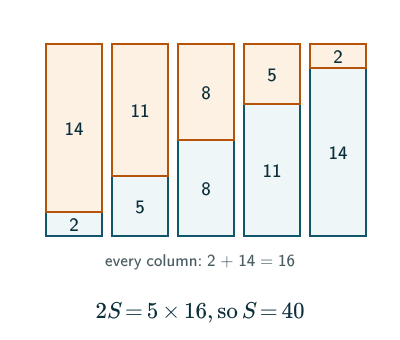
Sum of n terms of an A.P.
S = (n/2)(a + l)
S = (n/2)[2a + (n − 1)d]
1 + 2 + 3 + … + n = n(n + 1)/2
Putting l = a + (n − 1)d in the first form gives the second. The last line is the A.P. 1, 2, 3, … with a = 1, l = n. So the mean of 1, 2, …, n is (n + 1)/2, a first step towards their variance (Example 2 there). If Sn is given, the terms come from a1 = S1 and an = Sn − Sn−1 for n ≥ 2.
Arithmetic means
The arithmetic mean (A.M.) of two numbers a and b is A = (a + b)/2: it makes a, A, b an A.P. More generally, numbers A1, A2, …, An are n arithmetic means between a and b when a, A1, …, An, b is an A.P. Then b is the (n + 2)th term, so b = a + (n + 1)d.
Arithmetic means
A = (a + b)/2
d = (b − a)/(n + 1), A = a + kd
A + A + … + A = n(a + b)/2
For example, to insert 4 A.M.s between 3 and 23, d = (23 − 3)/5 = 4, giving 3, 7, 11, 15, 19, 23. The four means add up to 4 × 13 = 52. For positive a and b, the single A.M. (a + b)/2 is never less than the geometric mean √(ab): see A.M. ≥ G.M..
Solved examples
Example 1: Three numbers in A.P.
Three numbers in A.P. add up to 24 and their product is 440. Find them.
Write them as a − d, a, a + d, with a the middle term. The sum 3a = 24 gives a = 8. The product is 8(64 − d2) = 440, so d2 = 9 and d = ±3.
Answer: 5, 8, 11 (or 11, 8, 5).
Example 2: A term of a series of products (NCERT Miscellaneous Exercise, Q12)
Find the 20th term of the series 2 × 4 + 4 × 6 + 6 × 8 + … + n terms.
The first factors 2, 4, 6, … are an A.P. with kth term 2k; the second factors 4, 6, 8, … have kth term 2k + 2. So the kth term is 2k(2k + 2).
Answer: 40 × 42 = 1680.
Example 3: Paying by instalments (NCERT Miscellaneous Exercise, Q13)
A farmer buys a used tractor for ₹12 000. He pays ₹6000 in cash and the balance in annual instalments of ₹500 plus 12% interest on the unpaid amount. How much will the tractor cost him?
The balance ₹6000 takes 12 instalments. Interest is charged each year on the amount still unpaid: 6000, 5500, …, 500, an A.P. of 12 terms with sum (12/2)(6000 + 500) = 39 000. The interest is 12% of 39 000 = ₹4680.
Answer: 12 000 + 4680 = ₹16 680.
Example 4: Workers dropping out (NCERT Miscellaneous Exercise, Q18)
150 workers were engaged to finish a job in a certain number of days. 4 workers dropped out on the second day, 4 more on the third day, and so on. It took 8 more days to finish the work. Find the number of days in which the work was completed.
Let the job be planned for n days, so it takes 150n worker-days. It actually took n + 8 days with 150, 146, 142, … workers, an A.P. with d = −4. Its sum is (n + 8)/2 × [300 − 4(n + 7)] = 150n. Doubling gives (n + 8)(272 − 4n) = 300n, that is 4n2 + 60n − 2176 = 0, or n2 + 15n − 544 = 0. This is a quadratic equation that factorises as (n − 17)(n + 32) = 0, so n = 17 (−32 is negative).
Answer: 17 + 8 = 25 days.
Common mistakes to avoid
Common mistake
Using nd instead of (n − 1)d
The nth term is a + (n − 1)d: the first term has had nothing added. The 10th term of 3, 7, 11, … is 3 + 9 × 4 = 39, not 3 + 10 × 4 = 43.
Common mistake
Taking a = S − S for n = 1 as well
If Sn = n2 + 1, then a1 = S1 = 2, but Sn − Sn−1 = 2n − 1 gives 1 at n = 1. The terms are 2, 3, 5, 7, …, which is not an A.P. from the start.
Common mistake
Counting the terms wrongly
The multiples of 5 between 100 and 1000 run from 105 to 995: (995 − 105)/5 + 1 = 179 terms, not (1000 − 100)/5 = 180.
Common mistake
Adding past the sign change
In 20, 17, 14, … the sum is greatest when you stop at the last positive term, a7 = 2. That gives S7 = (7/2)(20 + 2) = 77. The next term, −1, brings it down to S8 = 76.
Quick revision summary
- An A.P. adds the same common difference d at each step; its nth term is a + (n − 1)d.
- The sum of n terms is (n/2)(a + l) = (n/2)[2a + (n − 1)d]; in particular 1 + 2 + … + n = n(n + 1)/2.
- The A.M. of a and b is (a + b)/2; n A.M.s between a and b have common difference (b − a)/(n + 1).
Formula sheet
- a = a + (n − 1)d
- S = (n/2)(a + l) = (n/2)[2a + (n − 1)d]
- 1 + 2 + 3 + … + n = n(n + 1)/2
- A = (a + b)/2
- d = (b − a)/(n + 1), A = a + kd
- a = S − S (n ≥ 2), a = S
Questions students ask
What is the difference between an arithmetic progression and an arithmetic sequence?
An arithmetic progression (A.P.) and an arithmetic sequence are the same thing, a sequence in which each term is the one before it plus a fixed common difference d; “A.P.” is the usual name in Indian textbooks, and “arithmetic sequence” in many others. The term that does mean something different is the arithmetic series, the sum of the terms of an A.P.: 6, 10, 14, 18 is an A.P., and 6 + 10 + 14 + 18 is the corresponding arithmetic series, whose sum is 48.
Is arithmetic progression in the Class 11 NCERT book?
Arithmetic progression has no section of its own in the 2026–27 NCERT Class 11 book: the introduction to its Sequences and Series chapter says the A.P. was studied in the previous class, and the nth term and the sum of n terms are taught in the NCERT Class 10 chapter Arithmetic Progressions. The Class 11 chapter still uses A.P.s in its Miscellaneous Exercise, and the JEE Main syllabus (Unit 6) lists arithmetic progressions and the insertion of arithmetic means between two given numbers. So JEE aspirants should revise the Class 10 formulas and add arithmetic means, as this page does.
What is the sum of an infinite arithmetic progression?
An infinite arithmetic progression has no finite sum unless every term is 0: when d > 0 its partial sums Sn grow past every number, when d < 0 they fall below every number, and when d = 0 and a ≠ 0 they equal na, which grows without limit in size. The reason is that its terms a + (n − 1)d do not shrink towards 0, and an infinite series cannot have a sum unless its terms do. An infinite G.P. is different: when −1 < r < 1 it does have a sum.
How do you check whether a sequence is an arithmetic progression?
A sequence is an arithmetic progression exactly when the difference an+1 − an is the same number for every n, so work it out in general and check that n drops out. Equivalently, the nth term must be linear in n, of the form pn + q, and then the common difference is p; for three numbers x, y, z the test is 2y = x + z. For example, an = 7 − 2n gives the A.P. 5, 3, 1, … with d = −2, but an = n2 does not, since its differences 3, 5, 7, … keep changing.
If the sum of m terms of an A.P. equals the sum of n terms, what is the sum of m + n terms?
For an A.P. in which the sum of the first m terms equals the sum of the first n terms, with m ≠ n, the sum of the first m + n terms is 0. The reason is that 2(Sm − Sn) works out to (m − n)[2a + (m + n − 1)d], so the bracket is 0, and Sm+n is (m + n)/2 times the same bracket. For example, 7, 5, 3, 1, −1, … has S3 = S5 = 15, and S8 = 0.
What are the formulas for the sum of squares and cubes of the first n natural numbers?
The sum of the squares of the first n natural numbers is 12 + 22 + … + n2 = n(n + 1)(2n + 1)/6, and the sum of their cubes is 13 + 23 + … + n3 = [n(n + 1)/2]2, the square of 1 + 2 + … + n. For n = 6 they give 91 and 441 = 212. These are not A.P. sums, and both are beyond the 2026–27 NCERT book, whose introduction promises them but which has no section on them; the JEE Main syllabus (Unit 6) does not name them either.
Practice questions
Try each question first, then open the answer to check your working.
-
Q1. A man deposited ₹10 000 in a bank at 5% simple interest a year. Find the amount at the beginning of the 15th year since he deposited it, and the total amount after 20 completed years (adapted from NCERT Miscellaneous Exercise, Q16).
Show answerHide answer
Each year adds 5% of 10 000 = ₹500. At the beginning of the 15th year, 14 years’ interest has been added: 10 000 + 14 × 500 = ₹17 000. At the end of the 15th year it would instead be ₹17 500. After 20 completed years: 10 000 + 20 × 500 = ₹20 000. Always distinguish a year’s position from the number of completed years.
-
Q2. Shamshad Ali buys a scooter for ₹22 000. He pays ₹4000 in cash and the balance in annual instalments of ₹1000 plus 10% interest on the unpaid amount. How much will the scooter cost him (NCERT Miscellaneous Exercise, Q14)?
Show answerHide answer
The balance ₹18 000 takes 18 instalments; the unpaid amounts 18 000, 17 000, …, 1000 add up to (18/2)(18 000 + 1000) = 171 000, and 10% of that is ₹17 100. Total cost 22 000 + 17 100 = ₹39 100.
-
Q3. Find the sum of all the multiples of 5 between 100 and 1000.
Show answerHide answer
105, 110, …, 995: 179 terms, so the sum is (179/2)(105 + 995) = 179 × 550 = 98 450.
-
Q4. The sum of three numbers in G.P. is 56. If we subtract 1, 7 and 21 from them, in that order, we get an A.P. Find the numbers (NCERT Miscellaneous Exercise, Q4).
Show answerHide answer
Let them be a, ar, ar2. The A.P. condition (a − 1) + (ar2 − 21) = 2(ar − 7) gives a(r − 1)2 = 8, and a(1 + r + r2) = 56. Dividing, 2r2 − 5r + 2 = 0, so r = 2 or 1/2. The numbers are 8, 16, 32 (or 32, 16, 8): subtracting gives 7, 9, 11 (or 31, 9, −13).