Series
NCERT Class 11 Mathematics Chapter 8 Section 8.3
Quick answer
A series is the expression a + a + a + … that joins the terms of a sequence with plus signs; it is finite or infinite as the sequence is. The sum of a finite series is the number obtained by adding its terms. In sigma notation, ∑ a (k = 1 to n) = a + a + … + a, where k takes every integer from 1 to n; for example, 1 + 3 + 5 + 7 is a finite series with four terms whose sum is 16.
With your textbook
NCERT Mathematics (Class 11), Chapter 8 “Sequences and Series”, Section 8.3 “Series”, pages 137–139.
Open the official NCERT chapter (PDF, 1.7 MB, ncert.nic.in) (opens in a new tab)
Checked against the 2026-27 reprint on .
What is a series?
Series
- If a1, a2, a3, … is a sequence, the expression a1 + a2 + a3 + … is the series associated with it (NCERT Section 8.3, page 137).
- The sum of a finite series is the number you get by adding its terms.
The series is finite or infinite according as the given sequence is finite or infinite.
NCERT Mathematics (Class 11), Section 8.3, page 137
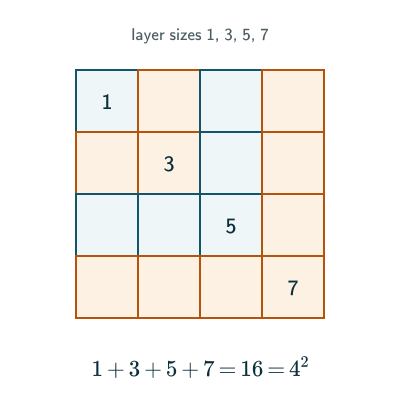
In plain words: a sequence lists numbers; a series writes them as a sum. The sequence of odd numbers 1, 3, 5, 7 gives the finite series 1 + 3 + 5 + 7, which has four terms and whose sum is 16 (NCERT page 137). Like a finite or infinite set, a sequence can stop or go on for ever, and its series does the same: 1 + 3 + 5 + 7 + … is an infinite series. Its running total grows past every number, so this infinite series has no finite sum.
When the series is used, it refers to the indicated sum not to the sum itself.
NCERT Mathematics (Class 11), Section 8.3, page 137
So “the series 1 + 3 + 5 + 7” means the expression with its plus signs, and “the sum of the series” means the number 16.
Sigma notation
Series are often represented in compact form, called sigma notation, using the Greek letter ∑ (sigma) as means of indicating the summation involved.
NCERT Mathematics (Class 11), Section 8.3, page 137
The Greek capital letter ∑ (sigma) means “add up”. The series a1 + a2 + … + an is written (NCERT page 137)
Read it as “the sum of ak for k from 1 to n”. The letter k is the index: it takes each integer value from the number below ∑ to the number above it, and the terms for those values are added. The index is only a placeholder, so writing j instead of k gives the same sum. When the index runs over the integers from m to n, with m ≤ n, there are n − m + 1 terms.
For example, the series of the figure, 1 + 3 + 5 + 7, is the sum of 2k − 1 for k = 1 to 4 written out, and its sum is 16. The sum of k2 for k = 1 to 5 is 1 + 4 + 9 + 16 + 25 = 55.
The notation, and three rules that follow from adding term by term (every ∑ in a line runs over the same values of k):
Sigma notation
∑ a (k = 1 to n) = a + a + … + a
∑ (a + b) = ∑ a + ∑ b
∑ c a = c ∑ a
∑ c = nc (k = 1 to n)
The last rule says that adding the same number c to itself n times gives nc. Sums of arithmetic progressions and geometric progressions have their own formulas.
Solved examples
Example 1: From a recurrence to a series (NCERT Example 3, page 138)
The sequence an is defined by a1 = 1, an = an−1 + 2 for n ≥ 2. Find the first five terms and write the corresponding series.
a2 = 1 + 2 = 3, a3 = 3 + 2 = 5, a4 = 5 + 2 = 7, a5 = 7 + 2 = 9.
Answer: 1, 3, 5, 7, 9; the series is 1 + 3 + 5 + 7 + 9 + …
Example 2: Another recurrence (NCERT Exercise 8.1, Q11)
Write the first five terms of a1 = 3, an = 3an−1 + 2 for n > 1, and the corresponding series.
a2 = 3 × 3 + 2 = 11, a3 = 3 × 11 + 2 = 35, a4 = 3 × 35 + 2 = 107, a5 = 3 × 10⁷ + 2 = 323.
Answer: 3, 11, 35, 107, 323; the series is 3 + 11 + 35 + 107 + 323 + …
Example 3: Expanding a sigma
Write out and evaluate the sum of (3k − 2) for k = 1 to 6.
Put k = 1, 2, …, 6: 1 + 4 + 7 + 10 + 13 + 16. There are 6 − 1 + 1 = 6 terms. Check with the rules: the 3k part gives 3(1 + 2 + … + 6) = 3 × 21 = 63, and −2 added 6 times gives −12, so the sum is 63 − 12 = 51.
Answer: 51.
Common mistakes to avoid
Common mistake
Calling a series a sequence
1, 3, 5, 7 is a sequence (a list). 1 + 3 + 5 + 7 is a series (a sum to be worked out), and 16 is the sum of that series.
Common mistake
Miscounting the terms of a sigma
The sum from k = 3 to k = 7 has 7 − 3 + 1 = 5 terms (k = 3, 4, 5, 6, 7), not 4.
Common mistake
Multiplying sums term by term
The sum of akbk is not (∑ ak)(∑ bk). For k = 1 to 3 with ak = bk = k: 1 + 4 + 9 = 14, but (1 + 2 + 3)2 = 36.
Common mistake
Forgetting that a constant is added n times
The sum of 5 for k = 1 to 10 is 5 × 10 = 50, not 5. In a sum of (2k + 3) for k = 1 to 10, the 3 also adds up to 30. If the index runs from 3 to 7, a constant is added 7 − 3 + 1 = 5 times, not 7.
Quick revision summary
- The series of the sequence a1, a2, … is a1 + a2 + …; it is finite or infinite as the sequence is. The sum of a finite series is the number obtained by adding its terms.
- ∑ (sigma) means “add up”; the index runs through every integer from the lower limit to the upper limit, n − m + 1 terms from m to n.
- Sums split over + and take constants outside; a constant c added n times gives nc.
Formula sheet
- ∑ a (k = 1 to n) = a + a + … + a
- ∑ (a + b) = ∑ a + ∑ b
- ∑ c a = c ∑ a
- ∑ c = nc (k = 1 to n)
- k = m to n: n − m + 1 terms (integers m ≤ n)
Questions students ask
What is the difference between a sequence and a series?
A sequence is an ordered list of numbers, while a series is the expression that adds the terms of a sequence: 5, 10, 15, 20 is a sequence, and 5 + 10 + 15 + 20 is its series, whose sum is 50. The two are linked by the partial sums, the running totals 5, 15, 30, 50, which themselves form a sequence. Both can be finite or infinite, and an infinite series has a sum only when its partial sums settle on one fixed number.
How do you write a series in sigma notation?
To write a series in sigma notation, find a formula for its kth term and then the first and last values of k: in 5 + 9 + 13 + … + 45 the terms go up by 4 from 5, so the kth term is 4k + 1, and 4k + 1 = 45 gives k = 11. The series is therefore ∑ (4k + 1) (k = 1 to 11), a sum of 11 terms. If the signs alternate and the first term is positive, put in a factor (−1)k+1, which is +1 for odd k and −1 for even k.
Can an infinite series have a finite sum?
Yes, an infinite series has a finite sum when its partial sums, the totals of its first n terms, get as close as we like to one fixed number: 1/2 + 1/4 + 1/8 + … has partial sums 1/2, 3/4, 7/8, … and its sum is 1. Terms that shrink towards 0 are not enough on their own: in 1 + 1/2 + 1/3 + 1/4 + … the blocks 1/3 + 1/4, then 1/5 + … + 1/8, then 1/9 + … + 1/16, and so on, each add up to more than 1/2, so the partial sums grow past every number and there is no finite sum. The NCERT Class 11 chapter adds up only finite series; for JEE the key infinite case is the infinite G.P. with −1 < r < 1.
Is summation notation the same as sigma notation?
Yes, summation notation and sigma notation are two names for the same thing: the sign ∑, the Greek capital letter sigma (the Greek S, for “sum”), written before a general term with the first and last values of the index. So “the summation of k from 1 to 4” and “sigma k, k = 1 to 4” both mean 1 + 2 + 3 + 4 = 10. A similar sign, the capital pi ∏, is used beyond NCERT for products: the product of k for k = 1 to 4 is 1 × 2 × 3 × 4 = 24.
Does the index in sigma notation have to start at 1?
No, the index in sigma notation can start at any integer, such as 0 or 2, and a series can be rewritten with other limits by shifting the index: the sum of k2 for k = 2 to 4 and the sum of (k + 1)2 for k = 1 to 3 are both 4 + 9 + 16 = 29. To shift, replace k by k + 1 in the term and lower both limits by 1; the number of terms, here 3, does not change. Shifting is how two sums are made to run over the same values of k before they are added term by term.
Practice questions
Try each question first, then open the answer to check your working.
-
Q1. Write the first five terms of a1 = a2 = 2, an = an−1 − 1 for n > 2, and the corresponding series (NCERT Exercise 8.1, Q13).
Show answerHide answer
2, 2, 1, 0, −1; the series is 2 + 2 + 1 + 0 + (−1) + …
-
Q2. Write the series for the first five terms of a1 = −1, an = an−1/n for n ≥ 2 (NCERT Exercise 8.1, Q12).
Show answerHide answer
The terms are −1, −1/2, −1/6, −1/24, −1/120, so the requested finite series is (−1) + (−1/2) + (−1/6) + (−1/24) + (−1/120).
-
Q3. Write 2 + 4 + 6 + … + 40 in sigma notation and find its sum.
Show answerHide answer
The last term is 40 = 2 × 20, so it is the sum of 2k for k = 1 to 20. Taking out the 2: 2(1 + 2 + … + 20). Pairing the ends, 1 + 20 = 2 + 19 = … = 10 + 11 = 21, ten pairs, so 1 + 2 + … + 20 = 210 and the sum is 2 × 210 = 420.
-
Q4. The sum of ak for k = 1 to 10 is 30. Find the sum of (2ak + 3) for k = 1 to 10.
Show answerHide answer
2 × 30 + 3 × 10 = 60 + 30 = 90.