Geometric progression
NCERT Class 11 Mathematics Chapter 8 Section 8.4
Quick answer
A geometric progression (G.P.) is a sequence of non-zero terms in which each term is the previous one multiplied by the same common ratio r, so it is a, ar, ar, … and its nth term is a = ar. The sum of its first n terms is S = a(1 − r) / (1 − r) = a(r − 1) / (r − 1) when r ≠ 1, and na when r = 1. The geometric mean of two positive numbers a and b is G = √(ab).
With your textbook
NCERT Mathematics (Class 11), Chapter 8 “Sequences and Series”, Section 8.4 “Geometric Progression (G.P.)”, pages 139–144.
Open the official NCERT chapter (PDF, 1.7 MB, ncert.nic.in) (opens in a new tab)
Checked against the 2026-27 reprint on .
What is a geometric progression?
Geometric progression (G.P.)
Such sequences are called geometric sequence or geometric progression abbreviated as G.P.
NCERT Mathematics (Class 11), Section 8.4, page 139
- A sequence a1, a2, a3, … is a G.P. if every term is non-zero and ak+1/ak = r, the same constant for every k ≥ 1.
- a = a1 is the first term and r is the common ratio: the G.P. is a, ar, ar2, ar3, ….
In plain words: in a G.P. you get each term by multiplying the one before it by the same number r; in an A.P. you add the same number instead. NCERT’s three examples (page 139) are 2, 4, 8, 16, … with r = 2; 1/9, −1/27, 1/81, −1/243, … with r = −1/3; and 0.01, 0.0001, 0.000001, … with r = 0.01.
It is observed that in each case, every term except the first term bears a constant ratio to the term immediately preceding it.
NCERT Mathematics (Class 11), Section 8.4, page 139
A negative r makes the signs alternate, and a ratio between −1 and 1 makes the terms shrink in size towards 0. The numbers of subsets of sets with 0, 1, 2, 3, … elements, 1, 2, 4, 8, …, form a G.P. with r = 2 (see the power set).
The general term
Each step multiplies by r, so the nth term is a multiplied by r exactly n − 1 times (NCERT Section 8.4.1, page 140): a1 = a, a2 = ar, a3 = ar2, …, a16 = ar15.
General term of a G.P.
a = ar
NCERT Example 4 (page 140): in 5, 25, 125, …, a = 5 and r = 5, so a10 = 5 × 59 = 510 and an = 5 × 5n−1 = 5n.
NCERT Example 5 (page 141): in 2, 8, 32, …, a = 2 and r = 4. If 131 072 is the nth term, 2 × 4n−1 = 131 072, so 4n−1 = 65 536 = 48, n − 1 = 8 and n = 9: 131 072 is the 9th term.
Sum to n terms
Let Sn = a + ar + ar2 + … + arn−1 (NCERT Section 8.4.2, page 140). If r = 1, every term is a and Sn = na. If r ≠ 1, multiply by r: rSn = ar + ar2 + … + arn. The two sums share every term except a and arn, so subtracting gives (1 − r)Sn = a − arn = a(1 − rn).
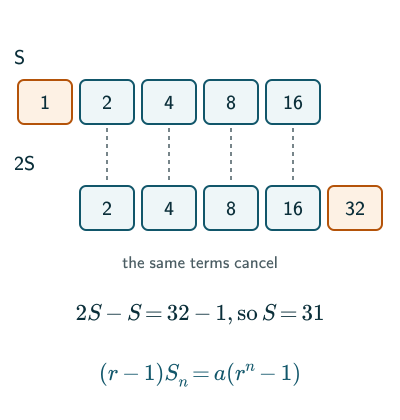
Sum of n terms of a G.P.
S = a(1 − r) / (1 − r) = a(r − 1) / (r − 1), r ≠ 1
S = na, r = 1
Use the first form when r < 1 and the second when r > 1, so the denominator is positive; both give the same number. NCERT page 140 prints only the second form: after “This gives” it leaves a blank where Sn = a(1 − rn)/(1 − r) belongs, and then prints “or” followed by Sn = a(rn − 1)/(r − 1). Both forms are in NCERT’s Summary (page 149).
NCERT Example 11 (page 143), using the idealized assumption that no ancestor occupies multiple positions in the family tree: a person has 2 parents, 4 grandparents, 8 great-grandparents, and so on. Over the ten generations before his own, a = 2, r = 2, n = 10, so S10 = 2(210 − 1) = 2046 ancestors.
Sum to infinity (JEE). If −1 < r < 1, the powers rn get as close to 0 as we like as n grows, so Sn = a(1 − rn)/(1 − r) gets as close as we like to a/(1 − r), the sum of the infinite G.P. The 2026–27 NCERT chapter does not cover it (the book gives it only in Appendix 1, A.1.3, page 316). It turns a recurring decimal into a fraction: 0.333… = 0.3 + 0.03 + 0.003 + … = 0.3/(1 − 0.1) = 1/3. If r ≥ 1 or r ≤ −1 the infinite G.P. has no sum.
Geometric mean
The geometric mean (G.M.) of two positive numbers a and b is √(ab) (NCERT Section 8.4.3, page 143). The G.M. of 2 and 8 is √16 = 4, and 2, 4, 8 are consecutive terms of a G.P.: a, G, b form a G.P. exactly when G2 = ab. The G.M. is never more than the A.M. (a + b)/2.
Given any two positive numbers a and b, we can insert as many numbers as we like between them to make the resulting sequence in a G.P.
NCERT Mathematics (Class 11), Section 8.4.3, page 143
To insert n numbers G1, G2, …, Gn between a and b, note that b is then the (n + 2)th term: b = arn+1. For positive a and b the G.M.s are taken positive, so r = (b/a)1/(n+1). When n + 1 is even, r = −(b/a)1/(n+1) also gives a G.P., with alternating signs, as in Example 6. The product of the n G.M.s is (√(ab))n, because terms the same distance from the two ends multiply to ab.
Geometric means
G = √(ab)
r = (b/a)1/(n+1)
G = ar, k = 1, 2, …, n
Solved examples
Example 1: Two terms given (NCERT Example 6, page 141)
In a G.P., the 3rd term is 24 and the 6th term is 192. Find the 10th term.
ar2 = 24 and ar5 = 192. Dividing, r3 = 8, so r = 2, and then a = 24/4 = 6.
Answer: a10 = 6 × 29 = 3072.
Example 2: A sum (NCERT Example 7, page 141)
Find the sum of the first n terms and of the first 5 terms of 1 + 2/3 + 4/9 + ….
a = 1 and r = 2/3 < 1, so Sn = (1 − (2/3)n)/(1 − 2/3) = 3[1 − (2/3)n].
Answer: Sn = 3[1 − (2/3)n], and S5 = 3 × 211/243 = 211/81.
Example 3: How many terms? (NCERT Example 8, pages 141–142)
How many terms of 3, 3/2, 3/4, … are needed to give the sum 3069/512?
a = 3, r = 1/2: Sn = 3(1 − 1/2n)/(1/2) = 6(1 − 1/2n) = 3069/512. So 1 − 1/2n = 3069/3072, 1/2n = 3/3072 = 1/1024 and 2n = 210.
Answer: 10 terms.
Example 4: Three terms from their sum and product (NCERT Example 9, page 142)
The sum of the first three terms of a G.P. is 13/12 and their product is −1. Find the common ratio and the terms.
Take the terms as a/r, a, ar: their product is a3 = −1, so a = −1. Then −1/r − 1 − r = 13/12, that is 12r2 + 25r + 12 = 0, a quadratic equation with roots r = −3/4 and r = −4/3.
Answer: r = −3/4 gives 4/3, −1, 3/4; r = −4/3 gives 3/4, −1, 4/3.
Example 5: Not a G.P., but close (NCERT Example 10, pages 142–143)
Find the sum of 7, 77, 777, 7777, … to n terms.
Write each term as 7/9 of 9, 99, 999, …:
Sn = (7/9)[(10 − 1) + (102 − 1) +
… + (10n − 1)]
= (7/9)[(10 + 102 + … + 10n) − n]
The powers of 10 form a G.P. with sum 10(10n − 1)/9.
Answer:
Sn = (7/9)[10(10n − 1)/9 − n]
Check n = 3:
(7/9)(1110 − 3) = 7 × 123 = 861
= 7 + 77 + 777.
Example 6: Inserting geometric means (NCERT Example 12, page 144)
Insert three numbers between 1 and 256 so that the resulting sequence is a G.P.
256 is the 5th term: 256 = 1 × r4, so r = 4 or r = −4 (real roots only).
Answer: 4, 16, 64 (with r = 4), or −4, 16, −64 (with r = −4).
Common mistakes to avoid
Common mistake
Using r instead of r
The nth term is arn−1: the first term has not been multiplied at all. The 10th term of 6, 12, 24, … is 6 × 29 = 3072, not 6 × 210.
Common mistake
Dropping the negative ratio
r2 = 4 or r6 = 64/729 has two real roots. With a = 729 and 7th term 64, r = 2/3 gives S7 = 2059 but r = −2/3 gives S7 = 463; check whether the question rules one out.
Common mistake
Using the sum formula when r = 1
a(1 − rn)/(1 − r) is 0/0 at r = 1. Then all terms equal a and Sn = na.
Quick revision summary
- A G.P. has non-zero terms with a constant ratio r = ak+1/ak; it is a, ar, ar2, … and its nth term is arn−1.
- Sn = a(1 − rn)/(1 − r) = a(rn − 1)/(r − 1) for r ≠ 1, and na for r = 1.
- The G.M. of positive a and b is √(ab); n G.M.s between a and b use r = (b/a)1/(n+1).
Formula sheet
- a = ar
- S = a(1 − r) / (1 − r) = a(r − 1) / (r − 1), r ≠ 1
- S = na, r = 1
- G = √(ab)
- r = (b/a)1/(n+1)
- G = ar, k = 1, 2, …, n
- sum to infinity = a / (1 − r), −1 < r < 1
Questions students ask
What is the difference between an arithmetic progression and a geometric progression?
An arithmetic progression adds the same common difference d to get each next term, while a geometric progression multiplies by the same common ratio r: 4, 7, 10, 13, … is an A.P. with d = 3, and 4, 12, 36, 108, … is a G.P. with r = 3. So the nth term is a + (n − 1)d in an A.P. but arn−1 in a G.P., and a sequence is tested by checking for equal differences in one case and equal ratios in the other. An A.P. changes by equal steps, while a G.P. of positive terms with r > 1 grows faster and faster. A constant sequence of non-zero terms, such as 5, 5, 5, …, is both, with d = 0 and r = 1.
Why is a geometric progression called geometric?
The name geometric progression goes back to the geometric mean, one of the three Pythagorean means (arithmetic, geometric and harmonic): in a G.P. of positive terms, each term with a term on each side is the geometric mean of those two, as each such term of an A.P. is their arithmetic mean. In 2, 10, 50, 250, …, 10 = √(2 × 50) and 50 = √(10 × 250). Why the mean itself is called geometric is less certain, but √(ab) has a geometric meaning: it is the side of a square with the same area as an a by b rectangle, which Euclid calls the mean proportional. With a negative ratio the signs alternate, but ak2 = ak−1ak+1 still holds.
What is the sum of an infinite G.P., and when does it exist?
The sum of an infinite G.P. a + ar + ar2 + … is a/(1 − r), and it exists only when −1 < r < 1, because only then do the powers rn shrink towards 0 and Sn = a(1 − rn)/(1 − r) settle on one number. For 12 − 6 + 3 − 3/2 + …, with r = −1/2, the sum is 12/(1 + 1/2) = 8, and the partial sums 12, 6, 9, 7.5, … close in on 8. If r = 1 the partial sums na grow without limit in size, if r = −1 they jump between a and 0, and if |r| > 1 the terms grow, so there is no sum. NCERT (2026–27) gives this sum only in Appendix 1 (A.1.3); the JEE Main syllabus (Unit 6) names geometric progressions without listing this formula separately.
How do you find the sum of a G.P. when its last term is given?
When the last term l of a G.P. is known, its sum is Sn = (lr − a)/(r − 1) for r ≠ 1, so the number of terms need not be found first. This follows from Sn = a(rn − 1)/(r − 1), because l = arn−1 gives arn = lr. For 2 + 6 + 18 + … + 1458, with r = 3, the sum is (1458 × 3 − 2)/(3 − 1) = 4372/2 = 2186. When r < 1 the same formula is easier to use as (a − lr)/(1 − r).
Is a geometric progression the same as exponential growth?
A geometric progression with a positive first term and positive common ratio models exponential growth (r > 1) or decay (0 < r < 1) counted in whole steps; r = 1 gives a constant sequence: its nth term arn−1 is an exponential function of n, taken only at n = 1, 2, 3 and so on. Anything that is multiplied by the same factor in each equal step of time forms a G.P., such as money at 8% a year compounded annually, multiplied by r = 1.08 each year, or a sample whose mass halves every hour, with r = 1/2. The difference is that an exponential function such as 2x is defined for every real x, while a G.P. is a sequence, a function on the natural numbers only.
Practice questions
Try each question first, then open the answer to check your working.
-
Q1. Find the 12th term of a G.P. whose 8th term is 192 and common ratio is 2 (NCERT Exercise 8.2, Q2).
Show answerHide answer
a12 = a8 × r4 = 192 × 16 = 3072.
-
Q2. Which term of (a) 2, 2√2, 4, … is 128; (b) √3, 3, 3√3, … is 729; (c) 1/3, 1/9, 1/27, … is 1/19 683 (NCERT Exercise 8.2, Q5)?
Show answerHide answer
(a) r = √2: 2(√2)n−1 = 128 gives (√2)n−1 = 64 = (√2)12, so n = 13. (b) r = √3: (√3)n = 729 = (√3)12, so n = 12. (c) r = 1/3: (1/3)n = 1/39, so n = 9.
-
Q3. How many terms of the G.P. 3, 32, 33, … are needed to give the sum 120 (NCERT Exercise 8.2, Q13)?
Show answerHide answer
Sn = 3(3n − 1)/2 = 120 gives 3n = 81, so n = 4 (3 + 9 + 27 + 81 = 120).
-
Q4. Given a G.P. with a = 729 and 7th term 64, determine S7 (NCERT Exercise 8.2, Q15).
Show answerHide answer
729r6 = 64, so r = 2/3 or −2/3.
With r = 2/3,
S7 = 729[1 − (2/3)7]/(1/3)
= 2187 − 128 = 2059.
With r = −2/3,
S7 = 729[1 + (2/3)7]/(5/3)
= 463.