General and middle terms
Beyond NCERT In the JEE Main syllabus; the Class 11 book has no section for it.
Quick answer
The general term of (a + b) is T = C a b, the (r + 1)th term, for r = 0, 1, …, n. If n is even there is one middle term, the (n/2 + 1)th; if n is odd there are two, the ((n + 1)/2)th and ((n + 3)/2)th. To find the term with a given power of x, set the power of x in T equal to it and solve for r, which must be a whole number from 0 to n.
What is the general term?
General term
For a positive integer n, in the formal expansion of (a + b)n, the term with br is the (r + 1)th term, counting from the left. Writing it as Tr+1:
- Tr+1 = nCran−rbr, for r = 0, 1, …, n.
- It is called the general term: r = 0 gives the first term an, r = 1 the second, and so on up to r = n, the last term bn.
- General and middle terms are in the JEE Main syllabus (Unit 5). The 2026–27 NCERT book writes this term inside its sigma notation (Section 7.2.1, page 130) but has no section on finding particular terms.
In plain words: you do not need the whole expansion to find one term. The term with br comes from choosing which r of the n brackets give b, so its coefficient is the number of combinations nCr. Because the first term has r = 0, the term number is always one more than r: the 4th term has r = 3.
When the second part is negative, keep the minus sign inside b. For (x − y)n, take b = −y, so the sign of each term is (−1)r:
General term
T = C a b, r = 0, 1, …, n
(x − y): T = (−1) C x y
The kth term from the end of (a + b)n is the (n − k + 2)th term from the start, since there are n + 1 terms in all. It is also the kth term of (b + a)n.
The middle term or terms
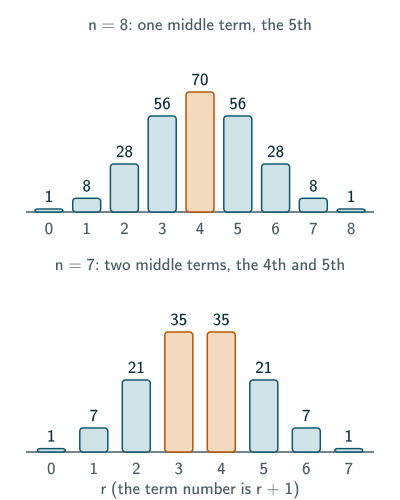
(a + b)n has n + 1 terms, so the number of middle terms depends on whether n is even or odd.
- n even: n + 1 is odd, and there is one middle term, the (n/2 + 1)th. For n = 8 it is the 5th term, T5.
- n odd: n + 1 is even, and there are two middle terms, the ((n + 1)/2)th and the ((n + 3)/2)th. For n = 7 they are T4 and T5.
Middle terms
n even: one middle term, the (n/2 + 1)th
n odd: two middle terms, the ((n + 1)/2)th and ((n + 3)/2)th
The middle binomial coefficients are the largest. nCr rises to the middle because each step multiplies it by (n − r + 1)/r, which is more than 1 while r < (n + 1)/2, and falls back symmetrically because nCr = nCn−r (see the properties of C). This is about nCr only: when a and b carry numbers, the greatest coefficient can be elsewhere. In (1 + 2x)7 the middle terms are T4 and T5, but the greatest coefficient is 672, in T6.
Finding a given term or coefficient
To find the term with a given power of x, or the term independent of x (the constant term), use the general term:
- Write Tr+1 and collect all the powers of x into one power x(something in r).
- Set that power equal to the power you want (0 for the term independent of x) and solve for r.
- r must be a whole number from 0 to n. If it is not, there is no such term.
- Put r back into Tr+1. The coefficient is the number in front, including its sign.
Ratios of neighbouring terms are often quicker than the terms themselves. For 1 ≤ r ≤ n, use a term ratio only when its denominator Tr is non-zero (and a ≠ 0 in the expression below). In (a + b)n, Tr+1/Tr = ((n − r + 1)/r) × b/a; for (1 + x)n the coefficients are in the ratio (n − r + 1)/r:
Neighbouring terms
T / T = (n − r + 1)/r × b/a
C / C = (n − r + 1)/r
Solved examples
Example 1: A term by its number
Find the 4th term of (x − 2y)7.
The 4th term has r = 3: T4 = 7C3x4(−2y)3 = 35 × (−8)x4y3.
Answer: T4 = −280x4y3.
Example 2: One middle term
Find the middle term of (x/3 + 9y)10.
n = 10 is even, so the middle term is the 6th, with r = 5: T6 = 10C5(x/3)5(9y)5 = 252 × (9/3)5x5y5 = 252 × 243x5y5.
Answer: T6 = 61 236x5y5.
Example 3: Two middle terms
Find the middle terms of (3 − x3/6)7.
n = 7 is odd, so the middle terms are the 4th and 5th (r = 3 and r = 4).
T4 = 7C3 · 34 · (−x3/6)3 = 35 × 81 × (−x9/216) = −2835x9/216 = −105x9/8.
T5 = 7C4 · 33 · (−x3/6)4 = 35 × 27 × x12/1296 = 945x12/1296 = 35x12/48.
Answer: T4 = −105x9/8 and T5 = 35x12/48.
Example 4: The term independent of x
Find the term independent of x in (x2 − 1/x)9.
Tr+1 = 9Cr(x2)9−r(−1/x)r = (−1)r · 9Crx18−3r. Set 18 − 3r = 0: r = 6, a whole number from 0 to 9.
Answer: T7 = (−1)6 · 9C6 = 84.
Example 5: A coefficient
Find the coefficient of x5 in (x + 3)8.
Tr+1 = 8Crx8−r3r. Set 8 − r = 5: r = 3, so T4 = 8C3 · 27x5 = 56 × 27x5.
Answer: 1512.
Common mistakes to avoid
Common mistake
Using r for the term number
The rth term is Tr = nCr−1an−r+1br−1, not nCran−rbr. For the 4th term of (x − 2y)7 the coefficient is 7C3, not 7C4.
Common mistake
Dropping the sign or the number inside b
In (x − 2y)7, b = −2y, so (−2y)3 = −8y3. Writing y3, or −2y3, gives the wrong coefficient.
Common mistake
Looking for one middle term when n is odd
(a + b)7 has 8 terms, so it has two middle terms, the 4th and 5th. Only an even n gives a single middle term.
Common mistake
Accepting an r that is not a whole number
In (x2 + 1/x)7 the power of x in Tr+1 is 14 − 3r. Setting it to 0 gives r = 14/3, which is not a whole number, so there is no term independent of x. The answer is not “r = 4.67”.
Quick revision summary
- The general term of (a + b)n is Tr+1 = nCran−rbr; the term number is r + 1.
- n even: one middle term, the (n/2 + 1)th; n odd: two, the ((n + 1)/2)th and ((n + 3)/2)th. Their binomial coefficients nCr are the largest; with numbers inside a or b, the greatest coefficient can be in another term.
- For a given power of x, solve for r in the general term; if r is not a whole number from 0 to n, there is no such term.
Formula sheet
- T = C a b, r = 0, 1, …, n
- (x − y): T = (−1) C x y
- n even: one middle term, the (n/2 + 1)th
- n odd: two middle terms, the ((n + 1)/2)th and ((n + 3)/2)th
- kth term from the end = (n − k + 2)th term
- T / T = (n − r + 1)/r × b/a, 1 ≤ r ≤ n, a ≠ 0, T ≠ 0
- C / C = (n − r + 1)/r
Questions students ask
How do you find the greatest term in a binomial expansion?
For a positive integer n and real x ≠ 0, the term of greatest absolute value in (1 + x)n, beyond NCERT, comes from the ratio of neighbouring terms: |Tr+1/Tr| ≥ 1 exactly when r ≤ m = (n + 1)|x|/(1 + |x|). If m is not a whole number, the greatest term is Tr+1 with r the whole-number part of m; if it is, Tm and Tm+1 have equal, greatest absolute values; for negative x their signs are opposite. When x = 0, the ratio method is unnecessary: T1 = 1 and all later terms are 0. For (1 + x)10 at x = 1/2, m = 11/3, so the greatest term is T4 = 15, not the middle term T6 ≈ 7.9. For (a + bx)n with a ≠ 0, use |bx/a| in place of |x|, or |b/a| for the coefficient of greatest absolute value. If a = 0, the expression is simply (bx)n; if the ratio is 0, only the first formal term can be non-zero.
What does ‘term independent of x’ mean?
The term independent of x is the constant term of an expansion: the term in which the power of x is 0, so its value is the same for every x ≠ 0. In (x − 2/x)6 the general term is 6Cr(−2)rx6−2r, so r = 3 gives the term independent of x, 6C3(−2)3 = −160. When no whole number r from 0 to n makes the power of x zero, the expansion has no term independent of x, which means its constant term is 0.
What is the middle term of (1 + x)?
The middle term of (1 + x)2n is the (n + 1)th term, Tn+1 = 2nCnxn, because the expansion has 2n + 1 terms and an even index gives a single middle term. Its coefficient 2nCn is the greatest binomial coefficient of the expansion, and it can also be written in the classic form [1 · 3 · 5 … (2n − 1)] × 2n/n!. For n = 3, the middle term of (1 + x)6 is 6C3x3 = 20x3, and indeed 1 · 3 · 5 × 23/3! = 120/6 = 20.
How is the general term of a binomial expansion different from that of an AP or GP?
The general term of a binomial expansion, Tr+1 = nCran−rbr, does the same job as the general term a + (n − 1)d of an AP or arn−1 of a GP: it gives the term in any position. The letters differ: in an AP or GP, n is the position, a the first term and r the common ratio, while in (a + b)n, n is the power, a one part of the binomial and r + 1 the term number. A binomial expansion also stops after n + 1 terms, while an AP or GP can be infinite.
Practice questions
Try each question first, then open the answer to check your working.
-
Q1. Find the 5th term of (2x − y)6.
Show answerHide answer
r = 4: 6C4(2x)2(−y)4 = 15 × 4x2y4 = 60x2y4.
-
Q2. Find the middle term of (x + 1/x)10.
Show answerHide answer
n = 10 is even, so the middle term is T6 (r = 5): 10C5x5(1/x)5 = 252.
-
Q3. Find the coefficient of x6 in (1 + 2x)9.
Show answerHide answer
Tr+1 = 9Cr(2x)r, so r = 6: 9C6 × 26 = 84 × 64 = 5376.
-
Q4. Find the term independent of x in (2x + 1/x2)6.
Show answerHide answer
Tr+1 = 6Cr26−rx6−3r. 6 − 3r = 0 gives r = 2: T3 = 15 × 16 = 240.