Locus and its equation
Beyond NCERT In the JEE Main syllabus; the Class 11 book has no section for it.
Quick answer
A locus is the path traced by a point that moves under a given condition, and its equation, with any necessary range restrictions, is satisfied by the coordinates of every point on the path and of no other point. To find it, take P(h, k) on the locus, write the condition as an equation in h and k, eliminate any parameter, and replace h, k by x, y. For example, the points equidistant from A(1, 2) and B(3, 4) form the line x + y = 5, the perpendicular bisector of AB.
What is a locus?
Locus and its equation
- The locus of a moving point is the set of all positions it can take while it obeys a given condition: the path it traces.
- An equation of the locus, together with any required restrictions on x and y, describes exactly the points satisfying the condition. Some loci need inequalities or excluded points as well as an equation.
In plain words: a locus turns a description in words into a curve. “All points 3 units from the origin” is a circle, and its equation is x2 + y2 = 9. “All points as far from A as from B” is a straight line, the perpendicular bisector of AB.
JEE Main 2027 lists “locus and its equation” in Unit 10, Co-ordinate Geometry. The 2026–27 NCERT book has no section on it, but Chapter 9 uses the idea. Miscellaneous Example 16 (page 172) and Miscellaneous Exercise Q19 (page 173) both ask for the path of a moving point:
Show that the path of a moving point such that its distances from two lines 3x – 2y = 5 and 3x + 2y = 5 are equal is a straight line.
NCERT Mathematics (Class 11), Chapter 9, Miscellaneous Examples, page 172
Finding the equation of a locus
The method is the same every time:
- Let P(h, k) be any point of the locus.
- Write the given condition as an equation in h and k, using the distance formula or whichever fact the condition is about.
- Simplify. If the condition involves a changing quantity (a parameter), eliminate it, and note any limit its range puts on x or y.
- Replace h by x and k by y.
Each step must work both ways, so that every point satisfying the final equation also satisfies the condition. Squaring both sides of PA = PB is safe, because distances are never negative.
Example: equidistant from two points. Find the locus of a point equidistant from A(1, 2) and B(3, 4).
PA2 = PB2 gives (h − 1)2 + (k − 2)2 = (h − 3)2 + (k − 4)2. The terms h2 and k2 cancel:
−2h + 1 − 4k + 4
= −6h + 9 − 8k + 16,
so 4h + 4k = 20. The locus is x + y = 5.
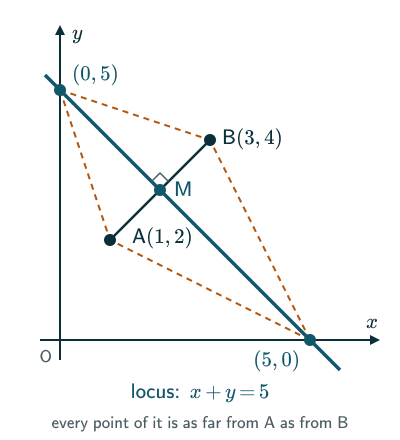
The answer checks out: the mid-point M(2, 3) of AB lies on it. Its slope, −1, times the slope of AB, 1, is −1. So the locus is the perpendicular bisector of AB.
Loci to recognise
- Equidistant from two distinct points: a straight line, the perpendicular bisector of the segment.
- At a fixed positive distance r from a point C(a, b): a circle, (x − a)2 + (y − b)2 = r2, from the distance formula. In the Argand plane the same circle is |z − (a + ib)| = r, because the modulus of a difference is a distance.
- Equidistant from a fixed point and a fixed line not through it: a parabola, as in Example 2 below. With the point (a, 0) and the line x = −a, it is y2 = 4ax.
- At a fixed positive distance from a line: two lines parallel to it, one on each side. For example, the points 2 units from the x-axis form the lines y = 2 and y = −2.
- Equidistant from two intersecting lines: the two lines that bisect the angles between them, as in Example 1 below (NCERT Miscellaneous Example 16).
- Making a given positive triangle area with two distinct fixed points: two lines parallel to the segment joining them (Example 3).
Circle as a locus
PC = r: (x − a) + (y − b) = r
Loci with a parameter
Often the condition involves a point that moves with the first one, such as the other end of a rod or a point on a given line. Write that point using a parameter, express h and k in terms of it, and eliminate it.
Example: a sliding rod. A rod AB of length 6 slides with A on the x-axis and B on the y-axis. Find the locus of its mid-point.
Let A = (a, 0) and B = (0, b). The rod’s length gives a2 + b2 = 36. The mid-point is P(h, k) = (a/2, b/2), so a = 2h and b = 2k. Then 4h2 + 4k2 = 36, and the locus is x2 + y2 = 9: a circle of radius 3 about the origin, of which the first-quadrant positions trace a quarter.
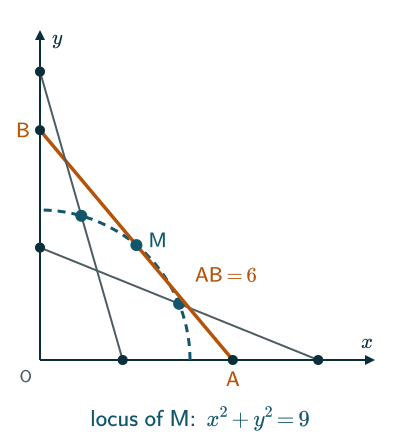
Rod of length l sliding on the axes
mid-point: x + y = l/4
Solved examples
Example 1: Equidistant from two lines (NCERT Miscellaneous Example 16, page 172)
Find the path of a point whose distances from the lines 3x − 2y = 5 and 3x + 2y = 5 are equal.
The distance of (h, k) from a line Ax + By + C = 0 is |Ah + Bk + C|/√(A2 + B2) (NCERT Section 9.4; see distance of a point from a line). Both distances have the same denominator, √(9 + 4) = √13, so the condition is |3h − 2k − 5| = |3h + 2k − 5|. Two numbers with equal absolute values are equal or opposite:
3h − 2k − 5 = 3h + 2k − 5 gives k = 0;
3h − 2k − 5 = −(3h + 2k − 5) gives h = 5/3.
Answer: the path is the pair of lines y = 0 and x = 5/3, the two bisectors of the angles between the given lines, which cross at (5/3, 0). NCERT works out both lines but then says the path “is a straight line”. Strictly, it is two straight lines.
Example 2: Equal distances from a point and a line
Find the locus of a point whose distance from (2, 0) equals its distance from the y-axis.
The distance of P(h, k) from the y-axis is |h|. So (h − 2)2 + k2 = h2, that is −4h + 4 + k2 = 0.
Answer: y2 = 4(x − 1). This curve is a parabola, which the Conic Sections chapter studies.
Example 3: A fixed triangle area
A(1, 1) and B(4, 5) are fixed. Find the locus of P such that triangle PAB has area 6.
By the area formula, ½|h(1 − 5) + 1(5 − k) + 4(k − 1)| = 6, that is |−4h + 3k + 1| = 12. So −4h + 3k + 1 = 12 or −4h + 3k + 1 = −12.
Answer: the two lines 4x − 3y + 11 = 0 and 4x − 3y − 13 = 0, both parallel to AB (slope 4/3). AB = 5, so P must be 12/5 from the line AB, on either side.
Example 4: A point dividing a moving segment
Q moves on the line x + y = 3, and P divides OQ internally in the ratio 1 : 2, where O is the origin. Find the locus of P.
By the section formula, P(h, k) = ((1 × xQ + 2 × 0)/3, (1 × yQ + 2 × 0)/3), so Q = (3h, 3k). Q is on the line, so 3h + 3k = 3.
Answer: x + y = 1, a line parallel to the one Q moves on.
Example 5: A right angle on a fixed segment
A(−1, 0) and B(1, 0) are fixed. Find the locus of P such that ∠APB = 90°.
PA ⟂ PB, so the product of their slopes is −1: (k/(h + 1)) × (k/(h − 1)) = −1, that is k2 = 1 − h2.
Answer: x2 + y2 = 1, the circle with diameter AB, without the points A and B themselves. At A or B there is no angle APB, and the slope working needs h ≠ ±1.
Common mistakes to avoid
Common mistake
Keeping only one sign
A condition with a modulus or a distance from a line usually gives two equations. In Example 1, keeping only 3h − 2k − 5 = 3h + 2k − 5 loses the line x = 5/3.
Common mistake
Forgetting the range of the parameter
Eliminating a parameter can add points the moving point never reaches. If P = (t2, 2t2 + 1), eliminating t gives y = 2x + 1, but x = t2 is never negative, so the locus is only the part of that line with x ≥ 0.
Common mistake
Leaving the parameter in
The answer must be an equation in x and y only. In the sliding rod, h = a/2 is not yet a locus; x2 + y2 = 9 is.
Common mistake
Including points that break the condition
Check the special points. In Example 5, A and B satisfy x2 + y2 = 1 but make no angle APB, so they are left out.
Common mistake
Forgetting to replace h and k
Work with P(h, k) to keep the moving point apart from fixed letters, but write the final answer with x and y.
Quick revision summary
- A locus is the set of points satisfying a condition; its equation and any range restrictions must include every allowed point and no others.
- Method: take P(h, k), write the condition in h and k, simplify and eliminate any parameter, then replace h, k by x, y.
- PA = PB gives the perpendicular bisector of AB (for A(1, 2) and B(3, 4), the line x + y = 5); PC = r gives the circle (x − a)2 + (y − b)2 = r2; equal distances from two intersecting lines give the two angle bisectors.
Formula sheet
- P(h, k) on the locus → condition in h, k → replace h, k by x, y
- PA = PB ⇔ P on the perpendicular bisector of AB (A ≠ B)
- PC = r: (x − a) + (y − b) = r, r ≥ 0
- rod of length l sliding on the axes, mid-point: x + y = l/4
Questions students ask
What is the difference between locus and loci?
Loci is simply the plural of locus, the Latin word for “place”: the set of all points that satisfy one condition is a locus, even when it has several pieces, such as a pair of lines, and two or more such sets are loci. For example, the circle x2 + y2 = 16 is the locus of the points 4 units from the origin, and circles of radius 4 about different centres are different loci. Locus is pronounced “LOH-kus”, and loci usually “LOH-sigh”.
What is the locus of a point equidistant from both the axes?
The locus of a point equidistant from the x-axis and the y-axis is the pair of lines y = x and y = −x, the two lines through the origin that bisect the angles between the axes. A point P(h, k) is |k| units from the x-axis and |h| units from the y-axis, so the condition |h| = |k| gives k = h or k = −h. Together the two lines are x2 = y2; for example, both (3, 3) and (3, −3) are 3 units from each axis.
How are the circle, parabola, ellipse and hyperbola defined as loci?
The circle, parabola, ellipse and hyperbola are each the locus of a point under one distance condition, as NCERT’s Conic Sections chapter defines them. A circle is the set of points at a fixed distance from its centre, and a parabola the points as far from the focus as from the directrix, a line not through the focus. An ellipse keeps the sum of the distances from two foci constant and greater than the distance between them, and a hyperbola keeps the absolute difference of those distances constant, positive and less than the distance between its distinct foci; the absolute value includes both branches.
Is locus a chapter in Class 11 NCERT Maths?
Locus is not a chapter or a section of the 2026–27 NCERT Class 11 Mathematics book, but the book uses the idea: Chapter 9 (Straight Lines) asks for the path of a moving point in Miscellaneous Example 16 and Miscellaneous Exercise Q19, and Chapter 10 (Conic Sections) defines the circle, parabola, ellipse and hyperbola as sets of points and finds the locus of a point on a sliding rod. The JEE Main syllabus names “locus and its equation” in Unit 10, Co-ordinate Geometry, so JEE aspirants practise the method on its own.
What is the locus of a point P such that PA + PB = AB?
The locus of a point P with PA + PB = AB is the segment AB itself, end points included: by the triangle inequality, PA + PB > AB for every other point of the plane, including the points of the line AB beyond A or B. If the constant sum is greater than AB, the locus is an ellipse with foci A and B, and if it is less than AB, no point qualifies. For A(0, 0) and B(4, 0), the point (1, 0) gives 1 + 3 = 4 and lies on the locus, while (2, 1) gives √5 + √5 ≈ 4.47, more than 4, so it does not.
Practice questions
Try each question first, then open the answer to check your working.
-
Q1. Find the locus of a point equidistant from (2, 3) and (−4, 1).
Show answerHide answer
(h − 2)2 + (k − 3)2 = (h + 4)2 + (k − 1)2 gives −4h − 6k + 13 = 8h − 2k + 17, that is 12h + 4k + 4 = 0. The locus is 3x + y + 1 = 0. Check: it passes through the mid-point (−1, 2).
-
Q2. Find the locus of a point whose distance from the origin is 5.
Show answerHide answer
h2 + k2 = 25, so the locus is the circle x2 + y2 = 25.
-
Q3. A is (0, 0) and B is (3, 0). Find the locus of P such that PA = 2PB.
Show answerHide answer
h2 + k2 = 4[(h − 3)2 + k2] gives 3h2 + 3k2 − 24h + 36 = 0. The locus is x2 + y2 − 8x + 12 = 0, a circle through (2, 0) and (6, 0).
-
Q4. Find the locus of a point that is always 2 units from the x-axis.
Show answerHide answer
|k| = 2, so the locus is the pair of lines y = 2 and y = −2.