Parabola
NCERT Class 11 Mathematics Chapter 10 Section 10.4
Quick answer
A parabola is the set of all points in a plane equidistant from a fixed line, the directrix, and a fixed point not on it, the focus. With its vertex at the origin, the parabola y = 4ax (a > 0) has focus (a, 0), directrix x = −a and opens to the right; the other standard forms are y = −4ax, x = 4ay and x = −4ay. Its latus rectum, the chord through the focus perpendicular to the axis, has length 4a.
With your textbook
NCERT Mathematics (Class 11), Chapter 10 “Conic Sections”, Section 10.4 “Parabola”, pages 182–187.
Open the official NCERT chapter (PDF, 3.0 MB, ncert.nic.in) (opens in a new tab)
Checked against the 2026-27 reprint on .
What is a parabola?
Parabola
A parabola is the set of all points in a plane that are equidistant from a fixed line and a fixed point (not on the line) in the plane.
NCERT Mathematics (Class 11), Section 10.4, page 182
- The fixed line is the directrix and the fixed point F is the focus.
A line through the focus and perpendicular to the directrix is called the axis of the parabola.
NCERT Mathematics (Class 11), Section 10.4, page 182
The point of intersection of parabola with the axis is called the vertex of the parabola
NCERT Mathematics (Class 11), Section 10.4, page 182
In plain words: a parabola is a locus, the path of a point that stays exactly as far from the focus as from the directrix. The vertex is the point of the parabola nearest to both, half-way between them on the axis. If the focus were on the directrix, the equal-distance points would form a straight line through the focus, perpendicular to the directrix: the degenerate parabola (NCERT page 182).
NCERT’s note on the name (page 182) says that “Para” means “for” and “bola” means “throwing”. “Bola” does come from the Greek for throwing, but the Greek para means “beside”, not “for”.
The standard equation y = 4ax
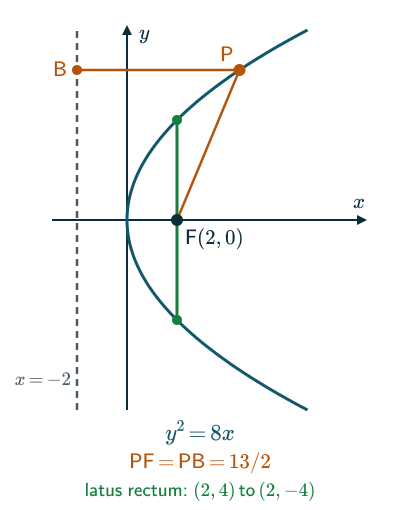
Put the vertex O at the origin and the axis along the x-axis, with the focus F(a, 0), a > 0, and the directrix x = −a (NCERT Section 10.4.1, pages 183–184, Fig 10.16). The distance from the directrix to the focus is then 2a. Let P(x, y) be a point of the parabola and B(−a, y) the foot of the perpendicular from P to the directrix. Then PF = PB gives
√((x − a)2 + y2) = |x + a|
(x − a)2 + y2 = (x + a)2
x2 − 2ax + a2 + y2 = x2 + 2ax + a2
y2 = 4ax.
Conversely, if y2 = 4ax, then PF2 = (x − a)2 + 4ax = (x + a)2 = PB2, so the point is on the parabola. Since a > 0, x is never negative: the curve lies in the first and fourth quadrants and opens to the right.
The other three orientations come the same way (NCERT page 184). NCERT labels them “Fig 11.15 (b)” to “(d)”; they are parts (b) to (d) of Fig 10.15, printed on pages 182–183.
These four equations are known as standard equations of parabolas.
NCERT Mathematics (Class 11), Section 10.4.1, page 184
| Equation | Focus | Directrix |
|---|---|---|
| y2 = 4ax | (a, 0) | x = −a |
| y2 = −4ax | (−a, 0) | x = a |
| x2 = 4ay | (0, a) | y = −a |
| x2 = −4ay | (0, −a) | y = a |
The first two have the x-axis as axis and open right and left; the last two have the y-axis as axis and open up and down.
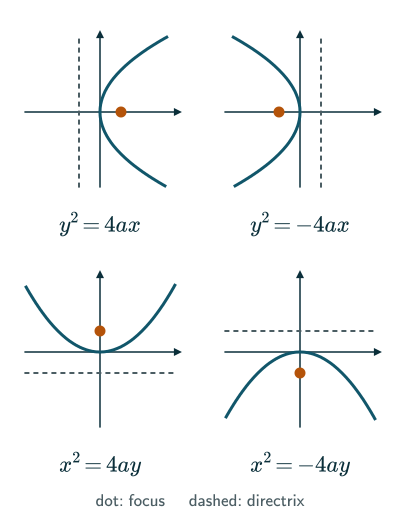
Parabola is symmetric with respect to the axis of the parabola.
NCERT Mathematics (Class 11), Section 10.4.1, page 184
How to read an equation (NCERT page 184): a y2 term means the axis is the x-axis, and the parabola opens right or left as the coefficient of x is positive or negative. An x2 term means the axis is the y-axis, and it opens up or down as the coefficient of y is positive or negative. The familiar graph of y = x2 (see functions and their graphs) is the parabola x2 = 4ay with a = 1/4: its focus is (0, 1/4).
Parabola y = 4ax
focus (a, 0)
directrix x = −a
Parabola x = 4ay
focus (0, a)
directrix y = −a
Latus rectum
Latus rectum of a parabola is a line segment perpendicular to the axis of the parabola, through the focus and whose end points lie on the parabola
NCERT Mathematics (Class 11), Section 10.4.2, page 185
For y2 = 4ax, put x = a: y2 = 4a2, so the ends are (a, 2a) and (a, −2a). NCERT’s argument (page 185) gets the same from the definition: an end A is as far from F as from the directrix, which is 2a.
Latus rectum of y = 4ax
ends (a, ±2a), length 4a
Focal distance (JEE). For a point P(x, y) of y2 = 4ax, PF = PB = x + a. So the distance from the focus is read straight off the x-coordinate. In the other forms the rule is the same: PF = a + |x| for y2 = ±4ax, and PF = a + |y| for x2 = ±4ay. Every point can also be written (at2, 2at) for a number t, because (2at)2 = 4a(at2).
Solved examples
Example 1: Reading a parabola (NCERT Example 5, page 185)
Find the focus, axis, directrix and latus rectum of y2 = 8x.
A y2 term and a positive coefficient of x: the axis is the x-axis and the parabola opens right. Comparing with y2 = 4ax, a = 2.
Answer: focus (2, 0), axis the x-axis, directrix x = −2, latus rectum 4a = 8.
Example 2: From focus and directrix (NCERT Example 6, page 186)
Find the parabola with focus (2, 0) and directrix x = −2.
The focus is on the x-axis, and the vertex is half-way between focus and directrix, at the origin. The focus is to the right, so y2 = 4ax with a = 2.
Answer: y2 = 8x.
Example 3: From vertex and focus (NCERT Example 7, page 186)
Find the parabola with vertex (0, 0) and focus (0, 2).
The axis is the y-axis and the focus is above the vertex, so x2 = 4ay with a = 2.
Answer: x2 = 8y.
Example 4: Through a point (NCERT Example 8, page 186)
Find the parabola with vertex at the origin, symmetric about the y-axis, passing through (2, −3).
The point is below the x-axis, so the parabola opens downwards: x2 = −4ay. Then 22 = −4a(−3), so a = 1/3.
Answer: x2 = −(4/3)y, that is 3x2 = −4y.
Example 5: A parabola opening left (NCERT Exercise 10.2, Q3, page 186)
Find the focus, axis, directrix and latus rectum of y2 = −8x.
A y2 term and a negative coefficient of x: it opens left, with 4a = 8 and a = 2.
Answer: focus (−2, 0), axis the x-axis, directrix x = 2, latus rectum 8.
Example 6: Through a point, axis along x (NCERT Exercise 10.2, Q11, page 187)
Find the parabola with vertex (0, 0), axis along the x-axis, passing through (2, 3).
The point has x > 0, so y2 = 4ax: 9 = 8a and a = 9/8.
Answer: y2 = (9/2)x, that is 2y2 = 9x.
Common mistakes to avoid
Common mistake
Taking 4a for a
In y2 = 12x, 4a = 12, so a = 3 and the focus is (3, 0), not (12, 0). The latus rectum is 4a = 12. First make the coefficient of the square 1: 2y2 = 9x is y2 = (9/2)x, so a = 9/8, not 9/4.
Common mistake
Choosing the wrong opening
The sign belongs to the variable that is not squared. x2 = −16y opens downwards; a negative sign does not change the axis.
Common mistake
Putting the focus on the directrix side
The focus and the directrix are on opposite sides of the vertex, each at distance a. For x2 = 8y, the focus is (0, 2) and the directrix y = −2, not y = 2.
Common mistake
Using the standard forms when the vertex is not at the origin
y2 = 4ax and the other three need the vertex at the origin. For a vertex (h, k), shift both coordinates: (y − k)2 = 4a(x − h) has axis y = k, focus (h + a, k), directrix x = h − a and latus rectum 4a. Complete the square first: y2 − 4y − 8x + 12 = 0 is (y − 2)2 = 8(x − 1), so the vertex is (1, 2), a = 2, the focus is (3, 2) and the directrix is x = −1, not (2, 0) and x = −2. NCERT itself keeps to the vertex-at-origin cases (page 184).
Quick revision summary
- A parabola is the set of points equidistant from a fixed line (the directrix) and a fixed point not on it (the focus); the axis is the line through the focus perpendicular to the directrix, and the vertex is where the parabola meets the axis.
- With the vertex at the origin: y2 = ±4ax (axis along x) and x2 = ±4ay (axis along y); the focus is at distance a from the vertex inside the curve, the directrix at distance a outside it.
- The latus rectum is the chord through the focus perpendicular to the axis; its length is 4a. For y2 = ±4ax, a point’s distance from the focus is a + |x|, and for x2 = ±4ay it is a + |y|.
Formula sheet
- y = 4ax: focus (a, 0), directrix x = −a
- y = −4ax: focus (−a, 0), directrix x = a
- x = 4ay: focus (0, a), directrix y = −a
- x = −4ay: focus (0, −a), directrix y = a
- latus rectum = 4a
- y = ±4ax: PF = a + |x|; x = ±4ay: PF = a + |y|
Questions students ask
What is the difference between a parabola and a hyperbola?
A parabola has one focus, one directrix, a single open branch and eccentricity 1, while a hyperbola has two foci, two branches and eccentricity greater than 1. Every point of a parabola is as far from the focus as from the directrix, whereas on a hyperbola the distances from the two foci differ by a constant 2a. A parabola has no centre and no asymptotes, while a hyperbola has a centre and branches that approach two asymptotes (beyond NCERT). In a standard equation a parabola has one squared variable, as in y2 = 4ax, and a hyperbola two with opposite signs, as in x2/a2 − y2/b2 = 1.
Why is the eccentricity of a parabola 1?
The eccentricity of a parabola is 1 because, in the focus–directrix description of a conic, e is the ratio PF/PB of the distance of a point P from the focus F to its distance PB from the directrix, and the definition of a parabola makes these two distances equal. NCERT defines eccentricity only for the ellipse and the hyperbola, as c/a. Because every parabola has the same e, all parabolas have the same shape: y2 = 4ax is y2 = 4x enlarged a times about the vertex, so two parabolas differ only in size and position.
Is a hanging chain a parabola or a catenary?
A uniform, flexible chain or cable hanging freely under its own weight forms a catenary, not a parabola, although the two look almost the same near the lowest point. The catenary is the hyperbolic cosine curve y = c cosh(x/c) (beyond NCERT and the JEE Main syllabus), and away from the bottom it rises more steeply than the parabola y = c + x2/(2c) that matches it there. A cable does hang in a parabola when its load is spread evenly along the horizontal rather than along the cable, as for a suspension-bridge cable holding up a level roadway much heavier than the cable itself, which is the model in NCERT’s suspension-bridge problem.
Why are satellite dishes and headlight reflectors shaped like a parabola?
Satellite dishes and the reflectors of torches and car headlights are parabolic because a parabolic mirror reflects every ray arriving parallel to its axis through the focus, and sends light from a source at the focus out parallel to the axis. A dish therefore gathers a weak signal from a distant satellite onto a receiver at its focus, and a bulb at the focus of a headlight gives a beam of parallel rays. The real reflector is a paraboloid, the surface traced by spinning a parabola about its axis; NCERT’s chapter introduction (Section 10.1) names telescopes, antennas, flashlights and headlights among the uses of conics.
How do you find the equation of a parabola when the directrix is a slanting line?
To find a parabola whose directrix is not parallel to an axis, a case NCERT leaves beyond its scope, use the definition: set the distance of P(x, y) from the focus equal to its perpendicular distance from the directrix and square both sides. With focus (1, 1) and directrix x + y + 2 = 0, this gives 2[(x − 1)2 + (y − 1)2] = (x + y + 2)2, that is x2 − 2xy + y2 − 8x − 8y = 0. This parabola has its vertex at the origin and its axis along y = x; the xy term shows the tilted axis, so none of the four standard forms fits.
Are tangents and normals to a parabola in the JEE Main syllabus?
Tangents and normals to a parabola are not named in the JEE Main syllabus, whose Unit 10 (Co-ordinate Geometry) lists “equations of conic sections (parabola, ellipse and hyperbola) in standard forms”, and NCERT’s Class 11 section on the parabola stops at the standard equations and the latus rectum. The discriminant test used for a circle carries over: putting y = mx + c (m ≠ 0) into y2 = 4ax gives a quadratic in x with a double root, so the line is a tangent, exactly when c = a/m. The vertical line x = 0 is also a tangent, at the vertex; it is not represented by a finite slope m.
Practice questions
Try each question first, then open the answer to check your working.
-
Q1. Find the focus, axis, directrix and latus rectum of y2 = 12x (NCERT Exercise 10.2, Q1).
Show answerHide answer
a = 3: focus (3, 0), axis the x-axis, directrix x = −3, latus rectum 12.
-
Q2. Find the focus, axis, directrix and latus rectum of x2 = 6y (NCERT Exercise 10.2, Q2).
Show answerHide answer
4a = 6, a = 3/2: focus (0, 3/2), axis the y-axis, directrix y = −3/2, latus rectum 6.
-
Q3. Find the parabola with focus (6, 0) and directrix x = −6 (NCERT Exercise 10.2, Q7).
Show answerHide answer
a = 6 and it opens right: y2 = 24x.
-
Q4. Find the parabola with vertex (0, 0) and focus (−2, 0) (NCERT Exercise 10.2, Q10).
Show answerHide answer
The focus is to the left, a = 2: y2 = −8x.