Ellipse
NCERT Class 11 Mathematics Chapter 10 Section 10.5
Quick answer
An ellipse is the set of all points in a plane whose distances from two fixed points, the foci, add up to a constant 2a greater than the distance between the foci. With its centre at the origin and foci (±c, 0), its equation is x/a + y/b = 1, where a > b and a = b + c. Its eccentricity is e = c/a, between 0 and 1, and its latus rectum has length 2b/a.
With your textbook
NCERT Mathematics (Class 11), Chapter 10 “Conic Sections”, Section 10.5 “Ellipse”, pages 187–195.
Open the official NCERT chapter (PDF, 3.0 MB, ncert.nic.in) (opens in a new tab)
Checked against the 2026-27 reprint on .
What is an ellipse?
Ellipse
An ellipse is the set of all points in a plane, the sum of whose distances from two fixed points in the plane is a constant.
NCERT Mathematics (Class 11), Section 10.5, page 187
- The two fixed points F1 and F2 are the foci (plural of focus).
The constant which is the sum of the distances of a point on the ellipse from the two fixed points is always greater than the distance between the two fixed points.
NCERT Mathematics (Class 11), Section 10.5, page 187
In plain words: tie the ends of a string to two pins and pull it tight with a pencil; as the pencil goes round, it draws an ellipse, because the two pieces of string always add up to the same length. In the Argand plane the same curve is |z − z1| + |z − z2| = 2a, with 2a greater than |z1 − z2|, since each modulus is a distance.
The mid point of the line segment joining the foci is called the centre of the ellipse.
NCERT Mathematics (Class 11), Section 10.5, page 187
The major axis is the segment through the foci, with ends on the ellipse; the minor axis is the segment through the centre perpendicular to it (NCERT page 187).
The end points of the major axis are called the vertices of the ellipse
NCERT Mathematics (Class 11), Section 10.5, page 187
NCERT writes 2a for the length of the major axis, 2b for the minor axis and 2c for the distance between the foci. For the non-circular ellipse treated below, a > b > 0. The circle case is described in the questions section. Thus a and b are the semi-major and semi-minor axes, and each focus is c from the centre.
How a, b and c are related
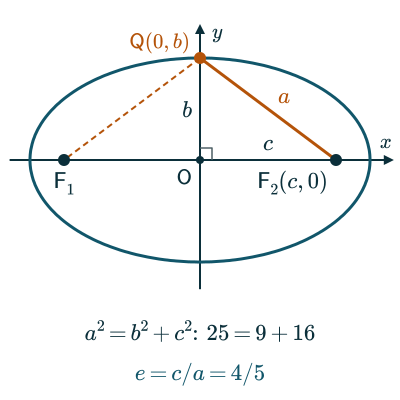
Take the end P of the major axis (NCERT Section 10.5.1, page 188, Fig 10.23). Its distances from the foci are a + c and a − c, so their sum, the constant of the ellipse, is 2a. Now take the end Q of the minor axis. It is equally far from both foci, so each distance is a. The right triangle with legs b (from the centre to Q) and c (from the centre to a focus) then has hypotenuse a:
a, b and c
a = b + c
c = √(a − b)
Eccentricity
The eccentricity of an ellipse is the ratio of the distances from the centre of the ellipse to one of the foci and to one of the vertices of the ellipse
NCERT Mathematics (Class 11), Section 10.5.2, page 188
Eccentricity of an ellipse
e = c/a, 0 < e < 1
Since 0 < c < a, the eccentricity lies between 0 and 1, and each focus is ae from the centre. When e is close to 0, the foci are close together and the ellipse is nearly a circle. When e is close to 1, the ellipse is long and flat. Also b2 = a2(1 − e2).
The standard equation
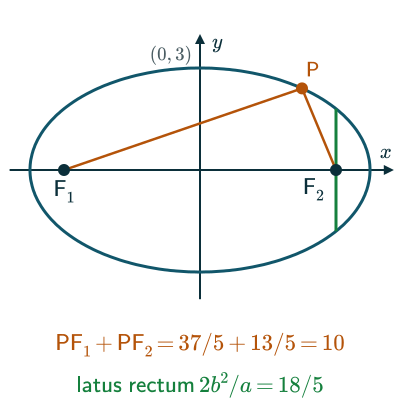
Put the centre at the origin and the foci at F1(−c, 0) and F2(c, 0) (NCERT Section 10.5.3, pages 188–191). For P(x, y) on the ellipse, PF1 + PF2 = 2a, and by the distance formula:
√((x + c)2 + y2) = 2a − √((x − c)2 + y2).
Squaring and cancelling gives 4a√((x − c)2 + y2) = 4a2 − 4cx, so √((x − c)2 + y2) = a − (c/a)x. Squaring again gives x2(a2 − c2)/a2 + y2 = a2 − c2. Put a2 − c2 = b2 and divide by b2:
Ellipse with foci on the x-axis (a > b)
x/a + y/b = 1
Conversely, every point with x2/a2 + y2/b2 = 1 has PF1 = a + (c/a)x and PF2 = a − (c/a)x (that is, a + ex and a − ex), which add up to 2a (NCERT page 190). So the equation describes exactly the ellipse. From it, −a ≤ x ≤ a and −b ≤ y ≤ b: the ellipse lies inside the rectangle bounded by x = ±a and y = ±b, touching its sides at (±a, 0) and (0, ±b), the ends of the two axes.
With the foci on the y-axis instead, the equation is x2/b2 + y2/a2 = 1, still with a > b.
These two equations are known as standard equations of the ellipses.
NCERT Mathematics (Class 11), Section 10.5.3, page 191
The foci always lie on the major axis.
NCERT Mathematics (Class 11), Section 10.5.3, page 191
To tell which way an ellipse lies, compare the denominators: the major axis is along the x-axis if x2 has the larger denominator, and along the y-axis if y2 has. The ellipse is symmetric about both axes.
Latus rectum
Latus rectum of an ellipse is a line segment perpendicular to the major axis through any of the foci and whose end points lie on the ellipse
NCERT Mathematics (Class 11), Section 10.5.4, page 192
Put x = c = ae in x2/a2 + y2/b2 = 1: y2 = b2(1 − e2) = b4/a2, so the ends are (c, ±b2/a).
Latus rectum of an ellipse
length = 2b/a
NCERT says the two halves of the latus rectum are equal “Since the ellipse is symmetric with respect to y-axis” (page 192). The ends (c, b2/a) and (c, −b2/a) are mirror images in the x-axis, so it is the symmetry about the x-axis, the major axis, that is used.
Solved examples
Example 1: Reading an ellipse (NCERT Example 9, page 192)
Find the foci, vertices, axes, eccentricity and latus rectum of x2/25 + y2/9 = 1.
25 > 9, so the major axis is along the x-axis: a = 5, b = 3, c = √(25 − 9) = 4.
Answer: foci (±4, 0), vertices (±5, 0), major axis 10, minor axis 6, e = 4/5, latus rectum 2b2/a = 18/5.
Example 2: Major axis along y (NCERT Example 10, page 193)
Find the foci, vertices, axes and eccentricity of 9x2 + 4y2 = 36.
Divide by 36: x2/4 + y2/9 = 1. Now 9 > 4, so the major axis is along the y-axis, with a = 3, b = 2 and c = √5.
Answer: foci (0, ±√5), vertices (0, ±3), major axis 6, minor axis 4, e = √5/3.
Example 3: From vertices and foci (NCERT Example 11, page 193)
Find the ellipse with vertices (±13, 0) and foci (±5, 0).
a = 13 and c = 5, so b2 = 169 − 25 = 144.
Answer: x2/169 + y2/144 = 1.
Example 4: From the major axis and foci (NCERT Example 12, page 194)
Find the ellipse with major axis 20 and foci (0, ±5).
The foci are on the y-axis, a = 10 and c = 5, so b2 = 100 − 25 = 75.
Answer: x2/75 + y2/100 = 1.
Example 5: Through two points (NCERT Example 13, pages 194–195)
Find the ellipse centred at the origin with major axis along the x-axis through (4, 3) and (−1, 4).
Write p = 1/a2 and q = 1/b2: 16p + 9q = 1 and p + 16q = 1. From the second, p = 1 − 16q; then 16 − 247q = 1, so q = 15/247 and p = 7/247.
Answer: 7x2/247 + 15y2/247 = 1, that is 7x2 + 15y2 = 247. NCERT gives only the final values of a2 and b2.
Example 6: Reading an ellipse with the major axis along y (NCERT Exercise 10.3, Q4, page 195)
Find the foci, vertices, axes, eccentricity and latus rectum of x2/25 + y2/100 = 1.
100 > 25, so the major axis is along the y-axis: a = 10, b = 5, c = √75 = 5√3.
Answer: foci (0, ±5√3), vertices (0, ±10), major axis 20, minor axis 10, e = √3/2, latus rectum 2 × 25/10 = 5.
Common mistakes to avoid
Common mistake
Taking a from the x-term every time
In NCERT’s notation a is always the larger semi-axis. In x2/4 + y2/9 = 1, a = 3 belongs to y, so the foci are on the y-axis. If a question writes x2/a2 + y2/b2 = 1 with b > a, the letters swap roles: the foci are (0, ±√(b2 − a2)), e2 = 1 − a2/b2 and the latus rectum is 2a2/b.
Common mistake
Using c = a + b
For an ellipse, c2 = a2 − b2: the foci are inside the ellipse, so c < a. (The plus sign belongs to the hyperbola.)
Common mistake
Not dividing to get 1 on the right
9x2 + 4y2 = 36 is not a2 = 9, b2 = 4. Divide by 36 first: x2/4 + y2/9 = 1.
Common mistake
Writing the latus rectum as 2b/a
The length is 2b2/a. For x2/25 + y2/9 = 1 it is 18/5, not 6/5.
Quick revision summary
- An ellipse is the set of points whose distances from two fixed points (the foci) add up to a constant 2a, greater than the distance 2c between the foci.
- a2 = b2 + c2; the eccentricity is e = c/a, between 0 and 1.
- Centre at the origin: x2/a2 + y2/b2 = 1 (foci (±c, 0)) or x2/b2 + y2/a2 = 1 (foci (0, ±c)), with a > b; the larger denominator shows the major axis.
- The latus rectum has length 2b2/a; the focal distances of P(x, y) are a ± ex when the major axis is along the x-axis, and a ± ey when it is along the y-axis.
Formula sheet
- x/a + y/b = 1, a > b: foci (±c, 0)
- x/b + y/a = 1, a > b: foci (0, ±c)
- a = b + c
- e = c/a, 0 < e < 1
- latus rectum = 2b/a
- PF = a + ex, PF = a − ex (foci on the x-axis)
Questions students ask
What is the area of an ellipse?
The area of the ellipse x2/a2 + y2/b2 = 1 is πab, where a and b are its semi-major and semi-minor axes. It is proved by integration in NCERT Class 12 (Application of Integrals), and it also follows from the circle of radius a, of area πa2: scaling it by the factor b/a in the y-direction turns it into the ellipse and multiplies every area by b/a. For example, with a = 7 and b = 3 the area is 21π ≈ 65.97 square units, and a = b = r gives the circle’s πr2.
What is the difference between an ellipse and a circle?
A circle is the special ellipse whose two axes are equal: with a = b, c = √(a2 − b2) = 0, both foci merge at the centre, the eccentricity is 0 and x2/a2 + y2/b2 = 1 becomes x2 + y2 = a2. An ellipse with a > b has a longer and a shorter axis, two separate foci and 0 < e < 1, and its points lie between b and a from the centre. Every point of a circle is the same distance, the radius, from the centre, so every diameter has the same length.
Is an oval the same as an ellipse?
An ellipse is one particular kind of oval, but not every oval is an ellipse. “Oval” is an everyday word for any smooth, rounded, elongated closed curve, such as the outline of an egg, which is wider at one end, and it has no single equation. An ellipse is fixed exactly by its two foci and the constant sum 2a of the distances from them, so it is symmetric about both of its axes and, in standard position, has the equation x2/a2 + y2/b2 = 1.
What is the formula for the perimeter of an ellipse?
The perimeter of an ellipse has no exact formula in a and b using ordinary functions, unlike its area πab: it is given by an elliptic integral, which is beyond NCERT and the JEE Main syllabus. A very accurate approximation, due to Ramanujan and also beyond the syllabus, is P ≈ π[3(a + b) − √u], where u = (3a + b)(a + 3b). For a = 7 and b = 3 it gives about 32.69, within 0.001 of the exact value, and for a circle, a = b = r, it gives exactly 2πr.
What are the directrices of an ellipse?
The directrices of the ellipse x2/a2 + y2/b2 = 1 (a > b) are the lines x = ±a/e, outside the ellipse, one on the side of each focus, and every point P of the ellipse has PF = e × PM, where PM is its distance from the directrix on the side of the focus F. NCERT defines the ellipse by the sum of the focal distances and does not use directrices; the focus–directrix form gives one definition for the ellipse, parabola and hyperbola. For x2/100 + y2/36 = 1, c = 8 and e = 4/5, so the directrices are x = ±25/2; the vertex (10, 0) is 2 from the focus (8, 0) and 5/2 from x = 25/2, a ratio of 4/5.
What is the parametric form of an ellipse?
The parametric form of the ellipse x2/a2 + y2/b2 = 1 is x = a cos θ, y = b sin θ, with 0 ≤ θ < 2π, because cos2 θ + sin2 θ = 1; it is beyond NCERT. The parameter θ, the eccentric angle, belongs to the point (a cos θ, a sin θ) of the auxiliary circle x2 + y2 = a2, and is in general not the angle that OP makes with the x-axis. On x2/49 + y2/9 = 1, θ = π/4 gives P(7/√2, 3/√2), and OP makes an angle of only about 23.2° with the x-axis.
Where are ellipses used in real life?
Ellipses appear in real life mainly as orbits and as reflectors: each planet moves round the Sun on an ellipse with the Sun at one focus (Kepler’s first law), and many satellites move on elliptical orbits round the Earth. An ideal elliptical mirror, or in three dimensions an ellipsoid of revolution about the major axis, reflects rays from one focus through the other, which is how an elliptical whispering gallery carries a whisper across the room and how a lithotripsy machine focuses shock waves on a kidney stone. A circle seen at a slant, such as the rim of a cup, also looks like an ellipse, and so does the cut made by a plane slicing a cylinder obliquely.
Practice questions
Try each question first, then open the answer to check your working.
-
Q1. Find the foci, vertices, axes, eccentricity and latus rectum of x2/36 + y2/16 = 1 (NCERT Exercise 10.3, Q1).
Show answerHide answer
a = 6, b = 4, c = √20 = 2√5: foci (±2√5, 0), vertices (±6, 0), major axis 12, minor axis 8, e = √5/3, latus rectum 2 × 16/6 = 16/3.
-
Q2. Find the foci, vertices, axes, eccentricity and latus rectum of x2/4 + y2/25 = 1 (NCERT Exercise 10.3, Q2).
Show answerHide answer
Major axis along y: a = 5, b = 2, c = √21. Foci (0, ±√21), vertices (0, ±5), major axis 10, minor axis 4, e = √21/5, latus rectum 8/5.
-
Q3. Find the ellipse with vertices (±5, 0) and foci (±4, 0) (NCERT Exercise 10.3, Q10).
Show answerHide answer
b2 = 25 − 16 = 9: x2/25 + y2/9 = 1.
-
Q4. Find the ellipse with minor axis 16 and foci (0, ±6) (NCERT Exercise 10.3, Q16).
Show answerHide answer
b = 8 and c = 6 on the y-axis, so a2 = 64 + 36 = 100: x2/64 + y2/100 = 1.