Circle
NCERT Class 11 Mathematics Chapter 10 Section 10.3
Quick answer
A circle is the set of all points in a plane at a fixed distance r (the radius) from a fixed point, the centre (h, k), so its equation is (x − h) + (y − k) = r; with the centre at the origin it is x + y = r. The general form x + y + 2gx + 2fy + c = 0 has centre (−g, −f) and radius √(g + f − c) when g + f − c is positive, found by completing the square in x and in y.
With your textbook
NCERT Mathematics (Class 11), Chapter 10 “Conic Sections”, Section 10.3 “Circle”, pages 179–181.
Open the official NCERT chapter (PDF, 3.0 MB, ncert.nic.in) (opens in a new tab)
Checked against the 2026-27 reprint on .
What is a circle?
Circle
A circle is the set of all points in a plane that are equidistant from a fixed point in the plane.
NCERT Mathematics (Class 11), Section 10.3, page 179
The fixed point is called the centre of the circle and the distance from the centre to a point on the circle is called the radius of the circle
NCERT Mathematics (Class 11), Section 10.3, page 179
In plain words: a circle is every point at one fixed distance r from one fixed point C. It is the section of a cone made by a plane perpendicular to the axis and not through the vertex (NCERT Section 10.2.1); through the vertex, that plane cuts only a point (NCERT Section 10.2.2). With coordinates, the definition becomes an equation.
The standard equation
Let the centre be C(h, k) and the radius r, and let P(x, y) be any point of the circle (NCERT page 180, Fig 10.12). By the definition, CP = r. The distance formula turns this into √((x − h)2 + (y − k)2) = r. Both sides are positive, so squaring loses nothing:
Circle with centre (h, k) and radius r
(x − h) + (y − k) = r
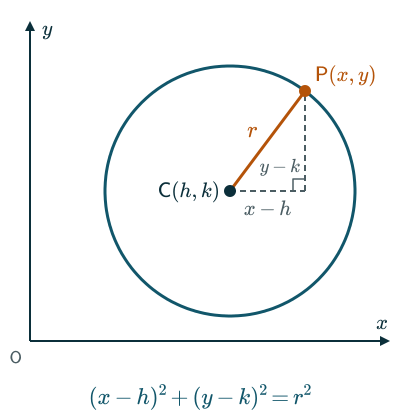
The equation of the circle is simplest if the centre of the circle is at the origin.
NCERT Mathematics (Class 11), Section 10.3, page 180
With the centre at the origin, h = k = 0 and the circle is x2 + y2 = r2 (NCERT Example 1). NCERT Example 2 (page 180): centre (−3, 2) and radius 4 give (x + 3)2 + (y − 2)2 = 16. In the Argand plane, the same circle is the set of complex numbers z with |z − z0| = r (see modulus as a distance).
Centre and radius from the general equation
Multiplying out (x − h)2 + (y − k)2 = r2 gives x2 + y2 − 2hx − 2ky + (h2 + k2 − r2) = 0. So a circle’s equation has equal coefficients of x2 and y2 and no xy term. To read off the centre and radius, collect the x terms and the y terms and complete the square in each: add (half the coefficient of x)2 and (half the coefficient of y)2 to both sides, the step behind the quadratic formula.
NCERT Example 3 (page 180): x2 + y2 + 8x + 10y − 8 = 0.
(x2 + 8x) + (y2 + 10y) = 8
Add (8/2)2 = 16 and (10/2)2 = 25 to both sides:
(x2 + 8x + 16) + (y2 + 10y + 25) = 8 + 16 + 25
(x + 4)2 + (y + 5)2 = 49
So the centre is (−4, −5) and the radius is 7.
The general form (JEE). Doing the same with x2 + y2 + 2gx + 2fy + c = 0 gives (x + g)2 + (y + f)2 = g2 + f2 − c:
General form of a circle
x + y + 2gx + 2fy + c = 0
centre = (−g, −f)
radius = √(g + f − c)
where g + f − c > 0
If g2 + f2 − c = 0, the “circle” is just the point (−g, −f), a point circle. If it is negative, no real point satisfies the equation (an imaginary circle). The coefficients of x2 and y2 must be 1 before you read off g and f: divide 2x2 + 2y2 − x = 0 by 2 first.
A circle from given conditions
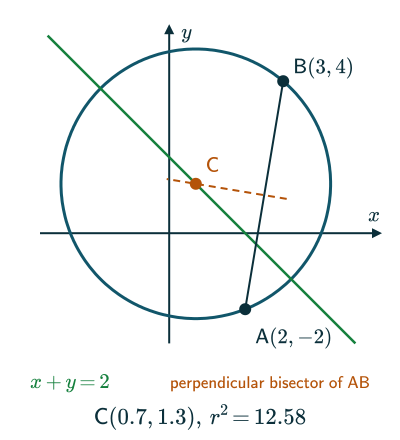
A circle has three unknowns, h, k and r, so it needs three independent conditions. When one condition is quadratic, there can be two circles (see the solved Example 4 below, NCERT Exercise 10.1, Q12). NCERT Example 4 (page 181) asks for the circle through (2, −2) and (3, 4) whose centre is on x + y = 2. The centre is equally far from the two points:
(2 − h)2 + (−2 − k)2 = (3 − h)2 + (4 − k)2
The h2 and k2 terms cancel:
8 − 4h + 4k = 25 − 6h − 8k
2h + 12k = 17.
With h + k = 2 this gives k = 1.3 and h = 0.7. Then r2 = 1.32 + 3.32 = 12.58, and the circle is (x − 0.7)2 + (y − 1.3)2 = 12.58. NCERT gives only the final values.
Inside, on or outside (JEE). A point P is inside, on or outside the circle as CP is less than, equal to or greater than r. In the form S = (x − h)2 + (y − k)2 − r2, put in the point and look at the sign of S: negative inside, zero on, positive outside. The same works straight from the general form: x2 + y2 + 2gx + 2fy + c equals (x + g)2 + (y + f)2 − r2, so put the point into the left side (after making the coefficient of x2 equal to 1) and read the sign.
Solved examples
Example 1: Centre and radius (NCERT Exercise 10.1, Q7, page 181)
Find the centre and radius of x2 + y2 − 4x − 8y − 45 = 0.
(x − 2)2 + (y − 4)2 = 45 + 4 + 16 = 65.
Answer: centre (2, 4), radius √65.
Example 2: Coefficients not 1 (NCERT Exercise 10.1, Q9, page 181)
Find the centre and radius of 2x2 + 2y2 − x = 0.
Divide by 2: x2 + y2 − x/2 = 0. Completing the square, (x − 1/4)2 + y2 = 1/16.
Answer: centre (1/4, 0), radius 1/4. The circle passes through the origin.
Example 3: Centre on a given line (NCERT Exercise 10.1, Q10, page 181)
Find the circle through (4, 1) and (6, 5) whose centre is on 4x + y = 16.
The centre is on the perpendicular bisector of the chord. The mid-point is (5, 3) and the chord has slope 2, so the bisector is y − 3 = −(x − 5)/2, that is x + 2y = 11. With 4x + y = 16 this gives the centre (3, 4). Then r2 = (4 − 3)2 + (1 − 4)2 = 10.
Answer: (x − 3)2 + (y − 4)2 = 10, that is x2 + y2 − 6x − 8y + 15 = 0.
Example 4: Two answers (NCERT Exercise 10.1, Q12, page 181)
Find the circle of radius 5 whose centre is on the x-axis and which passes through (2, 3).
The centre is (h, 0): (2 − h)2 + 9 = 25, so (2 − h)2 = 16 and h = −2 or 6.
Answer: (x + 2)2 + y2 = 25 or (x − 6)2 + y2 = 25, that is x2 + y2 + 4x − 21 = 0 or x2 + y2 − 12x + 11 = 0.
Example 5: Intercepts on the axes (NCERT Exercise 10.1, Q13, page 181)
Find the circle through (0, 0) that makes non-zero intercepts a and b on the axes.
It passes through (0, 0), (a, 0) and (0, b). In the general form, (0, 0) gives c = 0; then (a, 0) gives a2 + 2ga = 0, so g = −a/2, and likewise f = −b/2.
Answer: x2 + y2 − ax − by = 0. Its centre is (a/2, b/2), the mid-point of (a, 0) and (0, b): the angle at the origin is a right angle, so these two points are the ends of a diameter.
Example 6: Inside or outside? (NCERT Exercise 10.1, Q15, page 181)
Does (−2.5, 3.5) lie inside, outside or on the circle x2 + y2 = 25?
6.25 + 12.25 = 18.5 < 25.
Answer: inside, since its distance from the centre is √18.5 < 5.
Common mistakes to avoid
Common mistake
Getting the signs of the centre wrong
(x + 3)2 + (y − 2)2 = 16 has centre (−3, 2), not (3, −2). The centre is the point that makes both brackets zero.
Common mistake
Reading r as r
(x + 4)2 + (y + 5)2 = 49 has radius 7, not 49.
Common mistake
Forgetting to halve
In x2 + y2 + 8x + 10y − 8 = 0, 2g = 8, so g = 4 and f = 5: the centre is (−4, −5), not (−8, −10).
Common mistake
Reading g and f before dividing
In 2x2 + 2y2 − x = 0, the centre is (1/4, 0), not (1/2, 0). Make the coefficients of x2 and y2 equal to 1 first.
Common mistake
Calling every second-degree equation a circle
x2 + 2y2 = 4 has unequal coefficients, and x2 + y2 + 4x + 6y + 20 = 0 gives g2 + f2 − c = 4 + 9 − 20 < 0. Neither is a circle.
Quick revision summary
- A circle is the set of points at a fixed distance r (the radius) from a fixed point C (the centre).
- Centre (h, k), radius r: (x − h)2 + (y − k)2 = r2; centre at the origin: x2 + y2 = r2.
- x2 + y2 + 2gx + 2fy + c = 0 has centre (−g, −f) and radius √(g2 + f2 − c); complete the squares to see it.
- A circle needs three conditions; a point is inside, on or outside as its distance from the centre is less than, equal to or more than r.
Formula sheet
- (x − h) + (y − k) = r
- x + y = r
- x + y + 2gx + 2fy + c = 0: centre (−g, −f), radius √(g + f − c)
- inside / on / outside: CP < r, = r, > r
Questions students ask
What is the difference between the standard and general equation of a circle?
The standard equation of a circle, (x − h)2 + (y − k)2 = r2, shows the centre (h, k) and the radius r at a glance, while the general equation x2 + y2 + 2gx + 2fy + c = 0 is the same circle multiplied out, with its centre at (−g, −f). Every circle has both forms, and you pass between them by expanding or by completing the squares; but an equation of the general shape is a real circle only when g2 + f2 − c, the radius squared, is positive. For example, (x − 1)2 + (y + 3)2 = 9 expands to x2 + y2 − 2x + 6y + 1 = 0.
How do you find the equation of a circle passing through three points?
To find the equation of a circle through three points, put each point into x2 + y2 + 2gx + 2fy + c = 0 and solve the three linear equations for g, f and c. Exactly one circle passes through three points that are not on a line, and its centre is the circumcentre of their triangle; three distinct collinear points lie on no circle, and two points lie on infinitely many. For example, (6, 2), (1, 7) and (−4, 2) give g = −1, f = −2 and c = −20, so the circle is x2 + y2 − 2x − 4y − 20 = 0, with centre (1, 2) and radius 5.
What does c mean in the general equation of a circle?
In the general equation of a circle x2 + y2 + 2gx + 2fy + c = 0, the constant c is the value of the left side at the origin, so by the inside or outside test its sign tells where the origin lies, for a real circle: inside it if c < 0, on it if c = 0 and outside it if c > 0. In terms of the centre and radius, c = h2 + k2 − r2, the square of the centre’s distance from the origin minus the square of the radius. For example, x2 + y2 − 6x − 2y + 6 = 0 has c = 6 > 0: its centre (3, 1) is √10 from the origin, more than its radius 2.
What is the equation of the unit circle?
The unit circle is the circle of radius 1 centred at the origin, so its equation is x2 + y2 = 1. Each of its points is (cos θ, sin θ) for some angle θ, which is how the trigonometric functions are defined, and this is why cos2 θ + sin2 θ = 1. In the same way, every point of the circle with centre (h, k) and radius r is (h + r cos θ, k + r sin θ), the parametric form of a circle, beyond NCERT.
Is circle a separate chapter in Class 11 maths?
The circle is not a separate chapter in the NCERT Class 11 Mathematics book (2026–27 reprint): it is Section 10.3 of Chapter 10, Conic Sections, which derives the standard equation and finds the centre and radius by completing the square. The JEE Main syllabus (Unit 10) also names the general form, which NCERT uses only in examples, and two topics the NCERT book leaves out, the circle on given ends of a diameter and the points where a line meets a circle centred at the origin.
Practice questions
Try each question first, then open the answer to check your working.
-
Q1. Find the equation of the circle with centre (0, 2) and radius 2 (NCERT Exercise 10.1, Q1).
Show answerHide answer
x2 + (y − 2)2 = 4, that is x2 + y2 − 4y = 0.
-
Q2. Find the equation of the circle with centre (−2, 3) and radius 4 (NCERT Exercise 10.1, Q2).
Show answerHide answer
(x + 2)2 + (y − 3)2 = 16, that is x2 + y2 + 4x − 6y − 3 = 0.
-
Q3. Find the centre and radius of (x + 5)2 + (y − 3)2 = 36 (NCERT Exercise 10.1, Q6).
Show answerHide answer
Centre (−5, 3), radius 6.
-
Q4. Find the centre and radius of x2 + y2 − 8x + 10y − 12 = 0 (NCERT Exercise 10.1, Q8).
Show answerHide answer
(x − 4)2 + (y + 5)2 = 12 + 16 + 25 = 53, so the centre is (4, −5) and the radius √53.