Trigonometric functions
NCERT Class 11 Mathematics Chapter 3 Section 3.3
Quick answer
Trigonometric functions extend sine, cosine and the other ratios from acute angles to real numbers: if turning through x radians on the unit circle from (1, 0) reaches the point (a, b), then cos x = a and sin x = b, so sin x + cos x = 1 for every real x. The other four are tan x = sin x/cos x, cot x = cos x/sin x, sec x = 1/cos x and cosec x = 1/sin x, defined where the denominator is not 0. Sine and cosine repeat every 2π and lie between −1 and 1.
With your textbook
NCERT Mathematics (Class 11), Chapter 3 “Trigonometric Functions”, Section 3.3 “Trigonometric Functions”, pages 49–57.
Open the official NCERT chapter (PDF, 3.0 MB, ncert.nic.in) (opens in a new tab)
Checked against the 2026-27 reprint on .
Sine and cosine on the unit circle
In earlier classes, we have studied trigonometric ratios for acute angles as the ratio of sides of a right angled triangle. We will now extend the definition of trigonometric ratios to any angle in terms of radian measure and study them as trigonometric functions.
NCERT Mathematics (Class 11), Section 3.3, page 49
Sine and cosine of any real number
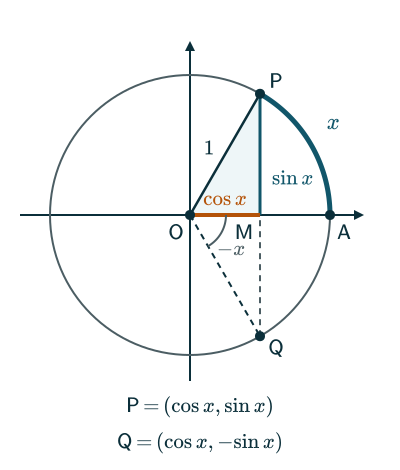
Take the unit circle (radius 1) with centre at the origin, start at A(1, 0), and go round the circle a distance |x|: anticlockwise if x > 0, clockwise if x < 0. If you stop at P(a, b), then
We define cos x = a and sin x = b
NCERT Mathematics (Class 11), Section 3.3, page 49
- The angle turned through is x radian, since the arc AP has length |x| on a circle of radius 1.
- P is on the unit circle, so a2 + b2 = 1: cos2 x + sin2 x = 1 for every real x.
In plain words: cos x is the first (horizontal) coordinate and sin x the second (vertical) coordinate of the point reached after turning through x radians. For an acute angle this agrees with the triangle ratios: in the right triangle OMP of the figure the hypotenuse OP is 1, so the adjacent side OM is cos x and the opposite side MP is sin x. Because x can be any angle in radians, even negative or bigger than 2π, sine and cosine are now functions defined on all real numbers.
Quadrantal angles and periodicity
Angles that are integer multiples of π/2 end on an axis and are called quadrantal angles (NCERT page 50). The points A, B, C, D where the circle meets the axes are (1, 0), (0, 1), (−1, 0) and (0, −1), so:
| x | cos x | sin x |
|---|---|---|
| 0 | 1 | 0 |
| π/2 | 0 | 1 |
| π | −1 | 0 |
| 3π/2 | 0 | −1 |
| 2π | 1 | 0 |
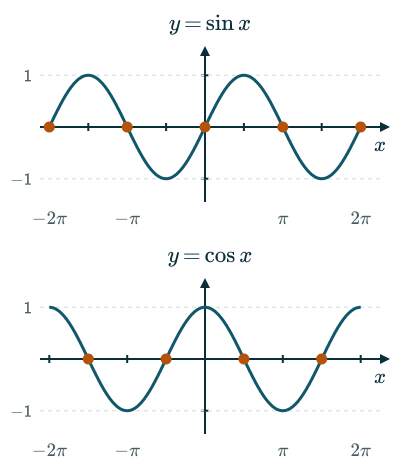
Thus, we also observe that if x increases (or decreases) by any integral multiple of 2π, the values of sine and cosine functions do not change.
NCERT Mathematics (Class 11), Section 3.3, page 50
Period 2π and zeros
sin (2nπ + x) = sin x, n ∈ Z
cos (2nπ + x) = cos x, n ∈ Z
sin x = 0 ⇔ x = nπ, n ∈ Z
cos x = 0 ⇔ x = (2n + 1)π/2, n ∈ Z
The other four functions
The remaining functions are defined from sine and cosine, wherever the denominator is not 0 (NCERT page 50); n is any integer:
- cosec x = 1/sin x, for x ≠ nπ;
- sec x = 1/cos x, for x ≠ (2n + 1)π/2;
- tan x = sin x/cos x, for x ≠ (2n + 1)π/2;
- cot x = cos x/sin x, for x ≠ nπ.
Dividing cos2 x + sin2 x = 1 by cos2 x gives 1 + tan2 x = sec2 x, and dividing it by sin2 x gives 1 + cot2 x = cosec2 x. These are the two “(why?)” identities on NCERT page 51.
Pythagorean identities
sin x + cos x = 1
1 + tan x = sec x
1 + cot x = cosec x
Values at the standard angles
The values at 0, π/6, π/4, π/3 and π/2 are the ones learnt in earlier classes; NCERT’s table (page 51) adds π, 3π/2 and 2π:
| x | sin x | cos x | tan x |
|---|---|---|---|
| 0 | 0 | 1 | 0 |
| π/6 | 1/2 | √3/2 | 1/√3 |
| π/4 | 1/√2 | 1/√2 | 1 |
| π/3 | √3/2 | 1/2 | √3 |
| π/2 | 1 | 0 | not defined |
| π | 0 | −1 | 0 |
| 3π/2 | −1 | 0 | not defined |
| 2π | 0 | 1 | 0 |
The values of cosec x, sec x and cot x are the reciprocal of the values of sin x, cos x and tan x, respectively.
NCERT Mathematics (Class 11), Section 3.3, page 51
Use each reciprocal only where both sides are defined. In particular, cot x = 1/tan x needs sin x ≠ 0 and cos x ≠ 0. The definition cot x = cos x/sin x still gives cot (π/2) = 0, even though tan (π/2) is undefined.
Signs in the four quadrants
If P(a, b) is reached by turning x, then turning −x reaches Q(a, −b), its mirror image in the x-axis (NCERT Section 3.3.1, page 51). So
Negative angles
cos (−x) = cos x, sin (−x) = −sin x
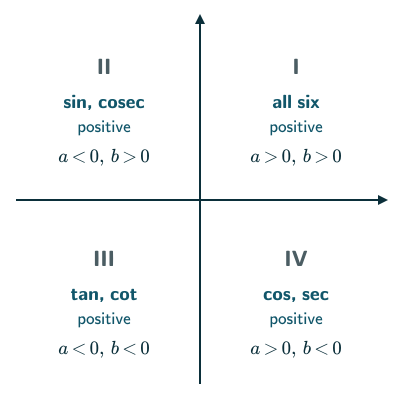
Quadrant I is 0 < x < π/2, II is π/2 < x < π, III is π < x < 3π/2 and IV is 3π/2 < x < 2π (or any of these plus a multiple of 2π). The sign of each function follows from the signs of a = cos x and b = sin x in each quadrant:
| Function | I | II | III | IV |
|---|---|---|---|---|
| sin, cosec | + | + | − | − |
| cos, sec | + | − | − | + |
| tan, cot | + | − | + | − |
A common way to remember it, going round anticlockwise from the first quadrant: All are positive, then only Sine (and cosec), then only Tangent (and cot), then only Cosine (and sec).
Domain and range
Thus, domain of y = sin x and y = cos x is the set of all real numbers and range is the interval [–1, 1], i.e., – 1 ≤ y ≤ 1.
NCERT Mathematics (Class 11), Section 3.3.2, page 52
The other four are undefined where their denominator is 0 (NCERT page 53):
| Function | Domain | Range |
|---|---|---|
| sin x, cos x | R | [−1, 1] |
| tan x | x ≠ (2n + 1)π/2 | R |
| sec x | x ≠ (2n + 1)π/2 | y ≤ −1 or y ≥ 1 |
| cot x | x ≠ nπ | R |
| cosec x | x ≠ nπ | y ≤ −1 or y ≥ 1 |
Here n ∈ Z.
Since −1 ≤ sin x ≤ 1, its reciprocal cosec x can never lie strictly between −1 and 1; the same holds for sec x. The domains and ranges are subsets of R, so these are real functions.
How the functions change, and their graphs
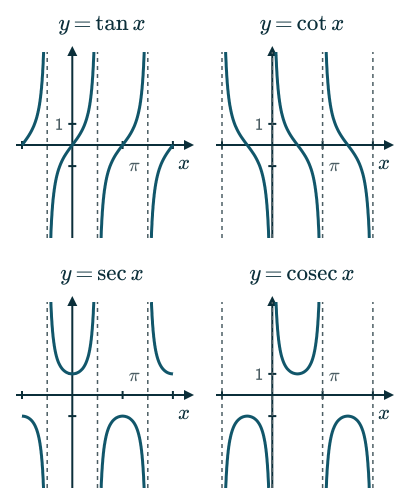
As x goes once round the circle, P moves through the four quadrants (NCERT table, page 53):
- sin x increases from 0 to 1 in I, decreases from 1 to 0 in II and from 0 to −1 in III, and increases from −1 to 0 in IV;
- cos x decreases from 1 to 0 in I and from 0 to −1 in II, then increases from −1 to 0 in III and from 0 to 1 in IV;
- tan x increases in every quadrant: from 0 to ∞ in I, from −∞ to 0 in II, and the same again in III and IV;
- cot x decreases in every quadrant: from ∞ to 0 in I, from 0 to −∞ in II, and the same again in III and IV;
- sec x increases from 1 to ∞ in I and from −∞ to −1 in II, then decreases from −1 to −∞ in III and from ∞ to 1 in IV;
- cosec x decreases from ∞ to 1 in I, increases from 1 to ∞ in II and from −∞ to −1 in III, and decreases from −1 to −∞ in IV.
Here “increases from 0 to ∞” means tan x increases and takes arbitrarily large positive values as x increases towards π/2 (NCERT pages 53–54).
The symbols ∞ and – ∞ simply specify certain types of behaviour of functions and variables.
NCERT Mathematics (Class 11), Section 3.3.2, page 54
The shadow (projection on a diameter) of a point moving steadily round a circle moves back and forth so that its position plotted against time is a sine wave; physics calls this simple harmonic motion. sec x and cosec x repeat after 2π, like cos x and sin x. tan (π + x) = tan x (proved in NCERT Section 3.4; see angles such as π + x), so tan x and cot x repeat after π.
Hence, values of tan x will repeat after an interval of π.
NCERT Mathematics (Class 11), Section 3.3.2, page 55
Solved examples
Example 1: From cos x to the other five (NCERT Example 6, page 55)
cos x = −3/5 and x lies in the third quadrant. Find the other five functions.
sec x = −5/3. sin2 x = 1 − 9/25 = 16/25, so sin x = ±4/5; in the third quadrant sin x < 0, so sin x = −4/5 and cosec x = −5/4. Then tan x = (−4/5)/(−3/5) = 4/3 and cot x = 3/4.
Answer: sin x = −4/5, cosec x = −5/4, sec x = −5/3, tan x = 4/3, cot x = 3/4.
Example 2: From cot x (NCERT Example 7, page 56)
cot x = −5/12 and x lies in the second quadrant. Find the other five.
tan x = −12/5, so sec2 x = 1 + 144/25 = 169/25 and sec x = ±13/5. In the second quadrant cos x < 0, so sec x = −13/5 and cos x = −5/13. Then sin x = tan x cos x = (−12/5)(−5/13) = 12/13, and cosec x = 13/12.
Answer: tan x = −12/5, sec x = −13/5, cos x = −5/13, sin x = 12/13, cosec x = 13/12.
Example 3: Removing whole turns (NCERT Examples 8 and 9, pages 56–57)
Find (i) sin (31π/3); (ii) cos (−1710°).
(i) 31π/3 = 10π + π/3, and 10π is five whole turns, so sin (31π/3) = sin (π/3). (ii) Add five whole turns: −1710° + 5 × 360° = 90°.
Answer: (i) √3/2; (ii) cos 90° = 0.
Example 4: A fourth-quadrant angle (NCERT Exercise 3.2, Q4)
sec x = 13/5 and x lies in the fourth quadrant. Find the other five.
cos x = 5/13, so sin2 x = 1 − 25/169 = 144/169; in the fourth quadrant sin x < 0, so sin x = −12/13.
Answer: cos x = 5/13, sin x = −12/13, cosec x = −13/12, tan x = −12/5, cot x = −5/12.
Example 5: Negative angles (NCERT Exercise 3.2, Q7 and Q10)
Find (i) cosec (−1410°); (ii) cot (−15π/4).
(i) −1410° + 4 × 360° = 30°, so cosec (−1410°) = cosec 30°. (ii) cot repeats every π; −15π/4 + 4π = π/4.
Answer: (i) 2; (ii) cot (π/4) = 1.
Common mistakes to avoid
Common mistake
Taking the positive square root without checking the quadrant
sin2 x = 16/25 gives sin x = 4/5 or −4/5. The quadrant decides: in Example 1 x is in the third quadrant, so sin x = −4/5.
Common mistake
Thinking sin x can be 2
sin x and cos x always lie between −1 and 1, so an equation such as sin x = 2 has no solution. Likewise sec x and cosec x can never equal 1/2.
Common mistake
Thinking tan x increases everywhere
tan x increases on each interval between asymptotes, but not on its whole domain: tan (π/4) = 1 but tan (3π/4) = −1.
Common mistake
Writing tan (π/2) = ∞
tan x is not defined at π/2, because cos (π/2) = 0. As x increases towards π/2, tan x takes arbitrarily large positive values; as x decreases towards π/2, arbitrarily large negative ones. ∞ is not a real number, so it is not a value.
Quick revision summary
- On the unit circle, the point reached by turning x is (cos x, sin x); so cos2 x + sin2 x = 1, and 1 + tan2 x = sec2 x, 1 + cot2 x = cosec2 x.
- tan x = sin x/cos x, cot x = cos x/sin x, sec x = 1/cos x and cosec x = 1/sin x, wherever the denominator is not 0.
- sin and cos repeat every 2π, tan and cot every π. sin x = 0 ⇔ x = nπ; cos x = 0 ⇔ x = (2n + 1)π/2.
- cos (−x) = cos x, sin (−x) = −sin x. Positive: all in I; sin, cosec in II; tan, cot in III; cos, sec in IV.
- sin and cos: domain R, range [−1, 1]. tan, sec: x ≠ (2n + 1)π/2. cot, cosec: x ≠ nπ.
Formula sheet
- cos x = a, sin x = b for P(a, b) on the unit circle
- sin x + cos x = 1
- 1 + tan x = sec x; 1 + cot x = cosec x
- sin (2nπ + x) = sin x
- cos (2nπ + x) = cos x
- sin x = 0 ⇔ x = nπ; cos x = 0 ⇔ x = (2n + 1)π/2
- cos (−x) = cos x; sin (−x) = −sin x
Questions students ask
What is the difference between trigonometric ratios and trigonometric functions?
Trigonometric ratios and trigonometric functions share the names sin, cos, tan, cosec, sec and cot, but the ratios are defined only for acute angles, as ratios of the sides of a right-angled triangle, while the functions are defined for every real number x (wherever the denominator is not 0) from the coordinates of the point reached by turning through x radians on the unit circle. For 0 < x < π/2 the two definitions give the same values, so the functions extend the ratios to angles such as 2π/3, −π/4 or 10 radians. Because they are built on the unit circle, trigonometric functions are also called circular functions.
What does All Silver Tea Cups mean in trigonometry?
All Silver Tea Cups (ASTC) is a mnemonic for the signs of the trigonometric functions: going anticlockwise from the first quadrant, All six are positive in I, only Sine and cosec in II, only Tangent and cot in III, and only Cosine and sec in IV. It works because the point reached on the unit circle is (cos x, sin x), and the signs of its two coordinates change from quadrant to quadrant. For example, 200° lies in the third quadrant, so tan 200° > 0 while sin 200° < 0 and cos 200° < 0. With x taken as acute, the same rule fixes the sign in the allied angle results for π ± x and 2π − x.
How do you remember the trigonometric ratios table?
The trigonometric ratios table can be rebuilt from one pattern: the sines of 0°, 30°, 45°, 60° and 90° are √0/2, √1/2, √2/2, √3/2 and √4/2, which simplify to the table’s values (√2/2 = 1/√2). The cosines are the same five values in reverse order, because cos x = sin (90° − x), and each tangent is the sine divided by the cosine, except that tan 90° is not defined, since cos 90° = 0. Values beyond 90° come from these through the quadrant signs and the allied angle results; the full table is under values at the standard angles.
Which trigonometric functions are even and which are odd?
Of the six trigonometric functions, cos and sec are even and sin, cosec, tan and cot are odd: cos (−x) = cos x and sin (−x) = −sin x, so tan (−x) = −tan x, and each reciprocal keeps the parity of its function. So sec (−π/3) = sec (π/3) = 2, but cosec (−π/6) = −cosec (π/6) = −2. The graph of an even function is symmetric about the y-axis and that of an odd function about the origin, as the sine and cosine graphs show. A sum such as sin x + cos x is neither even nor odd.
Why are trigonometric functions periodic, and what is the period of sin 2x?
Trigonometric functions are periodic because x and x + 2π lead to the same point on the unit circle, so sin, cos, sec and cosec repeat every 2π, while tan and cot repeat every π, since tan (π + x) = tan x. For k ≠ 0 the smallest positive period of sin kx and cos kx is 2π/|k| and that of tan kx is π/|k|: sin 2x has period π, cos 3x has period 2π/3 and tan 4x has period π/4. Taking the absolute value can halve the period: |sin x| repeats every π, because sin (π + x) = −sin x. Physics uses the same rule for sin ωt, whose period is 2π/ω (see periodic functions).
What is the difference between trigonometric and inverse trigonometric functions?
A trigonometric function takes an angle (a real number) to a value, while an inverse trigonometric function goes back from a value to an angle: the inverse sine takes a number in [−1, 1] to the angle in [−π/2, π/2] that has that sine. Because sin x takes each value in [−1, 1] at infinitely many x, it has to be restricted to such an interval before it can be inverted, which is why each inverse function has a principal value branch. The inverse sine is not the reciprocal 1/sin x, which is cosec x. Inverse trigonometric functions are taught in NCERT Class 12 Mathematics Part I, Chapter 2, not in the Class 11 book.
Is trigonometry in the JEE Main 2027 syllabus?
Yes, trigonometry is Unit 14 of the JEE Main 2027 Mathematics syllabus published by NTA, which lists trigonometrical identities and trigonometrical functions, and inverse trigonometrical functions and their properties. The Class 11 part is NCERT Chapter 3, Trigonometric Functions: angles in radians, the six functions with their signs, domains, ranges and graphs, and the sum and difference formulas with the identities built on them; the inverse functions are in NCERT Class 12, Chapter 2. The unit does not list trigonometric equations or heights and distances as separate topics.
Practice questions
Try each question first, then open the answer to check your working.
-
Q1. cos x = −1/2 and x lies in the third quadrant. Find the other five functions (NCERT Exercise 3.2, Q1).
Show answerHide answer
sin x = −√3/2, tan x = √3, cosec x = −2/√3, sec x = −2, cot x = 1/√3.
-
Q2. sin x = 3/5 and x lies in the second quadrant. Find the other five functions (NCERT Exercise 3.2, Q2).
Show answerHide answer
cos x = −4/5, tan x = −3/4, cosec x = 5/3, sec x = −5/4, cot x = −4/3.
-
Q3. Find sin 765° (NCERT Exercise 3.2, Q6).
Show answerHide answer
765° − 2 × 360° = 45°, so sin 765° = sin 45° = 1/√2.
-
Q4. Find (i) tan (19π/3); (ii) sin (−11π/3) (NCERT Exercise 3.2, Q8 and Q9).
Show answerHide answer
(i) 19π/3 = 6π + π/3, so tan (19π/3) = tan (π/3) = √3. (ii) −11π/3 + 4π = π/3, so sin (−11π/3) = sin (π/3) = √3/2.