SHM and uniform circular motion
NCERT Class 11 Physics Chapter 13 Section 13.4
Quick answer
The perpendicular projection of uniform circular motion onto a diameter is SHM: anticlockwise rotation gives x(t) = A cos(ωt + φ). The circle’s radius is the amplitude and its angular speed is the SHM angular frequency. For this anticlockwise convention the y-projection lags x by a quarter period; clockwise rotation reverses that lead–lag relation.
With your textbook
NCERT Physics Part II (Class 11), Chapter 13 “Oscillations”, Section 13.4 “Simple harmonic motion and uniform circular motion”, pages 264–266.
Open the official NCERT chapter (PDF, 1.6 MB, ncert.nic.in) (opens in a new tab)
Checked against the 2026-27 reprint on .
How is SHM related to uniform circular motion?
SHM as a projection of uniform circular motion
Let a particle P move round a circle of radius A with constant angular speed ω, anticlockwise, with the radius OP at angle φ to the +x-axis at t = 0. The foot P′ of the perpendicular from P to the x-axis then moves as (NCERT Section 13.4, pages 264–266)
which is simple harmonic motion. P is called the reference particle and its circle the reference circle. The radius of the circle is the amplitude, the angular speed of P is the angular frequency, and the starting angle of OP is the phase constant.
This shows that if P moves uniformly on a circle, its projection P′ on a diameter of the circle executes SHM.
NCERT Physics Part II (Class 11), Section 13.4, page 265
In plain words: watch a point going steadily round a circle, but look at it edge-on, so you only see how far left or right it is. What you see is a point sliding back and forth along a line, fast in the middle and slowing to a stop at each end. That edge-on view is exactly SHM.
Seeing it with a ball and a shadow
NCERT suggests a simple experiment (NCERT Fig. 13.9, page 264). Tie a ball to a string and whirl it in a horizontal circle at a steady angular speed. Now look at it from the side, at the level of the circle, or watch its shadow, cast by a distant lamp level with the circle, on a wall at right angles to the plane of the circle. The ball, or its shadow, seems to move to and fro along a straight line, with the centre of the circle as the midpoint. With parallel light rays, the shadow is the perpendicular projection onto a diameter normal to the viewing direction and is SHM. The ball itself still follows the circle; a nearby point lamp introduces perspective distortion.
The reference circle
Put the centre O of the circle at the origin (NCERT Fig. 13.10, page 265).
- At t = 0 the radius OP makes an angle φ with the +x-axis.
- P turns anticlockwise at angular speed ω, so in time t it turns through a further angle ωt. OP then makes the angle ωt + φ with the +x-axis.
- The foot of the perpendicular from P to the x-axis is P′, and OP′ is the projection of OP. The position of P′ is x(t) = A cos(ωt + φ), the defining equation of SHM.
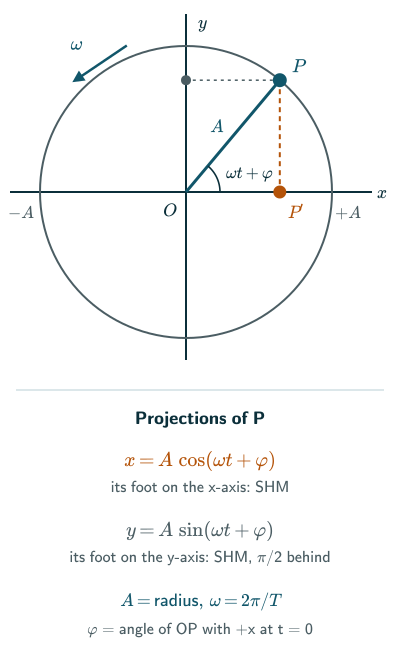
Any diameter works. Projecting on the y-axis instead gives (page 265)
This is also SHM, with the same amplitude and period, but its phase differs by π/2: since sin θ = cos(θ − π/2), the y-motion is a quarter of a period behind the x-motion.
Matching the symbols. The reference circle gives each constant of SHM a picture:
| SHM quantity | On the reference circle |
|---|---|
| amplitude A | radius of the circle |
| angular frequency ω | angular speed of P |
| period T = 2π/ω | time for one revolution |
| phase ωt + φ | angle of OP from the +x-axis at time t |
| phase constant φ | that angle at t = 0 |
The same picture also gives the velocity and acceleration of SHM, which the next section of the chapter works out.
Clockwise motion and angles in radians
If P goes round clockwise, the angle of OP from the +x-axis decreases: it is φ − ωt. Since cos(−θ) = cos θ, the projection is x(t) = A cos(ωt − φ). So for clockwise motion the phase constant in NCERT Eq. 13.4 is −φ, not φ (see Examples 2 and 4 below). The y-projection, A sin(φ − ωt), is then a quarter of a period ahead of the x-motion, not behind.
Radians. NCERT adds a footnote (page 265): an angle is a ratio of arc to radius, so it has no dimensions, and an angle written as a plain number is understood to be in radians. A degree must always be shown, so sin(15°) is the sine of 15 degrees but sin(15) is the sine of 15 radians. In ωt + φ, with ω in rad/s, give φ in radians too.
The forces are not the same
In spite of this connection between circular motion and SHM, the force acting on a particle in linear simple harmonic motion is very different from the centripetal force needed to keep a particle in uniform circular motion.
NCERT Physics Part II (Class 11), Section 13.4, page 265
The centripetal force on P has a constant size, mωA, and always points to the centre, so its direction keeps turning. The force on a particle in SHM always lies along one line, and its size changes from zero at the mean position to its largest at the extremes. The two are still linked: the x-component of the centripetal force, −mωA cos(ωt + φ) = −mωx, has exactly the form of the SHM force on a particle of the same mass (NCERT uses this projection in the next section, Section 13.5). Nothing in a block on a spring corresponds to the other component.
Solved examples
Example 1: Anticlockwise from 45° (NCERT Example 13.4(a))
A particle P moves anticlockwise on a circle of radius A with period 4 s. At t = 0, OP makes 45° with the +x-axis. Find the SHM of the x-projection.
At t = 0 the angle is 45° = π/4. In time t, OP turns anticlockwise through (2π/T)t, so its angle is (2π/T)t + π/4. With T = 4 s:
x(t) = A cos(2πt/4 + π/4) = A cos(πt/2 + π/4).
Answer: SHM of amplitude A, period 4 s and initial phase π/4 (page 265).
Example 2: Clockwise from 90° (NCERT Example 13.4(b))
A particle P moves clockwise on a circle of radius B with period 30 s. At t = 0, OP lies along the +y-axis. Find the SHM of the x-projection.
At t = 0 the angle is 90° = π/2. Moving clockwise, the angle after time t is π/2 − (2π/T)t. So
for T = 30 s.
In the form of NCERT Eq. 13.4, this is B cos(πt/15 − π/2).
Answer: SHM of amplitude B, period 30 s and initial phase −π/2 (page 266).
Example 3: Both projections
A particle moves anticlockwise on a circle of radius 0.2 m at 3 revolutions per second, with OP at 60° to the +x-axis at t = 0. Write the x- and y-projections and find them at t = 0.
ω = 2π × 3 = 6π rad/s (about 18.9 rad/s) and φ = 60° = π/3. So
x = 0.2 cos(6πt + π/3) and y = 0.2 sin(6πt + π/3), in metres.
At t = 0: x = 0.2 × 0.5 = 0.1 m and y = 0.2 × (√3/2), about 0.173 m.
Answer: both are SHMs of amplitude 0.2 m and period 1/3 s; at t = 0, x = 0.1 m and y ≈ 0.173 m.
Example 4: Clockwise from 30°
A particle moves clockwise on a circle of radius 5 cm with period 2 s, with OP at 30° to the +x-axis at t = 0. Write x(t) and find x at t = 1 s.
ω = 2π/2 = π rad/s. Clockwise, the angle is π/6 − πt, so x = 5 cos(π/6 − πt) = 5 cos(πt − π/6) cm: phase constant −π/6.
At t = 1 s, x = 5 cos(5π/6) = −5 × (√3/2), about −4.33 cm.
Answer: x = 5 cos(πt − π/6) cm; at t = 1 s, about −4.33 cm.
Example 5: The shadow of a turntable
A small ball sits on the rim of a turntable of radius 15 cm turning at 33⅓ revolutions per minute. Light from a distant lamp falls horizontally on it, at right angles to a vertical wall. Describe the motion of the ball’s shadow on the wall.
The shadow shows the projection of the circular motion, so it is SHM with amplitude equal to the radius, 15 cm.
ω = (100/3) × 2π/60, about 3.49 rad/s, and T = 60/(100/3) = 1.8 s.
Answer: SHM of amplitude 15 cm, angular frequency about 3.49 rad/s and period 1.8 s.
Common mistakes to avoid
Common mistake
Taking the diameter as the amplitude
The amplitude is the radius of the reference circle. The projection moves between −A and +A, a path of length 2A.
Common mistake
Keeping +φ for clockwise motion
For clockwise rotation the angle of OP is φ − ωt, so the projection is A cos(ωt − φ) and the phase constant is −φ (Examples 2 and 4).
Common mistake
Measuring the starting angle from the wrong axis
For the x-projection in the form A cos(ωt + φ), measure φ from the +x-axis, not from the y-axis.
Common mistake
Treating P′ as moving at a steady speed
P turns through equal angles in equal times, but P′ does not cover equal distances. From the mean position to A/2, OP turns through π/6, which takes T/12; from A/2 to A it turns through π/3, which takes T/6. Neither takes T/8. Find times as (angle turned)/ω.
Common mistake
Reading φ from the starting position alone
One value of x(0) fits two points on the circle, one above the x-axis and one below. For anticlockwise motion, P above the axis means P′ is moving towards −x (0 < φ < π); P below it means P′ is moving towards +x (−π < φ < 0).
Common mistake
Thinking the SHM force is a centripetal force
The centripetal force has a constant size and turns with P. The SHM force acts along a line and is proportional to the displacement.
Common mistake
Mixing degrees and radians
With ω in rad/s, ωt is in radians, so the phase constant must be in radians too: write π/4, not 45, inside the cosine.
Quick revision summary
- The projection of uniform circular motion on any diameter is SHM.
- Reference circle: radius = amplitude A; angular speed of P = angular frequency ω; angle of OP at t = 0 = phase constant φ for the anticlockwise x-projection.
- Anticlockwise from angle φ: x(t) = A cos(ωt + φ) and y(t) = A sin(ωt + φ); the y-motion is π/2 behind.
- Clockwise from angle φ: x(t) = A cos(ωt − φ).
- The connection is geometric: the centripetal force on P is not the SHM force, though its x-component has the same form, −mωx.
- Angles written without a unit are in radians.
Formula sheet
- x(t) = A cos(ωt + φ) (x-projection, anticlockwise)
- y(t) = A sin(ωt + φ) (y-projection, π/2 behind)
- x(t) = A cos(ωt − φ) (clockwise from angle φ)
- ω = 2π/T (angular speed of the reference particle)
Questions students ask
Is the projection of non-uniform circular motion simple harmonic?
In general it is not; a full-circle reference motion produces the standard full-amplitude sinusoidal projection when its angular speed is constant. If the particle’s angular speed changes, the angle of its radius is no longer ωt + φ, so the foot of the perpendicular from it to the diameter, x = A cos θ(t), still swings between −A and +A but is not a sinusoidal function of time. A stone whirled in a vertical circle on a string is an example: it moves faster at the bottom than at the top, so its shadow on the ground, with the Sun overhead, oscillates (periodically, if every turn takes the same time) but not in SHM.
Is uniform circular motion a combination of two SHMs?
Yes, uniform circular motion is the combination of two simple harmonic motions along perpendicular diameters, with the same amplitude and frequency and a phase difference of π/2: x = A cos ωt and y = A sin ωt give x + y = A, a circle traced at the steady angular speed ω. With unequal amplitudes the same two SHMs trace an ellipse, and with a phase difference of 0 or π they give a straight line, which is itself an SHM along a slanting line. Combining perpendicular SHMs is a step beyond the NCERT text; read the other way, it is the reference-circle result that each projection of uniform circular motion is an SHM.
How is the reference circle used to find the time between two positions in SHM?
The reference circle turns a time question in SHM into an angle question: above or below each of the two positions on the diameter, take the point of the circle that matches the direction of motion, and divide the angle the radius turns through between those points by ω, so t = (angle turned)/ω = (angle/360°) × T. For example, the particle is farther than A/2 from the centre on the +x side while the radius lies within 60° of the +x-axis, a turn of 120°, so it spends T/3 of each period there: 0.8 s for a period of 2.4 s. Adding the other side, it spends two-thirds of its time farther than A/2 from the mean position, because it moves slowly near the extremes.
Practice questions
Try each question first, then open the answer to check your working.
-
Q1. A particle moves on a circle of radius 10 cm at 2 revolutions per second. What are the amplitude and angular frequency of its shadow’s motion on a diameter?
Show answerHide answer
The amplitude is the radius, 10 cm, and ω = 2π × 2 = 4π rad/s, about 12.6 rad/s.
-
Q2. A reference particle moves anticlockwise. How are the motions of its projections on the x-axis and the y-axis related?
Show answerHide answer
Both are SHMs with the same amplitude and period. y = A sin(ωt + φ) = A cos(ωt + φ − π/2), so the y-motion is π/2 (a quarter of a period) behind the x-motion. (For clockwise motion the y-motion is π/2 ahead.)
-
Q3. Is the force on the reference particle the same as the force on the particle in SHM? Explain.
Show answerHide answer
No. The centripetal force on P has a constant size, mωA, and keeps changing direction. The SHM force acts along one line and changes size, being −mωx. Only the x-component of the centripetal force has this form.