The simple pendulum
NCERT Class 11 Physics Chapter 13 Section 13.8
Quick answer
A simple pendulum is a small bob on a light, inextensible string of length L. For small swings the restoring torque is proportional to the angle, so the bob moves in simple harmonic motion with period T = 2π√(L/g). The period does not depend on the mass of the bob or, for small angles, on the amplitude; a pendulum about 1 m long has a period of 2 s.
With your textbook
NCERT Physics Part II (Class 11), Chapter 13 “Oscillations”, Section 13.8 “The Simple Pendulum”, pages 270–271.
Open the official NCERT chapter (PDF, 1.6 MB, ncert.nic.in) (opens in a new tab)
Checked against the 2026-27 reprint on .
What is the period of a simple pendulum?
Simple pendulum
A simple pendulum is a small bob of mass m tied to an inextensible, massless string of length L, whose other end is fixed to a rigid support. Treat the bob as a point mass, measure L to its centre, and neglect air effects and pivot friction in a uniform gravitational field. For small swings in a vertical plane, the motion is approximately simple harmonic, with period (NCERT Eq. 13.26, Section 13.8, page 271)
- The period depends only on the length and on g.
- It does not depend on the mass of the bob, nor, for small swings, on the amplitude.
It is said that Galileo measured the periods of a swinging chandelier in a church by his pulse beats.
NCERT Physics Part II (Class 11), Section 13.8, page 270
In plain words: a pendulum is a natural clock. Pull the bob aside and gravity pulls it back towards the bottom, it overshoots, and it swings to and fro. For small swings each swing takes the same time, whatever the bob weighs, and a longer string makes a slower clock. NCERT suggests making one: a stone on a thread about 100 cm long swings with a period of about two seconds (page 270).
The forces on the bob
Only two forces act on the bob (NCERT Fig. 13.17, pages 270–271):
- the tension T along the string, towards the support;
- its weight mg, vertically down.
When the string makes an angle θ with the vertical, split the weight into two parts:
- mg cos θ along the string, away from the support;
- mg sin θ at right angles to the string, along the arc, back towards the mean position.
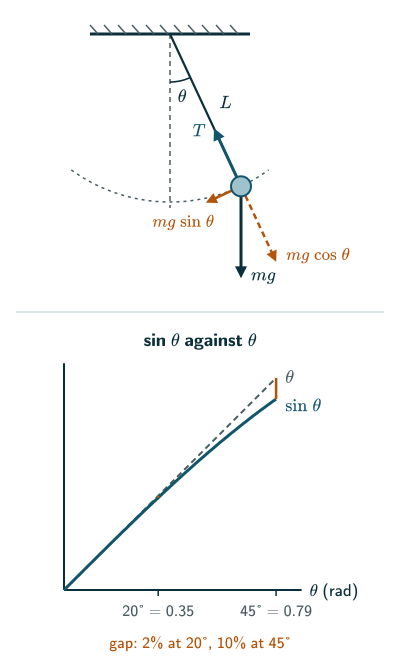
The bob moves on a circle of radius L centred on the support. (NCERT’s text calls it a circle of length L; L is the radius.) So it has two accelerations:
- a radial (centripetal) acceleration towards the support, provided by the net radial force T − mg cos θ. NCERT writes this acceleration as ωL; there ω is the bob’s angular speed at that instant, not the angular frequency of the oscillation;
- a tangential acceleration along the arc, because the speed keeps changing, provided by mg sin θ.
The period from the torque equation
It is easiest to take torques about the support, because the radial forces pass through it and give no torque. Only the tangential component mg sin θ, acting at distance L, has a torque (NCERT Eq. 13.19):
This is the restoring torque that tends to reduce angular displacement — hence the negative sign.
NCERT Physics Part II (Class 11), Section 13.8, page 271
By Newton’s law of rotation, τ = Iα, where I is the moment of inertia about the support and α the angular acceleration (NCERT Eqs. 13.20–13.22):
The small-angle step. In radians, sin θ = θ − θ/3! + θ/5! − … (NCERT Eq. 13.23). For small θ the later terms are tiny and sin θ ≈ θ, so (NCERT Eq. 13.24)
This has exactly the form a = −ωx of the acceleration in SHM (NCERT Eq. 13.11), with the angle in place of the displacement. So for small angles the bob moves in SHM with (NCERT Eq. 13.25)
The string is massless and the bob is approximated as a point mass at distance L, so I = mL. The m cancels and L/L = L, giving T = 2π√(L/g) (NCERT Eq. 13.26).
How small is small? NCERT Table 13.1 (page 271) compares θ in radians with sin θ (reproduced here with one rounding corrected; see the note below the table):
| θ (degrees) | θ (radians) | sin θ |
|---|---|---|
| 5 | 0.087 | 0.087 |
| 10 | 0.175 | 0.174 |
| 15 | 0.262 | 0.259 |
| 20 | 0.349 | 0.342 |
(NCERT’s table gives 10° as 0.174 rad; to three decimal places it is 0.175, since 10° = 0.17453 rad. The sine, 0.174, is right.) Even at 20° the two differ by only about 2%, but there is no sharp 20° cutoff: smaller amplitudes are needed for precise timing. The leading period correction is about θ/16, with angular amplitude θ in radians, with θ in radians (page 271).
What the period depends on
T = 2π√(L/g) tells you:
- T ∝ √L: four times the length doubles the period.
- T ∝ 1/√g: where gravity is weaker, as on the Moon, the pendulum swings more slowly. This is how a pendulum can measure g: g = 4πL/T (see the simple pendulum experiment).
- Not on the mass: both the restoring torque (∝ m) and the moment of inertia (∝ m) grow with the mass, so it cancels.
- Not on the amplitude, as long as the swings are small.
A seconds pendulum has a period of 2 s, so each swing from one side to the other takes 1 s (NCERT Example 13.8). Its length is about 1 m (Example 1).
Solved examples
Example 1: The seconds pendulum (NCERT Example 13.8)
What is the length of a simple pendulum that ticks seconds? Take g = 9.8 m s.
A pendulum that ticks seconds has a period of 2 s. From T = 2π√(L/g), L = gT/4π = 9.8 × 4/(4π), about 0.993 m.
Answer: about 1 m (page 271).
Example 2: NCERT’s home-made pendulum
Find the period of a pendulum 100 cm long (g = 9.8 m s).
T = 2π√(1/9.8) = 2π × 0.319, about 2.01 s.
Answer: about 2 s, as NCERT says for a stone on a 100 cm thread (page 270).
Example 3: Changing the length, or the planet
A seconds pendulum (period 2 s on the Earth) is (a) made four times as long, or (b) taken to the Moon, where g is one-sixth of its value on the Earth. Find the period in each case.
(a) T ∝ √L, so the period doubles: 4 s.
(b) T ∝ 1/√g, so the period grows by √6 ≈ 2.45: about 4.9 s.
Answer: (a) 4 s; (b) about 4.9 s.
Example 4: Measuring g
A pendulum 0.80 m long makes 20 oscillations in 36 s. Find g.
T = 36/20 = 1.8 s. Then g = 4πL/T = 4π × 0.80/1.8, about 9.75 m s.
Answer: about 9.75 m s.
Example 5: When does sin θ ≈ θ fail?
Compare sin θ with θ (in radians) at 5°, 20° and 45°.
- 5°: θ = 0.0873, sin θ = 0.0872, a gap of about 0.13%.
- 20°: θ = 0.349, sin θ = 0.342, about 2%.
- 45°: θ = 0.785, sin θ = 0.707, about 10%.
Answer: the approximation is excellent at 5°, good at 20° and poor at 45°. For large swings the motion is still periodic but no longer simple harmonic, and the period is longer than 2π√(L/g): about 0.8% longer at 20° and 4% longer at 45° (a step beyond the NCERT text).
Common mistakes to avoid
Common mistake
Using sin θ ≈ θ with θ in degrees
The approximation holds only with θ in radians: sin 10° ≈ 0.174, very close to 10° in radians (0.175), and nowhere near 10.
Common mistake
Expecting a heavier bob to swing faster
The mass cancels: T = 2π√(L/g) contains no m.
Common mistake
Measuring L only to the top of the bob
L runs from the point of support to the centre of the bob, not just along the thread: for a thread of length l and a bob of radius r, L = l + r. (NCERT treats the bob as a point; this goes a step beyond it.)
Common mistake
Using T = 2π√(L/g) for large swings
The formula rests on sin θ ≈ θ. For large amplitudes it underestimates the period (a step beyond the NCERT text): by about 4% at 45°.
Common mistake
Giving a seconds pendulum a period of 1 s
A seconds pendulum ticks once a second, once per swing; a full oscillation, there and back, takes 2 s.
Common mistake
Reading NCERT’s ωL as the SHM angular frequency
In the radial acceleration ωL, ω is the bob’s instantaneous angular speed, which is zero at the extremes. The angular frequency of the oscillation is √(g/L), a constant.
Quick revision summary
- Simple pendulum: a small bob on a light, inextensible string of length L.
- Forces: tension along the string and weight mg; mg sin θ gives the restoring torque −mgL sin θ about the support.
- Iα = −mgL sin θ; for small θ (in radians), sin θ ≈ θ and the motion is SHM.
- T = 2π√(I/mgL) and, with I = mL, T = 2π√(L/g).
- T ∝ √L and ∝ 1/√g; it does not depend on the mass or (for small swings) on the amplitude.
- Seconds pendulum: T = 2 s, L ≈ 1 m.
Formula sheet
- τ = −mgL sin θ
- α = −(mgL/I)θ (small θ, in radians)
- T = 2π√(I/mgL)
- T = 2π√(L/g)
- L = gT/4π; g = 4πL/T
Questions students ask
What is a compound pendulum, and how is its period different from a simple pendulum’s?
A compound (physical) pendulum is any rigid body swinging about a fixed horizontal axis, such as a metre rule pivoted at one end, with its mass spread out instead of concentrated in a small bob. For small swings its period is T = 2π√(I/mgd), where I is its moment of inertia about the axis and d the distance from the axis to its centre of mass; the simple pendulum is the case I = mL, d = L. A uniform rod of length L = 1 m pivoted at one end has I = mL/3 and d = L/2, so T = 2π√(2L/(3g)) ≈ 1.64 s (g = 9.8 m s), the period of a simple pendulum about 0.67 m long.
What is a conical pendulum, and what is its time period?
A conical pendulum is a bob on a string that moves in a horizontal circle at a steady speed, so the string sweeps out a cone at a fixed angle θ to the vertical; it goes round, not to and fro, so its motion is uniform circular motion, not SHM. The vertical part of the tension balances mg and the horizontal part supplies the centripetal force, which gives a period of revolution 2π√(h/g), where h = L cos θ is the height of the cone (a step beyond the NCERT text). This is shorter than 2π√(L/g) for the same string: with L = 1 m and θ = 60°, h = 0.5 m and the period is 2π√(0.5/9.8) ≈ 1.42 s, against 2.01 s.
What is the time period of a simple pendulum of infinite length?
The answer depends on the model. In a spatially uniform gravitational field, T = 2π√(L/g) grows without bound. A different idealisation keeps the bob’s equilibrium position near the surface of a spherical, nonrotating Earth while moving the fixed support to radius R + L; gravity then points towards Earth’s centre. For infinitesimal swings in that central-field model, the result is T = 2π√[LR/(g(L + R))], where R is the Earth’s radius (a step beyond the NCERT text): for L much smaller than R it reduces to 2π√(L/g), and as L grows without bound it tends formally to 2π√(R/g), about 85 minutes. This is a model limit, not a physically realisable infinite string. With R = 6.4 × 10 m and g = 9.8 m s, that is about 5080 s, the same as the period of a satellite skimming the Earth’s surface.
What is the time period of a simple pendulum whose bob swings in a liquid?
A simple pendulum whose bob swings in a liquid has a longer period, because the upthrust of the liquid reduces the bob’s effective weight: gravity acts as if it were g(1 − σ/ρ), where ρ is the density of the bob and σ that of the liquid, so T = 2π√(L/(g(1 − σ/ρ))), in the simplified buoyancy-only model, with a fully submerged bob denser than the liquid. This also neglects added fluid inertia, boundaries and drag, so it is not a complete prediction even for an inviscid liquid. For a bob of density 8000 kg m in water, that simplified model gives a period increase by √(8/7) ≈ 1.07, from 2.01 s to about 2.15 s for a 1 m pendulum. A bob less dense than the liquid would float up instead of hanging down.
Why does a pendulum clock lose time in summer?
A pendulum clock set to keep time in cooler weather loses time in summer because the heat expands its pendulum rod: the longer pendulum takes slightly longer for each swing, since T ∝ √L, so the clock runs slow. The period grows by a fraction of about ½α times the temperature rise, where α is the rod’s coefficient of linear expansion. A steel rod (α = 1.2 × 10 K) warmed by 15 °C makes the clock lose about ½ × 1.2 × 10 × 15 × 86 400 ≈ 7.8 s a day; colder than its setting temperature, the clock gains.
Practice questions
Try each question first, then open the answer to check your working.
-
Q1. Why does the period of a simple pendulum not depend on the mass of the bob?
Show answerHide answer
The restoring torque, −mgL sin θ, and the moment of inertia, mL, are both proportional to m. In α = −(mgL/I)θ the mass cancels, leaving ω = √(g/L).
-
Q2. Find the period of a simple pendulum 2.45 m long (g = 9.8 m s).
Show answerHide answer
T = 2π√(2.45/9.8) = 2π√0.25 = π, about 3.14 s.
-
Q3. Why is the motion of a simple pendulum simple harmonic only for small swings?
Show answerHide answer
The restoring torque is proportional to sin θ, not to θ. Only for small angles (in radians) is sin θ ≈ θ, which makes the angular acceleration proportional to the angular displacement, as SHM requires.