Energy in SHM
NCERT Class 11 Physics Chapter 13 Section 13.7
Quick answer
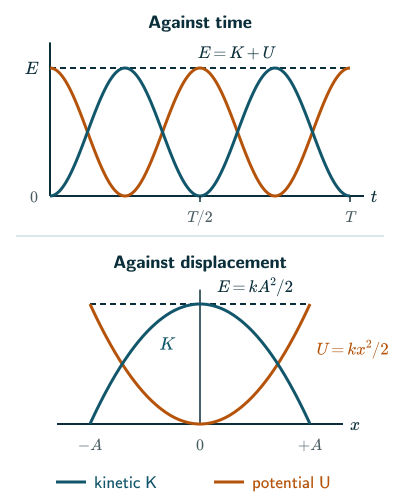
For a free undamped harmonic oscillator, choose potential energy zero at equilibrium: U = ½kx and total energy E = ½kA. Kinetic energy supplies the remainder, becoming greatest at equilibrium and zero at the extremes. Kinetic and potential energies each repeat every T/2, while their sum stays constant.
With your textbook
NCERT Physics Part II (Class 11), Chapter 13 “Oscillations”, Section 13.7 “Energy in simple harmonic motion”, pages 268–270.
Open the official NCERT chapter (PDF, 1.6 MB, ncert.nic.in) (opens in a new tab)
Checked against the 2026-27 reprint on .
How is energy shared in SHM?
Energy of a simple harmonic oscillator
For a particle of mass m in SHM, x(t) = A cos(ωt + φ), with force constant k = mω (NCERT Eq. 13.14a), with no damping or external driving and with potential energy set to zero at equilibrium, the energies are (NCERT Eqs. 13.15–13.18, Section 13.7, pages 268–269):
- The kinetic and potential energies each swing between zero and ½kA, and each repeats every T/2.
- Their sum, the total energy, stays constant.
The total mechanical energy of a harmonic oscillator is thus independent of time as expected for motion under any conservative force.
NCERT Physics Part II (Class 11), Section 13.7, page 269
In plain words: an oscillator keeps passing the same parcel of energy back and forth. At the middle of the swing it is all motion; at the ends it is all stored in the spring; in between it is shared. Nothing is lost (in this isolated, time-independent conservative model), so the total never changes.
Kinetic energy
The velocity in SHM is v = −ωA sin(ωt + φ), so (NCERT Eq. 13.15)
using k = mω. The kinetic energy is zero at the extremes, where the particle stops, and greatest, ½kA, at the mean position. The sign of v does not matter in K, so K repeats every T/2, not T (page 268).
In terms of position (a step beyond the NCERT text): since sin = 1 − cos, v = ωA − ωA cos(ωt + φ) = ω(A − x), so
Potential energy
The spring force F = −kx is a conservative force, so it has a potential energy, the same one you met for a stretched spring (written V there) (NCERT Eqs. 13.16–13.17):
It is zero at the mean position and greatest, ½kA, at the extremes, and it too repeats every T/2 (page 268). (NCERT refers back to Chapter 6 for the idea that only conservative forces have a potential energy; in the current book that is Chapter 5, Work, Energy and Power.)
Neither energy is ever negative. Kinetic energy cannot be negative, since it depends on the square of the speed; the potential energy is never negative because its arbitrary zero has been chosen at the mean position (page 269).
Total energy stays constant
Adding NCERT Eqs. 13.15 and 13.17, and writing θ for ωt + φ,
because cos + sin is always 1 (NCERT Eq. 13.18). The total energy depends only on the spring constant and the amplitude, not on time or position. Written with k = mω, it is E = ½mωA, which is also the largest kinetic energy, ½m(ωA).
For x = 0, the energy is kinetic; at the extremes x = ±A, it is all potential energy.
NCERT Physics Part II (Class 11), Section 13.7, page 269
Between these points, kinetic energy grows at the expense of potential energy or the other way round. Both peak twice in every period (NCERT Fig. 13.16, page 269). (That figure labels the sum with a small k, as k(t) + U(t); it means the kinetic energy K, not the spring constant.) This is the conservation of mechanical energy at work.
Two useful results (beyond the NCERT text):
- Equal shares. K = U when ½k(A − x) = ½kx, that is at x = ±A/√2, not at A/2.
- Averages. Averaged over time (a whole period), sin and cos each average ½, so the average kinetic and potential energies are each E/2. (A uniform mathematical average over x from −A to A gives 2E/3 and E/3; this weights positions equally and is not the physical time average.)
Solved examples
Example 1: Block on a spring (NCERT Example 13.7)
A 1 kg block on a frictionless surface is fixed to a spring of constant 50 N m. It is pulled 10 cm from equilibrium and released from rest at t = 0. Find its kinetic, potential and total energies when it is 5 cm from the mean position.
ω = √(k/m) = √50, about 7.07 rad/s, and x(t) = 0.1 cos(7.07t).
At x = 0.05 m, cos(7.07t) = 0.5, so |sin(7.07t)| = √3/2 ≈ 0.866 and the speed is 0.1 × 7.07 × 0.866, about 0.612 m/s.
K = ½ × 1 × 0.6124 ≈ 0.1875 J, about 0.19 J. (Directly: K = ½k(A − x) = ½ × 50 × (0.01 − 0.0025) = 0.1875 J.) U = ½ × 50 × 0.05 = 0.0625 J.
Total: 0.1875 + 0.0625 = 0.25 J. Check: at the extreme all the energy is potential, ½ × 50 × 0.1 = 0.25 J.
Answer: K ≈ 0.19 J, U = 0.0625 J, E = 0.25 J, as conservation of energy requires (pages 269–270).
Example 2: Where are K and U equal?
For the block in Example 1, where are the kinetic and potential energies equal?
K = U means each is E/2: ½kx = ¼kA, so x = ±A/√2 = ±10/√2 cm.
Answer: at x ≈ ±7.07 cm, not at ±5 cm. At 5 cm the energy is still three-quarters kinetic (Example 5). Starting from an extreme, K = U first happens at ωt = π/4, that is after T/8, and then every T/4.
Example 3: Doubling the amplitude
The same spring–block oscillator is set going with twice the amplitude. How do its total energy, greatest speed and period change?
E = ½kA, so doubling A multiplies E by 4. vmax = ωA doubles. T = 2π√(m/k) does not involve A, so it is unchanged.
Answer: energy ×4, greatest speed ×2, period unchanged.
Example 4: Energy from period and amplitude
A 0.2 kg particle performs SHM with amplitude 5 cm and period 0.5 s. Find its total energy and greatest speed.
ω = 2π/0.5 = 4π, about 12.57 rad/s. E = ½mωA = ½ × 0.2 × 12.57 × 0.05, about 0.0395 J.
vmax = ωA = 12.57 × 0.05, about 0.628 m/s. Check: ½ × 0.2 × 0.6283 ≈ 0.0395 J.
Answer: about 0.040 J (39.5 mJ), and 0.63 m/s at the mean position.
Example 5: How much is kinetic?
What fraction of the total energy is kinetic when the particle is at x = A/2?
K/E = ½k(A − x)/(½kA) = 1 − (x/A) = 1 − ¼ = ¾.
Answer: 75% kinetic and 25% potential.
Common mistakes to avoid
Common mistake
Giving K and U the period of the motion
K and U depend on sin and cos, which repeat twice as often: each has period T/2.
Common mistake
Putting K = U at half the amplitude
At x = A/2 the potential energy is only a quarter of E. The energies are equal at x = ±A/√2 (Example 2).
Common mistake
Taking the energy as proportional to the amplitude
E = ½kA goes as the square of the amplitude: double the amplitude and the energy goes up four times (Example 3).
Common mistake
Mixing up E = ½kA and E = ½mωA
They are the same thing, since k = mω. For a given spring and amplitude, E = ½kA does not depend on the mass. For a given ω and amplitude, E = ½mωA is proportional to the mass. So a heavier block on the same spring with the same amplitude has the same energy; it just moves more slowly (vmax = A√(k/m)).
Common mistake
Expecting the energy to change during the motion
Without friction the total energy is the same at every instant and every position. Only its split between K and U changes.
Quick revision summary
- K = ½kA sin(ωt + φ) = ½k(A − x): greatest at x = 0, zero at x = ±A.
- U = ½kx = ½kA cos(ωt + φ): zero at x = 0, greatest at x = ±A.
- E = K + U = ½kA = ½mωA, constant for the undriven, time-independent conservative oscillator.
- K and U each repeat every T/2; both peak twice per period.
- K = U at x = ±A/√2; each averages E/2 over a period.
Formula sheet
- K = ½kA sin(ωt + φ) = ½k(A − x)
- U = ½kx = ½kA cos(ωt + φ)
- E = ½kA = ½mωA (E = K + U)
- K = U at x = ±A/√2
Questions students ask
Can the potential energy of a particle in SHM be non-zero at the mean position?
Yes, the potential energy in SHM can be non-zero at the mean position, because only changes in potential energy have a meaning and its zero can be put anywhere. The usual U = ½kx simply chooses zero at the mean position; with U = U0 + ½kx the motion is exactly the same. For a mass hanging on a vertical spring, for example, the spring is already stretched by mg/k at the mean position, so its elastic energy there is not zero, yet the elastic and gravitational energies together, measured from their values at the mean position, add up to ½ky for a displacement y.
What is the formula for the total energy in SHM in terms of frequency?
In terms of the frequency ν, the total energy of a particle of mass m in SHM of amplitude A is E = ½mωA = 2πmνA, since ω = 2πν. So, for a given mass, the energy grows as the square of both the frequency and the amplitude: a 0.5 kg body oscillating at 2 Hz with an amplitude of 3 cm has E = 2π × 0.5 × 2 × 0.03 ≈ 0.036 J, and doubling the frequency at the same mass and amplitude would make it four times as large.
How does the amplitude of a real oscillator change as it loses energy?
As a real oscillator loses mechanical energy to friction and air resistance, its amplitude falls in proportion to the square root of the energy left: at each turning point, where speed is zero, E = ½kA relates energy to that turning-point displacement; for light damping this also describes the slowly varying energy envelope, so A = √(2E/k). When half the energy has gone, the amplitude is 1/√2, about 71%, of its starting value, and if each cycle removes 2% of the energy, the amplitude shrinks by only about 1% per cycle. The simple pendulum experiment follows this loss by plotting the square of the amplitude, which is proportional to the energy, against time.
Practice questions
Try each question first, then open the answer to check your working.
-
Q1. At which positions in SHM are the kinetic energy and the potential energy each greatest?
Show answerHide answer
The kinetic energy is greatest at the mean position, where the speed is greatest. The potential energy is greatest at the extremes ±A, where the restoring potential is greatest relative to equilibrium. For a vertical spring this includes both elastic and gravitational potential energy.
-
Q2. A spring of constant 200 N m oscillates with amplitude 5 cm. Find the total energy, and the kinetic and potential energies at x = 3 cm.
Show answerHide answer
E = ½ × 200 × 0.05 = 0.25 J. U = ½ × 200 × 0.03 = 0.09 J, so K = 0.25 − 0.09 = 0.16 J.
-
Q3. Why does the kinetic energy of a particle in SHM repeat every half period?
Show answerHide answer
K = ½mv depends on v, not on the sign of v. Half a period later the particle is at the mirror point −x, moving the other way at the same speed: v(t + T/2) = −v(t). So v, and K, repeat every T/2: the swing from +A to −A and the swing back give identical cycles of K.