Classical idea of redox reactions
NCERT Class 11 Chemistry Chapter 7 Section 7.1
Quick answer
Classically, oxidation adds oxygen or a more electronegative partner, or removes an electropositive partner; reduction reverses those changes. These are useful guides, but oxidation-number changes resolve exceptions such as metal hydrides. Oxidation and reduction are paired: the oxidising agent is reduced, while the reducing agent is oxidised.
With your textbook
NCERT Chemistry Part II (Class 11), Chapter 7 “Redox Reactions”, Section 7.1 “Classical Idea of Redox Reactions-Oxidation and Reduction Reactions”, pages 235–237.
Open the official NCERT chapter (PDF, 1.9 MB, ncert.nic.in) (opens in a new tab)
Checked against the 2026-27 reprint on .
What are oxidation and reduction?
Oxidation and reduction (classical idea)
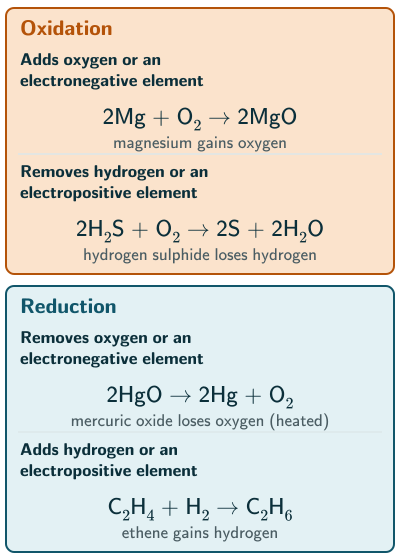
To summarise, the term “oxidation” is defined as the addition of oxygen/electronegative element to a substance or removal of hydrogen/ electropositive element from a substance.
NCERT Chemistry Part II (Class 11), Section 7.1, page 236
- Reduction is the reverse: the removal of oxygen or another electronegative element from a substance, or the addition of hydrogen or another electropositive element to it (NCERT page 236).
- Oxidation and reduction always happen together in the same reaction, so such reactions are called redox reactions.
In plain words: in the oldest sense, a substance is oxidised when it picks up oxygen, as magnesium does when it burns, and reduced when it gives oxygen up, as mercuric oxide does when it is heated. These classical rules are guides, not universal tests: check oxidation-number changes when an element changes bonding partners or when hydrogen/oxygen has an unusual oxidation state. Chemists then noticed that chlorine, fluorine or sulphur can play the part of oxygen, and that hydrogen plays the opposite part, so the definitions grew step by step. Redox reactions are everywhere: burning fuels, extracting highly reactive metals by electrolysis, making caustic soda, running batteries and the corrosion of metals all involve them (NCERT page 235).
Oxidation as gain of oxygen or loss of hydrogen
Originally, oxidation meant adding oxygen to an element or a compound. The air is about one-fifth dioxygen, which is why so many elements occur on the earth as their oxides (NCERT Section 7.1, page 235). Magnesium and sulphur are oxidised because oxygen is added to them:
- 2Mg(s) + O2(g) → 2MgO(s)
- S(s) + O2(g) → SO2(g)
When methane burns, CH4(g) + 2O2(g) → CO2(g) + 2H2O(l), the carbon gains oxygen and also loses its hydrogen. This led chemists to count the removal of hydrogen as oxidation too (page 236). In 2H2S(g) + O2(g) → 2S(s) + 2H2O(l), hydrogen sulphide is oxidised to sulphur because its hydrogen is removed.
Other electronegative and electropositive elements
Elements other than oxygen can play oxygen’s part. Magnesium is oxidised just as much when it combines with fluorine, chlorine or sulphur (page 236):
- Mg(s) + F2(g) → MgF2(s)
- Mg(s) + Cl2(g) → MgCl2(s)
- Mg(s) + S(s) → MgS(s)
What these partners share is that they are more electronegative than magnesium: they pull electrons towards themselves (see electronegativity). By the same reasoning, removing an electropositive element counts as oxidation, just as removing hydrogen does. In
2K4[Fe(CN)6](aq) + H2O2(aq) → 2K3[Fe(CN)6](aq) + 2KOH(aq)
potassium ferrocyanide loses the electropositive element potassium as it becomes potassium ferricyanide, so it is oxidised (page 236).
Reduction
At first, reduction meant only the removal of oxygen from a compound. The term was then broadened in step with oxidation: reduction is the removal of oxygen or another electronegative element, or the addition of hydrogen or another electropositive element (page 236). NCERT’s examples:
- 2HgO(s) → 2Hg(l) + O2(g) on heating: oxygen is removed from mercuric oxide;
- 2FeCl3(aq) + H2(g) → 2FeCl2(aq) + 2HCl(aq): the electronegative element chlorine is removed from ferric chloride;
- CH2=CH2(g) + H2(g) → H3C–CH3(g): hydrogen is added to ethene.
Why oxidation and reduction go together
Look again at the reduction of ferric chloride: the chlorine it loses is not destroyed but goes to hydrogen, and hydrogen gaining chlorine is an oxidation. The same happens in
2HgCl2(aq) + SnCl2(aq) → Hg2Cl2(s) + SnCl4(aq)
Mercury in mercuric chloride is reduced from +2 to +1; the product is richer in mercury relative to chlorine, without any mercury entering from outside: HgCl2 has two chlorine atoms for each mercury, Hg2Cl2 only one. Stannous chloride is oxidised to stannic chloride, because chlorine is added to it (page 236). The two chlorine atoms that 2HgCl2 gives up are exactly the two that SnCl2 gains. The other reactions show the same pairing. In 2H2S + O2 → 2S + 2H2O, for instance, the oxygen that oxidises hydrogen sulphide itself gains hydrogen and is reduced. Even when a single substance reacts, as in 2HgO → 2Hg + O2, both changes happen: the mercury loses oxygen and is reduced, while the oxygen loses the electropositive element mercury and is oxidised. Oxidation and reduction always occur simultaneously, which is why the word redox (reduction plus oxidation) was coined for this class of reactions.
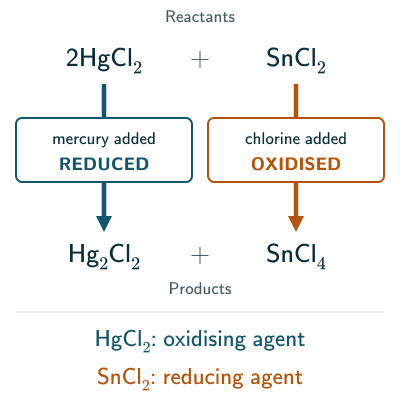
Oxidising and reducing agents. The substance that brings about an oxidation is the oxidising agent, and it is itself reduced; the substance that brings about a reduction is the reducing agent, and it is itself oxidised. In the reaction above, HgCl2 is the oxidising agent and SnCl2 the reducing agent.
Where the classical idea struggles. In 2Na(s) + H2(g) → 2NaH(s), sodium gains hydrogen. If hydrogen always played the electropositive part, sodium would count as reduced. Only by noticing that hydrogen is more electronegative than sodium can we say that sodium is oxidised and hydrogen reduced (NCERT Problem 7.1). Cases like this led to the electron-transfer view of redox reactions in NCERT Section 7.2, where Na+H− shows directly that sodium has lost an electron.
Solved examples
Example 1: Hydrogen sulphide and chlorine (NCERT Problem 7.1 (i), page 236)
Identify the species oxidised and reduced in H2S(g) + Cl2(g) → 2HCl(g) + S(s).
H2S loses its hydrogen (an electropositive element) to chlorine, and chlorine gains hydrogen. The sulfur oxidation number rises from −2 to 0; chlorine falls from 0 to −1. Hydrogen stays +1: changing its partner here does not itself mean hydrogen is oxidised.
Answer: H2S is oxidised and chlorine is reduced.
Example 2: The thermite-type reaction (NCERT Problem 7.1 (ii), pages 236–237)
Identify the species oxidised and reduced in 3Fe3O4(s) + 8Al(s) → 9Fe(s) + 4Al2O3(s).
Aluminium gains oxygen; ferrous ferric oxide, Fe3O4, loses it.
Answer: Aluminium is oxidised (it is the reducing agent) and Fe3O4 is reduced (it is the oxidising agent).
Example 3: Sodium and hydrogen (NCERT Problem 7.1 (iii), pages 236–237)
Identify the species oxidised and reduced in 2Na(s) + H2(g) → 2NaH(s).
Hydrogen is more electronegative than sodium, so here hydrogen plays the part that oxygen or chlorine plays elsewhere: an electronegative element is added to sodium, and the electropositive element sodium is added to hydrogen.
Answer: Sodium is oxidised and hydrogen is reduced. The answer depends on knowing the electronegativities, which is the weakness of the classical idea.
Example 4: The blast furnace (NCERT Exercise 7.3 (b), page 252)
In Fe2O3(s) + 3CO(g) → 2Fe(s) + 3CO2(g), which substance is oxidised, which is reduced, and which is the reducing agent?
Carbon monoxide gains oxygen, becoming carbon dioxide. Iron(III) oxide loses all its oxygen, leaving iron.
Answer: CO is oxidised and Fe2O3 is reduced; CO is the reducing agent and Fe2O3 the oxidising agent. Check the balance: Fe 2 = 2, C 3 = 3, O 3 + 3 = 6 = 6.
Common mistakes to avoid
Common mistake
Thinking oxidation needs oxygen
Magnesium burning in chlorine, Mg + Cl2 → MgCl2, is as much an oxidation of magnesium as burning in oxygen. Any more electronegative partner will do.
Common mistake
Mixing up “oxidised” and “oxidising agent”
The substance that is oxidised is the reducing agent, and the substance that is reduced is the oxidising agent. In Fe2O3 + 3CO → 2Fe + 3CO2 (Example 4), CO is oxidised and is the reducing agent.
Common mistake
Treating every gain of hydrogen as reduction
Gaining hydrogen means reduction only when hydrogen is the more electropositive partner, as with ethene or chlorine. With a reactive metal, as in 2Na + H2 → 2NaH, hydrogen is the more electronegative partner and the metal is oxidised.
Quick revision summary
- Oxidation (classical): addition of oxygen or an electronegative element, or removal of hydrogen or an electropositive element.
- Reduction: the reverse, removal of oxygen or an electronegative element, or addition of hydrogen or an electropositive element.
- Oxidation and reduction always occur together: redox reactions.
- Oxidising agent: is reduced; reducing agent: is oxidised.
- The classical idea needs electronegativities to decide cases such as NaH; electron/oxidation-number bookkeeping makes the change clearer once the product bonding is known.
Formula sheet
- Oxidation: + O or electronegative element; − H or electropositive element
- Reduction: − O or electronegative element; + H or electropositive element
- Oxidising agent is reduced; reducing agent is oxidised
Questions students ask
What is the difference between oxidation and reduction?
Oxidation and reduction are opposite changes that always occur together: in the classical idea, oxidation is the addition of oxygen or another electronegative element, or the removal of hydrogen, and reduction is the reverse. In terms of electrons, oxidation is loss and reduction is gain; in terms of oxidation numbers, oxidation raises an element’s oxidation number and reduction lowers it. In 2Ca + O2 → 2CaO, calcium gains oxygen, loses two electrons per atom and goes from 0 to +2 (oxidised), while oxygen goes from 0 to −2 (reduced).
What are some common oxidising and reducing agents?
Common oxidising agents are oxygen, ozone, the halogens (fluorine is the strongest), hydrogen peroxide, nitric acid, potassium permanganate (KMnO4) and potassium dichromate (K2Cr2O7), while common reducing agents are hydrogen, carbon, carbon monoxide, hydrogen sulphide and reactive metals such as sodium, magnesium, aluminium and zinc. At home, the hypochlorite in bleach and hydrogen peroxide are oxidising agents, and vitamin C (ascorbic acid), an antioxidant, is a reducing agent. The role can depend on the partner: hydrogen peroxide oxidises iodide ions to iodine but reduces acidified permanganate.
What is the difference between oxidation and combustion?
Combustion is one kind of oxidation: a rapid exothermic reaction of a fuel with an oxidant, commonly oxygen, usually producing light, as when the butane in LPG burns, 2C4H10 + 13O2 → 8CO2 + 10H2O. Oxidation is the wider idea, any gain of oxygen or another electronegative element, loss of hydrogen or loss of electrons, fast or slow, with or without oxygen. In ordinary oxygen combustion the fuel is oxidised and oxygen is reduced; other oxidants, such as fluorine, can support combustion too, but not every oxidation is a combustion: the rusting of iron and the slow oxidation that turns fats and oils rancid give no flame.
Why is rusting of iron a redox reaction?
Rusting is a redox reaction because iron is oxidised and oxygen is reduced: in moist air, iron atoms lose electrons, Fe → Fe2+ + 2e−, and oxygen dissolved in near-neutral water gains them, O2 + 2H2O + 4e− → 4OH− (in acid, the equivalent half reaction is O2 + 4H+ + 4e− → 2H2O). The Fe2+ ions are then oxidised further by air to hydrated iron(III) oxide, Fe2O3·xH2O, which is rust, so in classical terms the iron has gained oxygen. Rusting needs both oxygen and water and is faster in salt water, a better electrolyte; this electrochemical picture of corrosion is taught in Class 12 Electrochemistry.
Is photosynthesis a redox reaction?
Yes, photosynthesis is a redox reaction: in 6CO2 + 6H2O → C6H12O6 + 6O2, carbon dioxide gains hydrogen and loses oxygen, so it is reduced to glucose, while water loses its hydrogen and its oxygen is oxidised to O2. In oxidation numbers, carbon falls from +4 in CO2 to an average of 0 in glucose, and oxygen rises from −2 in water to 0. The equation is a net balance: writing 12H2O on the left and 6H2O on the right makes clear that the evolved O2 comes from water. The reaction stores the energy of sunlight, and respiration, C6H12O6 + 6O2 → 6CO2 + 6H2O, is the reverse redox reaction, in which glucose is oxidised and oxygen reduced to release that energy.
Practice questions
Try each question first, then open the answer to check your working.
-
Q1. In CuO(s) + H2(g) → Cu(s) + H2O(g) (NCERT Exercise 7.3 (a)), which substance is oxidised and which is reduced?
Show answerHide answer
Copper(II) oxide loses oxygen, so it is reduced; hydrogen gains oxygen, so it is oxidised. Hydrogen is the reducing agent and CuO the oxidising agent.
-
Q2. Magnesium is said to be oxidised both in 2Mg + O2 → 2MgO and in Mg + S → MgS. Why is the second also called an oxidation?
Show answerHide answer
Sulphur, like oxygen, is more electronegative than magnesium. Adding any electronegative element to a substance counts as oxidation in the classical idea, so magnesium is oxidised in both.
-
Q3. In 2K4[Fe(CN)6] + H2O2 → 2K3[Fe(CN)6] + 2KOH, which substance is oxidised, which is reduced, and which is the oxidising agent?
Show answerHide answer
Potassium ferrocyanide loses the electropositive element potassium, so it is oxidised. Hydrogen peroxide gains potassium (in KOH), so it is reduced, and it is the oxidising agent.