The lanthanoids
NCERT Class 12 Chemistry Chapter 4 Section 4.5
Quick answer
NCERT treats the lanthanoids as the fourteen elements after lanthanum in which the 4f subshell fills; IUPAC’s family name includes lanthanum. The plus-three oxidation state predominates, with important plus-two and plus-four exceptions. Poor shielding by 4f electrons produces the lanthanoid contraction, making zirconium and hafnium unusually similar in size and chemistry.
With your textbook
NCERT Chemistry Part I (Class 12), Chapter 4 “The d- and f-Block Elements”, Section 4.5 “The Lanthanoids”, pages 108–111.
Open the official NCERT chapter (PDF, 4.2 MB, ncert.nic.in) (opens in a new tab)
Checked against the 2026-27 reprint on .
What are the lanthanoids?
The lanthanoids
The lanthanoids are the fourteen elements that follow lanthanum, cerium (Z = 58) to lutetium (Z = 71), in which the 4f orbitals fill. Lanthanum resembles them so closely that it is usually discussed with them, and the general symbol Ln covers the whole set. They resemble one another more closely than the members of any ordinary transition series, and NCERT says they have only one stable oxidation state, +3 (page 108); its own Section 4.5.3 adds occasional +2 and +4 ions (page 109), so +3 is their dominant state, with important +2 and +4 exceptions. Their best-known shared feature:
The overall decrease in atomic and ionic radii from lanthanum to lutetium (the lanthanoid contraction) is a unique feature in the chemistry of the lanthanoids.
NCERT Chemistry Part I (Class 12), Section 4.5.2, page 109
In plain words: across the lanthanoids each new electron goes deep inside the atom, into the 4f orbitals, where it hardly changes how the atom looks from outside. So the fourteen elements are near-twins, and the only steady change is that the atoms and ions shrink a little at each step.
They form the first row of the f-block, printed in a separate panel at the foot of the periodic table.
Electronic configurations
All the lanthanoid atoms have 6s in common, with a varying number of 4f electrons, and every Ln3+ ion, the most stable state, is 4fn, with n rising from 1 to 14 (NCERT Section 4.5.1, page 109). Outside the [Xe] core (NCERT Table 4.9, page 110):
| Ln | Z | Atom | Ln3+ |
|---|---|---|---|
| La | 57 | 5d1 6s2 | 4f0 |
| Ce | 58 | 4f1 5d1 6s2 | 4f1 |
| Pr | 59 | 4f3 6s2 | 4f2 |
| Nd | 60 | 4f4 6s2 | 4f3 |
| Pm | 61 | 4f5 6s2 | 4f4 |
| Sm | 62 | 4f6 6s2 | 4f5 |
| Eu | 63 | 4f7 6s2 | 4f6 |
| Gd | 64 | 4f7 5d1 6s2 | 4f7 |
| Tb | 65 | 4f9 6s2 | 4f8 |
| Dy | 66 | 4f10 6s2 | 4f9 |
| Ho | 67 | 4f11 6s2 | 4f10 |
| Er | 68 | 4f12 6s2 | 4f11 |
| Tm | 69 | 4f13 6s2 | 4f12 |
| Yb | 70 | 4f14 6s2 | 4f13 |
| Lu | 71 | 4f14 5d1 6s2 | 4f14 |
- Where 5d appears. Lanthanum, cerium, gadolinium and lutetium keep one electron in 5d. For gadolinium that leaves a half-filled 4f7, and for lutetium a full 4f14 (reasoned from the table).
- Other ions in NCERT Table 4.9: Ce4+ is 4f0, Pr4+ 4f1, Nd4+ 4f2, Tb4+ 4f7 and Dy4+ 4f8; Eu2+ is 4f7 and Yb2+ 4f14. Table 4.9 also lists configurations for Ln2+: most are the atom less its two 6s electrons, such as Gd2+ 4f7 5d1 and Lu2+ 4f14 5d1, but Ce2+ is 4f2 (NCERT page 110). A configuration entry does not mean every such ion is a common stable aqueous species (reasoned).
Atomic and ionic sizes
- Both shrink from La to Lu. Compare radii on the same coordination and bonding convention. The fall in atomic radii, derived from the structures of the metals, is not quite regular, while the fall in the radii of the M3+ ions is (NCERT Section 4.5.2, page 109; the ions are plotted in NCERT Fig. 4.6). In Table 4.9 the atomic radius falls from 187 pm (La) to 173 pm (Yb), apart from europium’s 199 pm; the table gives no lutetium values, and the Ln3+ radius falls from 106 pm (La3+) to 86 pm (Yb3+) (NCERT page 110).
- NCERT slip (page 110): Table 4.9 gives ytterbium an atomic radius of 173 pm and lutetium none. Beyond the NCERT text, ytterbium’s metallic radius is about 193 pm, large like europium’s; europium metal is thought to hold the larger Eu2+ ion, and a similar reason, Yb2+ (4f14), is suggested for ytterbium, while about 174 pm is lutetium’s (Wikipedia, “Lanthanide”). NCERT’s own text names Eu and Yb as the exceptions to the smooth trends (page 110). If a question quotes Table 4.9, use its figures.
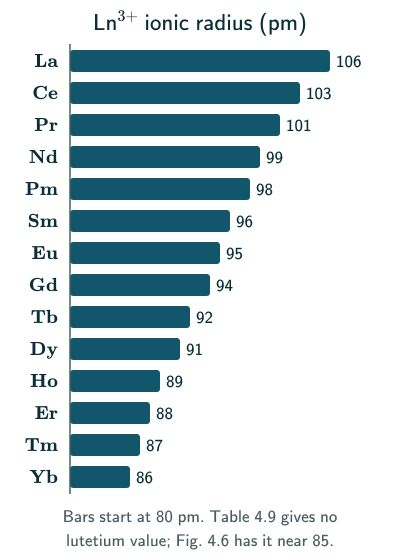
Lanthanoid contraction
- What it is. The steady decrease in size from lanthanum to lutetium is the lanthanoid contraction (NCERT page 109).
- Why it happens. As in an ordinary transition series, each added electron shields the others imperfectly from the nucleus. But one 4f electron shields another even less well than one d electron shields another, so as the nuclear charge rises along the series the size falls fairly regularly (NCERT page 109).
- Its consequence for the 5d series. The contraction of the lanthanoid series cancels the increase in size expected from the 4d to the 5d series, so the third transition series has almost the same radii as the second: zirconium 160 pm and hafnium 159 pm. That is why zirconium and hafnium occur together in nature and are hard to separate (NCERT page 109).
- Separating the lanthanoids. Beyond the NCERT text: because the ionic radius falls smoothly and predictably, the lanthanoid ions can be separated by chromatography, since the stability of their complexes with anions such as EDTA4− rises as the radius falls (Wikipedia, “Lanthanide contraction”).
Oxidation states
- +3 dominates. La(III) and Ln(III) compounds predominate; +2 and +4 ions are occasionally found in solution or in solids. The irregularity comes mainly from the extra stability of empty, half-filled or filled f subshells (NCERT Section 4.5.3, page 109).
- NCERT slip (page 109): the sentence opens “In the lanthanoids, La(II) and Ln(III) compounds are predominant species”, confirmed on the page image. Lanthanum is +3 (La3+, 4f0, in Table 4.9 on page 110); read it as La(III).
- +4. Ce4+ is favoured by its noble gas configuration, 4f0, but it is a strong oxidant that returns to +3. Its E⊖(Ce4+/Ce3+) of +1.74 V means it could oxidise water, but the reaction is very slow, so Ce(IV) is a good analytical reagent. NCERT says Pr, Nd, Tb and Dy “also exhibit +4 state but only in oxides, MO2” (page 109); give that in an exam. Tb(IV), with half-filled f orbitals, is an oxidant (NCERT page 109). Beyond the NCERT text: “only in oxides” is too narrow, since terbium(IV) fluoride, TbF4, is also known, a white solid and a strong oxidiser (Wikipedia, “Terbium(IV) fluoride”).
- +2. Eu2+ forms by losing the two s electrons, and its f7 configuration explains it; it is a strong reducing agent and returns to +3. Yb2+, f14, is a reductant too, and samarium, like europium, shows +2 and +3 (NCERT page 109).
| State | Ion | f set | Acts as |
|---|---|---|---|
| +4 | Ce4+ | 4f0 | oxidant |
| +4 | Tb4+ | 4f7 | oxidant |
| +2 | Eu2+ | 4f7 | reductant |
| +2 | Yb2+ | 4f14 | reductant |
General characteristics
- The metals. Silvery white, soft, and quick to tarnish in air; hardness rises with atomic number, samarium being steel hard. They have typical metallic structures and conduct heat and electricity well. Density and other properties change smoothly except for Eu and Yb, and sometimes Sm and Tm (NCERT Section 4.5.4, page 110).
- Melting points. NCERT gives them as 1000 to 1200 K, with samarium at 1623 K (NCERT page 110).
- NCERT slip (page 110): beyond the NCERT text, the Wikipedia “Melting points of the elements (data page)” shows that only three lanthanoids melt between 1000 and 1200 K, cerium (1068 K), ytterbium (1097 K) and europium (1099 K), as does lanthanum (1193 K); the remaining values extend much higher. The Royal Society of Chemistry lists samarium at 1345 K and lutetium at 1936 K, so samarium is not the highest-melting member. If a question quotes NCERT’s figures, use them.
- Colour. Many Ln3+ ions are coloured, in solids and in solution, which NCERT attributes to their f electrons; neither La3+ nor Lu3+ shows any colour, but the rest do so. The absorption bands are narrow, probably because the excitation is within the f level (NCERT page 110).
- NCERT slip (page 110): NCERT says every Ln3+ ion except La3+ and Lu3+ is coloured. Beyond the NCERT text: in aqueous solution Ce3+, Eu3+, Gd3+ and Yb3+ are colourless too (Wikipedia, “Lanthanide”, table of ion colours, after Cotton). In an exam, give NCERT’s La3+ and Lu3+; add the others only if the options require it.
- Magnetism. The lanthanoid ions other than the f0 type (La3+ and Ce4+) and the f14 type (Yb2+ and Lu3+) are all paramagnetic (NCERT page 110); give that in an exam. Strictly, their moments cannot be found by counting unpaired electrons alone: spin–orbit coupling and thermally populated levels matter, especially for Eu(III) and Sm(III) (reasoned).
- Ionisation enthalpies. The first is about 600 kJ mol−1 and the second about 1200 kJ mol−1, comparable with calcium’s. Abnormally low third ionisation enthalpies for lanthanum, gadolinium and lutetium point to the extra stability of empty, half-filled and full f levels, as with exchange energy in the 3d series (NCERT page 110).
- Reactivity. The early lanthanoids are reactive, like calcium; the later ones behave more like aluminium. E⊖(Ln3+/Ln) lies between −2.2 and −2.4 V, except −2.0 V for europium (NCERT pages 110–111).
- Reactions (NCERT page 111, Fig. 4.7): with hydrogen on gentle heating; with carbon at 2773 K, giving the carbides Ln3C, Ln2C3 and LnC2; with dilute acids, liberating hydrogen; with halogens, burning to LnX3; with oxygen to Ln2O3; with water to Ln(OH)3 and H2; with nitrogen to LnN and with sulphur to Ln2S3. The hydroxides are definite compounds, not just hydrated oxides, and basic like the alkaline earth hydroxides.
- Uses named by NCERT. NCERT calls the production of alloy steels for plates and pipes “the best single use of the lanthanoids” (page 111); give that in an exam. Mischmetall, about 95% lanthanoid metal and 5% iron with traces of S, C, Ca and Al, goes into magnesium-based alloys for bullets, shells and lighter flints. Mixed lanthanoid oxides catalyse petroleum cracking, and some oxides are phosphors in television screens (NCERT page 111).
Solved examples
Example 1: Ions that break the +3 rule
Write the 4f configurations of Ce4+, Eu2+, Tb4+ and Yb2+, and say which are oxidants and which reductants.
Answer: Ce (4f1 5d1 6s2) loses four electrons: Ce4+ 4f0, an oxidant. Eu (4f7 6s2) loses the two 6s electrons: Eu2+ 4f7, a reductant. Tb (4f9 6s2) loses four: Tb4+ 4f7, an oxidant. Yb (4f14 6s2) loses two: Yb2+ 4f14, a reductant. Each reaches an empty, half-filled or full f set, and each tends to return to +3 (NCERT pages 109–110).
Example 2: Magnetic moments of Gd and Lu
Find the spin-only magnetic moments of Gd3+ and Lu3+.
Answer: Gd3+ is 4f7: seven f orbitals, one electron each, so n = 7 and μ = √(7 × 9) = √63 = 7.94 BM. Lu3+ is 4f14: all paired, n = 0, μ = 0, diamagnetic (NCERT page 110 lists f14 ions as not paramagnetic).
Example 3: How big is the contraction?
Using NCERT Table 4.9, find the average fall in Ln3+ radius per element from La3+ to Yb3+, and compare the Zr–Hf difference with the Ti–Zr increase (Ti 147, Zr 160, Hf 159 pm; NCERT pages 94 and 109).
Answer: 106 − 86 = 20 pm over 13 steps: about 1.5 pm per element. From titanium to zirconium the radius rises by 13 pm, but from zirconium to hafnium it changes by only −1 pm: the lanthanoid contraction has wiped out the expected increase (reasoned).
Common mistakes to avoid
Common mistake
Treating +2 and +4 as the usual lanthanoid states
+3 is the common, stable state. Ce(IV), Tb(IV), Eu(II) and Yb(II) exist because they reach empty, half-filled or full f sets, and they tend to return to +3.
Common mistake
Expecting La and Lu to be coloured
They are f0 and f14: with no f–f excitation possible they are colourless, and they are not paramagnetic.
Common mistake
Expecting a large size difference between Zr and Hf
It nearly cancels the expected increase, so the two are almost the same size. In the quoted values Hf is indeed 1 pm smaller (159 against 160 pm); the lesson is near-equality, not a rule forbidding a small reversal.
Quick revision summary
- Lanthanoids: Ce to Lu (Z = 58–71), 4f filling; with La they are written Ln; atoms 6s with varying 4f; Ln = 4f, n = 1 to 14.
- Lanthanoid contraction: steady fall in size La → Lu, from the poor shielding of one 4f electron by another; Zr 160 pm ≈ Hf 159 pm.
- +3 dominant; Ce (f) and Tb (f) oxidants; Eu (f) and Yb (f) reductants.
- Soft, silvery, reactive metals: early ones like calcium, later like aluminium; many Ln ions are coloured, NCERT excepting La and Lu (Ce, Eu, Gd and Yb are colourless too). All ions except the f and f types are paramagnetic (NCERT).
- Uses: alloy steels, mischmetall (about 95% Ln, 5% Fe) in lighter flints, cracking catalysts, phosphors.
Formula sheet
- Lanthanoids: Ce (Z = 58) to Lu (Z = 71)
- Ln: 4f, n = 1 to 14
- E⊖(Ce/Ce) = +1.74 V
- E⊖(Ln/Ln) = −2.2 to −2.4 V (Eu −2.0 V)
- Spin-only moment: μ = √(n(n + 2)) BM
Questions students ask
What is the difference between lanthanides, lanthanoids and rare earth elements?
Lanthanides and lanthanoids are two names for the same elements: IUPAC recommends lanthanoid, keeping the ending -ide for anions such as chloride, though lanthanide is still common (beyond the NCERT text; IUPAC Recommendations 2005, IR-3.5). NCERT counts 14 lanthanoids, cerium to lutetium, and discusses lanthanum with them (NCERT page 108), while the IUPAC periodic table labels all 15 elements from 57 to 71 lanthanoids (IUPAC Recommendations 2005). The rare earth elements are a wider set of 17, the 15 lanthanoids with scandium and yttrium, which share their ores and much of their chemistry (Wikipedia, “Rare-earth element”); actinide and actinoid pair the same way.
Why is europium’s atomic radius so much larger than its neighbours’?
Europium’s atomic radius, 199 pm against 180 pm for both samarium and gadolinium (NCERT Table 4.9, page 110), is large because in the metal each europium atom keeps its half-filled 4f7 set and gives only its two 6s electrons to the metallic bonding, as Eu2+, where most of the others give three (beyond the NCERT text; Wikipedia, “Lanthanide”). With fewer bonding electrons the atoms sit farther apart, and europium has the lowest density of the series; ytterbium, 4f14, behaves the same way, with a metallic radius near 193 pm (same source), though Table 4.9 prints 173 pm. NCERT names Eu and Yb as the elements whose density breaks the smooth trend (page 110).
Does the spin-only formula give the magnetic moments of lanthanoid ions?
No, the spin-only formula, μ = √(n(n + 2)) BM, fits few lanthanoid ions: 4f electrons lie inside the filled 5s and 5p shells and, unlike 3d electrons, whose orbital contribution is quenched (NCERT page 102), keep their orbital motion, strongly coupled to spin (beyond the NCERT text; Wikipedia, “Lanthanide”, “Lanthanide contraction”). So Dy3+ and Ho3+, with five and four unpaired electrons, show the largest moments, about 10.4–10.7 BM (Wikipedia, “Lanthanide”). If a question asks for the spin-only value, as NCERT Exercise 4.31 does, use the formula.
Why are the lanthanoids so difficult to separate from one another?
The lanthanoids are hard to separate because their ions are nearly identical: all are mainly +3 (NCERT page 109), and neighbouring Ln3+ ions differ in radius by only 1–3 pm (NCERT Table 4.9, page 110), so their salts dissolve, crystallise and form complexes almost alike (reasoned). Beyond the NCERT text, industry uses solvent extraction over many stages: tributyl phosphate dissolved in kerosene, shaken with a water solution of the nitrates, takes up some lanthanoids a little more readily than others, so each pass enriches the two layers slightly (Wikipedia, “Lanthanide”; reasoned).
Is the lanthanoid contraction in the JEE Main and NEET syllabus?
Yes, the lanthanoid contraction is named in Unit 11 of both the JEE Main 2027 and the NEET (UG) 2026 syllabus, in the line “Lanthanoids - Electronic configuration, oxidation states and Lanthanoid contraction” (JEE Main; NEET prints “oxidation states, and lanthanoid contraction”). The actinoids line names only their “Electronic configuration and oxidation states”, so the actinoid contraction (NCERT page 112) is not named in either.
Practice questions
Try each question first, then open the answer to check your working.
-
Q1. Use Hund’s rule to derive the electronic configuration of the Ce3+ ion, and calculate its spin-only magnetic moment. (NCERT Exercise 4.31.)
Show answerHide answer
Ce is [Xe] 4f1 5d1 6s2; losing the two 6s electrons and the 5d electron leaves Ce3+ [Xe] 4f1, one unpaired electron. μ = √(1 × 3) = 1.73 BM.
-
Q2. What are inner transition elements? Decide which of these atomic numbers belong to them: 29, 59, 74, 95, 102, 104. (NCERT Exercise 4.28.)
Show answerHide answer
Inner transition elements are the f-block elements, in which the 4f or 5f orbitals fill: the lanthanoids and the actinoids (NCERT page 89). 59 (praseodymium) is a lanthanoid, and 95 (americium) and 102 (nobelium) are actinoids. 29 (copper), 74 (tungsten) and 104 (rutherfordium) are d-block elements; rutherfordium belongs to the 6d series, which is actinium plus rutherfordium to copernicium (NCERT page 89).
-
Q3. What is mischmetall, and what is it used for? (Based on NCERT Exercise 4.27.)
Show answerHide answer
An alloy of about 95% lanthanoid metal and 5% iron, with traces of S, C, Ca and Al. Much of it goes into magnesium-based alloys for bullets, shells and lighter flints (NCERT page 111).