Lymph and tissue fluid
NCERT Class 11 Biology Chapter 15 Section 15.2
Quick answer
Lymph is tissue fluid collected into lymphatic vessels and returned to the major veins. It carries lymphocytes, nutrients, hormones and the fats absorbed by the lacteals of the intestinal villi (NCERT page 197); beyond the NCERT text, it also returns excess fluid and leaked small proteins to the blood.
With your textbook
NCERT Biology (Class 11), Chapter 15 “Body Fluids and Circulation”, Section 15.2 “Lymph (Tissue Fluid)”, page 197.
Open the official NCERT chapter (PDF, 3.1 MB, ncert.nic.in) (opens in a new tab)
Checked against the 2026-27 reprint on .
Lymph (tissue fluid)
Lymph
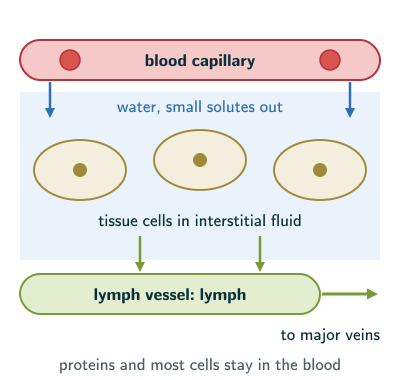
As blood, a fluid connective tissue, passes through the capillaries in tissues, some water and many small water-soluble substances move out into the spaces between the cells, leaving the larger proteins and most of the formed elements in the blood vessels (NCERT Section 15.2, page 197).
The fluid present in the lymphatic system is called the lymph.
NCERT Biology (Class 11), Section 15.2, page 197
In plain words: blood never touches most cells directly. A little of its liquid seeps out of the capillaries and bathes the cells, and every exchange happens through this bath. The extra fluid is then gathered up by a separate set of drainage pipes, the lymph vessels, and poured back into the veins.
Interstitial fluid
- The fluid released out of the capillaries into the spaces between cells is the interstitial fluid or tissue fluid (NCERT page 197).
- It has the same mineral distribution as plasma, but the larger proteins and most formed elements stay behind in the blood vessels (page 197).
- Exchange of nutrients, gases and so on between the blood and the cells always occurs through this fluid (page 197).
Lymphatic system
- An elaborate network of vessels, the lymphatic system, collects the interstitial fluid and drains it back to the major veins (NCERT page 197).
- The fluid inside the lymphatic system is the lymph (page 197).
- NCERT’s section heading and its Summary (pages 197 and 203) treat lymph and tissue fluid as one name; the section text separates them: the fluid around the cells is interstitial (tissue) fluid, and once it is inside the lymphatic system it is lymph (page 197).
Functions of lymph
NCERT lists what lymph does (page 197):
- It is a colourless fluid containing specialised lymphocytes, which are responsible for the immune responses of the body.
- It is an important carrier for nutrients, hormones and so on.
- Fats are absorbed through lymph in the lacteals present in the intestinal villi.
| Feature | Blood | Lymph |
|---|---|---|
| Colour | red (haemoglobin in RBCs) | colourless |
| Larger proteins | present | mostly absent |
| Formed elements | RBCs, WBCs, platelets | mainly lymphocytes |
| Flows in | blood vessels | lymph vessels, to veins |
(NCERT pages 193–197; Chapter Summary, page 203.)
Beyond the NCERT text: some small proteins can leak out through the capillary walls, and the lymph capillaries pick them up with the excess tissue fluid and return them to the venous blood (NCI SEER Training Modules, “Introduction to the Lymphatic System”, public domain). In the villi, absorbed fats enter the lacteals packaged as chylomicrons, which make the lymph there milky; it is called chyle (Wikipedia, “Lacteal”, facts in our words). In an NCERT-based answer, keep NCERT’s lines: lymph is colourless, and the larger proteins stay in the blood vessels (page 197).
Solved examples
Example 1: Lymph and blood (NCERT Exercises 5 and 7a)
What is the difference between lymph and blood?
Answer: blood is a red fluid connective tissue of plasma with RBCs, WBCs and platelets, flowing in blood vessels. Lymph is the tissue fluid collected by the lymphatic system: colourless, with the same minerals as plasma but without the larger proteins and most formed elements, containing mainly lymphocytes, and drained back into the major veins. NCERT’s Summary says lymph is almost similar to blood except for the protein content and the formed elements (NCERT pages 193–197 and 203).
Example 2: Where fats go
After a fatty meal, where are most of the digested fats absorbed in the intestine?
Answer: into the lacteals, the lymph vessels in the intestinal villi; fats are absorbed through lymph (NCERT page 197).
Example 3: Why tissue fluid matters
A cell deep in a tissue is never in direct contact with blood. How does it get nutrients and O?
Answer: through the interstitial (tissue) fluid. Exchange of nutrients, gases and so on between blood and cells always occurs through this fluid, which forms from blood as it passes through the capillaries (NCERT page 197).
Common mistakes to avoid
Common mistake
Saying tissue fluid is just plasma
Tissue fluid has the same mineral distribution as plasma, but the larger proteins and most formed elements stay in the blood vessels (NCERT page 197).
Common mistake
Sending lymph back into arteries
The lymphatic system drains the fluid back into the major veins (NCERT page 197).
Quick revision summary
- Water and small solutes leave the tissue capillaries as interstitial (tissue) fluid, with the same minerals as plasma; the larger proteins and most formed elements stay in the blood.
- All exchange between blood and cells happens through this fluid; the lymphatic system collects it and drains it into the major veins.
- Lymph is colourless, carries lymphocytes for immune responses, carries nutrients and hormones, and carries the fats absorbed by the lacteals of the intestinal villi.
Formula sheet
- tissue fluid: water + small solutes from capillaries; same minerals as plasma
- lymphatic system: collects tissue fluid → major veins
- lymph: colourless; lymphocytes; carries nutrients, hormones; fats via lacteals
Questions students ask
What is the difference between lymph and plasma?
Lymph differs from plasma in colour, protein content and where it flows: plasma is the straw-coloured, viscous fluid matrix of blood, while lymph is a colourless fluid (NCERT pages 193 and 197). Plasma is 6–8 per cent protein, mainly fibrinogen, globulins and albumins (pages 193–194), whereas lymph forms from tissue fluid, which lacks the larger plasma proteins (page 197), so lymph usually has less protein (reasoned). Beyond the NCERT text, some small proteins leak into tissue fluid and return in lymph (NCI SEER, “Introduction to the Lymphatic System”). Plasma flows with the blood cells inside the blood vessels, while lymph flows in the separate vessels of the lymphatic system (page 197).
Is tissue fluid the same as lymph?
Tissue fluid and lymph are the same fluid in two places: the fluid that leaves the capillaries and bathes the cells is interstitial or tissue fluid, and once the lymphatic system has collected it, it is called lymph (NCERT page 197). Beyond the NCERT text, tissue fluid becomes lymph by entering lymph capillaries, which begin as blind-ended sacs among the cells and whose walls act as one-way valves, letting fluid in but not out (NCI SEER Training Modules, “Components of the Lymphatic System”).
What is chyle, and how is it different from lymph?
Chyle is the lymph of the small intestine turned milky white by absorbed fat: beyond the NCERT text, it is an opaque, milky-white fluid made mainly of emulsified fats that enters the lymphatic system from the small intestine (MeSH, US National Library of Medicine, “Chyle”). Lymph elsewhere is colourless (NCERT page 197), so chyle differs mainly in the fat it carries, the visible sign of NCERT’s point that fats are absorbed through lymph in the intestine (page 197).
What happens if tissue fluid is not drained by the lymphatic system?
Tissue fluid that is not drained builds up between the cells and makes the tissue swell: beyond the NCERT text, an abnormal build-up of fluid in the tissues is called oedema, and oedema caused by blocked lymph vessels or disorders of the lymph nodes is called lymphoedema (MeSH, US National Library of Medicine, “Edema” and “Lymphedema”). Normally this does not happen, because the lymphatic system collects the fluid that leaves the capillaries and returns it to the blood (NCERT page 197).
How is the lymphatic system different from the blood circulatory system?
The lymphatic system is a one-way drainage network, while the blood circulatory system is a circuit driven by a pump: blood is moved by a muscular chambered heart through a closed network of branching blood vessels (NCERT page 198), whereas lymph vessels carry fluid only away from the tissues and return it to the blood (page 197). Beyond the NCERT text, the lymphatic system has no central heart-like pump: lymph is pushed along by the squeeze of skeletal muscles, breathing movements and the contraction of smooth muscle in the vessel walls, and valves in the vessels stop it flowing back (NCI SEER Training Modules, “Components of the Lymphatic System”).
Practice questions
Try each question first, then open the answer to check your working.
-
Q1. What are lacteals, and what do they absorb?
Show answerHide answer
Lymph vessels in the intestinal villi; fats are absorbed through lymph in them (NCERT page 197).
-
Q2. Which cells in lymph are responsible for immune responses?
Show answerHide answer
Specialised lymphocytes (NCERT page 197).
-
Q3. Into which vessels does the lymphatic system drain the tissue fluid?
Show answerHide answer
The major veins (NCERT page 197).