Equal sets
NCERT Class 11 Mathematics Chapter 1 Section 1.5
Quick answer
Equal sets are sets with exactly the same elements: A = B when every element of A is in B and every element of B is in A. Order and repetition do not matter: the letters of ALLOY and of LOYAL give the same set {A, L, O, Y}. To show two sets are not equal, find one element that is in one set but not the other.
With your textbook
NCERT Mathematics (Class 11), Chapter 1 “Sets”, Section 1.5 “Equal Sets”, pages 7–9.
Open the official NCERT chapter (PDF, 2.2 MB, ncert.nic.in) (opens in a new tab)
Checked against the 2026-27 reprint on .
When are two sets equal?
Equal sets
Given two sets A and B, if every element of A is also an element of B and if every element of B is also an element of A, then the sets A and B are said to be equal.
NCERT Mathematics (Class 11), Section 1.5, page 7
- Equal sets have exactly the same elements; we write A = B, and A ≠ B otherwise (NCERT Definition 3, page 7).
- Order and repetition do not matter: {1, 2, 3, 4} = {3, 1, 4, 2}, and {1, 2, 3} = {2, 2, 1, 3, 3}. For ordered pairs, order does matter: (1, 2) ≠ (2, 1).
In plain words: two sets are equal when they hold the same objects, however they are written. Lists that look different can describe the same set, and a set described in words can equal one written in roster form. To test equality, check both ways round: everything in A must be in B, and everything in B must be in A.
Testing for equality
Two convenient steps:
- write each set in roster form where you can, removing repetitions (an infinite set such as {x : x is a multiple of 10} cannot be listed in full, so compare its rule);
- compare element by element: one element in A but not in B (or the other way) is enough to show A ≠ B.
NCERT’s examples (page 7): {1, 2, 3, 4} and {3, 1, 4, 2} are equal; the set A of primes less than 6 and the set P of prime factors of 30 are equal, since both are {2, 3, 5}. Descriptions from other subjects work the same way: the set of elements in period 1 of the periodic table equals {H, He}.
A set does not change if one or more elements of the set are repeated.
NCERT Mathematics (Class 11), Section 1.5, page 7
That is why repeated elements are usually left out: the letters of ALLOY and of LOYAL both give the set {A, L, O, Y} (NCERT Example 8, page 8).
Equal sets and equivalent sets. Equal sets always have the same number of elements, but the converse is false: {1, 2} and {3, 4} both have two elements and are not equal. Finite sets with the same number of elements are called equivalent; this term is not in the NCERT text, but it is often used.
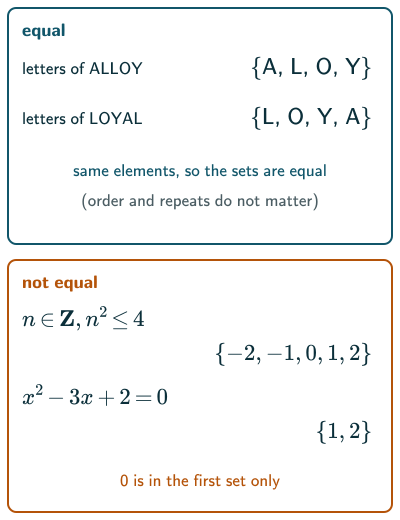
Solved examples
Example 1: Pairs of equal sets (NCERT Example 7, page 8)
Which of these sets are equal: A = {0}, B = {x : x > 15 and x < 5}, C = {x : x − 5 = 0}, D = {x : x2 = 25}, E = {x : x is a positive integer root of x2 − 2x − 15 = 0}?
In roster form: B = ϕ (no number is both above 15 and below 5); C = {5}; D = {−5, 5}; x2 − 2x − 15 = (x − 5)(x + 3), so E = {5}. Only A contains 0; B is the only empty set; D contains −5, which C and E do not.
Answer: only C and E are equal.
Example 2: Letters and roots (NCERT Example 8, page 8)
(i) Are the sets of letters in ALLOY and in LOYAL equal? (ii) Are A = {n : n ∈ Z and n2 ≤ 4} and B = {x : x ∈ R and x2 − 3x + 2 = 0} equal?
(i) Both are {A, L, O, Y}. (ii) A = {−2, −1, 0, 1, 2}; x2 − 3x + 2 = (x − 1)(x − 2), so B = {1, 2}. Since 0 ∈ A but 0 ∉ B, they differ.
Answer: (i) equal; (ii) not equal.
Example 3: A = B or not? (NCERT Exercise 1.2, Q4)
(i) A = {a, b, c, d}, B = {d, c, b, a}; (ii) A = {4, 8, 12, 16}, B = {8, 4, 16, 18}; (iii) A = {2, 4, 6, 8, 10}, B = {x : x is a positive even integer and x ≤ 10}; (iv) A = {x : x is a multiple of 10}, B = {10, 15, 20, 25, 30, …}.
(i) Same letters, different order. (ii) 12 ∈ A but 12 ∉ B. (iii) B = {2, 4, 6, 8, 10}. (iv) 15 ∈ B, but 15 is not a multiple of 10.
Answer: (i) equal; (ii) not equal; (iii) equal; (iv) not equal.
Example 4: Selecting equal sets (NCERT Exercise 1.2, Q6)
From A = {2, 4, 8, 12}, B = {1, 2, 3, 4}, C = {4, 8, 12, 14}, D = {3, 1, 4, 2}, E = {−1, 1}, F = {0, a}, G = {1, −1}, H = {0, 1}, select the equal sets.
Compare sets with the same number of elements, element by element.
Answer: B = D and E = G. No other pair matches: A and C differ (2 against 14), and F and H differ (a against 1), taking a as a letter. If a were an unknown number, F = H exactly when a = 1.
Common mistakes to avoid
Common mistake
Comparing lists instead of sets
{4, 8, 12, 16} and {8, 4, 16, 12} are equal even though the order differs; {1, 2} and {1, 2, 2} are equal even though one list is longer. Reduce both to sets first.
Common mistake
Checking only one direction
Every element of {2, 3} is in {1, 2, 3}, but the sets are not equal: 1 is in the second set only. Equality needs both directions.
Common mistake
Confusing equal with equivalent
{1, 2, 3} and {4, 5, 6} have the same number of elements but different elements, so they are not equal.
Quick revision summary
- A = B when every element of A is in B and every element of B is in A.
- In subset language: A = B ⇔ A ⊂ B and B ⊂ A (NCERT Section 1.6, page 9); this is how set identities are proved.
- Order and repetition do not change a set.
- To show A ≠ B, find one element in one set but not in the other.
Formula sheet
- A = B ⇔ (every element of A is in B) and (every element of B is in A)
- {1, 2, 3} = {3, 1, 2} = {1, 1, 2, 3}
Questions students ask
What is the difference between equal and equivalent sets?
Equal sets have exactly the same elements, while equivalent sets need only have the same number of elements: {p, q, r} and {6, 7, 8} are equivalent, since each has 3 elements, but they are not equal. So equal sets are always equivalent, but equivalent sets are equal only when their elements also match, as for {5, 7, 9} and {9, 5, 7}. For infinite sets, beyond NCERT, “equivalent” means that the elements can be paired off one to one, so the even natural numbers are equivalent to N (pair n with 2n) although they are only part of it.
What is the symbol for equivalent sets?
There is no NCERT symbol for equivalent sets: other books write A ~ B, A ≈ B or A ≡ B, and for finite sets the clearest way to say it is n(A) = n(B). Equal sets are written A = B, and sets that are not equal A ≠ B. So {1, 2} and {6, 9} are equivalent, but writing {1, 2} = {6, 9} would be wrong, because = says that the two sets have the same elements, not just the same number of them.
What is the difference between equal sets and subsets?
Equal sets are subsets of each other, while a subset need only lie inside the other set: A ⊂ B means every element of A is in B, and A = B means that A ⊂ B and B ⊂ A both hold. So {3, 6} ⊂ {3, 6, 9} although the two sets are not equal, while {3, 6, 9} and {9, 6, 3} are subsets of each other and therefore equal. Every set is a subset of itself, and a subset that is not equal to the whole set is a proper subset.
How do you prove that two infinite sets are equal?
Two infinite sets are proved equal by showing that each is a subset of the other: take any element of A and show that it lies in B, then take any element of B and show that it lies in A. For example, {x : x ∈ Z and x is even} equals {x : x ∈ Z and x2 is even}: the square of an even integer is even and the square of an odd integer is odd, so an integer with an even square must itself be even. Listing a few elements of each set can show that two sets differ, but it never proves that they are equal.
Practice questions
Try each question first, then open the answer to check your working.
-
Q1. Are A = {2, 3} and B = {x : x is a solution of x2 + 5x + 6 = 0} equal (NCERT Exercise 1.2, Q5 (i))?
Show answerHide answer
x2 + 5x + 6 = (x + 2)(x + 3), so B = {−2, −3}. A ≠ B.
-
Q2. Are the sets of letters in FOLLOW and in WOLF equal (NCERT Exercise 1.2, Q5 (ii))?
Show answerHide answer
Both are {F, O, L, W}, so they are equal.
-
Q3. Show that the sets of letters needed to spell CATARACT and TRACT are equal (NCERT Example 23, pages 20–21).
Show answerHide answer
CATARACT gives {C, A, T, R}; TRACT gives {T, R, A, C}. Each element of one is in the other, so the sets are equal.
-
Q4. Is {x : x ∈ N and x2 = 9} equal to {3}?
Show answerHide answer
Yes: x = 3 or −3, but −3 is not a natural number, so the set is {3}.