Universal set
NCERT Class 11 Mathematics Chapter 1 Section 1.7
Quick answer
The universal set U is the basic set that contains every element of the sets under discussion in a particular context; every set in the problem is a subset of U. It is chosen to suit the problem, so the integers can sit in U = Q or U = R, and it can be larger than needed. In a Venn diagram U is drawn as a rectangle.
With your textbook
NCERT Mathematics (Class 11), Chapter 1 “Sets”, Section 1.7 “Universal Set”, pages 12–13.
Open the official NCERT chapter (PDF, 2.2 MB, ncert.nic.in) (opens in a new tab)
Checked against the 2026-27 reprint on .
What is the universal set?
Universal set
The universal set, usually written U, is the basic set that contains every element of the sets under discussion in a particular context; the sets being studied are its subsets (NCERT Section 1.7, page 12).
- It depends on the context: it is chosen, not fixed once and for all.
- For the set of integers, the universal set can be the rational numbers Q or the real numbers R (NCERT page 12).
- In human population studies, the universal set is all the people in the world.
In plain words: before you talk about “the even numbers” or “the girls in the class”, you need to know what the even numbers are taken from, or which class. The universal set is that background collection. Every other set in the problem sits inside it, and later the complement of a set, “everything not in A”, means everything in U that is not in A.
Choosing a universal set
When we study the number system, we work with the natural numbers and their subsets: the primes, the even numbers and so on. Then N can serve as the universal set (NCERT page 12). A universal set must contain every set in the problem as a subset, but it can be larger than needed:
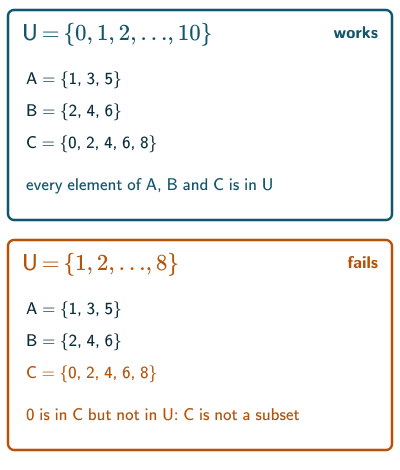
- for {1, 3, 5}, {2, 4, 6} and {0, 2, 4, 6, 8}, the set {0, 1, 2, …, 10} works; {0, 1, 2, 3, 4, 5, 6} does not, because it lacks 8, and {1, 2, 3, 4, 5, 6, 7, 8} does not, because it lacks 0 (NCERT Exercise 1.3, Q8);
- for the right triangles, or the isosceles triangles, the set of all triangles in the plane is a natural universal set (NCERT Exercise 1.3, Q7).
The choice matters as soon as complements appear. Take A = {2, 4, 6, …}. If U = N, everything outside A is the odd natural numbers; if U = Z, it also includes 0 and every negative integer, such as −1 and −2; if U = R, it also contains ½ and √2.
In a Venn diagram, the universal set is usually drawn as a rectangle and its subsets as circles inside it (NCERT Section 1.8, page 13).
The same idea is used in chemistry when elements are sorted: to say which elements are metals, the universal set is all the elements, and the non-metals and metalloids are what is left.
Solved examples
Example 1: Which universal sets work? (NCERT Exercise 1.3, Q8)
For A = {1, 3, 5}, B = {2, 4, 6} and C = {0, 2, 4, 6, 8}, which of these can be the universal set: (i) {0, 1, 2, 3, 4, 5, 6}; (ii) ϕ; (iii) {0, 1, 2, …, 10}; (iv) {1, 2, …, 8}?
Every element of A, B or C must be in U: that is 0, 1, 2, 3, 4, 5, 6 and 8.
Answer: only (iii). (i) lacks 8, so C is not a subset of it; (ii) ϕ has no elements, so A, B and C are not subsets of it; (iv) lacks 0, so C is not a subset of it.
Example 2: Proposing a universal set (NCERT Exercise 1.3, Q7)
Propose universal sets for (i) the set of right triangles and (ii) the set of isosceles triangles.
Each set is made of triangles, so a set of triangles containing them will do.
Answer: for both, the set of all triangles in the plane (a larger set, such as all polygons in the plane, would also work).
Example 3: The universal set changes the answer
Let A = {2, 4, 6, …}, the even natural numbers. List three elements that are not in A when U = N, and three more when U = Z.
With U = N, the elements outside A are odd natural numbers: 1, 3, 5. With U = Z, A is still {2, 4, 6, …}, so 0 and every negative integer are outside it too: 0, −1, −2.
Answer: for example 1, 3, 5 when U = N, and 0, −1, −2 (as well as 1, 3, 5) when U = Z.
Common mistakes to avoid
Common mistake
Thinking there is one fixed universal set
U is chosen to suit the problem. The same set of integers can sit in U = Q or U = R.
Common mistake
Taking U to be just the sets put together
U can hold elements that are in none of the sets: in a class where some students play cricket and some play football, those who play neither are still in U.
Common mistake
Choosing a universal set that is too small
Every set in the problem must be a subset of U. {1, 2, …, 8} cannot be the universal set for {0, 2, 4, 6, 8}, because 0 is missing.
Quick revision summary
- The universal set U contains every element of the sets under discussion; all of them are its subsets.
- It depends on the context and can be larger than necessary: the integers can sit in U = Q or U = R.
- In Venn diagrams U is a rectangle.
Formula sheet
- A ⊂ U for each set A under discussion
Questions students ask
What is the symbol for the universal set?
The universal set is written U in NCERT and most Indian books, and it is drawn as a rectangle in a Venn diagram. Some British school books use the Greek letter ξ (xi) or a script ℰ instead, and in probability the sample space, which plays the same part, is written S or Ω. Whatever the letter, the set it names must contain every set in the problem as a subset.
What is the difference between a universal set and a superset?
A superset of a set A is a set that contains every element of A and at least one more (NCERT calls B a superset of A when A ⊂ B and A ≠ B), while the universal set is the one set chosen to contain every set in the whole problem as a subset. With A = {1, 2}, B = {1, 2, 3} and C = {4, 5}, B is a superset of A, but it cannot be the universal set, because C is not a subset of B; {1, 2, 3, 4, 5} can. So every set in the problem is a subset of the universal set, but a superset of one set need not be a universal set.
Is the universal set U the same as the union sign ∪?
No, the universal set U and the union sign ∪ only look alike: U is a capital letter that names a set, while ∪ is an operation that joins two sets into one, as in A ∪ B. Since every set in the problem is a subset of U, their union lies inside U too, but it need not fill it: with U = {1, 2, 3, 4}, A = {1} and B = {2, 3}, A ∪ B = {1, 2, 3} ≠ U.
Is a universal set always infinite?
No, a universal set can be finite or infinite: it only has to contain every set in the problem. For one throw of a die, U = {1, 2, 3, 4, 5, 6} is finite, while for questions about the multiples of 3 and of 5, U = N is infinite. In probability this finite universal set is called the sample space, and each event, such as “a number greater than 4” = {5, 6}, is a subset of it.
Practice questions
Try each question first, then open the answer to check your working.
-
Q1. Can {2, 4, 6, 8} be the universal set for A = {2, 4} and B = {4, 6, 8}?
Show answerHide answer
Yes: both A and B are subsets of {2, 4, 6, 8}.
-
Q2. Suggest a universal set for the sets of vowels and of consonants of the English alphabet.
Show answerHide answer
The set of all 26 letters of the English alphabet.
-
Q3. Can ϕ ever be a universal set?
Show answerHide answer
Only in the trivial case where the only set under discussion is ϕ itself. Every set in the problem must be a subset of U, and the only subset of ϕ is ϕ. So ϕ can never be the universal set for a non-empty set, which is why (ii) fails in Example 1.