Complement of a set
NCERT Class 11 Mathematics Chapter 1 Section 1.10
Quick answer
The complement A′ of a set A is the set of all elements of the universal set U that are not in A, so A′ = U − A. It satisfies A ∪ A′ = U, A ∩ A′ = ϕ and (A′)′ = A. De Morgan’s laws say that the complement of a union is the intersection of the complements and the complement of an intersection is the union of the complements.
With your textbook
NCERT Mathematics (Class 11), Chapter 1 “Sets”, Section 1.10 “Complement of a Set”, pages 18–20.
Open the official NCERT chapter (PDF, 2.2 MB, ncert.nic.in) (opens in a new tab)
Checked against the 2026-27 reprint on .
What is the complement of a set?
Complement of a set
Let U be the universal set and A a subset of U. Then the complement of A is the set of all elements of U which are not the elements of A.
NCERT Mathematics (Class 11), Section 1.10, page 18
- It is written A′ (read “A complement”): A′ = {x : x ∈ U and x ∉ A}.
- So A′ = U − A: the complement is the difference between the universal set and A (NCERT page 18).
In plain words: the complement of A is everything in the universal set that A leaves out. If U is the set of students of Class XI in a coeducational school and A is the set of girls, then A′ is the boys (NCERT Example 21, page 19). The complement always depends on U: change the universal set and the complement changes too.
Finding a complement
List U, then strike out the elements of A. For U = {1, 2, …, 10} and A = {1, 3, 5, 7, 9}, A′ = {2, 4, 6, 8, 10} (NCERT Example 20, page 19).
NCERT’s opening example (page 18): U is the set of all prime numbers and A the primes that do not divide 42. The only primes that divide 42 are 2, 3 and 7, so A′ = {2, 3, 7}.
If A is a subset of the universal set U, then its complement A′ is also a subset of U.
NCERT Mathematics (Class 11), Section 1.10, page 19
Taking the complement twice gives back the original set: in NCERT Example 20, (A′)′ = {1, 3, 5, 7, 9} = A. In probability the universal set is the sample space S, and the complement A′ of an event A is the event “not A”. Complements are handy in other subjects too: with U the set of all elements and A the metals, A′ is the set of non-metals and metalloids.
De Morgan’s laws
For U = {1, 2, 3, 4, 5, 6}, A = {2, 3} and B = {3, 4, 5} (NCERT Example 22, page 19): A′ = {1, 4, 5, 6} and B′ = {1, 2, 6}, so A′ ∩ B′ = {1, 6}. Also A ∪ B = {2, 3, 4, 5}, so (A ∪ B)′ = {1, 6}. The two agree, and this is true for all sets:
The complement of the union of two sets is the intersection of their complements and the complement of the intersection of two sets is the union of their complements.
NCERT Mathematics (Class 11), Section 1.10, page 19
De Morgan’s laws
(A ∪ B)′ = A′ ∩ B′
(A ∩ B)′ = A′ ∪ B′
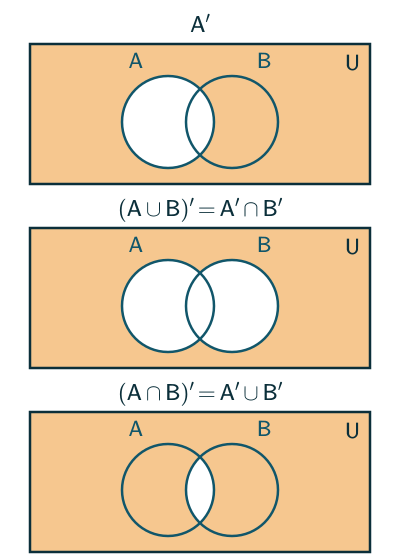
NCERT Exercise 1.5, Q5 asks for Venn diagrams of (A ∪ B)′, A′ ∩ B′, (A ∩ B)′ and A′ ∪ B′. By De Morgan’s laws they pair up: (i) and (ii) are both the middle panel of the figure, and (iii) and (iv) are both the bottom panel.
They are named after the mathematician Augustus De Morgan. In words: an element is outside “A or B” exactly when it is outside A and outside B; it is outside “A and B” exactly when it is outside A or outside B.
Properties of complement
NCERT lists the first four laws (page 20), and the last two follow from them; each can be checked on a Venn diagram:
| Law | Statement |
|---|---|
| Complement laws | A ∪ A′ = U; A ∩ A′ = ϕ |
| De Morgan’s laws | (A ∪ B)′ = A′ ∩ B′; (A ∩ B)′ = A′ ∪ B′ |
| Double complementation | (A′)′ = A |
| Empty set and universal set | ϕ′ = U; U′ = ϕ |
| Difference as a complement | A − B = A ∩ B′ = B′ − A′ |
| Complement reverses inclusion | A ⊂ B ⇔ B′ ⊂ A′ |
The complement laws say that A and A′ together fill U and share nothing: every element of U is in exactly one of them.
Solved examples
Example 1: Complements in a small universe (NCERT Exercise 1.5, Q1 (i), (iii), (iv), (vi))
U = {1, 2, …, 9}, A = {1, 2, 3, 4}, B = {2, 4, 6, 8}, C = {3, 4, 5, 6}. Find A′, (A ∪ C)′, (A ∪ B)′ and (B − C)′.
A ∪ C = {1, 2, 3, 4, 5, 6}; A ∪ B = {1, 2, 3, 4, 6, 8}; B − C = {2, 8}. Then strike each out of U.
Answer: A′ = {5, 6, 7, 8, 9}; (A ∪ C)′ = {7, 8, 9}; (A ∪ B)′ = {5, 7, 9}; (B − C)′ = {1, 3, 4, 5, 6, 7, 9}.
Example 2: Verifying De Morgan’s laws (NCERT Exercise 1.5, Q4)
U = {1, 2, …, 9}, A = {2, 4, 6, 8} and B = {2, 3, 5, 7}. Verify both laws.
A′ = {1, 3, 5, 7, 9}, B′ = {1, 4, 6, 8, 9}. A ∪ B = {2, 3, 4, 5, 6, 7, 8}, so (A ∪ B)′ = {1, 9}, and A′ ∩ B′ = {1, 9}. A ∩ B = {2}, so (A ∩ B)′ = {1, 3, 4, 5, 6, 7, 8, 9}, and A′ ∪ B′ = {1, 3, 4, 5, 6, 7, 8, 9}.
Answer: (A ∪ B)′ = A′ ∩ B′ = {1, 9} and (A ∩ B)′ = A′ ∪ B′ = {1, 3, 4, 5, 6, 7, 8, 9}.
Example 3: Complements in N (NCERT Exercise 1.5, Q3 (i), (iii), (viii), (x))
With U = N, find the complements of (i) the even natural numbers; (ii) the positive multiples of 3; (iii) {x : x + 5 = 8}; (iv) {x : x ≥ 7}.
(iii) The set is {3}. (iv) Everything below 7 is left.
Answer: (i) the odd natural numbers; (ii) the natural numbers not divisible by 3, {1, 2, 4, 5, 7, 8, …}; (iii) N − {3} = {1, 2, 4, 5, 6, …}; (iv) {1, 2, 3, 4, 5, 6}.
Example 4: Triangles (NCERT Exercise 1.5, Q6)
U is the set of all triangles in a plane and A the triangles with at least one angle different from 60°. What is A′?
A′ holds the triangles with no angle different from 60°, that is, all three angles equal to 60°.
Answer: A′ is the set of equilateral triangles.
Common mistakes to avoid
Common mistake
Forgetting that A′ depends on U
The complement of {1, 3, 5} is {2, 4} if U = {1, 2, 3, 4, 5} but {2, 4, 6} if U = {1, 2, …, 6}. Always write down U first.
Common mistake
Writing (A ∪ B)′ = A′ ∪ B′
Taking the complement swaps ∪ and ∩: (A ∪ B)′ = A′ ∩ B′. In Example 2, A′ ∪ B′ has 8 elements while (A ∪ B)′ has only 2.
Common mistake
Thinking ϕ′ is empty
ϕ′ = U: nothing is in ϕ, so everything in U is in its complement.
Quick revision summary
- A′ = {x : x ∈ U and x ∉ A} = U − A; A′ ⊂ U.
- Complement laws: A ∪ A′ = U, A ∩ A′ = ϕ. Double complement: (A′)′ = A. ϕ′ = U, U′ = ϕ.
- De Morgan’s laws: (A ∪ B)′ = A′ ∩ B′ and (A ∩ B)′ = A′ ∪ B′.
Formula sheet
- A′ = {x : x ∈ U and x ∉ A} = U − A
- A ∪ A′ = U; A ∩ A′ = ϕ; (A′)′ = A; ϕ′ = U; U′ = ϕ
- (A ∪ B)′ = A′ ∩ B′; (A ∩ B)′ = A′ ∪ B′
Questions students ask
Which symbols are used for the complement of a set?
The complement of a set A is written A′ in NCERT, read “A complement”; other books write Ac, Ā (A with a bar) or U − A, and all of them name the same set {x : x ∈ U and x ∉ A}. With more than one set, brackets matter: (A ∪ B)′ is the complement of the union, which De Morgan’s law turns into A′ ∩ B′, while A ∪ B′ joins A to the complement of B alone.
What is the difference between the complement and the relative complement of a set?
The complement A′ is taken inside the universal set, A′ = U − A, while the relative complement of B in A is the difference A − B, the elements of A that are not in B, taken inside A instead of U; to mark the contrast, A′ is sometimes called the absolute complement. The two are linked by A − B = A ∩ B′. For U = {a, b, c, d, e, f}, A = {a, b, c, d} and B = {c, d, e}: B′ = {a, b, f} and A − B = A ∩ B′ = {a, b}.
How do you prove De Morgan’s law (A ∪ B)′ = A′ ∩ B′?
De Morgan’s law (A ∪ B)′ = A′ ∩ B′ is proved by showing that both sides have the same elements, through a chain of equivalences for any x in U: x ∈ (A ∪ B)′ ⇔ x ∉ A ∪ B ⇔ x ∉ A and x ∉ B ⇔ x ∈ A′ and x ∈ B′ ⇔ x ∈ A′ ∩ B′. Each step works in both directions, so every element of the left side is in the right side and every element of the right side is in the left, which is what equality of sets means. The second law, (A ∩ B)′ = A′ ∪ B′, is proved the same way, using x ∉ A ∩ B ⇔ x ∉ A or x ∉ B. A Venn diagram illustrates the laws but does not prove them for all sets.
Does De Morgan’s law hold for three sets?
Yes, De Morgan’s laws hold for three sets, and for any finite number of sets: (A ∪ B ∪ C)′ = A′ ∩ B′ ∩ C′ and (A ∩ B ∩ C)′ = A′ ∪ B′ ∪ C′. They follow from the two-set laws used twice, writing A ∪ B ∪ C as (A ∪ B) ∪ C, or directly, since an element lies outside A ∪ B ∪ C exactly when it lies outside each of A, B and C. For U = {1, 2, …, 7}, A = {1, 2}, B = {2, 5} and C = {6}, both sides of the first law give {3, 4, 7}.
What is De Morgan’s law for set difference?
De Morgan’s laws for set difference are A − (B ∪ C) = (A − B) ∩ (A − C) and A − (B ∩ C) = (A − B) ∪ (A − C): removing a union leaves what survives both removals, and removing an intersection leaves what survives at least one. They are De Morgan’s laws worked inside A instead of U, since A − X = A ∩ X′ for any set X. For A = {1, 2, 3, 4, 5}, B = {1, 2} and C = {2, 3}, both sides of the first law give {4, 5}.
Is De Morgan’s law in sets the same as in Boolean algebra?
Yes, De Morgan’s law in sets is the same law as in Boolean algebra and logic gates, written in other symbols: complement corresponds to NOT, union to OR and intersection to AND. So (A ∪ B)′ = A′ ∩ B′ becomes NOT (A OR B) = (NOT A) AND (NOT B), which is why a NOR gate gives the same output as an AND gate whose two inputs are first inverted. In logic the same law says that “not (p or q)” means “not p and not q”.
Practice questions
Try each question first, then open the answer to check your working.
-
Q1. U = {a, b, c, d, e, f, g, h}. Find the complements of A = {a, b, c} and C = {a, c, e, g} (NCERT Exercise 1.5, Q2 (i), (iii)).
Show answerHide answer
A′ = {d, e, f, g, h}; C′ = {b, d, f, h}.
-
Q2. Fill in: (i) A ∪ A′ = …; (ii) ϕ′ ∩ A = …; (iii) A ∩ A′ = …; (iv) U′ ∩ A = … (NCERT Exercise 1.5, Q7).
Show answerHide answer
(i) U; (ii) U ∩ A = A; (iii) ϕ; (iv) ϕ ∩ A = ϕ.
-
Q3. With U = N, find the complement of the set of prime numbers (NCERT Exercise 1.5, Q3 (iv)).
Show answerHide answer
The natural numbers that are not prime: 1 and the composite numbers, {1, 4, 6, 8, 9, 10, …}.
-
Q4. If n(U) = 50, n(A) = 20, n(B) = 25 and n(A ∩ B) = 10, find n(A′ ∩ B′).
Show answerHide answer
By De Morgan’s law A′ ∩ B′ = (A ∪ B)′. n(A ∪ B) = 20 + 25 − 10 = 35, so n(A′ ∩ B′) = 50 − 35 = 15. Likewise n(A′ ∪ B′) = n(U) − n(A ∩ B) = 50 − 10 = 40.