Permutations
NCERT Class 11 Mathematics Chapter 6 Section 6.3
Quick answer
A permutation is an arrangement of objects in a definite order. The number of permutations of n different objects taken r at a time, without repetition, written nPr, is n(n − 1)(n − 2) … (n − r + 1), which equals n factorial divided by (n − r) factorial, and with repetition it is n to the power r. When all n objects are arranged and some are alike, the count is n factorial divided by the factorials of the numbers of alike objects of each kind.
With your textbook
NCERT Mathematics (Class 11), Chapter 6 “Permutations and Combinations”, Section 6.3 “Permutations”, pages 104–114.
Open the official NCERT chapter (PDF, 2.4 MB, ncert.nic.in) (opens in a new tab)
Checked against the 2026-27 reprint on .
What is a permutation?
Permutation
A permutation is an arrangement in a definite order of a number of objects taken some or all at a time.
NCERT Mathematics (Class 11), Section 6.3, page 105
- The number of permutations of n different objects taken r at a time, with no repetition, is written nPr.
- Order matters: ROSE and REOS are different permutations of the same four letters, just as (1, 2) and (2, 1) are different ordered pairs.
- A selection in which order does not matter is a combination.
In plain words: a permutation is an ordered arrangement. NCERT’s example (page 104): three-letter words from the letters of NUMBER with no letter repeated, such as NUM, NMU, MUN. The first place can take any of 6 letters, the second any of the remaining 5, the third any of the remaining 4, so by the multiplication principle there are 6 × 5 × 4 = 120 words. With repetition allowed there would be 6 × 6 × 6 = 216.
Permutations of distinct objects
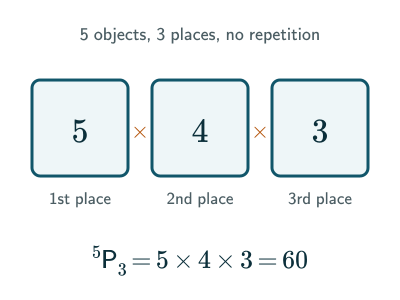
Filling r places in order from n different objects gives n choices for the first place, n − 1 for the second, and so on down to n − r + 1 for the rth (NCERT Theorem 1, page 105):
Theorem 1
P = n(n − 1)(n − 2) … (n − r + 1)
for 0 < r ≤ n, no repetition
Factorial notation
The notation n! represents the product of first n natural numbers
NCERT Mathematics (Class 11), Section 6.3.2, page 105
So n! = 1 × 2 × 3 × … × n, read “n factorial”: 1! = 1, 2! = 2, 3! = 6, 4! = 24, 5! = 120, 6! = 720, 7! = 5040. NCERT also defines 0! = 1 (page 105). A factorial contains every smaller factorial:
Factorial
n! = n × (n − 1)!, for integers n ≥ 1
0! = 1
This makes ratios of factorials easy: 7!/5! = (7 × 6 × 5!)/5! = 42, and 12!/(10! × 2!) = 12 × 11/2 = 66 (NCERT Example 6, page 106).
The formula for P
Multiplying the top and bottom of n(n − 1) … (n − r + 1) by (n − r)! fills in the missing factors: [n(n − 1) … (n − r + 1) × (n − r)!]/(n − r)! = n!/(n − r)!, because the top is now n × (n − 1) × … × 1 (NCERT Section 6.3.3, page 107).
Permutations
P = n!/(n − r)!, 0 ≤ r ≤ n
P = n!, P = 1
with repetition: n
P = 1 because there is exactly one way to arrange nothing, and the formula gives n!/n! = 1, so it holds for r = 0 too. If repetition is allowed, every place has n choices, so there are nr arrangements (NCERT Theorem 2, page 108). For example, a chairman and a vice-chairman can be chosen from 12 people in 12P2 = 12 × 11 = 132 ways (NCERT page 108).
When some objects are alike
The letters of ROOT are not all different. If the two Os are labelled O1 and O2, there are 4! = 24 arrangements, but each word, such as ROOT, appears twice (RO1O2T and RO2O1T). So there are 4!/2! = 12 different words (NCERT Section 6.3.4, pages 108–109).
The same argument works for any number of kinds. NCERT states it, without proof, as Theorem 4 (page 110): if p1 of n objects are of one kind, p2 of a second kind, and so on up to pk of a kth kind, with the rest all different, the number of arrangements of all n objects is
Objects not all different
n!/(p! p! … p!)
all n objects in a row
p, p, …, p alike of each kind
For INSTITUTE (9 letters, I twice and T three times) there are 9!/(2! 3!) = 30 240 arrangements. For ALLAHABAD (9 letters, A four times and L twice) there are 9!/(4! 2!) = 7560 (NCERT Example 9, page 110). Four red, three yellow and two green discs in a row give 9!/(4! 3! 2!) = 1260 arrangements (NCERT Example 15, pages 112–113).
Arrangements with conditions
- A place that cannot take some objects. Numbers between 100 and 1000 from 0, 1, 2, 3, 4, 5 with no repetition: 6P3 = 120 arrangements, minus the 5P2 = 20 that start with 0, gives 100 (NCERT Example 11, pages 110–111).
- Objects that must stay together. Treat them as one block, arrange the blocks, then arrange inside the block. DAUGHTER with the vowels A, U, E together: 6! × 3! = 4320; not all together: 8! − 4320 = 36 000 (NCERT Example 14, page 112).
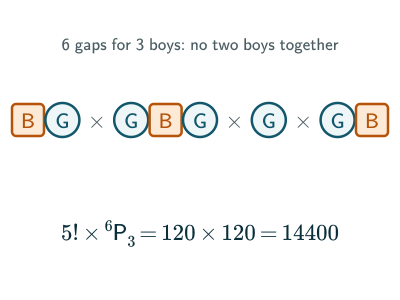
- Objects that must be apart: the gap method. Seat 5 girls first (5! ways); the 3 boys then go into 3 of the 6 gaps, in 6P3 = 120 ways, so no two boys sit together: 5! × 120 = 14 400 (NCERT Example 24, page 122).
Solved examples
Example 1: Factorials (NCERT Example 8, page 106)
If 1/8! + 1/9! = x/10!, find x.
Write everything over 10! = 10 × 9 × 8!: 1/8! = 90/10! and 1/9! = 10/10!. So x = 90 + 10.
Answer: x = 100.
Example 2: Solving for n (NCERT Example 12, page 111)
Find n if (i) nP5 = 42 nP3, n > 4; (ii) nP4 : n−1P4 = 5 : 3, n > 4.
(i) Cancel n(n − 1)(n − 2): (n − 3)(n − 4) = 42, so n2 − 7n − 30 = 0 and (n − 10)(n + 3) = 0. (ii) nP4 has the factors n, n − 1, n − 2 and n − 3, and n−1P4 the factors n − 1, n − 2, n − 3 and n − 4. Cancelling the three they share leaves n/(n − 4) = 5/3, so 3n = 5(n − 4).
Answer: (i) n = 10 (n cannot be −3); (ii) n = 10.
Example 3: Reject the impossible root (NCERT Example 13, page 112)
Find r if 5 × 4Pr = 6 × 5Pr−1.
Write both with factorials: 5 × 4!/(4 − r)! = 6 × 5!/(6 − r)!. Since 5 × 4! = 5!, cancel 5!: (6 − r)!/(4 − r)! = 6, that is (6 − r)(5 − r) = 6, so r2 − 11r + 24 = 0 and r = 8 or r = 3. But 4Pr needs r ≤ 4. Check r = 3: 5 × 24 = 120 and 6 × 20 = 120.
Answer: r = 3 only. NCERT writes “Hence r = 8, 3”, but r = 8 is impossible, because 4 objects cannot be arranged 8 at a time.
Example 4: Repeated letters with conditions (NCERT Example 16, pages 113–114)
INDEPENDENCE has 12 letters: N three times, E four times, D twice. Find the number of arrangements in all, and how many of them (i) start with P; (ii) have all the vowels together; (iii) have the vowels never together; (iv) begin with I and end in P.
All: 12!/(3! 4! 2!). (i) Fix P: 11!/(3! 2! 4!). (ii) The vowels EEEEI form one block; with the 7 consonants (N three times, D twice) that is 8 objects: 8!/(3! 2!) = 3360, and the block can be arranged in 5!/4! = 5 ways. (iii) Subtract (ii) from the total. (iv) Fix I and P: 10!/(3! 2! 4!).
Answer: All: 1 663 200; (i) 138 600; (ii) 16 800; (iii) 1 663 200 − 16 800 = 1 646 400; (iv) 12 600. NCERT’s 1 646 400 counts the arrangements in which the vowels are not all together. If NCERT’s “the vowels never occur together” meant that no two vowels are side by side, place the 7 consonants first (7!/(3! 2!) = 420 ways), then put the 5 vowels into 5 of the 8 gaps: 8P5/4! = 280 ways (divide by 4! because the four Es are alike), so 420 × 280 = 117 600.
Example 5: Dictionary order (NCERT Example 22, page 121)
The 60 words formed from AGAIN are listed as in a dictionary. Which is the 50th word?
Words starting with A: 4! = 24; with G: 4!/2! = 12; with I: 12. That is 48 words. The words starting with N, in order, begin NAAGI, NAAIG.
Answer: NAAIG (the 49th is NAAGI).
Example 6: Repeated digits and a leading 0 (NCERT Example 23, pages 121–122)
How many numbers greater than 1 000 000 can be formed using the digits 1, 2, 0, 2, 4, 2, 4?
A number greater than 1 000 000 made from these 7 digits must use all of them, and each digit can be used only as often as it is listed (NCERT’s note, page 122): 2 three times, 4 twice, 1 and 0 once. All arrangements: 7!/(3! 2!) = 420. The ones with 0 in front are not 7-digit numbers; fixing 0 leaves 6!/(3! 2!) = 60 of them.
Answer: 420 − 60 = 360.
Common mistakes to avoid
Common mistake
Forgetting to divide for repeated letters
BALL has 4!/2! = 12 arrangements, not 4! = 24: swapping the two Ls gives the same word.
Common mistake
Letting 0 lead a number
Arrangements of digits that include 0 also count “numbers” such as 092. Subtract the arrangements that start with 0, as in NCERT Example 11 and Example 6 above.
Common mistake
Keeping a root that makes P meaningless
nPr needs 0 ≤ r ≤ n and whole numbers. A quadratic in r or n can give a root outside that range, which must be rejected (Example 3).
Quick revision summary
- A permutation is an ordered arrangement; n! = 1 × 2 × … × n, 0! = 1 and n! = n × (n − 1)! for n ≥ 1.
- nPr = n!/(n − r)! for 0 ≤ r ≤ n; with repetition, nr.
- Objects with p1, p2, … alike: n!/(p1! p2! …). Together: block method; apart: gap method.
Formula sheet
- P = n!/(n − r)!
- P = n!, P = 1
- n! = n × (n − 1)! for n ≥ 1; 0! = 1
- with repetition: n
- alike objects: n!/(p! p! … p!)
Questions students ask
Why is 0! equal to 1?
0! (zero factorial) equals 1 by definition, and the definition is chosen so that the factorial rules keep working at zero: putting n = 1 in n! = n × (n − 1)! gives 1! = 1 × 0!, so 0! must be 1. The permutation formula agrees, since arranging all n objects gives nPn = n!/(n − n)! = n!/0!, and this must equal n!, so again 0! = 1. It also matches the counting meaning of a factorial: there is exactly one way to arrange no objects, the empty arrangement.
What is the formula for circular permutations?
For n ≥ 1, the number of circular permutations of n different objects, a JEE topic beyond the NCERT book, is (n − 1)!, because turning a circle round does not change who sits next to whom: fix one object and arrange the other n − 1 in order from it. This applies when only the relative order matters, as at a round table with unnumbered seats; for a necklace or garland, which can also be turned over, clockwise and anticlockwise orders are the same, so the count is (n − 1)!/2 for n ≥ 3. For example, 8 people can sit at a round table in 7! = 5040 ways, and 8 different beads make 5040/2 = 2520 different necklaces.
Are circular permutations in NCERT and the JEE Main syllabus?
Circular permutations are not in the NCERT Class 11 Mathematics book, whose Chapter 6 counts arrangements in a line only, and the JEE Main syllabus (Unit 4) does not name them either: it lists the fundamental principle of counting, permutations and combinations, the meaning of P(n, r) and C(n, r), and simple applications. Round-table and necklace counting can be derived as applications of permutations, using (n − 1)! when rotations are identified, and (n − 1)!/2 for n ≥ 3 when reflections are also identified. These extensions go beyond the worked material in this NCERT chapter.
Does “the vowels never come together” mean no two vowels are side by side?
“The vowels never come together” can be read in two ways, which can differ once a word has three or more vowels: “the vowels are not all in one block”, found as all arrangements minus the block ones, or “no two vowels are side by side”, found by the gap method. For AUDIT (vowels A, U, I), the first reading gives 5! − 3! × 3! = 120 − 36 = 84 arrangements, the second only 2! × 3! = 12 (D and T leave 3 gaps for the 3 vowels). NCERT’s solution of Example 16 (INDEPENDENCE) uses the first reading, and this page’s worked example gives both counts.
How do you find the rank of a word in dictionary order?
The rank of a word in dictionary order is 1 more than the number of arrangements of its letters that come before it, counted from the left: at each place, count the arrangements that agree with the word so far but have a smaller unused letter there. For MOTHER (letters in order E, H, M, O, R, T), the earlier words start with E or H (2 × 5! = 240), ME or MH (2 × 4! = 48), MOE, MOH or MOR (3 × 3! = 18), or MOTE (2! = 2), so its rank is 240 + 48 + 18 + 2 + 1 = 309. With repeated letters, count the arrangements of the remaining letters with the alike-objects formula, as in NCERT Example 22 (AGAIN) in the solved examples.
Practice questions
Try each question first, then open the answer to check your working.
-
Q1. Evaluate (i) 8!; (ii) 4! − 3!; (iii) 8!/(6! × 2!). Is 3! + 4! = 7!? (NCERT Exercise 6.2, Q1–Q3)
Show answerHide answer
(i) 40 320; (ii) 24 − 6 = 18; (iii) 8 × 7/2 = 28. No: 3! + 4! = 30 but 7! = 5040.
-
Q2. How many 4-digit numbers have no digit repeated (NCERT Exercise 6.3, Q2)?
Show answerHide answer
The first digit cannot be 0: 9 choices; then 9, 8 and 7 for the others: 9 × 9 × 8 × 7 = 4536.
-
Q3. How many words can be formed from all the letters of EQUATION, each used once (NCERT Exercise 6.3, Q8)?
Show answerHide answer
8 different letters: 8! = 40 320.
-
Q4. In how many of the distinct arrangements of MISSISSIPPI do the four Is not come together (NCERT Exercise 6.3, Q10)?
Show answerHide answer
All arrangements: 11!/(4! 4! 2!) = 34 650. With the four Is as one block: 8!/(4! 2!) = 840. So 34 650 − 840 = 33 810.