Limits
NCERT Class 11 Mathematics Chapter 12 Section 12.3
Quick answer
The limit of f(x) as x tends to a is the value f(x) approaches as x gets close to a from both sides, whatever f(a) is. It exists only when the left-hand and right-hand limits are equal. Limits respect sums, differences, products and quotients (a quotient only when the denominator’s limit is not 0); a polynomial’s limit is p(a), and in a 0/0 rational limit the factor x − a is cancelled first.
With your textbook
NCERT Mathematics (Class 11), Chapter 12 “Limits and Derivatives”, Section 12.3 “Limits”, pages 220–233.
Open the official NCERT chapter (PDF, 3.4 MB, ncert.nic.in) (opens in a new tab)
Checked against the 2026-27 reprint on .
What is a limit?
Limit of a function
The limit of f (x) as x tends to zero is to be thought of as the value f (x) should assume at x = 0.
NCERT Mathematics (Class 11), Section 12.3, page 220
- We write limx→a f(x) = l when the values f(x) get as close to l as we like for all x close enough to a, with x ≠ a.
- What happens at x = a itself does not matter: f(a) may be different from l, or not defined at all.
In plain words: the limit is the value the graph is heading for as x closes in on a. NCERT’s first examples (page 220):
- f(x) = x2 heads for 0 as x tends to 0;
- the modulus function g(x) = |x|, x ≠ 0, also heads for 0, although g(0) is not defined;
- h(x) = (x2 − 4)/(x − 2) heads for 4 as x tends to 2, although h is not defined at 2 (putting x = 2 gives 0/0).
For x ≠ 2, h(x) = (x − 2)(x + 2)/(x − 2) = x + 2, so its graph is the line y = x + 2 with a hole at (2, 4). Limits make precise the “approaching” used for the velocity at an instant.
Left-hand and right-hand limits
Note that there are essentially two ways x could approach a number a either from left or from right, i.e., all the values of x near a could be less than a or could be greater than a.
NCERT Mathematics (Class 11), Section 12.3, page 221
The value that f is heading for from the left (x < a) is the left-hand limit, written limx→a− f(x). The value from the right (x > a) is the right-hand limit, limx→a+ f(x).
If the right and left hand limits coincide, we call that common value as the limit of f(x) at x = a
NCERT Mathematics (Class 11), Section 12.3, page 221
Here we consider finite, two-sided limits at points approachable from both sides. Such a limit exists exactly when both one-sided limits are finite and equal. At an endpoint, a one-sided limit may instead be appropriate. For f(x) = 1 when x ≤ 0 and f(x) = 2 when x > 0 (NCERT Fig 12.3), the left-hand limit at 0 is 1 and the right-hand limit is 2:
In this case the right and left hand limits are different, and hence we say that the limit of f (x) as x tends to zero does not exist (even though the function is defined at 0).
NCERT Mathematics (Class 11), Section 12.3, page 221
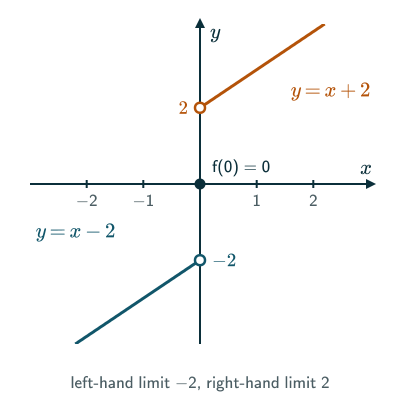
NCERT Illustration 9 (pages 226–227) tabulates f(−0.1) = −2.1, f(−0.01) = −2.01 and f(−0.001) = −2.001, and says the value is “decreasing to –2”. Those values increase towards −2; only their size decreases. The left-hand limit, −2, is right.
The limit and the value at a point
note that in general, at a given point the value of the function and its limit may be different (even when both are defined).
NCERT Mathematics (Class 11), Section 12.3, page 228
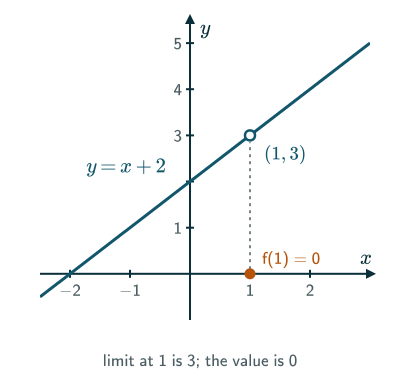
NCERT Illustration 10 (page 227): f(x) = x + 2 for x ≠ 1 and f(1) = 0. Near 1 the values are near 3 from both sides, so limx→1 f(x) = 3, while f(1) = 0.
Tables only suggest a limit. NCERT’s tables (Illustrations 1 to 10) evaluate f close to a and read off the trend. Two slips around NCERT Table 12.9 (page 225), for f(x) = x + cos x: the entry for x = −0.1 is printed as 0.9850, but −0.1 + cos 0.1 ≈ 0.8950. The text after it also calls it “Table 13.9”. Neither changes the limit, 1.
Algebra of limits
Limit of sum of two functions is sum of the limits of the functions
NCERT Mathematics (Class 11), Section 12.3.1, page 228
NCERT states four rules as Theorem 1, “without proof”, and a fifth, for a constant multiple λ, in a note: if limx→a f(x) and limx→a g(x) both exist as finite numbers, then
Algebra of limits (both limits finite; for f/g, lim g ≠ 0)
lim (f + g) = lim f + lim g
lim (f − g) = lim f − lim g
lim (f · g) = lim f · lim g
lim (f/g) = lim f / lim g
lim (λf) = λ lim f
All limits are taken as x → a. The quotient rule needs lim g ≠ 0. When the denominator tends to 0, as in (x2 − 4)/(x − 2) at 2, simplify first.
Polynomials and rational functions
Polynomials. Since limx→a x = a, the product rule gives limx→a xn = an, and then the sum rule gives, for any polynomial p:
limx→a p(x) = p(a).
Rational functions g(x)/h(x). If h(a) ≠ 0, the limit is g(a)/h(a). If h(a) = 0:
- g(a) ≠ 0: there is no finite limit.
- If g is the zero polynomial, the quotient is zero wherever defined, so its limit is 0. Assume the denominator polynomial is not identically zero.
- Otherwise, g(a) = 0 too: both have the factor x − a. Write g(x) = (x − a)kg1(x) and h(x) = (x − a)lh1(x) with g1(a) ≠ 0 and h1(a) ≠ 0, cancel, and compare k with l.
A 0/0 rational limit at x = a
k > l: the limit is 0
k = l: the limit is g(a)/h(a)
k < l: no finite limit
When k < l, the values grow without bound near a. NCERT’s 0/0 discussion (pages 229–230) treats only k > l and k < l, although NCERT Example 2 (iv) and (v) both have k = l. Its general rule on page 237 (cancel, then substitute) covers that case. The cancelling is allowed because x ≠ a in a limit.
Theorem 2 (NCERT page 232). For every positive integer n,
limx→a (xn − an)/(x − a) = nan−1.
Proof: xn − an = (x − a)(xn−1 + xn−2a + … + an−1). After cancelling x − a, the bracket has n terms, each tending to an−1.
The expression in the above theorem for the limit is true even if n is any rational number and a is positive.
NCERT Mathematics (Class 11), Section 12.3.2, page 232
This limit is the derivative of xn at a.
Solved examples
Example 1: Polynomials (NCERT Example 1, page 230)
Find limx→1 (x3 − x2 + 1), limx→3 x(x + 1) and limx→−1 (1 + x + x2 + … + x10).
A polynomial’s limit is its value: 1 − 1 + 1 = 1; 3 × 4 = 12. In the third, the eleven terms at x = −1 are 1, −1, 1, …, 1: six 1s and five −1s.
Answer: 1, 12 and 1.
Example 2: A plain limit and two 0/0 forms (NCERT Example 2 (i)–(iii), pages 230–231)
Find the limit of (x2 + 1)/(x + 100) as x → 1, and the limits of (x3 − 4x2 + 4x)/(x2 − 4) and of (x2 − 4)/(x3 − 4x2 + 4x) as x → 2.
In the first, the denominator is 101 ≠ 0, so substitute: 2/101.
x3 − 4x2 + 4x = x(x − 2)2 and x2 − 4 = (x − 2)(x + 2). In the second, k = 2 > l = 1: after cancelling, x(x − 2)/(x + 2) → 0. In the third, k = 1 < l = 2: (x + 2)/(x(x − 2)) has numerator → 4 and denominator → 0.
Answer: 2/101; 0; the third does not exist.
Example 3: The case k = l (NCERT Example 2 (iv), page 231)
Find the limit of (x3 − 2x2)/(x2 − 5x + 6) as x → 2.
x2(x − 2)/((x − 2)(x − 3)) = x2/(x − 3) for x ≠ 2.
Answer: 4/(2 − 3) = −4.
Example 4: Combine first (NCERT Example 2 (v), page 232)
Find the limit, as x → 1, of the difference (x − 2)/(x2 − x) − 1/(x3 − 3x2 + 2x).
Neither fraction has a limit at 1 on its own (each denominator tends to 0 while its numerator does not), so the difference rule cannot be used yet: combine first. The denominators are x(x − 1) and x(x − 1)(x − 2). Over the common denominator:
((x − 2)2 − 1)/
= (x − 1)(x − 3)/
= (x − 3)/(x(x − 2)) for x ≠ 1.
Answer: (1 − 3)/(1 × (−1)) = 2.
Example 5: Using Theorem 2 (NCERT Example 3, page 233)
Find limx→1 (x15 − 1)/(x10 − 1) and limx→0 (√(1 + x) − 1)/x.
Divide top and bottom by x − 1: the limits are 15 × 114 and 10 × 19. For the second, put y = 1 + x, so y → 1: (y1/2 − 1)/(y − 1) → ½ × 1−1/2.
Answer: 15/10 = 3/2 and 1/2.
Example 6: Fractional powers (NCERT Exercise 12.1, Q10, page 237)
Find limz→1 (z1/3 − 1)/(z1/6 − 1).
Divide top and bottom by z − 1 and use Theorem 2 with n = 1/3 and n = 1/6; here a = 1 > 0, so the Remark applies.
Answer: (1/3)/(1/6) = 2.
Example 7: Making a piecewise function have a limit (NCERT Exercise 12.1, Q28, page 238)
f(x) = a + bx for x < 1, 4 for x = 1 and b − ax for x > 1. If limx→1 f(x) = f(1), find a and b.
The left-hand limit is a + b and the right-hand limit is b − a. Both must equal f(1) = 4.
Answer: a + b = 4 and b − a = 4, so a = 0 and b = 4.
Example 8: A limit from a given limit (NCERT Exercise 12.1, Q31, page 239)
If limx→1 (f(x) − 2)/(x2 − 1) = π, find limx→1 f(x).
f(x) − 2 = [(f(x) − 2)/(x2 − 1)] × (x2 − 1)
By the product rule, its limit is π × 0 = 0.
Answer: limx→1 f(x) = 2.
Common mistakes to avoid
Common mistake
Writing 0/0 as the answer
0/0 is a signal to simplify, not a value. (x2 − 4)/(x − 2) at 2 is 0/0, and its limit is 4.
Common mistake
Taking the limit to be f(a)
That holds for polynomials, but not in general. In NCERT Illustration 10 the limit at 1 is 3 and f(1) = 0.
Common mistake
Checking only one side
For |x|/x at 0 the right-hand limit is 1 and the left-hand limit is −1, so the limit does not exist, though each side has a clear value.
Common mistake
Using the quotient rule with a zero denominator
lim (f/g) = lim f / lim g needs lim g ≠ 0. Factorise or combine the fractions first, as in Example 4.
Quick revision summary
- limx→a f(x) = l means f(x) is as close to l as we like for x close to a, x ≠ a; f(a) does not matter.
- The limit exists exactly when the left-hand and right-hand limits are equal; then it is their common value.
- Limits of sums, differences, products and quotients are the sums, differences, products and quotients of the limits (for a quotient, lim g ≠ 0).
- For a polynomial, the limit is p(a). For a rational function with h(a) ≠ 0, it is g(a)/h(a); in the 0/0 case, cancel the factor x − a first.
- limx→a (xn − an)/(x − a) = nan−1, also for rational n when a > 0.
Formula sheet
- limit exists ⟺ left-hand limit = right-hand limit
- lim (f ± g) = lim f ± lim g; lim fg = lim f · lim g
- lim (f/g) = lim f / lim g, if lim g ≠ 0
- polynomial p: lim (x→a) p(x) = p(a)
- lim (x→a) (x − a)/(x − a) = na (n a positive integer, or n rational and a > 0)
Questions students ask
When does the limit of a function not exist?
The limit of f(x) as x tends to a does not exist when the left-hand and right-hand limits are different (a jump), when f(x) grows without bound near a, or when f(x) keeps oscillating without settling on one value. For example, 1/x2 grows beyond every number as x tends to 0, so it has no finite limit there; NCERT Illustration 8 (for x > 0) writes this as +∞ and notes that such limits do not come up in its course. The standard oscillating case, beyond NCERT, is sin(1/x) near 0, which takes every value from −1 to 1 on every interval around 0.
What is the difference between a limit and continuity?
A limit is the value f(x) approaches as x tends to a, whatever happens at a itself, while continuity at a asks for more: the limit must exist, f(a) must be defined, and the two must be equal. So a function continuous at a has a limit there, but a function with a limit at a need not be continuous there: (x2 − 9)/(x − 3) has limit 6 as x tends to 3 but is not defined at 3. Continuity itself is NCERT Class 12 work (Chapter 5) and is in the JEE Main syllabus (Unit 7); the jumps of sgn x and [x] are drawn on the Functions page.
What is the difference between limits and derivatives?
A limit is the value a function approaches as x tends to a point, while a derivative is one particular limit: the derivative of f at a is the limit of (f(a + h) − f(a))/h as h tends to 0, the instantaneous rate of change of f at a. Every derivative is a limit, but not every limit is a derivative: the limit of x2 + 1 as x → 2 is just 5, the value the function heads for. Limits must come first because that ratio is 0/0 at h = 0 and can only be found as a limit, which is why NCERT treats limits in Section 12.3 before the derivative in Section 12.5.
What are the important limits formulas for Class 11?
The Class 11 limits formulas are few: a limit exists when the left-hand and right-hand limits exist and are equal; the algebra of limits splits sums, differences, products and quotients (denominator limit not 0); a polynomial’s limit at a is p(a); and (xn − an)/(x − a) → nan−1 as x → a, for every positive integer n (and rational n if a > 0). This page’s formula sheet collects them. The trigonometric limits of (sin x)/x and (1 − cos x)/x as x → 0 are in NCERT Section 12.4, Limits of Trigonometric Functions (page 235).
What is L’Hospital’s rule, and can it be used for Class 11 limits?
L’Hospital’s rule applies to a quotient with limiting form 0/0 or ∞/∞ when f and g are differentiable near a (possibly excluding a), g′ is non-zero there, and f′/g′ has a limit, finite or infinite. Under these conditions the original quotient has that same limit. The rule is not in the NCERT Class 11 book, which reaches derivatives only after limits, and is not named in the JEE Main syllabus (Unit 7) text, so learn to find limits by factorising and the standard limits, and use the rule at most as a check. For (x2 − 1)/(x2 + x − 2) as x → 1, a 0/0 form, it gives 2x/(2x + 1) → 2/3, the same as cancelling x − 1. For other forms, directly taking the ratio of derivatives is not justified and can give a wrong answer, so check the conditions first.
How do you find the limit of a function as x tends to infinity?
For a rational function, the standard way to find a limit as x tends to infinity is to divide the numerator and the denominator by the highest power of x in the denominator, and use the fact that 1/x, 1/x2, … tend to 0 as x grows. For (3x2 + 5)/(2x2 − x), dividing by x2 gives (3 + 5/x2)/(2 − 1/x), which tends to 3/2. In general this gives the ratio of the leading coefficients when the degrees are equal, 0 when the numerator has the lower degree, and no finite limit when it has the higher. NCERT’s Class 11 chapter takes limits only as x tends to a real number a, so limits at infinity go beyond it.
Practice questions
Try each question first, then open the answer to check your working.
-
Q1. Evaluate limx→3 (x + 3), limx→π (x − 22/7) and limr→1 πr2 (NCERT Exercise 12.1, Q1–Q3).
Show answerHide answer
Each is the value at the point: 6, π − 22/7 and π.
-
Q2. Evaluate limx→4 (4x + 3)/(x − 2) and limx→−1 (x10 + x5 + 1)/(x − 1) (NCERT Exercise 12.1, Q4 and Q5).
Show answerHide answer
The denominators are not 0 at the points: 19/2 and (1 − 1 + 1)/(−2) = −1/2.
-
Q3. Evaluate limx→0 ((x + 1)5 − 1)/x (NCERT Exercise 12.1, Q6).
Show answerHide answer
Put y = x + 1, so y → 1: (y5 − 1)/(y − 1) → 5 × 14 = 5.
-
Q4. Evaluate limx→2 (3x2 − x − 10)/(x2 − 4) (NCERT Exercise 12.1, Q7).
Show answerHide answer
(3x + 5)(x − 2)/
((x − 2)(x + 2)) = (3x + 5)/(x + 2) for x ≠ 2, which tends to 11/4.