Escape speed
NCERT Class 11 Physics Chapter 7 Section 7.8
Quick answer
Escape velocity, or escape speed, is the least speed with which a body must be launched from a planet’s surface so that it never falls back but reaches infinity, in the isolated, non-rotating planet model with no air resistance or further propulsion. For a planet of mass M, radius R and surface gravity g, setting the body’s total energy ½mv − GMm/R to zero gives √(2GM/R) = √(2gR), about 11.2 km/s for the Earth. It does not depend on the body’s mass, nor on the direction of launch as long as the path does not run into the planet.
With your textbook
NCERT Physics Part I (Class 11), Chapter 7 “Gravitation”, Section 7.8 “Escape speed”, pages 135–137.
Open the official NCERT chapter (PDF, 1.8 MB, ncert.nic.in) (opens in a new tab)
Checked against the 2026-27 reprint on .
What is escape speed?
Escape speed
The escape speed is the least speed with which a body must be thrown from a planet’s surface so that it never falls back but reaches infinity, ignoring air resistance. For a planet of mass M and radius R, with gravity g at its surface,
For the Earth it is about 11.2 km/s (NCERT Physics Part I (Class 11), Section 7.8, page 136, where it is written (Vi)min).
In plain words: a ball thrown upwards slows down, stops and falls back. Throw it faster and it goes higher. Because gravity weakens with distance, each extra bit of speed buys more and more height, and at one particular speed the ball would keep going for ever, slowing all the way but never stopping and never turning back. That speed is the escape speed.
The model is an isolated, spherical, non-rotating planet and a body of negligible mass that coasts after launch. Speeds are measured in a non-rotating frame centred on the planet, and the path must clear its surface; other bodies and air resistance are neglected.
It comes straight from conservation of mechanical energy, using the gravitational potential energy −GMm/r, which is zero at infinity.
Deriving the escape speed
A body of mass m is thrown with speed v from a height h, that is, from a distance RE + h from the Earth’s centre, where ME and RE are the Earth’s mass and radius. Its total mechanical energy is
Ignoring air resistance, only gravity does work on it, so E stays the same all the way. If the body reaches infinity with speed vf, its energy there is all kinetic, ½mvf2, because the potential energy is zero at infinity. So
The left side cannot be negative. The body can reach infinity only if
and the least such speed makes the two sides equal (NCERT Eqs. (7.26) to (7.30), pages 135–136):
Escape speed from a height h
From the surface, h = 0. Using GME = gRE2 (from acceleration due to gravity):
Escape speed from the Earth’s surface
With g = 9.8 m s and RE = 6.4 × 10 m, ve = √(1.2544 × 10) m s = 11 200 m s, that is, 11.2 km/s. In NCERT’s words:
This is called the escape speed, sometimes loosely called the escape velocity.
NCERT Physics Part I (Class 11), Section 7.8, page 136
“Loosely”, because only its size matters, not its direction, as the next sections show.
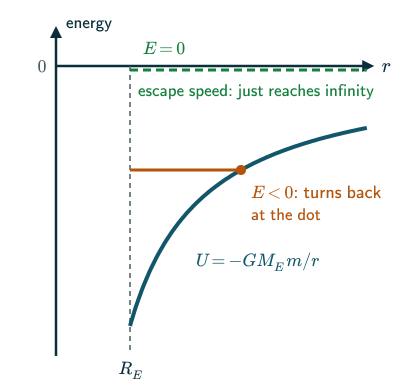
Reading the energy picture
The figure describes a body launched radially outwards, with zero angular momentum. For a non-radial bound orbit, radial velocity vanishes at a turning point while tangential velocity generally remains nonzero; the total kinetic energy need not vanish there.
The figure plots the potential energy U = −GMEm/r outside the Earth, and the body’s total energy E as a horizontal line. At every point the kinetic energy is E − U, the gap between the line and the curve, and it cannot be negative.
- E < 0: the line meets the curve. There the kinetic energy is zero, and the body turns back. It is bound to the Earth.
- E = 0: the body was thrown at exactly the escape speed. The gap closes only at infinity, so it slows down for ever but never turns back.
- E > 0: the body reaches infinity with speed to spare. Thrown from the surface with speed v, it arrives there with vf2 = v − ve2.
In this isolated-planet model, zero or positive total energy permits escape on a trajectory that does not intersect the planet. Starting from the surface, the least kinetic energy for escape is GMEm/RE = mgRE, the size of its potential energy there.
What escape speed depends on
- Not on the mass of the body. The mass m cancels. A pebble and a spacecraft need the same 11.2 km/s, though the spacecraft needs far more energy.
- Not on the direction of launch. This is beyond the NCERT text but follows from the same argument: energy is a scalar, so any direction works as long as the path does not run into the ground (air resistance ignored). That is why it is a speed, not a velocity.
- On the planet. A larger mass or a smaller radius gives a larger escape speed. For a planet of mean density ρ, M = (4/3)πRρ, so ve = R√(8πGρ/3): planets of equal density have escape speeds in proportion to their radii.
- On the starting height. From a height h the escape speed √(2GME/(RE + h)) is smaller than from the surface.
Real launches. The formula is for a body given its speed once and then left to coast. A rocket does not need 11.2 km/s at lift-off, because its engines keep pushing it for a long time. Air resistance raises the speed a thrown body would need. A rocket launched eastwards near the equator gains the Earth’s rotation speed there, about 0.465 km/s.
Escape is not orbit. A satellite skimming the surface needs an orbital speed of about 7.9 km/s, √(gRE), along the surface. The escape speed is √2 times this. The same holds at any distance r: the escape speed √(2GM/r) is √2 times the circular orbital speed √(GM/r) there, so a satellite in a circular orbit escapes if its speed is raised by about 41%.
The Moon’s escape speed and its tenuous atmosphere
The same formula applies on the Moon, with the Moon’s surface gravity and radius in place of the Earth’s. Both are smaller, so the Moon’s escape speed is about five times smaller (NCERT Section 7.8, page 136). NCERT gives it as 2.3 km/s, which is slightly low. With the Moon’s surface gravity, 1.62 m s, and radius, 1.74 × 10 m, the formula gives 2.37 km/s, that is, 2.4 km/s to two figures (Example 2).
NCERT links this low value to the absence of a substantial lunar atmosphere:
Gas molecules if formed on the surface of the moon having velocities larger than this will escape the gravitational pull of the moon.
NCERT Physics Part I (Class 11), Section 7.8, page 136
The fuller picture: NASA describes an extremely tenuous exosphere, where particles rarely collide. It is continually supplied and depleted by interactions with the surface, impacts, radiation and the solar wind. Low escape speed makes loss easier, but it does not by itself determine how long a gas is retained; molecular mass, temperature, sources and nonthermal loss processes matter too. For example, oxygen’s root-mean-square speed at 300 K is only about 0.48 km/s: that comparison alone does not establish rapid oxygen loss. Do not model today’s lunar exosphere as a dense gas in which frequent collisions continually replenish fast molecules.
Solved examples
Example 1: Escape speed of the Earth
Find the escape speed from the Earth’s surface. Take G = 6.67 × 10 N m kg, ME = 6.0 × 10 kg and RE = 6.4 × 10 m.
2GME/RE = 2 × 6.67 × 10 × 6.0 × 10/(6.4 × 10), about 1.25 × 10 m s. Its square root is about 1.12 × 10 m s.
Check with g = 9.8 m s: √(2gRE) = √(2 × 9.8 × 6.4 × 10) = √(1.2544 × 10) = 11 200 m s.
Answer: about 11.2 km/s, roughly 40 000 km/h.
Example 2: Escape speed of the Moon
The Moon’s surface gravity is 1.62 m s and its radius 1.74 × 10 m. Find its escape speed and compare it with the Earth’s.
ve = √(2gR) = √(2 × 1.62 × 1.74 × 10) = √(5.64 × 10), about 2.37 × 10 m s.
The Earth’s escape speed is 11.2/2.37, about 4.7 times larger.
Answer: about 2.4 km/s, roughly a fifth of the Earth’s.
Example 3: Escaping from one sphere to another
This is NCERT Example 7.4 (pages 136–137). Two uniform solid spheres of radius R, with masses M and 4M, are held fixed with their centres 6R apart. A projectile of mass m is fired from the surface of the sphere of mass M straight towards the centre of the other. Find the threshold launch speed v for passage to the second sphere, and the limiting striking speed for a launch just above that threshold (NCERT leaves the striking-speed part as an exercise).
The neutral point. At a distance r from the centre of M the two pulls cancel when
so (6R − r) = 4r, 6R − r = 2r and r = 2R. (The other root, r = −6R, is not between the spheres.) Before this point N the pull of M wins; after it the pull of 4M wins. The potential energy has a maximum at N. At exactly the threshold energy, the projectile approaches N with speed tending to zero and takes infinite time to reach it. To pass N and strike the other sphere in finite time, its launch speed must be slightly greater than the threshold.
Threshold speed (NCERT’s “minimum”). At the start the projectile is R from the centre of M and 5R from the centre of 4M; at N it is 2R and 4R away. Per unit mass, its energy at the start and at N is
Energy is conserved, so Ei = EN, which gives ½v = GM/R + 4GM/(5R) − 3GM/(2R) = (10 + 8 − 15)GM/(10R) = 3GM/(10R), and
Limiting striking speed. For launches approaching the threshold from above, at the surface of 4M it is 5R from the centre of M and R from the centre of 4M. Its energy per unit mass is still −3GM/(2R), the value at N, so for the striking speed vs, ½vs2 − GM/(5R) − 4GM/R = −3GM/(2R), that is,
so vs = √(27GM/(5R)) = 3v.
Answer: threshold v = √(3GM/(5R)), about 0.775√(GM/R); the limiting striking speed is 3v, about 2.32√(GM/R). At exactly the threshold there is no impact in finite time; any slightly greater launch speed crosses the neutral point and gives a slightly greater striking speed.
Example 4: Thrown at half the escape speed
A body is thrown straight up from the Earth’s surface at half the escape speed, 5.6 km/s. Ignoring air resistance, how high does it rise? Compare with v/(2g). Take RE = 6400 km and g = 9.8 m s.
At the top its speed is zero. With v = ve2/4 = GME/(2RE), energy conservation divided by m gives
so h = RE/3, about 2130 km.
In general, for a body thrown straight up at a speed v below ve: from ½v − GME/RE = −GME/(RE + h) with GME = ve2RE/2, we get RE + h = ve2RE/(ve2 − v), so h = REv/(ve2 − v).
The constant-g formula would give 5600/(2 × 9.8) m = 1600 km, too little, because g weakens with height.
Answer: about 2130 km (one third of the Earth’s radius), not 1600 km.
Common mistakes to avoid
Common mistake
Thinking a heavier body needs a higher escape speed
The mass cancels. A heavier body needs more energy to escape, but the same speed.
Common mistake
Thinking escape needs an infinite speed
With constant g, reaching infinite height would need an infinite speed. Gravity weakens as 1/r, so the work done against it over an infinite path is finite, GMEm/RE, and a finite speed is enough.
Common mistake
Confusing escape with getting into orbit
A low orbit needs about 7.9 km/s, along the surface, and the body keeps circling. Escape needs 11.2 km/s, and the body never comes back.
Common mistake
Forgetting the starting height
From a height h the distance from the centre is RE + h, and the escape speed is √(2GME/(RE + h)), not the surface value.
Quick revision summary
- The escape speed is the least launch speed with which a body reaches infinity and never returns; at that speed its total energy is zero.
- From the Earth’s surface it is √(2GME/RE) = √(2gRE), about 11.2 km/s; NCERT writes it (Vi)min.
- It does not depend on the body’s mass or, ignoring air and the ground, on the direction of launch. From a height h it is √(2GME/(RE + h)).
- Faster than ve, a body keeps vf2 = v − ve2 at infinity; slower, a body thrown straight up rises to h = REv/(ve2 − v) and falls back.
- The Moon’s escape speed is about 2.4 km/s; its tenuous exosphere requires both sources and loss processes, not just an escape-speed comparison.
- In short, with M and R the planet’s mass and radius, the escape speed is √(2GM/R) = √(2gR).
Formula sheet
- ve = √(2GME/RE) = √(2gRE) ≈ 11.2 km/s
- ve = √(2GME/(RE + h)) (from a height h)
- vf2 = v2 − ve2 (speed left at infinity)
- h = RE v2/(ve2 − v2) (thrown straight up at v < ve)
Questions students ask
What is the difference between escape velocity and orbital velocity?
Circular orbital speed is the speed a satellite needs to circle a planet of mass M at a distance r from its centre, √(GM/r), while escape velocity is the least speed that frees a body for good, √(2GM/r); at the same distance escape velocity is √2, about 1.41, times orbital velocity. Near the Earth’s surface they are about 7.9 km/s and 11.2 km/s. In a circular orbit the total energy is −GMm/(2r), so the body stays bound; at escape velocity it is zero. For a circular orbit, velocity must be at right angles to the radius, while escape velocity works in any direction that clears the planet.
Is escape velocity the same as escape speed?
Yes, escape velocity and escape speed are the same quantity, about 11.2 km/s from the Earth’s surface; NCERT calls it the escape speed and notes that it is sometimes loosely called the escape velocity. “Speed” is the better word, because only its size matters: thrown at 11.2 km/s in any direction that does not run into the ground, a body escapes (air resistance ignored), so its direction is not part of the definition.
What is the escape velocity of the Sun?
The escape velocity from the Sun’s surface is about 618 km/s, some 55 times the Earth’s 11.2 km/s. It follows from ve = √(2GM/R) with the Sun’s mass M = 1.99 × 10 kg and radius R = 6.96 × 10 m: 2GM/R ≈ 3.81 × 10 m s, whose square root is about 6.18 × 10 m s. Starting from the Earth’s distance from the Sun, 1.50 × 10 m, escaping the Sun needs about 42 km/s relative to the Sun.
What is the dimensional formula of escape velocity?
Escape velocity is a speed, so its dimensional formula is [M L T] and its SI unit is m s, though it is usually quoted in km/s. You can check this from ve = √(2GM/R): G has dimensions [M L T], so GM/R has [L T], and its square root has [L T].
How does escape velocity change if a planet’s radius is halved but its mass stays the same?
Halving a planet’s radius at the same mass raises its escape velocity by a factor of √2, about 1.41, because ve = √(2GM/R) is proportional to 1/√R when M is fixed. For the Earth this would mean about 1.41 × 11.2 ≈ 15.8 km/s. In general ve ∝ √(M/R): doubling the mass at the same radius also multiplies it by √2, while doubling both the mass and the radius leaves it unchanged.
Practice questions
Try each question first, then open the answer to check your working. Take g = 9.8 m s and RE = 6.4 × 10 m.
-
Q1. What is the escape speed for a body starting 600 km above the Earth’s surface?
Show answerHide answer
r = 7.0 × 10 m and GME = gRE2, so ve = √(2gRE2/r) = √(1.147 × 10), about 10.7 km/s.
-
Q2. A probe is launched radially outwards from the Earth’s surface at 15 km/s. Ignoring air resistance and other bodies, with what speed does it move very far from the Earth?
Show answerHide answer
vf = √(v − ve2) = √(15 − 11.2) = √99.56, about 10.0 km/s.
-
Q3. A planet has the same mean density as the Earth but twice its radius. What is its escape speed?
Show answerHide answer
ve = R√(8πGρ/3) is proportional to R at equal density, so it is 2 × 11.2 = 22.4 km/s.