Gravitational potential energy
NCERT Class 11 Physics Chapter 7 Section 7.7
Quick answer
With the zero taken at infinite separation, the gravitational potential energy of two point masses a distance r apart is U = −Gmm/r; it is negative and rises towards zero as they move apart. Near the Earth’s surface its change reduces to mgh for heights small compared with the Earth’s radius. The gravitational potential is the potential energy per unit mass, V = −GM/r outside a uniform sphere of mass M, r from its centre.
With your textbook
NCERT Physics Part I (Class 11), Chapter 7 “Gravitation”, Section 7.7 “Gravitational potential energy”, pages 134–135.
Open the official NCERT chapter (PDF, 1.8 MB, ncert.nic.in) (opens in a new tab)
Checked against the 2026-27 reprint on .
What is gravitational potential energy?
Gravitational potential energy of two masses
For two point masses m1 and m2 a distance r apart, choosing the potential energy to be zero when they are infinitely far apart,
(NCERT Physics Part I (Class 11), Section 7.7, page 135, where NCERT writes it as V.)
Symbols on this page. U is potential energy, V is potential and W12 is work. NCERT uses other letters in places: it writes potential energy as W in Eqs. (7.21) and (7.25), and as V on page 135, and in its Example 7.3 it writes the potential as U.
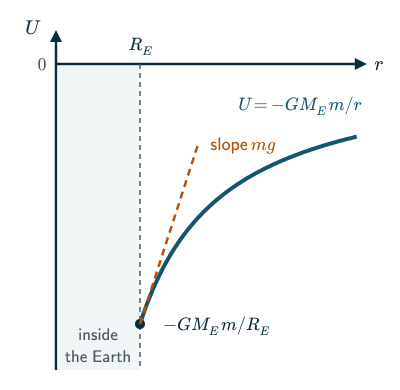
In plain words: gravity is a conservative force, so a pair of masses has a potential energy that depends only on how far apart they are. Taking the zero at infinite separation, the potential energy is negative at every finite distance, and it rises towards zero as the masses move apart. To pull two initially stationary masses apart slowly, an external agent must do positive work; it raises their potential energy from a negative value towards zero. In general the agent’s work equals ΔU + ΔK, whereas gravity’s work is −ΔU.
Near the Earth’s surface the familiar formula mgh is a special case, valid only for heights small compared with the Earth’s radius. The potential energy page introduced mgh; this page gives the general result.
Potential energy near the surface: mgh
Close to the Earth’s surface, at heights much smaller than the Earth’s radius, the force of gravity on a mass m is practically constant, mg, directed towards the centre. Lifting it with no net change in kinetic energy from a height h1 to a height h2 then takes external work mg(h2 − h1), so we can assign a potential energy
Potential energy near the surface
where U0, a constant, is the potential energy on the surface (h = 0). Only differences of potential energy matter, and U0 cancels out of every difference (NCERT Section 7.7, pages 134–135, where it is called W0).
The general expression: U = −GMm/r
For larger distances the force is not constant. By the law of gravitation, outside the Earth it is GMEm/r, towards the centre, where ME is the Earth’s mass and r the distance from its centre. The work needed to lift m slowly from r1 to r2 (with r2 > r1) is
which is positive, as lifting needs work. (In NCERT’s printed Eq. (7.24) on page 134 the integral sign has come out as a small circle; it is this integral from r1 to r2.) This is the difference U(r2) − U(r1) if
for r greater than the Earth’s radius. Here U∞ (NCERT’s W1) is the potential energy at infinity. Choosing U∞ = 0, as is conventional,
Gravitational potential energy (Earth and mass m)
This is the formula used to find the escape speed and the energy of an orbiting satellite.
mgh from the general formula. Between the surface and a height h,
With g = GME/RE2 this is the same as ΔU = mgh/(1 + h/RE), a form that uses g and RE in place of G and ME. When h is much less than RE, the bracket is nearly 1 and ΔU becomes mgh. For larger h the exact difference is smaller than mgh (Example 1).
Two particles, and many. The same work argument for any two point masses gives U = −Gm1m2/r. For a group of particles:
It should be noted that an isolated system of particles will have the total potential energy that equals the sum of energies (given by the above equation) for all possible pairs of its constituent particles.
NCERT Physics Part I (Class 11), Section 7.7, page 135
Gravitational potential
The gravitational potential due to the gravitational force of the earth is defined as the potential energy of a particle of unit mass at that point.
NCERT Physics Part I (Class 11), Section 7.7, page 135
So the potential is the potential energy divided by the mass placed there. Outside the Earth,
Gravitational potential
Potential is a scalar, measured in J kg. It belongs to the point, whatever mass is put there; the potential energy of a mass m at that point is mV. For several masses, the potentials add as plain numbers (Example 2). The formula −GM/r holds outside a point mass, a uniform sphere or a spherical shell of mass M, with r measured from the centre; it does not hold for bodies of other shapes.
Three results beyond the NCERT text:
- Inside a uniform hollow shell of mass M and radius R there is no force, so V does not change; it keeps its value at the shell, −GM/R.
- Inside a uniform solid sphere, at distance r from the centre, V = −GM(3R − r)/(2R). At the centre this is −3GM/(2R), 1.5 times the surface value.
- For a spherically symmetric potential, the field’s radial component (outward positive) is −dV/dr. For V = −GM/r this is −GM/r: size GM/r, pointing towards the centre.
Solved examples
Example 1: Lifting a mass to a height equal to the Earth’s radius
How much energy is needed to lift a 1 kg mass from the Earth’s surface to a height equal to the Earth’s radius, RE = 6.4 × 10 m? Take g = 9.8 m s. Compare with mgh.
since GME = gRE2. This is 1 × 9.8 × 6.4 × 10/2, about 3.1 × 10 J.
Answer: about 3.1 × 10 J. The formula mgh would give mgRE, about 6.3 × 10 J, twice too much, because g weakens with height.
Example 2: Four masses at the corners of a square
This is NCERT Example 7.3 (page 135). Four particles, each of mass m, sit at the corners of a square of side l. Find the potential energy of the system and the gravitational potential at the centre of the square.
Potential energy. There are six pairs: four sides of length l and two diagonals of length √2 l. Adding −Gm/r for each pair:
Potential at the centre. Each mass is at distance l/√2 from the centre and contributes −Gm/(l/√2) = −√2 Gm/l. The four add:
Answer: U ≈ −5.41 Gm/l; V = −4√2 Gm/l, about −5.66 Gm/l.
Example 3: A satellite’s potential energy
Find the gravitational potential and the potential energy of a 100 kg satellite 600 km above the Earth’s surface. Take RE = 6400 km and g = 9.8 m s.
The satellite is r = 7000 km = 7.0 × 10 m from the centre. With GME = gRE2 = 9.8 × (6.4 × 10), about 4.01 × 10 m s,
and U = mV ≈ −5.73 × 10 J.
Answer: about −5.73 × 10 J kg and −5.73 × 10 J.
Common mistakes to avoid
Common mistake
Dropping the minus sign
With the zero at infinity, gravitational potential energy and potential are negative everywhere at finite distance. Moving away from the Earth makes them less negative, that is, larger.
Common mistake
Using mgh for large heights
mgh assumes a constant g. For heights comparable with the Earth’s radius, use −GMEm/r; mgh overestimates the energy (Example 1).
Common mistake
Confusing potential with potential energy
Potential V is energy per unit mass (J kg) and belongs to a point; potential energy U = mV (J) belongs to a mass placed there, or to a pair of masses.
Common mistake
Counting each pair twice
For a system of particles, add −Gmimj/rij once for each pair. Four particles make six pairs, not twelve.
Quick revision summary
- Near the surface, the potential energy rises by mgh when a mass is raised by h; only differences matter.
- In general, with the zero at infinity, U = −GMEm/r outside the Earth and U = −Gm1m2/r for two point masses; it is negative and rises towards zero with distance.
- The external work to move a mass slowly from r1 to r2 is GMEm(1/r1 − 1/r2), which reduces to mgh for small heights.
- For several particles, add the energies of all pairs.
- Gravitational potential is potential energy per unit mass: V = −GME/r outside the Earth, or V = −GM/r outside any uniform sphere or spherical shell of mass M (r from its centre), a scalar in J kg.
Formula sheet
- U = −Gmm/r (zero at infinity)
- U = −GME m/r (mass m outside the Earth)
- ΔU = GME m(1/r1 − 1/r2) (from r1 to r2)
- ΔU ≈ mgh (h ≪ RE)
- V = −GME/r (potential)
Questions students ask
Why is gravitational potential energy negative?
Gravitational potential energy is negative because its zero is taken at infinite separation and gravity attracts: you must do positive work to pull two masses apart to infinity, and that work raises their energy up to zero, so at any finite distance it is below zero, U = −Gm1m2/r. The minus sign comes from this choice of zero, and only changes in U have physical meaning. With the zero taken at the Earth’s surface instead, as in mgh, a body above the surface has a positive potential energy.
What is the SI unit and dimensional formula of gravitational potential?
Gravitational potential is potential energy per unit mass, so its SI unit is the joule per kilogram, J kg, the same as m s, and its dimensional formula is [M L T]. It is a scalar: a mass m placed at a point where the potential is V has potential energy mV, in joules.
What is the difference between gravitational potential and gravitational field?
Gravitational potential is the potential energy per unit mass at a point, a scalar in J kg, while the gravitational field is the force per unit mass there, a vector in N kg. Each field component is minus the potential’s rate of change in that direction; for spherical symmetry its radial component is −dV/dr, so V = −GM/r outside a point mass or uniform sphere of mass M gives a field of size GM/r, towards the centre. A point can have zero field but a non-zero potential: midway between two equal masses M a distance d apart the pulls cancel, yet the potential there is −4GM/d.
Is the gravitational force conservative?
For a fixed Newtonian mass distribution, gravity is conservative: its work depends only on the endpoints and is zero round a closed path. For a single fixed point mass or spherical source, the endpoints matter only through their distances from the centre. This is because the force always points along the line to the attracting mass and its size depends only on the distance r. That is why a potential energy, U = −GMm/r, can be defined for gravity, as for a spring but not for friction.
Practice questions
Try each question first, then open the answer to check your working.
-
Q1. Find the gravitational potential energy of two 10 kg point masses 0.5 m apart. Take G = 6.67 × 10 N m kg.
Show answerHide answer
U = −Gm1m2/r = −6.67 × 10 × 100/0.5, about −1.33 × 10 J.
-
Q2. What is the gravitational potential at the Earth’s surface? Take g = 9.8 m s and RE = 6.4 × 10 m.
Show answerHide answer
V = −GME/RE = −gRE = −9.8 × 6.4 × 10, about −6.27 × 10 J kg.
-
Q3. Three equal masses m sit at the corners of an equilateral triangle of side a. Find the potential energy of the system.
Show answerHide answer
There are three pairs, each a distance a apart, so U = −3Gm/a.