Enthalpy of neutralization
Beyond NCERT In the JEE Main and NEET syllabus; the Class 11 book has no section for it.
Quick answer
Dilute strong acids and hydroxide bases neutralise through H + OH → HO, releasing approximately 56–57 kJ per mole of water near room temperature. Weak electrolytes add ionisation enthalpy contributions, and measured values also depend on concentration, dilution and temperature. A calorimeter uses the temperature rise and total heat capacity; divide the released heat by the stoichiometric moles neutralised and attach a negative sign.
What is the enthalpy of neutralisation?
Enthalpy of neutralisation
The enthalpy of neutralisation, ΔneutH, is the enthalpy change per mole of acid–base neutralisation, conventionally normalised to one mole of water formed. For a dilute strong acid and hydroxide base, the net reaction is:
- H+(aq) + OH−(aq) → H2O(l); ΔneutH is negative (heat is given out);
- for dilute strong acid–strong hydroxide base solutions at comparable temperatures, the value is about −57 kJ mol−1, because the reaction is approximately the same under matched dilute conditions;
- if the acid or the base is weak, some of the heat is usually used to ionise it, so less heat is given out (hydrofluoric acid is a familiar exception);
- it is measured by mixing known amounts of acid and base in an insulated calorimeter and recording the temperature rise.
In plain words: hydrochloric acid and sodium hydroxide in water are already fully split into ions. When you mix them, the main net chemical change is that H+ and OH− join to make water, and that gives out nearly the same amount of heat per mole under comparable dilute-solution conditions. Concentration, dilution and temperature affect a measured value. Measure how much the mixture warms, allow for the heat taken by the beaker, and scale up to one mole.
The NCERT Class 11 textbook does not describe this experiment, but the JEE Main and NEET (UG) syllabuses list it among the practical chemistry experiments of Unit 20. The method below follows the NCERT Laboratory Manual Chemistry for Class 12, Unit 3 (Thermochemical Measurement), Experiment 3.2, pages 24–26, with the calorimeter constant found as in Experiment 3.1 (pages 20–22).
Theory
HCl and NaOH are strong electrolytes, fully ionised in water, and so is the product NaCl. Writing all the ions:
H+(aq) + Cl−(aq) + Na+(aq) + OH−(aq) → Na+(aq) + Cl−(aq) + H2O(l)
Na+ and Cl− appear on both sides and take no part, so dilute strong acid–strong hydroxide base neutralisation has the same net reaction, H+(aq) + OH−(aq) → H2O(l), and gives approximately the same heat per mole of water at the same temperature. The NCERT Laboratory Manual (page 24) gives this as 57 kJ mol−1; standard data tables give about 55.8 kJ mol−1 for very dilute solutions.
With a weak acid or base the weak electrolyte is only partly ionised. It has to ionise as it reacts, and that step usually absorbs heat, so less heat is given out overall. From standard data for dilute solutions: hydrochloric acid with ammonia solution gives about 52 kJ mol−1, and hydrocyanic acid, a very weak acid, with sodium hydroxide only about 12 kJ mol−1. The Laboratory Manual states the rule without exceptions, but hydrofluoric acid is the one to remember: although HF is weak, HF + NaOH gives out about 68 kJ mol−1, more than a strong acid, because the small F− ion is so strongly hydrated that ionising HF releases heat.
By Hess’s law, neutralising a weak acid is the same as ionising it and then neutralising the H+ formed, so:
Enthalpy of ionisation of a weak acid
ΔionH = ΔneutH(weak) − ΔneutH(strong)
For HCN this gives −12 − (−55.8), about +44 kJ mol−1.
The heat is found from the temperature rise of the mixture and the calorimeter (the method of mixtures):
Heat given out
q = (V × 4.184 + W) × Δt
where V is the total volume of the mixture in mL, 4.184 J mL−1 K−1 is the density times the specific heat capacity, taken the same as for water, W is the calorimeter constant (the heat taken by the beaker, thermometer and stirrer per kelvin, in J K−1) and Δt is the temperature rise. The Laboratory Manual (footnote, page 21) explains why water’s value can be used: a dilute solution is a few per cent denser than water but has a few per cent smaller specific heat, so the product is nearly the same. Then:
Enthalpy of neutralisation
ΔneutH = −q/n(H2O)
with n(H2O) the moles of water formed. For HCl/NaOH this equals the moles of the limiting reagent; for polyprotic acids or bases supplying multiple OH ions, use the balanced reaction and acid/base equivalents. Assume negligible heat loss and only pressure–volume work; mixing/dilution heats are included in a raw measured value unless separately corrected.
Apparatus
- A 250 mL beaker (the calorimeter) standing on a small wooden block inside a 500 mL beaker, with cotton wool packed between them and a cardboard lid.
- A thermometer reading to 0.1 °C, and a stirrer.
- 100 mL of 1.0 M HCl and 100 mL of 1.0 M NaOH, and two more 250 mL beakers.
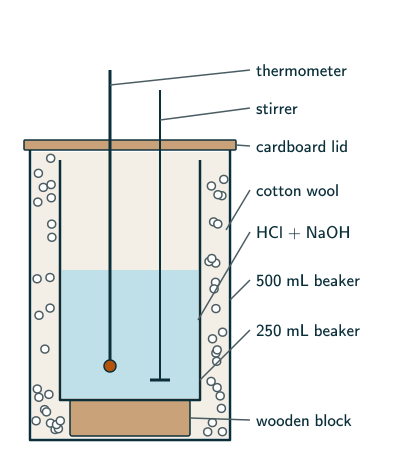
Procedure
A. Calorimeter constant. The beaker itself takes up some heat, so this is measured first:
- Put 100 mL of water in the inner beaker; record its temperature, tc.
- Heat another 100 mL of water to 50–60 °C and record its exact temperature, th, just before mixing.
- Pour the hot water into the beaker, stir and record the mixed temperature, tm (th > tm > tc).
- Heat lost by the hot water equals heat gained by the cold water and the beaker, which gives W (below).
Calorimeter constant
W = 4.184 [Vh(th − tm) − Vc(tm − tc)]/
The Laboratory Manual’s Eqs. (4) and (5) (page 20) write the bracket as Vc(tm − tc) + Vh(tm − th) with no minus sign in front; as printed that gives a negative W. The minus sign is lost in moving the terms of W(tm − tc) + … = 0 across. The same page also calls the energy needed to warm 1 g of a substance by 1 K its heat capacity; that is the specific heat capacity.
B. Neutralisation.
- Put 100 mL of 1.0 M HCl in the calorimeter and cover it; take 100 mL of 1.0 M NaOH in another beaker.
- Allow both solutions and the calorimeter to reach the same initial temperature, t1, and record it.
- Pour the NaOH into the HCl, stir and record the final (highest) temperature, t2.
- Heat given out q = (200 × 4.184 + W)(t2 − t1) J for 0.100 mol of water; multiply by ten for one mole (1000 mL of each solution).
The Laboratory Manual (page 25) writes the heat as (100 + 100 + W)(t2 − t1) × 4.18 J. That would be right only if W were a “water equivalent” in grams. Here W comes from step A in J K−1, so it must not be multiplied by 4.18 again; use (200 × 4.184 + W)(t2 − t1).
Precautions (Laboratory Manual, page 26): read the thermometer to 0.1 °C; measure the volumes carefully; insulate the two beakers well; avoid excessive stirring, which warms the liquid by friction.
Solved examples
Example 1: Finding the calorimeter constant
100 mL of water at 25.0 °C is in the calorimeter; 100 mL of water at 55.0 °C is poured in, and the mixture settles at 39.4 °C. Find W.
Heat lost by hot water: 100 × 4.184 × (55.0 − 39.4) = 6527 J. Heat gained by cold water: 100 × 4.184 × (39.4 − 25.0) = 6025 J. The beaker took the rest, 502 J, for a 14.4 K rise.
Answer: W = 502/14.4, about 34.9 J K−1.
Example 2: The enthalpy of neutralisation of HCl by NaOH
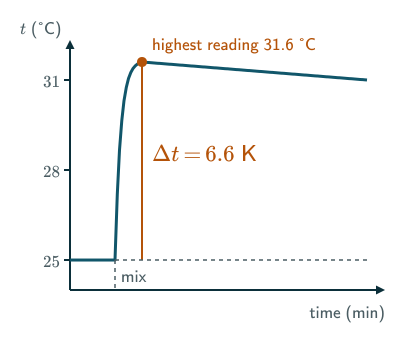
In that calorimeter, 100 mL of 1.0 M HCl and 100 mL of 1.0 M NaOH, both at 25.0 °C, are mixed; the highest temperature is 31.6 °C. Find ΔneutH.
Δt = 6.6 K. q = (200 × 4.184 + 34.9) × 6.6 = (836.8 + 34.9) × 6.6, about 5753 J. Moles of water formed = 0.100 L × 1.0 mol L−1 = 0.100 mol.
Answer: ΔneutH = −5753/0.100 J mol−1, about −57.5 kJ mol−1.
Example 3: Weak base against strong base
Under the same conditions, hydrochloric acid gives a smaller temperature rise with ammonia solution than with sodium hydroxide. Explain.
Ammonia solution is a weak base, mostly NH3 molecules rather than ions. As the acid is added, the reaction is H+(aq) + NH3(aq) → NH4+(aq), which can be pictured as ionising the base and then forming water; the ionising step absorbs some heat.
Answer: less heat is given out, about 52 kJ mol−1 instead of about 56 (standard data, dilute solutions), so the temperature rises less.
Example 4: Different amounts, same ΔH
50 mL of 1.0 M HCl is mixed with 100 mL of 1.0 M NaOH. How many moles of water form, and would ΔneutH per mole differ from Example 2?
The acid is limiting: 0.050 mol of H+, so 0.050 mol of water forms. About half as much heat is given out, and it is shared by 150 mL of solution.
Answer: 0.050 mol of water; ΔneutH per mole is approximately the same, about −57 kJ mol−1, under the usual dilute-solution approximation; a precise result can differ because the final concentrations and dilution heats change, though the temperature rise is smaller.
Common mistakes to avoid
Common mistake
Dividing by the moles of acid plus base
ΔneutH is per mole of water formed, which must be found from reaction stoichiometry, not by adding acid and base moles.
Common mistake
Forgetting the calorimeter
The beaker, thermometer and stirrer also warm up. Leaving out W makes the heat, and ΔneutH, too small in size.
Common mistake
Using the volume of one solution
After mixing, the heat warms all 200 mL (150 mL in Example 4), so V is the total volume.
Common mistake
Giving the answer a positive sign
Neutralisation releases heat, so ΔneutH is negative, even though the temperature of the mixture rises.
Quick revision summary
- ΔneutH: heat change when 1 mol of H+ and 1 mol of OH− form 1 mol of water.
- Dilute strong acid + strong hydroxide base: approximately −57 kJ mol−1, since the net reaction is H+ + OH− → H2O.
- Weak acid or base: usually less heat, because some is used to ionise it (HF is a familiar exception); ΔionH = ΔneutH(weak) − ΔneutH(strong).
- Measure the calorimeter constant W by the method of mixtures; then q = (V × 4.184 + W)Δt and ΔneutH = −q/n(water).
Formula sheet
- H(aq) + OH(aq) → HO(l); ΔH ≈ −57 kJ mol (strong acid, strong base)
- W = 4.184[Vh(th − tm) − Vc(tm − tc)]/
(tm − tc) - q = (V × 4.184 + W) × Δt
- ΔneutH = −q/n(water formed)
- ΔionH = ΔneutH(weak) − ΔneutH(strong)
Questions students ask
What is the difference between heat of neutralisation and enthalpy of neutralisation?
Heat of neutralisation and enthalpy of neutralisation are two names for the same quantity, since neutralisation is carried out at constant pressure, where the heat given out equals −ΔH. The difference is in how it is quoted: a heat of neutralisation is often given as a positive amount of heat evolved, 57 kJ, while the enthalpy of neutralisation carries the sign, ΔneutH ≈ −57 kJ mol. Both are per mole of water formed, in kJ mol (J mol in SI units); the heat measured in one experiment is in joules and becomes the molar value only after dividing by the moles of water formed: 1.43 kJ for 0.0250 mol of water means −57.2 kJ mol.
Why do some books give −57.1 kJ mol and others −55.8 kJ mol for the enthalpy of neutralisation?
The enthalpy of neutralisation of a strong acid by a strong base is not a fixed constant: it changes with temperature and slightly with concentration. Many books quote older measured values, 57.1 to 57.3 kJ mol in size (13.7 kcal mol), and the NCERT Laboratory Manual gives 57 kJ mol, while standard data for very dilute solutions at 25 °C give −55.8 kJ mol. Near room temperature, the value becomes less negative by roughly 0.2 kJ mol for each kelvin rise, so in calculations use the value the question gives.
What is the enthalpy of neutralisation of a weak acid with a weak base?
The enthalpy of neutralisation of a weak acid by a weak base is the strong acid–strong base value corrected for the ionisation of both: by Hess’s law, ΔneutH ≈ −55.8 kJ mol + ΔionH(acid) + ΔionH(base), using standard data for dilute solutions. Ethanoic (acetic) acid ionises with almost no heat change, so with ammonia solution it gives about −52 kJ mol, close to hydrochloric acid with ammonia, while hydrocyanic acid, whose ionisation absorbs about 44 kJ mol, gives only about −9 kJ mol with ammonia. So less heat is usually given out than with a strong acid and a strong base, by an amount that depends on the particular acid and base.
Is the enthalpy of neutralisation experiment in Class 11 or Class 12?
The enthalpy of neutralisation experiment is a Class 12 practical: the NCERT Laboratory Manual Chemistry for Class 12 describes it, and the CBSE 2026–27 Class 12 practical syllabus lists ‘enthalpy of neutralization of strong acid (HCl) and strong base (NaOH)’ as one of three thermochemistry experiments, of which students do any one. The theory it rests on, enthalpy and Hess’s law, is Class 11 Chemistry Unit 5, though the NCERT Class 11 textbook does not cover the experiment. For the entrance exams, the JEE Main 2027 and NEET (UG) 2026 syllabuses list its chemical principles in Unit 20, Principles Related to Practical Chemistry.
Practice questions
Try each question first, then open the answer to check your working.
-
Q1. Why is the enthalpy of neutralisation the same for HCl + NaOH, HNO3 + KOH and H2SO4 + NaOH (per mole of water formed)?
Show answerHide answer
In the idealised dilute limit, each supplies acid/base equivalents and the main net neutralisation is H+(aq) + OH−(aq) → H2O(l), which gives approximately the same heat per mole of water in that limit. (Strictly, HSO4− is only partly ionised in 1 M acid and its ionisation gives out heat, so a measured value for H2SO4 is somewhat larger; exam questions treat H2SO4 as a strong acid.)
-
Q2. 100 mL of 0.50 M HCl and 100 mL of 0.50 M NaOH at 26.0 °C are mixed in a calorimeter with W = 40 J K−1; the highest temperature is 29.3 °C. Find ΔneutH.
Show answerHide answer
Δt = 3.3 K. q = (200 × 4.184 + 40) × 3.3 = 876.8 × 3.3, about 2893 J for 0.050 mol of water. ΔneutH = −2893/0.050 J mol−1, about −57.9 kJ mol−1.
-
Q3. Using the readings of Example 2 (W = 34.9 J K−1, Δt = 6.6 K), a student uses the Laboratory Manual’s expression (100 + 100 + W)(t2 − t1) × 4.18 J. What value of ΔneutH does she get, and why is it too large?
Show answerHide answer
(200 + 34.9) × 6.6 × 4.18, about 6480 J for 0.100 mol, so about −64.8 kJ mol−1 instead of about −57.5. W is already in J K−1, so multiplying it by 4.18 again counts the beaker’s heat about four times over.