Thermodynamic processes
NCERT Class 11 Physics Chapter 11 Section 11.8
Quick answer
Thermodynamic processes include isothermal (constant temperature), adiabatic (no heat transfer), isochoric (constant volume), isobaric (constant pressure) and cyclic changes. For a reversible adiabatic ideal-gas process with constant heat capacities, PVγ is constant; a rapid change alone does not justify this formula. A closed system returning to its starting state has ΔU = 0, so its net heat and net work are equal.
With your textbook
NCERT Physics Part II (Class 11), Chapter 11 “Thermodynamics”, Section 11.8 “Thermodynamic processes”, pages 233–236.
Open the official NCERT chapter (PDF, 1.8 MB, ncert.nic.in) (opens in a new tab)
Checked against the 2026-27 reprint on .
What are thermodynamic processes?
The special processes
A thermodynamic process takes a system from one state to another. NCERT Table 11.2 (page 234) names four special kinds:
- isothermal: temperature constant;
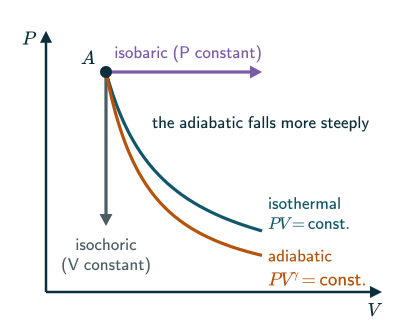
- isobaric: pressure constant;
- isochoric: volume constant;
- adiabatic: no heat flows between the system and its surroundings (ΔQ = 0).
A cyclic process brings the system back to its starting state. The definitions alone do not imply reversibility. For the formulas below, assume a closed, fixed-composition ideal gas, only pressure–volume work, constant heat capacities, and quasi-static, non-dissipative steps unless a different model is explicitly stated (NCERT Section 11.8, pages 233–236).
In plain words: picture a gas in a cylinder with a piston. You can let it expand while keeping it in a big bath at a fixed temperature (isothermal), let it push a fixed weight (isobaric), lock the piston and heat it (isochoric), or wrap it in insulation and let it expand (adiabatic). Each kind has its own simple rule for work and heat, which the first law, ΔQ = ΔU + ΔW, ties together.
Quasi-static process
If the outside pressure on a gas is suddenly lowered, the piston accelerates and the gas passes through states that are not in equilibrium, with no single pressure or temperature (page 233). Such states are hard to handle, so we imagine an idealised process that is infinitely slow, hence the name quasi-static (nearly static) (page 234; NCERT Fig. 11.7).
In a quasi-static process, at every stage, the difference in the pressure of the system and the external pressure is infinitesimally small.
NCERT Physics Part II (Class 11), Section 11.8.1, page 234
For reversible heat transfer, the temperature difference across the conducting contact is also infinitesimal. Across an adiabatic wall the outside temperature need not match the gas. Quasi-static means slow relative to internal relaxation; it alone does not rule out friction or other irreversibility. To change the pressure, change the outside pressure by a tiny amount at a time and let the gas catch up; to change the temperature, use a series of reservoirs whose temperatures differ by tiny amounts. At every stage the system is in equilibrium, so its state variables are defined throughout and the process can be drawn as a curve on a P–V graph.
A quasi-static process is obviously a hypothetical construct.
NCERT Physics Part II (Class 11), Section 11.8.1, page 234
In practice, slow processes without sudden piston motion or large temperature gradients come close to it (page 234).
Isothermal process
At constant temperature the ideal-gas equation gives PV = constant, which is Boyle’s law (page 234). An example is a gas expanding in a metal cylinder placed in a large reservoir: the reservoir stays at a nearly fixed temperature, and sufficiently effective heat transfer keeps the expanding gas close to it.
Work. Over a small volume change the work is PΔV; adding these up with P = μRT/V gives
Work in an isothermal process (NCERT Eq. 11.12)
(The printed NCERT Eq. 11.12 on page 234 shows “In” for the natural logarithm ln.)
Thus, there is no change in the internal energy of an ideal gas in an isothermal process.
NCERT Physics Part II (Class 11), Section 11.8.2, page 235
That is because the internal energy of an ideal gas depends only on temperature. So ΔU = 0 and, by the first law, Q = W. In an isothermal expansion (V2 > V1), W > 0: the gas takes in heat and does work. In an isothermal compression, W < 0: work is done on the gas and it gives out heat (page 235). Since P1V1 = P2V2, also W = μRT ln(P1/P2).
Adiabatic process
The system is insulated, so ΔQ = 0 and the first law gives ΔU = −W. Work done by the gas lowers its internal energy and, for an ideal gas, its temperature (page 235). For a reversible adiabatic change of a fixed amount of ideal gas with constant γ, the relation quoted by NCERT is
Adiabatic process of an ideal gas (NCERT Eqs. 11.13–11.14)
so P1V1γ = P2V2γ. Here γ is the ratio of the specific heats at constant pressure and constant volume. Since Cp > Cv, γ > 1, and the adiabatic curve on a P–V graph is steeper than the isotherm through the same point (NCERT Fig. 11.8, page 235).
Work. Integrating P dV with P = constant/Vγ gives (page 235)
Work in an adiabatic process (NCERT Eq. 11.16)
using PV = μRT in the second step. If the gas does work (W > 0), T2 < T1: it cools. If work is done on it (W < 0), it warms (page 235). From the same initial state to the same final volume, the reversible ideal-gas expansion does more work isothermally than adiabatically (in the figure, from V = 1 to 3.6 the areas are 5.12 and 4.01 units); for the same compression, more work must be done on it adiabatically.
Temperature and volume (beyond NCERT). Putting P = μRT/V into PVγ = constant gives TVγ−1 = constant, which links temperature and volume directly (Example 2).
Isochoric process
The volume is fixed, so pressure–volume work is zero. With no stirring, electrical or other work, W = 0. All the heat taken in goes into internal energy, ΔQ = ΔU, and raises the temperature. The temperature change for a given heat is set by the specific heat at constant volume: ΔQ = μCvΔT (page 235). (ΔU = μCvΔT holds for an ideal gas in every process, not only at constant volume.)
Isobaric process
The pressure is fixed, and the work done by the gas is
Work in an isobaric process (NCERT Eq. 11.17)
The temperature changes, so the internal energy does too: the heat taken in goes partly into internal energy and partly into work. The temperature change for a given heat is set by the specific heat at constant pressure: ΔQ = μCpΔT (page 235). For an ideal gas ΔU/ΔQ = 1/γ and W/ΔQ = 1 − 1/γ: 5/7 and 2/7 for nitrogen (Example 4: 2079/2910 ≈ 0.714).
Cyclic process
In a cyclic process the system returns to its starting state. Internal energy is a state variable, so ΔU = 0 over a cycle, and by the first law the net heat taken in equals the net work done by the system (pages 235–236). On a P–V graph, that net work is the area enclosed by the cycle: positive (net work done by the gas) if the cycle runs clockwise, negative (net work done on the gas) if anticlockwise. This holds only with P on the vertical axis and V on the horizontal; redraw V–P, P–T or V–T cycles on a P–V graph first (Example 6).
Solved examples
Take R = 8.31 J mol K.
Example 1: Isothermal expansion
1.0 mol of an ideal gas at 300 K expands isothermally to twice its volume. Find the work done, the heat taken in and ΔU.
W = μRT ln(V2/V1) = 1.0 × 8.31 × 300 × ln 2 = 2493 × 0.693, about 1728 J.
ΔU = 0 (isothermal, ideal gas), so Q = W.
Answer: W ≈ 1.73 kJ, Q ≈ 1.73 kJ, ΔU = 0.
Example 2: Idealised insulated compression of air
Air (γ = 1.4) at 300 K and 1.0 × 10 Pa undergoes an idealised reversible adiabatic compression to one-tenth of its volume, with γ treated as constant. This models part of a diesel-engine cycle; speed alone does not justify the reversible formula. Find its final temperature and pressure.
TVγ−1 = constant, so T2 = T1(V1/V2)γ−1 = 300 × 100.4 = 300 × 2.512, about 754 K.
PVγ = constant, so P2 = P1 × 101.4 = 1.0 × 10 × 25.1, about 2.51 × 10 Pa.
Answer: about 754 K (480 °C) and 2.51 × 10 Pa, illustrating compression heating. Actual ignition also depends on fuel, pressure, mixing and ignition delay.
Example 3: Work in an adiabatic expansion
2 mol of a monatomic ideal gas (γ = 5/3) expands adiabatically and cools from 400 K to 300 K. Find the work done and ΔU.
W = μR(T1 − T2)/(γ − 1) = 2 × 8.31 × 100/(2/3), about 2493 J.
ΔQ = 0, so ΔU = −W.
Answer: the gas does about 2.49 kJ of work, and its internal energy falls by the same amount.
Example 4: Heating at constant pressure
2 mol of nitrogen (Cp = 29.1, Cv = 20.8 J mol K, NCERT Table 10.4) is heated at constant pressure from 300 K to 350 K. Find W, Q and ΔU.
W = μRΔT = 2 × 8.31 × 50, about 831 J.
Q = μCpΔT = 2 × 29.1 × 50 = 2910 J.
ΔU = Q − W = 2910 − 831, about 2079 J; check: μCvΔT = 2 × 20.8 × 50 = 2080 J.
Answer: W ≈ 831 J, Q = 2910 J, ΔU ≈ 2.08 kJ.
Example 5: Heating at constant volume
The same 2 mol of nitrogen is heated by 50 K at constant volume. Find W, Q and ΔU.
W = 0. Q = ΔU = μCvΔT = 2 × 20.8 × 50 = 2080 J.
Answer: no work; 2080 J of heat, all of it raising the internal energy. Compared with Example 4, the same ΔU needs about 830 J less heat (the 831 J of work in Example 4, to rounding), because no work is done.
Example 6: A rectangular cycle
A gas is taken round a rectangle on a P–V graph, clockwise, between 1.0 × 10 Pa and 2.0 × 10 Pa and between 1.0 L and 3.0 L. Find the net work done and the net heat taken in.
Clockwise, the top side is an expansion at 2.0 × 10 Pa: W = 2.0 × 10 × 2.0 × 10 = +400 J. The bottom side is a compression at 1.0 × 10 Pa: W = −200 J. The vertical sides have W = 0. Net work = 200 J, the enclosed area.
ΔU = 0 over a cycle, so the net heat taken in = net work.
Answer: 200 J of work done by the gas, and 200 J of net heat taken in.
Common mistakes to avoid
Common mistake
Confusing isothermal and adiabatic
Isothermal fixes temperature; adiabatic fixes heat transfer at zero. Temperature changes in an adiabatic ideal-gas process only if its internal energy changes; insulated free expansion is an important exception.
Common mistake
Using the adiabatic law for a free expansion
PVγ = constant holds only for a quasi-static adiabatic process. In an insulated free expansion into a vacuum no work is done and no heat flows, so an ideal gas’s temperature does not change: the end states obey P1V1 = P2V2. A “sudden” or “quick” change may justify negligible heat transfer, but does not establish reversibility. Use PV^γ = constant only when the reversible, constant-γ ideal-gas model is stated or justified. For a finite constant outside pressure use the first law and boundary work instead.
Common mistake
Using log in the isothermal work formula
It is the natural logarithm: ln 2 ≈ 0.693, while log 2 ≈ 0.301.
Common mistake
Forgetting that ΔU = 0 only for the whole cycle
In a cyclic process ΔU = 0 overall, but in each separate step of the cycle ΔU may be non-zero.
Quick revision summary
- Quasi-static: slow relative to internal relaxation, with well-defined equilibrium states along the path. Reversibility additionally excludes dissipative effects.
- Isothermal (ideal gas): PV = constant, ΔU = 0, Q = W = μRT ln(V2/V1).
- Adiabatic: ΔQ = 0. For reversible ideal-gas steps with constant γ, PV^γ = constant with γ = C_p/C_v; W = μR(T1 − T2)/(γ − 1); expansion cools, compression warms.
- Isochoric: W = 0, ΔQ = ΔU = μCvΔT. Isobaric: W = PΔV = μRΔT, ΔQ = μCpΔT.
- Cyclic: ΔU = 0, net heat = net work = area enclosed on the P–V graph.
Formula sheet
- W = μRT ln(V/V) (isothermal)
- PVγ = constant, γ = Cp/Cv (reversible adiabatic ideal gas, constant γ)
- W = μR(T − T)/(γ − 1) (adiabatic)
- W = P(V − V) = μR(T − T) (isobaric)
- W = 0, ΔQ = ΔU (isochoric)
- TVγ−1 = constant (reversible adiabatic ideal gas, constant γ)
Questions students ask
What is the difference between isothermal and adiabatic processes?
The difference between isothermal and adiabatic processes is what is held fixed: an isothermal process keeps the temperature constant, letting heat flow in or out as needed, while an adiabatic process allows no heat flow. Its temperature may change, depending on work and the equation for internal energy. For an ideal gas, isothermal changes follow PV = constant with ΔU = 0 and Q = W, whereas reversible adiabatic changes with constant γ follow PVγ = constant with Q = 0 and ΔU = −W, so the gas cools when it expands and warms when it is compressed. On a P–V graph the adiabatic curve through a point is steeper than the isotherm.
Is an adiabatic process fast or slow?
An adiabatic process can be fast or slow: what defines it is that no heat flows in or out of the system. A fast change is nearly adiabatic even without insulation, because heat has no time to cross the walls, while a slow change is adiabatic only in a well-insulated container. A reversible isothermal piston process requires heat transfer to keep pace with compression or expansion. Constant temperature by itself, however, does not imply reversibility or the logarithmic work formula. For PVγ = constant to apply, the gas must also keep a single pressure throughout: a low-dissipation piston stroke short compared with the heat-leak timescale but long compared with internal pressure/thermal relaxation times can approximate this, while a free expansion into a vacuum does not.
What are some examples of adiabatic processes in daily life?
Everyday adiabatic processes are quick expansions and compressions of air: air remaining in a rapidly emptied insulated vessel can cool as escaping gas carries energy away; flow through the valve is an open-system problem, not simply a closed-gas PV^γ process. The barrel of a bicycle pump warms when you pump hard, mainly because the air inside is compressed quickly (friction can also contribute to warming). Opening a chilled bottle of soda can produce a wisp of fog at the neck as the escaping gas expands and cools. Air rising in the atmosphere also expands and cools nearly adiabatically, which is how many clouds form.
How is the adiabatic equation of an ideal gas derived?
The adiabatic relation PVγ = constant follows from the first law with no heat flow and the ideal-gas equation: for a reversible adiabatic change of μ moles with constant C and C, dU = −P dV gives μCv dT = −P dV, while differentiating PV = μRT gives P dV + V dP = μR dT. Eliminating dT, with R = Cp − Cv, leaves CpP dV + CvV dP = 0, that is dP/P + γ dV/V = 0 with γ = Cp/Cv. Integrating gives ln P + γ ln V = constant, so PVγ = constant.
In which process does a gas do the most work: isobaric, isothermal or adiabatic?
For an expansion from the same initial state to the same final volume, a gas does the most work at constant pressure, less isothermally and least adiabatically. Doubling the volume of an ideal gas that starts at P0 and V0 gives W = P0V0, P0V0 ln 2 ≈ 0.69 P0V0 and, for γ = 1.4, about 0.61 P0V0, because the pressure stays highest along the isobar and falls fastest along the adiabatic curve. For a compression to the same final volume the order reverses: the adiabatic compression needs the most work done on the gas.
What is a polytropic process?
A polytropic process is one that follows PVn = constant for some fixed number n, a form beyond the NCERT text, which does not name it. For an ideal gas the four special processes are particular cases: n = 0 is isobaric, n = 1 is isothermal, n = γ describes a reversible adiabatic ideal-gas path with constant γ and n → ∞ is isochoric. For n ≠ 1 the work done by the gas is W = (P1V1 − P2V2)/(n − 1), which becomes the adiabatic formula when n = γ.
Practice questions
Try each question first, then open the answer to check your working.
-
Q1. Why does an ideal gas cool in a reversible adiabatic expansion doing positive work, but not in a reversible isothermal expansion?
Show answerHide answer
Adiabatically, no heat comes in, so the work the gas does comes out of its internal energy and its temperature falls. Isothermally, heat flows in from the surroundings to make up exactly for the work done, so for an ideal gas the internal energy and temperature stay the same.
-
Q2. 2 mol of an ideal gas at 350 K is compressed isothermally to one-third of its volume. Find the work done by the gas.
Show answerHide answer
W = μRT ln(V2/V1) = 2 × 8.31 × 350 × ln(1/3), about −6.39 × 10 J. The negative sign means work is done on the gas, and the gas gives out the same amount of heat.
-
Q3. In which process is all the heat supplied to a gas used to raise its internal energy? In which is all of it used to do work?
Show answerHide answer
Isochoric: W = 0, so ΔQ = ΔU. Isothermal (ideal gas): ΔU = 0, so ΔQ = W.