Carnot engine
NCERT Class 11 Physics Chapter 11 Section 11.11
Quick answer
A Carnot engine is a reversible heat engine working between a hot reservoir at T and a cold one at T, using two isothermal and two adiabatic steps. Its efficiency is η = 1 − T/T, with temperatures in kelvin, and no engine working between the same two temperatures can be more efficient. The efficiency depends only on the two temperatures, not on the working substance.
With your textbook
NCERT Physics Part II (Class 11), Chapter 11 “Thermodynamics”, Section 11.11 “Carnot engine”, pages 237–239.
Open the official NCERT chapter (PDF, 1.8 MB, ncert.nic.in) (opens in a new tab)
Checked against the 2026-27 reprint on .
What is a Carnot engine?
Carnot engine and Carnot cycle
A Carnot engine is a reversible heat engine working between just two reservoirs, a hot one at temperature T1 and a cold one at T2. Its cycle, the Carnot cycle, has four reversible steps: an isothermal expansion at T1, an adiabatic expansion from T1 to T2, an isothermal compression at T2, and an adiabatic compression back to T1. Its efficiency is
with both temperatures in kelvin. No engine working between the same two temperatures can do better. (NCERT Section 11.11, pages 237–239.)
A reversible heat engine operating between two temperatures is called a Carnot engine.
NCERT Physics Part II (Class 11), Section 11.11, page 237
In plain words: given a hot source and a cold sink, what is the most work you could possibly get from each joule of heat? Sadi Carnot, a French engineer, asked this in 1824 and found the answer: it depends only on the two temperatures. The hotter the source and the colder the sink, the better, but you can never reach 100%.
Interestingly, Carnot arrived at the correct answer, even though the basic concepts of heat and thermodynamics had yet to be firmly established.
NCERT Physics Part II (Class 11), Section 11.11, page 237
Why these four steps
The best engine must be reversible, because irreversibility lowers efficiency (page 237). For NCERT’s simple cycle with no internal heat-storage device, this gives the following steps:
- Heat must be taken in and given out with no finite temperature difference between the gas and the reservoir. So heat is absorbed from the hot reservoir isothermally at T1, and given out to the cold reservoir isothermally at T2.
- To change the gas’s temperature from T1 to T2 and back, using any process that exchanges heat, say an isochoric one, would need a whole series of reservoirs at temperatures in between. With only those contacts and no internal regenerator, these changes must be adiabatic, with no heat flow.
The Carnot cycle
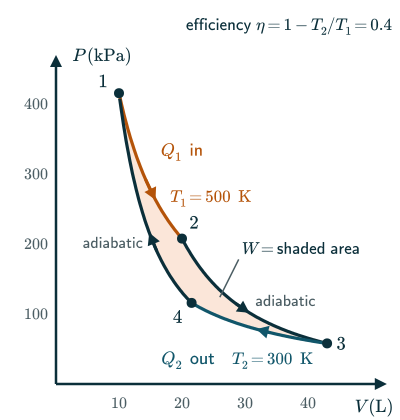
With an ideal gas as the working substance (NCERT Fig. 11.9, pages 237–238), where μ is the fixed number of moles and γ = C_p/C_v is treated as constant:
- Step 1 → 2: isothermal expansion at T1, from (P1, V1) to (P2, V2). The gas takes in heat Q1 = μRT1 ln(V2/V1), equal to the work it does (NCERT Eq. 11.18).
- Step 2 → 3: adiabatic expansion from T1 to T2. The gas does work μR(T1 − T2)/(γ − 1) (NCERT Eq. 11.19).
- Step 3 → 4: isothermal compression at T2. The gas gives out heat Q2 = μRT2 ln(V3/V4), equal to the work done on it (NCERT Eq. 11.20).
- Step 4 → 1: adiabatic compression from T2 back to T1. Work μR(T1 − T2)/(γ − 1) is done on the gas (NCERT Eq. 11.21).
The two adiabatic works are equal and opposite, so they cancel. The net work per cycle is W = Q1 − Q2, the area enclosed by the cycle on a P–V graph.
Efficiency of a Carnot engine
The efficiency is η = W/Q1 = 1 − Q2/Q1. Using the two isothermal heats,
(NCERT Eq. 11.23.)
For the adiabatic steps TVγ−1 is constant, so T1V2γ−1 = T2V3γ−1 and T1V1γ−1 = T2V4γ−1 (the lines before NCERT Eqs. 11.24–11.25). Dividing the first by the second gives (V2/V1)γ−1 = (V3/V4)γ−1, so V3/V4 = V2/V1 (NCERT Eq. 11.26), so the logarithms cancel:
Efficiency of a Carnot engine (NCERT Eq. 11.27)
(In the printed NCERT Eq. 11.23 the natural logarithm ln appears as “In”, and in Eq. 11.25 the exponent should read 1/(γ − 1).)
Since Q2/Q1 = T2/T1, a Carnot engine always satisfies
Heats and temperatures in a Carnot cycle (NCERT Eq. 11.28, rearranged)
Running it backwards. Every step of the Carnot cycle can be reversed. Then the engine takes heat Q2 from the cold reservoir, has work W done on it, and gives Q1 to the hot reservoir: a reversible refrigerator (page 238).
Indeed it is the only reversible engine possible that works between two reservoirs at different temperatures.
NCERT Physics Part II (Class 11), Section 11.11, page 238
NCERT’s “only reversible engine” wording refers to its simple construction. More elaborate ideal cycles with perfect internal heat storage, such as a regenerative Stirling cycle, can follow different paths while having the same Carnot efficiency. The universal result is the efficiency limit, not a unique mechanical design.
Carnot’s theorem
NCERT proves two results, sometimes called Carnot’s theorem (pages 238–239):
- Working between two given temperatures, no engine can have a higher efficiency than a Carnot engine.
- The efficiency of a Carnot engine does not depend on the working substance.
The idea of the proof of (1) (NCERT Fig. 11.10, page 239). Suppose an irreversible engine I were more efficient than a Carnot engine R. Let I take Q1 from the source, give work W′ and reject Q1 − W′ to the sink. Run R backwards as a refrigerator that returns the same Q1 to the source. Because R is reversible, it then needs exactly the work W it would give as an engine taking in Q1, and since ηR < ηI, W < W′. R takes Q1 − W from the sink, so the pair takes (Q1 − W) − (Q1 − W′) = W′ − W from the sink and turns it all into work. The source is left unchanged. That breaks the Kelvin–Planck statement of the second law, so I cannot be more efficient than R. A similar argument shows that a reversible engine using one working substance cannot beat one using another.
Because of (2), we may calculate η with an ideal gas, whose equation of state is simple, and the result η = 1 − T2/T1 holds for every Carnot engine. NCERT’s Eq. 11.28 can therefore be used to define a truly universal thermodynamic temperature scale, independent of any particular substance. For an ideal gas it agrees with the ideal-gas (kelvin) temperature (page 239). NCERT’s text says that scale was “introduced in section 11.9”; it was introduced in Section 10.4 of the previous chapter, Thermal Properties of Matter.
Solved examples
Take R = 8.31 J mol K.
Example 1: The cycle in the figure
1 mol of a monatomic ideal gas (γ = 5/3) runs a Carnot cycle between 500 K and 300 K, expanding isothermally from 10 L to 20 L at 500 K. Find Q1, Q2, W and η.
Q1 = μRT1 ln(V2/V1) = 8.31 × 500 × ln 2, about 2880 J.
V3/V4 = V2/V1 = 2, so Q2 = 8.31 × 300 × ln 2, about 1728 J.
W = Q1 − Q2, about 1152 J; η = 1152/2880 = 0.40.
Answer: Q1 ≈ 2880 J, Q2 ≈ 1728 J, W ≈ 1152 J and η = 0.40, which equals 1 − 300/500. (With γ = 5/3, V3 = 20 × (5/3)1.5 ≈ 43.0 L and V4 ≈ 21.5 L, as in the figure; Q1, Q2 and W do not depend on γ.)
Example 2: Checking a claim
An inventor claims an engine working between 227 °C and 27 °C with an efficiency of 50%. Is this possible?
In kelvin: T1 = 500 K, T2 = 300 K. The Carnot limit is 1 − 300/500 = 0.40.
Answer: no. 50% is more than the 40% of a Carnot engine between these temperatures, which no engine can beat.
Example 3: Raising the efficiency
A Carnot engine works between 500 K and 300 K (η = 40%). To make it 50% efficient, what hot temperature is needed if the sink stays at 300 K? What cold temperature, if the source stays at 500 K?
η = 1 − T2/T1 = 0.5 gives T2/T1 = 0.5.
With T2 = 300 K: T1 = 600 K. With T1 = 500 K: T2 = 250 K.
Answer: 600 K, or 250 K.
Example 4: Heat rejected
A Carnot engine takes in 1000 J of heat at 600 K and rejects heat at 300 K. How much heat does it reject, and how much work does it do?
Q2 = Q1 × T2/T1 = 1000 × 300/600 = 500 J. W = 1000 − 500 = 500 J.
Answer: 500 J rejected and 500 J of work, an efficiency of 50%.
Example 5: A Carnot refrigerator
A Carnot engine run backwards keeps the inside of a refrigerator at 270 K in a room at 300 K. How much work does it need to remove 900 J of heat from inside?
From Q1/T1 = Q2/T2, Q1 = 900 × 300/270 = 1000 J, so W = Q1 − Q2 = 100 J. Here T1 = 300 K (room), T2 = 270 K and Q2 = 900 J. The coefficient of performance, the heat removed per joule of work, is α = Q2/W = 9. For a Carnot refrigerator this equals T2/(T1 − T2) = 270/30 (both formulas are beyond the NCERT text).
Answer: 100 J. Real refrigerators need more, since they are not reversible.
Common mistakes to avoid
Common mistake
Using Celsius temperatures
η = 1 − T2/T1 needs absolute temperatures in kelvin. Between 227 °C and 27 °C, 1 − 27/227 would give a wrong 88%; the right value is 40% (Example 2).
Common mistake
Thinking a better working substance helps
The Carnot efficiency depends only on the two reservoir temperatures, not on the gas or other substance used.
Common mistake
Thinking 100% efficiency is possible
η = 1 would need T2 = 0 K, which cannot be reached; and the second law already forbids it.
Common mistake
Expecting real engines to reach the Carnot efficiency
The Carnot efficiency is the upper limit for any engine between two temperatures, reached only by a fully reversible engine. Real engines, with friction and finite temperature differences, always do worse.
Quick revision summary
- A Carnot engine is a reversible engine working between two reservoirs at T1 (hot) and T2 (cold).
- Carnot cycle: isothermal expansion at T1, adiabatic expansion, isothermal compression at T2, adiabatic compression.
- Efficiency: η = 1 − T2/T1, with temperatures in kelvin; also Q1/T1 = Q2/T2.
- Carnot’s theorem: no engine between the same two temperatures is more efficient, and the efficiency does not depend on the working substance.
- Run backwards, a Carnot engine is a reversible refrigerator; Q1/T1 = Q2/T2 defines the thermodynamic temperature scale.
Formula sheet
- η = 1 − T/T (Carnot engine)
- Q/T = Q/T
- W = Q − Q
- Q = μRT ln(V/V) (isothermal step at T)
Questions students ask
Is the Carnot cycle in the JEE Main and NEET syllabus?
The Carnot cycle and Carnot engine are not named in the JEE Main 2027 or NEET (UG) 2026 Physics syllabuses: in both, Unit 8, Thermodynamics, ends with the second law of thermodynamics and reversible and irreversible processes. They are part of NCERT Class 11 Physics (Section 11.11), and the JEE Advanced 2026 syllabus does list the Carnot engine and its efficiency. The Carnot efficiency, 1 − T2/T1 with temperatures in kelvin, is the upper limit the second law sets for any heat engine working between two reservoirs, so it is still worth knowing for questions on engine efficiency.
Why is the Carnot cycle not practically possible?
The Carnot cycle cannot be built exactly because every step must be reversible: the isothermal steps need heat to flow across an almost zero temperature difference, so they must run infinitely slowly, and the adiabatic steps must also be quasi-static, with perfect insulation and a frictionless piston. Switching the cylinder between perfect thermal contact and perfect insulation in each cycle is also impossible in practice. Even if it could be done, an engine running infinitely slowly would deliver almost no power, so real engines run fast and accept a lower efficiency than 1 − T2/T1.
Is a Carnot engine 100% efficient because it is reversible?
No, a Carnot engine is reversible but not 100% efficient: its efficiency is 1 − T2/T1, which is less than 1 for any sink above 0 K. Being reversible means it wastes nothing beyond what the second law demands, yet in every cycle it must still give out heat Q2 = Q1T2/T1 to the cold reservoir. For example, between 800 K and 300 K a Carnot engine turns 1 − 300/800 = 62.5% of the heat it takes in into work and rejects the other 37.5%.
What is the difference between a Carnot engine and a Carnot refrigerator?
A Carnot refrigerator is a Carnot engine run backwards between the same two temperatures: it takes heat Q2 from the cold reservoir, has work W done on it and gives Q1 = Q2 + W to the hot one. Its coefficient of performance is α = Q2/W = T2/(T1 − T2), which is linked to the engine’s efficiency η by α = (1 − η)/η. For example, between 350 K and 300 K the engine has η = 50/350 = 1/7 ≈ 14.3%, and the refrigerator has α = 300/50 = 6, which equals (6/7)/(1/7).
How is the Carnot cycle different from the Otto cycle of a petrol engine?
The Carnot cycle uses two isothermal and two adiabatic steps and takes in all its heat at the single hot temperature, while the Otto cycle, the idealised model of a petrol engine, uses two adiabatic and two constant-volume steps and takes in heat while its temperature rises. In the ideal-gas, constant-γ air-standard model, the Otto efficiency is 1 − 1/rγ−1, where r = Vmax/Vmin is the compression ratio, and it is always lower than the Carnot efficiency between the highest and lowest temperatures of the same cycle. The Otto cycle is not part of NCERT Class 11 Physics.
Practice questions
Try each question first, then open the answer to check your working.
-
Q1. Why must a Carnot engine take in and give out heat isothermally?
Show answerHide answer
To be reversible, heat must flow with no finite temperature difference between the gas and the reservoir. With fixed reservoirs at T1 and T2, the gas must be at T1 while taking in heat and at T2 while giving it out.
-
Q2. Find the efficiency of a Carnot engine working between 100 °C and 0 °C.
Show answerHide answer
η = 1 − 273/373, about 0.268, that is about 27%.
-
Q3. Which is more effective for raising the efficiency of a Carnot engine: raising the source temperature by 10 K or lowering the sink temperature by 10 K?
Show answerHide answer
Lowering the sink. η = 1 − T2/T1 changes by 10/T1 when T2 falls by 10 K, but by 10T/[T(T + 10)] when T rises by 10 K. The latter is smaller because T < T. This compares mathematically allowed temperature changes, not their engineering cost; the sink must remain above 0 K.