Thermal equilibrium
NCERT Class 11 Physics Chapter 11 Sections 11.1–11.2
Quick answer
Two systems are in thermal equilibrium when their temperatures are equal and there is no net heat transfer between them through thermal contact. Full thermodynamic equilibrium also requires mechanical and chemical balance, and a steady state held fixed by the surroundings, with heat still flowing through it, is not equilibrium. An adiabatic wall prevents heat transfer, so systems on its two sides may remain at different temperatures.
With your textbook
NCERT Physics Part II (Class 11), Chapter 11 “Thermodynamics”, Sections 11.1–11.2 “Introduction” and “Thermal equilibrium”, pages 226–228.
Open the official NCERT chapter (PDF, 1.8 MB, ncert.nic.in) (opens in a new tab)
Checked against the 2026-27 reprint on .
What is thermal equilibrium?
Equilibrium state and thermal equilibrium
A system is the part of the world we choose to study, such as a gas in a cylinder. Everything outside the system is its surroundings; in practice, the part near enough to exchange energy with it.
- A system is in an equilibrium state when its macroscopic variables, such as pressure, volume, temperature, mass and composition, do not change with time. Strictly, a steady state held fixed by its surroundings, such as a rod between a flame and ice, is not equilibrium, because heat keeps flowing through it (reasoned; see Common mistakes).
- Two systems are in thermal equilibrium with each other when they can exchange heat through a conducting wall, yet there is no more energy flow from one to the other. Their temperatures are then equal. Strictly, this is thermal balance, not necessarily mechanical or chemical balance (reasoned).
(The two bullets: NCERT Section 11.2, pages 227–228. NCERT uses “system” and “surroundings” without defining them.)
the state of a system is an equilibrium state if the macroscopic variables that characterise the system do not change in time.
NCERT Physics Part II (Class 11), Section 11.2, page 227
In plain words: put a hot cup of milk in a cold room and things keep changing: the milk cools, the air nearby warms. In an ideal model without evaporation, chemical change or other energy inputs, the temperature changes eventually become negligible. Milk and room are then at the same temperature, and nothing more happens on its own. That “nothing changes any more” is thermal equilibrium.
Thermodynamics looks at the whole, not the molecules
Thermodynamics is a macroscopic science.
NCERT Physics Part II (Class 11), Section 11.1, page 227
Thermodynamics describes a gas, for example, by a few quantities that can be measured directly: pressure, volume, temperature, mass and composition. It does not track the positions and velocities of its molecules, as a microscopic description would; kinetic theory sits in between, using the spread of molecular speeds (page 227).
It also differs from mechanics. Mechanics follows the motion of a body as a whole: for a body to be in mechanical equilibrium, the net external force and torque on it must be zero. Thermodynamics is concerned with the body’s internal state. NCERT’s example (page 227): when a bullet is fired from a gun, what changes is its mechanical state, its kinetic energy in particular, not its temperature. In practice, firing can also heat the bullet a little, through friction in the barrel (reasoned). When it stops in a block of wood, that kinetic energy becomes internal energy, and the bullet and the wood around it get hotter (see Example 3 below).
System, surroundings and walls
What happens to a system depends on its surroundings and on the wall that separates them (pages 227–228):
- an adiabatic wall is insulating: it lets no heat through (it may still move);
- a diathermic wall is conducting: it lets heat flow from one side to the other.
A system closed off by adiabatic walls on every side exchanges no heat with its surroundings. NCERT’s example of an equilibrium state is a gas in a closed, rigid container, completely insulated, whose pressure, volume, temperature, mass and composition stay fixed (page 227).
Two gases, two kinds of wall
Take two gases A and B in separate containers, with states given by their pressures and volumes (PA, VA) and (PB, VB). For a given mass of gas, pressure and volume can be taken as its two independent variables: fix them and the temperature is fixed too (NCERT, page 227).
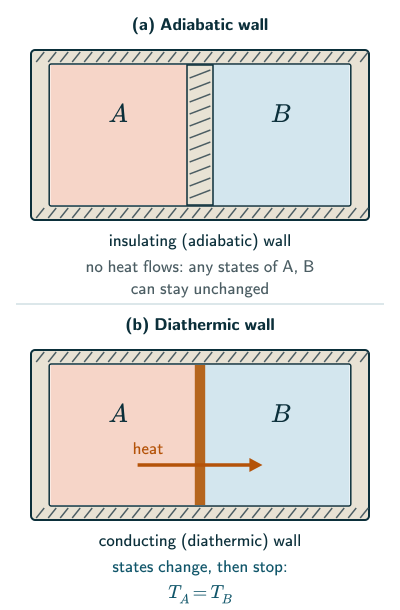
- Adiabatic wall between them (NCERT Fig. 11.1(a)): no heat flows, so with the wall held fixed, any state (PA, VA) of A can stay as it is alongside any state (PB, VB) of B. Nothing forces them to change.
- Diathermic wall between them (NCERT Fig. 11.1(b)): the variables of A and B change on their own until both reach new equilibrium states, and then stop changing. No net heat flows between them: A is in thermal equilibrium with B.
Not every variable has to change. If both gases are in rigid containers, their volumes stay fixed and only their pressures change (NCERT footnote, page 228; see Example 1 below).
In thermal equilibrium, the temperatures of the two systems are equal.
NCERT Physics Part II (Class 11), Section 11.2, page 228
The zeroth law of thermodynamics, which comes next in NCERT, is what lets us define temperature as the quantity that is equal for systems in thermal equilibrium.
Solved examples
Example 1: Two gases in rigid containers
Two rigid containers hold equal amounts (in moles) of the same ideal gas: A at 500 K and 2.0 atm, B at 300 K and 1.0 atm. They are placed in contact through a diathermic wall, and the pair is insulated from everything else. Find the final temperature and pressures.
Assume constant molar heat capacity over the range and negligible container heat capacity. The gases are identical in kind and amount, so A loses as much heat as B gains and each changes temperature by the same amount: the final temperature is (500 + 300)/2 = 400 K.
The volumes cannot change, so each pressure is proportional to its temperature (PV = μRT, where μ is the number of moles, with V fixed).
A: 2.0 × 400/500 = 1.6 atm. B: 1.0 × 400/300, about 1.33 atm.
Answer: 400 K; A at 1.6 atm and B at about 1.33 atm. The pressures are not equal: thermal equilibrium needs equal temperatures, not equal pressures.
Example 2: Unequal amounts
Repeat Example 1 with 1 mol of the gas at 300 K and 3 mol at 500 K.
With the same constant molar heat capacity and negligible container capacities, each mole needs the same heat per kelvin, so the final temperature is the mole-weighted average: (1 × 300 + 3 × 500)/4 = 450 K.
Answer: 450 K, closer to the temperature of the larger amount.
Example 3: A bullet stopping in wood
A lead bullet moving at 300 m s stops in a block of wood. Suppose half its kinetic energy goes into heating the bullet. Assuming no phase change and constant s = 127.7 J kg K for lead (NCERT Table 10.3), find the rise in its temperature.
Half the kinetic energy heats the bullet: ½ × ½mv = msΔT, so the mass cancels. Kinetic energy per kilogram: ½ × 300 = 45 000 J kg. Half of it, 22 500 J kg, heats the bullet.
ΔT = 22 500/127.7, about 176 K.
Answer: about 176 K. The ordered motion of the bullet as a whole has become disordered internal motion, which shows up as a rise in temperature.
Common mistakes to avoid
Common mistake
Confusing thermal and mechanical equilibrium
Mechanical equilibrium means zero net force and torque. Thermal equilibrium means no net heat flow and unchanging macroscopic variables, with equal temperatures. A ball resting on a table can be in mechanical equilibrium while it is still cooling.
Common mistake
Thinking thermal equilibrium needs equal pressures
Two gases in thermal equilibrium have equal temperatures. Their pressures and volumes can be quite different (Example 1).
Common mistake
Calling a steady state an equilibrium state
A rod with one end in a flame and the other in ice settles into a steady state: the temperature at each point stops changing. It is still not in equilibrium. Its temperature differs from point to point, heat keeps flowing through it, and its state stays fixed only because the flame and ice hold it there. Remove them and wrap the rod in insulation, and its temperatures start to even out. At equilibrium there are no sustained macroscopic heat or matter currents; microscopic motion and exchanges continue.
Common mistake
Thinking the body with more internal energy gives heat
Heat flows from the higher temperature to the lower one, whatever their sizes. A bucket of water at 30 °C has far more internal energy than a red-hot pin, yet heat flows from the pin into the water. Thermal equilibrium means equal temperatures, not equal internal energies.
Quick revision summary
- A system is the part of the world being studied; its surroundings are everything outside it, in practice the part that can exchange energy with it.
- Equilibrium state: the macroscopic variables (pressure, volume, temperature, mass, composition) do not change with time; a steady state held by the surroundings is not equilibrium.
- Adiabatic walls let no heat through; diathermic walls do.
- Through a diathermic wall, two systems change until they reach thermal equilibrium; their temperatures are then equal.
- Thermodynamics deals with the internal, macroscopic state of a body, not its motion as a whole.
Formula sheet
- Thermal equilibrium: TA = TB
- Rigid container (ideal gas): P ∝ T
Questions students ask
What is the difference between thermal equilibrium and thermodynamic equilibrium?
Thermal equilibrium is one part of thermodynamic equilibrium: it means equal temperatures, so no net heat flows between systems that can exchange heat. A system is in thermodynamic equilibrium only when it is in thermal, mechanical and chemical equilibrium at once: thermal balance, mechanical force balance, and no net chemical reaction or transfer of matter. Mechanical balance need not mean uniform pressure: gravity can support a hydrostatic pressure gradient. Its macroscopic variables, such as pressure, volume, temperature and composition, then stay constant on their own, with no heat or matter flowing through the system.
How do you calculate the final temperature when two bodies reach thermal equilibrium?
The final temperature at thermal equilibrium follows from heat lost by the hotter body = heat gained by the colder one, provided external heat/work, reactions and container heat capacity are negligible, neither body changes phase, and the specific heats are approximately constant: T = (m1s1T1 + m2s2T2)/
What are some examples of thermal equilibrium in daily life?
Thermal equilibrium in daily life is reached whenever things stay in contact long enough for the net heat flow to stop: food in a refrigerator cools to the temperature inside it, and a glass of iced water warms to room temperature once the ice has melted. A steel spoon and a wooden spoon left in the same room for hours are in thermal equilibrium at room temperature, even though, in a room cooler than your hand, the steel feels colder. It feels colder only because it conducts heat away from your hand faster, so touch is not a reliable guide to temperature.
What is the difference between thermal contact and thermal equilibrium?
Thermal contact is a condition and thermal equilibrium is the state it leads to: two bodies are in thermal contact when heat can flow between them, for example through a conducting (diathermic) wall, and they are in thermal equilibrium once no net heat flows because their temperatures are equal. Bodies at different temperatures in thermal contact are not yet in equilibrium; heat flows from the hotter to the colder until the temperatures match.
Is thermal equilibrium the same as an isothermal process?
No, thermal equilibrium is a state of two or more systems, while an isothermal process is a change of one system at constant temperature. Systems are in thermal equilibrium when their temperatures are equal and no net heat flows; in an isothermal process a gas changes its pressure and volume while its temperature stays fixed. The two are linked: a reversible isothermal piston process approaches thermal equilibrium with a large reservoir at every stage, so it runs slowly relative to thermal relaxation, with heat crossing a conducting wall over only a tiny temperature difference.
Do molecules stop moving when bodies reach thermal equilibrium?
No, molecules keep moving at thermal equilibrium; what stops is the net flow of heat. Molecules on both sides still collide and pass energy across the boundary, but on average as much energy crosses in one direction as in the other, so there is no net heat flow and the macroscopic variables stop changing. Thermal equilibrium is therefore a dynamic balance, not a frozen state.
Practice questions
Try each question first, then open the answer to check your working.
-
Q1. A gas is in a closed, rigid, perfectly insulated container, and its pressure and temperature do not change. Is it in an equilibrium state? What if the insulation under its base is removed and it is placed on a hot plate?
Show answerHide answer
Yes: its macroscopic variables do not change with time; this is NCERT’s own example of an equilibrium state (page 227). With the base no longer insulated, heat flows in from the plate, and the temperature and pressure rise. The gas is not in equilibrium again until it reaches the plate’s temperature.
-
Q2. 2 mol of an ideal gas at 350 K and 1 mol of the same gas at 290 K are in rigid containers joined by a diathermic wall and insulated from outside. Assume constant molar heat capacity and negligible container heat capacity. Find the final temperature.
Show answerHide answer
(2 × 350 + 1 × 290)/3 = 990/3 = 330 K.
-
Q3. What is the difference between an adiabatic wall and a diathermic wall?
Show answerHide answer
An adiabatic wall is insulating and lets no heat flow through it. A diathermic wall is conducting and lets heat flow, so systems on either side can reach thermal equilibrium.